


For most engineering organizations, the question isn’t whether to use edge computing or cloud computing. It’s where each workload should run to balance latency, reliability, compliance, operational complexity, and cost…
Key Points
- Edge computing isn’t one place. It can mean a sensor, a gateway, a rack at a customer facility, or provider-managed metro/MEC capacity, each with different constraints.
- Cloud can mean a location (AWS, Azure, Google Cloud regions) or an operating model: infrastructure as code, managed control planes, centralized identity, CI/CD, and elastic capacity.
- Four conditions force edge placement: hard real-time latency or jitter SLOs; bandwidth economics that make raw upstream impractical; explicit data residency or sovereignty requirements; and required offline autonomy during WAN partitions.
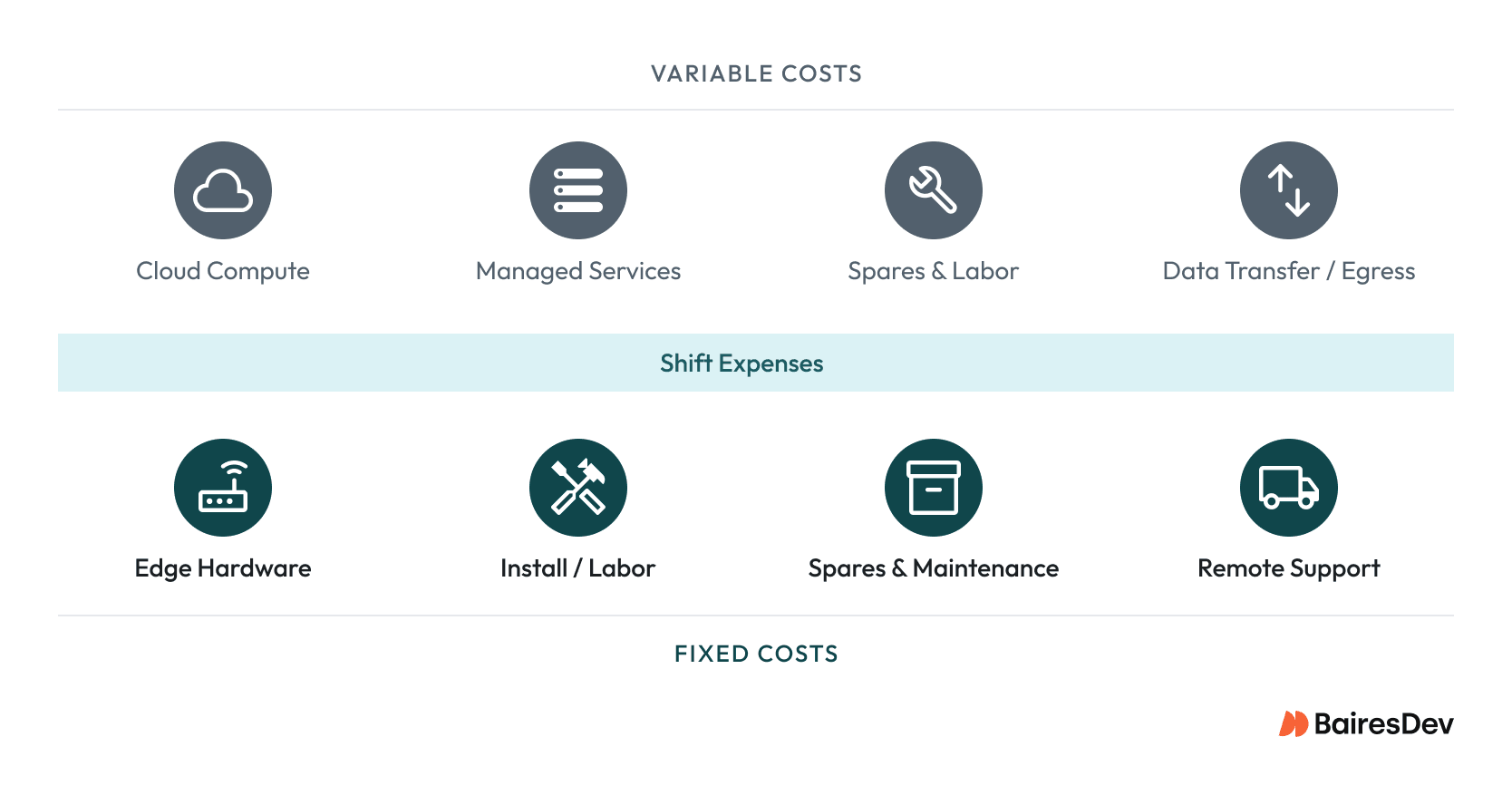
- Edge shifts costs from variable (cloud compute, egress) to fixed (hardware, installs, truck rolls, fleet patching). The cloud bill is visible immediately. The edge bill shows up later.
Edge runs compute near the data source. Cloud runs it in centralized regions. The placement decision turns on architecture and operating model: which parts of your system must run on-device or on-prem, and which parts should stay centralized for scale, governance, and shared state. Get that split wrong and you’ll end up operating a distributed system with untracked costs, version drift across sites, or an ‘offline-capable’ product that quietly depends on cloud for auth and config.
This guide cuts through the definitional confusion around edge and cloud, gives you a structured scorecard for placement decisions, and maps common workload archetypes to their natural home. It won’t tell you edge is always faster or cloud is always cheaper because neither is universally true.
Getting the Definitions Right
Before making a placement call, you need to pin down what you actually mean by ‘edge’ and ‘cloud’. The distinction is less obvious than most architecture conversations assume.
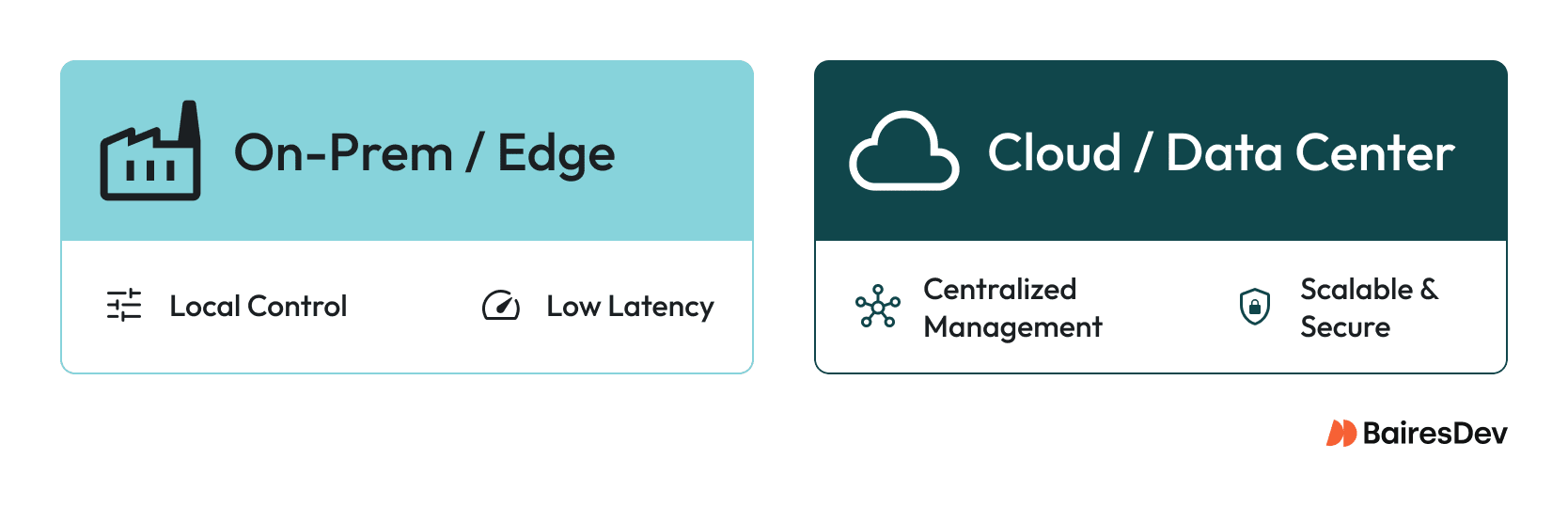
‘Edge’ isn’t one place. It can mean compute running on smart devices, a local gateway, a rack in a customer facility, a branch office, or provider-managed metro or multi-access edge computing (MEC) capacity. Each option carries different constraints around latency, power, hardware access, data security, and failure recovery. A workload that fits an industrial gateway may not belong on a sensor, and metro capacity won’t solve an outage problem if the site still depends on the WAN.
‘Cloud’ needs the same precision. Sometimes it means hyperscaler regions: AWS, Azure, Google Cloud, IBM Cloud. Sometimes it means an operating model: infrastructure as code, managed control planes, centralized identity, CI/CD, observability, and elastic capacity. Private cloud can fit that model even when the hardware sits outside a public region. The distinction matters because the governance benefits of cloud, consistent deployment, centralized IAM, unified logging, can be replicated on-prem. What you can’t replicate easily is the elasticity and the managed-service ecosystem.
In many hybrid deployments, a dedicated cloud application layer centralizes governance, shared state, and elastic scaling while edge nodes focus on local data processing and continuity. Before making a workload placement call, write down two things: where the workload runs, and who owns patching, scaling, monitoring, and recovery. Until those are explicit, your team will keep debating labels.
The Four Conditions That Force Edge Placement
The risk in edge vs. cloud decisions isn’t choosing wrong, it’s making the choice on vague grounds. ‘Needs to be fast’ and ‘privacy matters’ aren’t requirements. They’re categories. The following four conditions should be treated as forcing functions when you can quantify at least one of them.
Hard Real-Time Latency or Jitter SLOs
If your control loop cannot tolerate the round-trip time to a regional data center, plus the jitter around it, the workload belongs at the edge. Measure p95 and p99 end-to-end latency from input to actuation rather than relying on average network latency or RTT.
A 20 ms PLC-adjacent control loop might demand on-prem or edge processing even if your average RTT to a cloud region looks acceptable. That’s because edge nodes can saturate and queue under load. A target of 20 ms can quickly become 200 ms when CPU throttles or storage stalls.
Even when edge reduces network latency, capacity planning still matters. Under sustained load, edge nodes can become bottlenecks faster than large cloud environments. Treat edge capacity as a first-class SLO and define utilization thresholds, alerting, and remediation plans before deployment.
For latency-sensitive workloads such as industrial automation, robotics, autonomous systems, and real-time processing, placement decisions should be based on measured end-to-end performance requirements rather than network latency alone.
Bandwidth and Egress Economics
Some workloads generate data volumes that are simply too large or too continuous to send upstream economically. Model bytes per device per day, peak-to-average data transfer ratios, and the reduction achieved through local processing.
If raw data is high-volume or expensive to move, processing it locally (by reducing it to events, metadata, features, or embeddings before upload) can change the economics by orders of magnitude.
Sending full-resolution video upstream for “maybe useful later” gets expensive fast. Extracting motion events, redacted clips, metadata, or feature vectors locally is often far more cost-effective.
Some providers include a small free egress tier. That can shift the break-even point for low-volume workloads. For example, Azure currently includes the first 100 GB per month of internet egress at no charge. Verify current pricing directly with your provider because pricing models change over time.
Data Residency and Sovereignty
When your contract or regulation prohibits raw sensitive data from leaving a site or region, edge becomes an architectural requirement, not a preference. Processing PII or PHI on-prem and exporting only aggregates or derived artifacts can satisfy data minimization requirements and reduce audit scope, but only if you enforce it at the architecture level, not just in policy. You also sign up to patch and monitor every location where that raw data stays. Edge gives you better residency control; it doesn’t give you less compliance work.
Offline Autonomy
If WAN connectivity drops are normal in your operating environment, edge isn’t primarily about speed, it’s about continuity. Write down the autonomy window your system requires (minutes, hours, days) and the re-sync rule: what’s authoritative state, and how do you handle conflicts when the link recovers? A remote industrial site, for instance, may need local inference and local rules enforcement during outages while cloud stays the system of record once connectivity resumes. ‘Needs to work offline’ isn’t a requirement until you’ve defined the autonomy window, reconciliation logic, and what continuity actually requires during a partition.
The Workload Placement Scorecard
When you don’t evaluate tradeoffs systematically, the loudest constraint wins. Latency gets all the attention. Security has a hard requirement. Finance sees the cloud bill only after the design is built. The scorecard below balances the argument before you commit. Use it for every workload slice that isn’t already settled by one of the four forcing functions above.
Workload Placement Scorecard
| Scorecard Dimension | What to Quantify | Pulls Toward Edge When… | Pulls Toward Cloud When… |
| Latency & jitter | End-to-end budget; p95/p99 latency; jitter tolerance; miss-deadline impact | Tight control loops or hard SLOs can’t tolerate regional round-trip time or variance | Latency targets are moderate; cloud regions meet p95/p99 comfortably |
| Bandwidth & egress economics | Bytes/device/day; peak-to-average ratio; reduction ratio after local processing; who pays transport | Raw data streams are high-volume or continuous; local reduction changes the cost curve by orders of magnitude | Volumes are modest; transfer costs stay low relative to managed-service value |
| Sovereignty, residency & audit | Data classification (PII/PHI/etc.); residency constraints; audit and proof obligations | Raw data can’t leave the site or region; exporting only derived artifacts reduces compliance scope | No residency constraints; centralized governance is simpler to audit |
| Offline resilience | Partition frequency; required autonomy window; local state and cache needs; re-sync and conflict strategy | System must keep functioning during WAN loss for minutes, hours, or days | Connectivity is reliable; brief outages are acceptable |
| Security & blast radius | Compromise scope; identity and attestation feasibility; patch and rotation cadence | Limiting per-site or per-device impact is worth the cost of fleet security primitives | Centralized IAM, logging, and incident response are more manageable and the blast radius is acceptable |
| Fleet ops & failure handling | Number of sites/devices; churn; remote-hands needs; tooling maturity | Central ops burden is too high without local autonomy; distributed failure domains are acceptable | Small fleet; cloud-native tooling is mature and well-staffed |
| TCO (fixed vs. variable) | Fixed costs (hardware/labor/spares); variable costs (compute/storage/egress); risk cost | Variable cloud cost dominates vs. a predictable fixed edge footprint | Fixed edge infrastructure cost (hardware, truck rolls, lifecycle) exceeds variable cloud savings |
A note on the TCO row: The cloud bill is visible early because it is metered and centralized. The edge bill emerges later through duplicated per-site infrastructure (compute, storage, networking, and sometimes security appliances), plus operational overhead such as truck rolls, spare hardware inventories, failed or partially applied OTA updates, fragmented monitoring stacks per site, on-call escalation across time zones, and engineering time spent maintaining environments that diverge over time.
Force a break-even analysis before committing to any significant edge deployment. Useful inputs include bytes per device per day after local reduction, sustained compute per site, annual physical visit rate, and ownership of patching and lifecycle SLAs.
Organizational Readiness Matters as Much as Architecture
Before committing to an edge strategy, clarify operational ownership. Who manages fleet operations? Who rotates certificates? Who handles failed upgrades? Who owns device lifecycle management? And does the platform engineering team have experience operating distributed systems at scale? Architectural success often depends as much on operational readiness as technology selection. If ownership of these responsibilities is unclear, the organization is usually not ready to operate a large edge deployment regardless of the technical architecture.
When the Cloud Is Safer
Cloud infrastructure is the right default when centralized control of shared state and governance is the priority: long-horizon analytics, model training pipelines, and globally accessible APIs. If your primary goal is keeping one authoritative dataset, distributing execution usually adds complexity without meaningful upside. Cloud platforms also provide managed databases, analytics platforms, monitoring systems, and other managed services that would be expensive to recreate and operate across a distributed edge fleet.
Watch for the ‘edge-first’ trap: pushing too much logic to edge locations can recreate a mini-cloud you have to manage across hundreds of sites. Multi-tenant feature computation or training data prep pushed to customer sites tends to turn into version skew. A centralized cloud deployment would have been one controlled rollout with one set of controls.
Scale is real: according to IDC, global enterprise spending on edge computing solutions reached nearly $261 billion in 2025, growing at 13.8% CAGR toward $380 billion by 2028. That level of investment reflects genuine edge-forcing workloads, not a wholesale replacement of centralized cloud infrastructure.
Designing the Edge/Cloud Split
Hybrid architectures break when ‘local’ systems still depend on cloud for basics: auth, feature flags, config fetches, model downloads. The network degrades, the local path fails, and the ‘offline-capable’ promise evaporates. Usually that means the team never drew a clear boundary between what must work on-site and what can wait for the cloud.
A workable split isn’t ‘run some stuff at the edge.’ It’s a set of explicit contracts. Define the local critical path and make it depend only on local computing resources. Then define the cloud data products you export (aggregates, periodic snapshots, model updates) and the conditions under which the edge node accepts them.
An industrial gateway, for example, can run anomaly inference and stop-the-line rules locally and accept model updates only when they pass a version gate. Decide up front what data management responsibilities must sync (e.g., models, policies, device identity) and what becomes eventually consistent (e.g., telemetry backfill).
Security and Data Sovereignty in Hybrid Deployments
Cloud makes governance easier with centralized IAM, logging, policy, and incident response. But it concentrates risk. One bad credential or shared-service misconfiguration can affect a lot at once. Edge can reduce blast radius per site or device, but it forces you to operate fleet security as a first-class capability.
That means owning, at scale: device and workload identity and attestation; key and certificate rotation; OTA patching with staged rollout controls and rollback; and physical access and tamper handling for lost, stolen, or customer-managed hardware. Teams consistently underestimate the operational maturity that fleet requires. It’s not a feature you add later.
Fleet Operations: The Underestimated Cost
Edge Kubernetes stacks, whether KubeEdge or any of the alternatives, carry the same operational complexity and remain less mature than cloud baselines. Production experience is thinner, recovery patterns are less battle‑tested, and the maturity gap shows up directly in hiring difficulty and vendor support.
Edge can look clean on an architecture diagram and punishing in day-to-day operations. Each additional site multiplies upgrade coordination, physical failure scenarios, and on-call burden. If you’re deploying to hundreds of locations, budget the operational model alongside the compute costs—before you finalize the design.
Workload Archetypes: A First-Pass Placement Guide
Teams can burn a lot of time debating ‘edge or cloud?’ at the application level. That’s usually the wrong frame. The better question is: what has to happen locally for the product to work? The table below maps common workload archetypes to their natural placement. Use it for a first-pass decision, then validate against the scorecard above.
Workload Archetype Placement Guide
| Workload Archetype | Run at Edge | Run in Cloud |
| IoT control loops (industrial, robotics, building systems) | Sensing, actuation logic, local ruleset with bounded cache | Fleet policy, audit logs, SLA reporting |
| Video & high-volume sensors | Motion detection, redaction, feature extraction—turn streams into events | Storage of selected clips, cross-site search, long-term retention |
| Real-time healthcare monitoring | PHI handling, bedside alerting, local buffering during network partitions | Derived signals for central monitoring, cohort analysis, model training |
| Analytics & data warehousing | Pre-processing that materially reduces upload volume | Centralized data, elastic compute, managed services, repeatable governance |
| Global SaaS APIs & shared state | Caching, request termination, policy enforcement at the perimeter | Authoritative state, global access, consistent deployments |
| Disaster recovery & business continuity | Local continuity when WAN failure is normal; bounded autonomy window | Recovery substrate; long-term state of record; reconciliation after reconnect |
| Edge AI / edge inference | Inference when latency, cost, or data privacy requires it | Feature stores, labeling workflows, model training, staged fleet rollout |
Put too much in the cloud and costs creep up. Put too much at the edge and you’re running a distributed ops team. These archetypes give you a defensible starting point—not a final answer.
An Adoption Path That Lowers Risk
Don’t move the whole workload to edge at once. Start with work that can fail open: filtering, feature extraction, or local caching. Use a small pilot fleet to prove latency targets and operational stability. Don’t add control loops or data-of-record flows until the pilot has hit its SLOs.
Once the pilot is stable, fund the fleet fundamentals: device identity, certificate rotation, staged OTA rollout with rollback, and observability. Those aren’t features you can bolt on later—they’re the prerequisites for safe expansion. Only after those are in place should you extend to offline autonomy and tighter local critical paths.
The IDC trajectory reinforces the urgency: enterprise edge spending is projected to reach $380 billion by 2028, driven by real-time data processing demands, the proliferation of IoT devices, and edge AI workloads. Teams that get the operating model right early have a durable advantage over those who discover the fleet management costs after deployment.
Making the Call Before the Architecture Locks
Distributed compute isn’t one place. It can mean a sensor, a gateway, a rack at a customer facility, or provider-managed metro/MEC capacity—each with different constraints. The teams that struggle aren’t the ones who chose wrong. They’re the ones who chose on vague grounds and discovered the real constraints after the architecture was already built.
The scorecard and archetypes in this guide aren’t meant to replace engineering judgment. They’re meant to make the conversation explicit before commitments are made. Write down the latency budget. Model the bandwidth economics. Define the autonomy window. Specify who owns patching and what the rollback path looks like. Those questions expose the real constraints—and they’re much cheaper to answer on a whiteboard than in production.
Hybrid architectures are increasingly the norm at enterprise scale: according to IDC projections, close to 60% of organizations are expected to adopt hybrid edge architectures by 2027. Across the edge–cloud continuum, the architecture question isn’t whether to hybridize—it’s whether your team has the platform engineering, embedded systems, and fleet security expertise to operate it safely.
Planning an edge-cloud rollout typically exposes gaps across platform engineering, embedded systems, data infrastructure, and fleet operations. These gaps are often organizational rather than purely technical, and should be accounted for early in the architecture decision process.