



Executive Summary:
Governance determines whether AI and analytics initiatives deliver value or stall. This article argues that governed data is the precondition for explainable AI, and that models in production require defined ownership, approval paths, and drift monitoring. Readers get six questions to assess AI governance maturity, illustrated by two enterprise cases.
A few years ago, I worked with a healthcare organization that had built a predictive model to identify patients at high risk of readmission. On paper, it was a success. The model consistently outperformed baseline approaches, surfaced meaningful risk patterns, and had been validated by data science teams as directionally correct. Then leadership shelved it.
Performance was never the problem. As clinicians examined the outputs more closely, they found that the underlying data was less reliable than it appeared. Different facilities were coding similar conditions in different ways. Key variables were missing in certain regions because of workflow differences. In some cases, historical data reflected billing behavior more than clinical reality. None of these issues individually broke the model. Together, they made it difficult to explain with confidence why a patient was being flagged.
That lack of explainability became the deciding factor. Leadership concluded that if they could not justify why a patient was identified as high risk, they could not responsibly use the model to influence care decisions. The model was directionally correct and ungovernable, and that was enough to prevent adoption.
This pattern extends well beyond healthcare. Organizations continue to invest heavily in cloud modernization, digital transformation, analytics, AI, cybersecurity, and regulatory compliance, and many of those initiatives still fail to deliver sustained value. The missing ingredient is usually governance.
Over the course of my career leading enterprise data, analytics, and AI initiatives, I have consistently found that organizations with strong governance foundations innovate more effectively and achieve more durable business outcomes. What follows is what that foundation requires: governed data, explainable AI, and models that stay accountable in production.
Governance Is a Business Capability Built on Process
Many organizations still treat governance as either a technical function or a compliance requirement. Neither framing captures its role. Governance is a business capability that defines how decisions are made, how accountability is assigned, and how outcomes are measured.
It provides a shared structure that aligns people, processes, and technology across the enterprise. Without it, decision-making becomes fragmented, accountability becomes unclear, and risk increases in ways that are difficult to manage. Over time, this erodes trust and slows adoption of even well-designed solutions.
When governance is in place, decision-making becomes more transparent, accountability is clearly defined, and risks are actively managed before they surface as incidents.
A common misstep in transformation efforts is the assumption that governance can be implemented through technology alone. Organizations often invest in platforms before defining the processes those platforms are meant to support.
Technology can enforce governance, but it cannot define it.
Before introducing tools, organizations need clarity on how decisions will be made, answering:
- Which decisions require governance?
- Who is responsible for them?
- What approval paths are required?
- How will success be measured?
- How will exceptions be handled?
When those foundations are unclear, technology automates inconsistency. When they are well defined, technology accelerates alignment and scale.
How Data Governance Builds Trust in Information
Data is one of the most critical assets in modern organizations, and its value depends entirely on trust. Data governance establishes that trust by defining ownership, standardizing definitions, and ensuring consistency in how information is created and used. In practice, that means clarifying who owns key data elements, how business terms are defined, what quality standards must be met, how data is secured, and how lineage is tracked across systems.
Without that structure, teams interpret the same metric in different ways. I have seen this firsthand with a length-of-stay and patient flow measure used for capacity planning. Financial, operational, and clinical teams each reported a different value, and the highest and lowest differed by roughly 15%.
Finance excluded certain cost components. Operations applied inconsistent inclusion rules across facilities. Clinical systems used different timing logic and pulled from different source systems. Each team believed its calculation was correct, and each was right by its own definition. Because no governed definition existed, the organization spent weeks reconciling numbers, revising reports, and re-educating leadership on what the metric actually meant.
The cost extended beyond time. It delayed a major capacity planning decision, consumed significant executive attention, and reduced confidence in reporting accuracy.
Strong data governance prevents this fragmentation by ensuring everyone works from a shared and trusted understanding of information. It turns data from disconnected reports into a reliable enterprise asset.
That experience became one of the foundational reasons I argue that explainable, trustworthy AI has to begin with governed data rather than with the model.
Why Explainability Begins With Governed Data
As organizations adopt AI more broadly, explainability has become a central requirement. Leaders increasingly expect not only accurate recommendations but clear reasoning behind them, and that expectation is difficult to meet without governed data.
Even when models perform well, they often rely on data that lacks consistent definitions or traceability. When that happens, organizations struggle to answer basic questions about how outputs were generated, what data was used, and whether results can be reproduced. Those were the questions the clinicians asked, and the readmission model could not answer them.
When data is not governed, explainability becomes fragile. When explainability is weak, trust declines. And when trust declines, adoption slows regardless of technical performance. Governed data provides the transparency needed to close that gap and lets organizations scale analytics and AI with confidence.
AI Governance: Building Trust in Decisions
If data governance builds trust in information, AI governance builds trust in decisions derived from that information. Much of this becomes concrete during AI software development, when ownership, approval paths, and monitoring requirements are either designed into the system or left to be resolved later. As AI systems move from experimentation into production, they introduce both opportunity and risk at scale.
Governing them means answering six questions on an ongoing basis:
- Who owns the model? Accountability for performance and outcomes has to sit with a named owner, not a team in general.
- Who approves deployment? Moving a model into production is a business decision with a defined approval path.
- How is performance monitored? Thresholds tied to business impact, reviewed on a schedule someone is responsible for.
- How is bias identified? Testing for disparate outcomes before deployment and at intervals afterward.
- How is drift detected? Models degrade as conditions change, and detection has to be built in rather than left to observation.
- How are outcomes measured? Real-world business results, not model metrics.
These are not one-time questions. Governance runs as a continuous cycle: define and align on what the model is for, develop and validate it, deploy and approve it through the agreed path, monitor and detect changes in performance, then respond and improve. Each pass through that cycle returns to the first question.
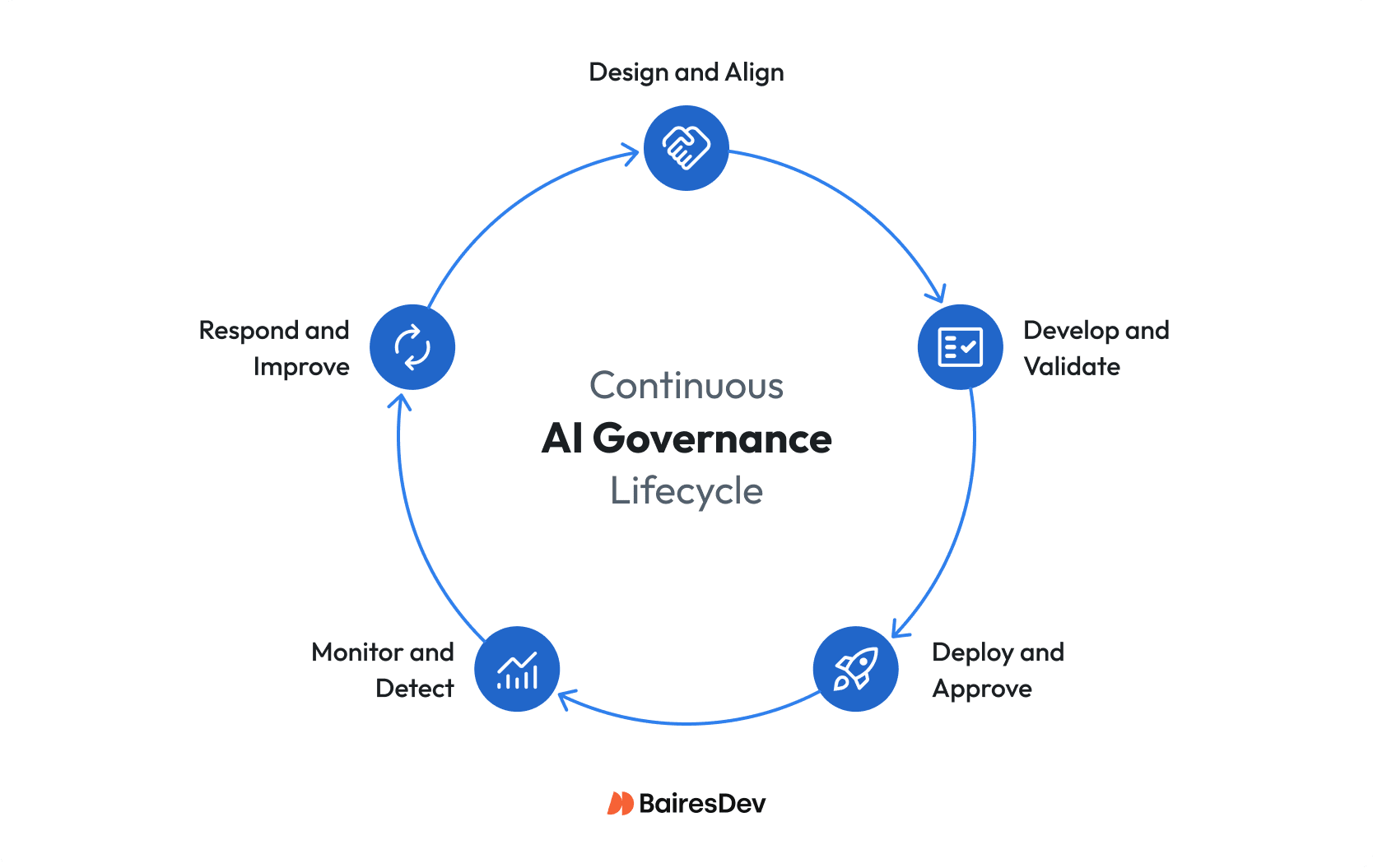
AI governance provides the structure to manage these responsibilities consistently. It ensures that models are built well and operated responsibly. The goal is to make innovation sustainable rather than to slow it.
What Happens When Drift Monitoring Is Missing
In one enterprise AI program I supported, a production model was deployed to optimize staffing across a large service network. The early results were strong, with measurable reductions in overtime costs and improved service coverage.
Over time, however, external conditions changed due to a policy shift that altered demand patterns. The model continued to rely on historical data that no longer reflected current reality.
Because there was no formal structure for monitoring drift, the change went unnoticed for several weeks. Performance degradation was gradual and easy to dismiss as normal variation. There were no defined thresholds tied to business impact, and no clear ownership for ongoing model monitoring.
The issue surfaced when an operations manager noticed recurring staffing shortages in specific regions and escalated the concern informally. A subsequent review confirmed that the model was significantly under-forecasting demand in those areas.
The model was rolled back and the team reinstated a temporary rule-based system while corrections were made. Leadership later acknowledged that the issue was not a sudden failure of the model, but a gradual misalignment with reality that went undetected due to missing governance controls.
The cost was several weeks of operational inefficiency, increased overtime costs, and emergency engineering effort to stabilize the system. It also produced a structural change in how models were managed, including explicit ownership, defined drift thresholds, and mandatory monitoring requirements.
Four of the six questions in the previous section had no answer in that environment.
How to Measure Whether Governance Is Working
Governance is often evaluated on activity, counting policies written, controls implemented, and reviews completed. The most effective programs measure outcomes instead.
The measures that matter are adoption rates, business impact, risk reduction, operational efficiency, and user confidence. For AI systems specifically, add how quickly models reach production, how often performance degrades, and how frequently exceptions are raised.
In the staffing case, none of those measures existed. The model’s original business case was built on overtime reduction, and no one was tracking whether that reduction held. Governance becomes valuable when it can demonstrate measurable improvement in business performance and decision quality.
Governance as a Competitive Advantage
Competitive advantage will not be defined solely by technological capability. As models become more widely available, the differentiator becomes the ability to build and maintain trust at scale.
Trust in data determines how confidently organizations can analyze their performance. Trust in decisions determines how effectively they can act on insights. Trust in processes determines how consistently they can execute across teams. Governance is what enables all three.
The advantage shows up as speed. One of the more significant governance results I have seen came from ending the debates over whose data was correct. In a healthcare environment where analytics touched clinical, financial, and operational decisions, establishing ownership, definitions, and controls meant that AI and analytics initiatives moved faster because teams trusted the data from the start. Governance removed friction that had been slowing the work down.
When governance is strong, it becomes almost invisible in day-to-day operations. Decisions move faster, alignment improves, and risk becomes manageable. The result is greater confidence across the organization.
Trust Is the Foundation for Scalable AI
As organizations continue their digital and AI transformation journeys, governance will increasingly become a competitive advantage rather than a compliance requirement. Technology will continue to evolve. Models will become more powerful. New platforms will emerge. Yet one thing will remain constant: people will only adopt what they trust.
Data governance builds trust in information. AI governance builds trust in decisions. Together they produce explainable, repeatable outcomes that organizations can scale with confidence. Governance is a leadership discipline, and in the age of AI, trust may be the most valuable asset an organization can build.
Key Takeaways
- Governance is a business capability that defines how decisions are made, not a compliance function or a platform purchase.
- A model can be accurate and still fail to reach production if its outputs cannot be explained.
- Conflicting metric definitions across departments cost weeks of reconciliation and erode confidence in reporting.
- Models degrade as conditions change, and drift goes undetected without defined thresholds and named ownership.
- Governance should be measured by adoption, business impact, and user confidence rather than by policies written.