



When a pilot shows basic feasibility, model quality usually isn’t the main issue. Instead, it’s often data access and governance, integration with systems of record, provable validation, and business processes nobody updated. Most organizations are still early in that operational maturity, so the fastest path forward is diagnosing which barrier is stalling your program.
Key Points
- The common barriers to AI adoption are mostly organizational, not technical.
- Developers often adopt AI faster than their organizations can operationalize it.
- A pilot that works in a sandbox proves little about production readiness.
- Diagnose the specific stall point, then fix the smallest foundation that unblocks the next release.
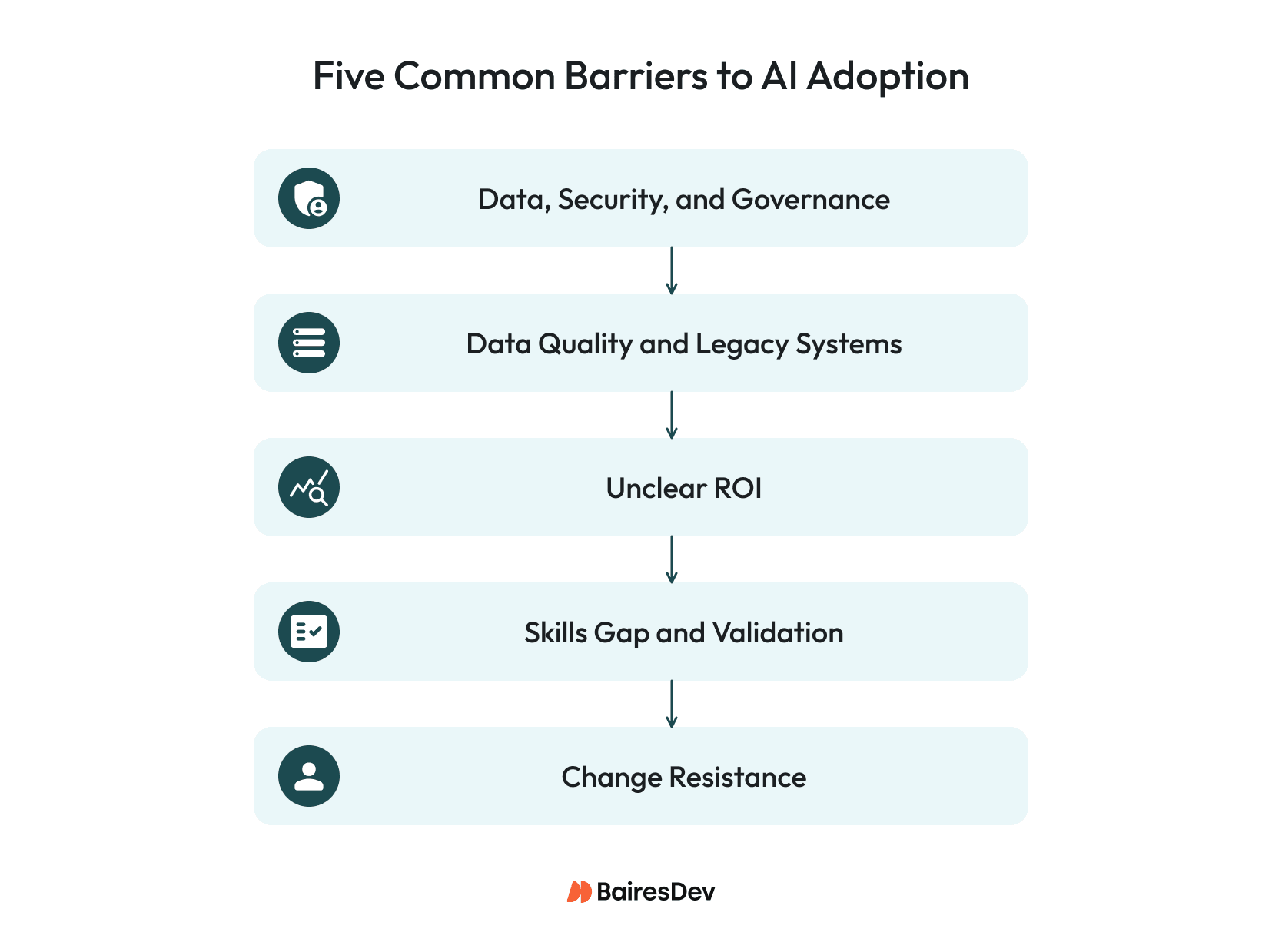
The most common barriers to AI adoption aren’t technical, but organizational. They come from governance gaps, data readiness issues, economic constraints, validation requirements, and unchanged workflows.
You’ll face those same five failure points whenever you try to push a pilot into production. Below, we’ll show you how to pinpoint what’s stalling your program, then pick the smallest set of changes to win buy-in for AI initiatives at scale.
Why Does Enterprise AI Adoption Stall?
Experimentation often outruns operational readiness. Although nearly nine in ten respondents in McKinsey’s 2025 global survey reported regular AI use, only 39% reported any enterprise-level EBIT impact from AI. The same research found that nearly two-thirds of respondents said their organizations hadn’t yet begun scaling AI across the enterprise.
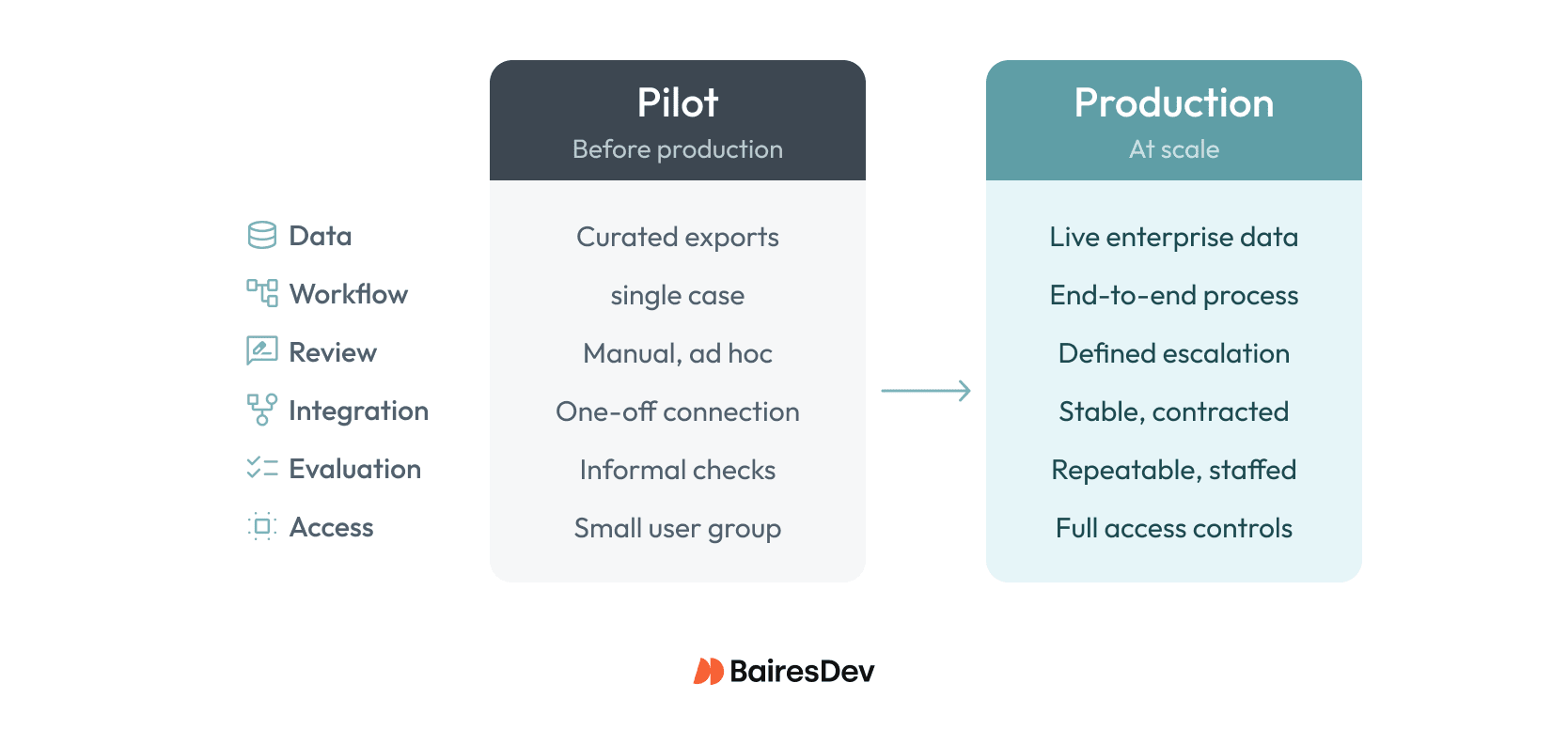
A support-agent copilot can look great in a sandbox, then fail in implementation because it needs PII access, auditable suggestion trails, and an owner for ongoing prompt, policy, and evaluation updates. Many enterprises are relearning an old lesson: pilots aren’t production. Gartner found that only 41% of generative AI prototypes reached production on average, compared with 42% of nongenerative AI prototypes.
Throughout this article, survey figures reflect what the respective researchers reported.
Data, Security, and Governance
The 2026 RSM Middle Market AI survey shows a clear pattern: data quality leads as the top inhibitor at 34%, security and privacy concerns follow at 30%, and legacy systems integration and talent gaps each account for 28%.
Security reviews rarely reject the model itself. They reject the data flows, permissions, logging, or ownership around it. Enterprise-scale AI programs usually need explicit ownership for AI accountability, auditability, and incident response.
A generative AI feature that drafts customer responses may seem trivial until it needs to join a CRM record with ticket history and send the draft back into a system of record. Which fields are allowed? Are prompts and outputs logged? These questions can slam the brakes on AI adoption. You don’t need perfect governance to start building, but you do need more than a paperwork step.
“Good enough” governance usually means meeting these tests:
| Governance element | What “good enough” looks like |
| Data classification and scope | Knowing which sources are in bounds, which fields are banned, and what must be masked. |
| Access and identity | Least-privilege service accounts, approved connectors, and a reviewable path for new data access. |
| Auditability | Logs for prompts, retrieved context, and outputs, with masking and retention rules, and a way to reproduce important decisions. |
| Accountability | A named owner for policy, evaluation thresholds, incident response, and third-party risk. |
For agentic AI systems, these controls become even more important because systems may retrieve information, invoke tools, and take actions across multiple applications. Governance therefore becomes part of the architecture, not simply a final approval step.
Data Quality Meets Legacy Systems
Gartner reported in 2025 that 63% of organizations either don’t have or aren’t sure they have the right data management practices for AI. Gartner also predicted that through 2026, organizations will abandon 60% of AI projects that aren’t supported by AI-ready data.
Gartner’s more recent October 2025 research still found that only 4% of organizations have AI-ready data, reinforcing the gap between AI experimentation and data foundations.
Without consistent data, no amount of model tuning can make an AI system trustworthy at scale.
The moment you try to scale, the problem stops being “can the model do this?” and becomes “can you feed it the same thing your production systems run on, every time.” In a pilot, you usually work with a clean export, a handpicked knowledge base, or a narrow slice of tickets. In production, your context has duplicates and conflicting definitions, with half the data trapped behind brittle SOAP services or a 15-year-old ERP. That can turn a two-week prototype into a multi-quarter AI integration project.
Before you scale, two things must be true. First, you should be able to retrieve the right records with predictable latency. Second, your integration surface should support change without breaking downstream consumers. Without an authoritative source for key entities, basic data contracts, and fresh context, output quality will swing even if prompts are well tuned.
Data quality work often becomes a delivery-critical data management track once you connect AI models to systems of record and need consistent, low-latency context.
| By the numbers | What it means for AI-ready data |
| 4% | Share of organizations Gartner found have AI-ready data in its 2025 research. |
| 63% | Share that either don’t have or aren’t sure they have the right data management practices for AI. |
| 60% | Share of AI projects Gartner predicts organizations will abandon through 2026 when they aren’t supported by AI-ready data. |
| 48% | Share of respondents in NVIDIA’s 2026 State of AI research who identified data sufficiency or other data-related issues as a top AI challenge. |
The 4%, 63%, and 60% figures come from Gartner’s research; the 48% figure comes from NVIDIA’s 2026 State of AI research.
AI Strategy Doesn’t Survive Delivery
The first sprint after the demo can saddle you with unplanned integration work, review overhead, and incident handling. You may end up tracking activity like prompts per day while the real cost is in permissions or human review time. Project managers surveyed in the same Q3 2025 research identified unclear ROI and limited resources among the barriers to AI adoption.
For example, a customer-support auto-draft feature can look like it saves minutes per ticket, until you include the cost of routing rules, redaction, QA sampling, and the rework caused by confidently wrong drafts that agents have to correct under time pressure.
AI strategy usually fails in one of three ways:
- The use case is interesting but isn’t tied to a measurable bottleneck.
- The cost model ignores integration, review, monitoring, and exception handling.
- There’s no definition of the evidence that would justify scaling, revising, or stopping.
To restore focus, force a few decisions early. Pick use cases where AI removes a known bottleneck and define one primary outcome metric with a pre-AI baseline. Then turn your AI roadmap into sequencing. Decide what you’ll operationalize this quarter, such as data access, an evaluation harness, monitoring, or a review workflow, versus what you’ll postpone.
The business case also needs to survive the entire workflow. Gartner reported in April 2026 that only 39% of surveyed technology leaders were confident that their current AI investments would have a positive impact on financial performance. Organizations reporting successful AI initiatives were investing up to four times more, as a percentage of revenue, in foundational areas such as data quality, governance, AI-ready people, and change management than organizations reporting poor outcomes.
That makes the sequencing question important. The AI investment isn’t just the model or tool. It’s also the operational foundation required to make the capability repeatable.
Validation Skills Gaps
Your team should be able to prove AI systems behave acceptably in their workflows and on their data. When validation is fuzzy, Security, Legal, and Risk often default to “no.” When that happens, every incident becomes an argument about whether the AI was “supposed to do that.”
Validation challenges often surface once AI systems move beyond demos and into real workflows. Teams struggle to prove accuracy and reliability under real operating conditions, and time pressure makes it difficult to run thorough reviews. Many organizations also report gaps in test coverage and limited access to representative data, which leaves validation work inconsistent and often under-resourced.
Imagine you ship an LLM-based “change summary” feature that drafts release notes from Jira and pull requests. It looks great until it misses a breaking change and support inherits the fallout. At that point, the question is whether you budgeted time for review.
Make validation a staffed, repeatable engineering capability rather than a best-effort review step. Set an eval owner, define impact-based pass/fail thresholds (such as accuracy, groundedness, latency, and human-override rate) and instrument monitoring so drift triggers action.
Consider creating a small cross-functional group involving product, engineering, security, and the domain owner. Its job is to translate domain risk into measurable checks and keep those checks current as prompts, models, and policies change.
Change Management and Workflow Adoption
AI resistance usually isn’t a personality problem. It comes from implementing AI without updating the change-control and incident-response process. Identify who’s allowed to use the tool, what counts as good output, how work gets reviewed, and what happens when something goes wrong.
Industry research shows a similar gap between individual adoption and organizational readiness. While teams often report clear personal productivity gains from AI, RSM’s 2026 Middle Market AI Survey found that only 36% of organizations have AI fully embedded in core processes. Most firms are still operating in pilot mode, constrained by data quality issues, integration challenges, and slow operational processes that make it difficult to scale early wins into enterprise‑level impact.
In that vacuum, teams either avoid the tools or use them in ways you can’t audit or support. That’s how you end up with shadow AI: engineers pasting snippets into public chat tools and security finding out after the fact.
For example, if you roll out a copilot for on-call or customer support without updating runbooks and escalation paths, you’ll create a split-brain workflow. The tool suggests an action, the human can’t justify it, and the incident commander rejects it under pressure. People then learn the wrong lesson. They say AI “doesn’t work,” when the real issue is that you never defined when suggestions are advisory or executable. You also never decided what evidence is required either way.
Minimum viable change management is small but explicit. Publish a lightweight usage policy tied to data classes and assign an accountable owner for quality and adoption inside that workflow. This step can help keep you from paying for AI tools while your organization optimizes for avoiding blame.
McKinsey’s 2025 research supports the same point from a broader enterprise perspective: workflow redesign had the strongest relationship with enterprise-level EBIT impact among the organizational attributes it tested, yet only 21% of respondents using generative AI said their organizations had fundamentally redesigned at least some workflows.
Common Barriers to AI Adoption: Decision Matrix
Run three pilots in parallel and they often stall in different places: security review loops, data-join failures, or a lack of a clear success definition. A simple matrix is often the fastest way to stop debating and start sequencing.
When you’re trying to decide what to fix first, treat AI adoption like reliability work. Follow the incident log or SOC 2 audit findings the way you would for any production system.
NVIDIA’s 2026 State of AI research found that data sufficiency or other data-related issues topped the list of AI challenges at 48%, followed by a lack of AI experts at 38% and unclear ROI at 30%.
Barrier Matrix
| Barrier | Symptom (what you see) | Why it stalls | First move |
| Data, Security, and Governance | Approvals bounce between Security, Legal, and Platform; nobody can answer what data is in bounds. | No auditable access, logging, or owner. | Define allowed sources and fields, and ship with least-privilege access plus appropriate logging. |
| Data Quality and Legacy Systems | Pilot works on exports, fails on live data; latency and mismatched IDs break flows. | You can’t retrieve consistent truth from systems of record. | Declare systems of record for key entities and implement one stable integration surface, such as an API or data contract. |
| Unclear Strategy and ROI | Lots of demos and seats, no metric that survives end-to-end cost. | No baseline, target delta, or kill gate. | Pick one workflow constraint and one outcome metric with a pre-AI baseline. |
| Talent and Skills Gap (Validation) | Arguments about “good enough,” repeated incidents, no test set. | Outputs can’t be proven safe or useful. | Build a lightweight eval harness from real edge cases and assign an eval owner. |
| Cultural Resistance and Change Management | Low adoption or invisible shadow usage; unclear review and escalation. | The workflow didn’t change, so risk shifts to individuals. | Embed AI into a specific step with a usage policy and an accountable workflow owner. |
Getting Past the Barriers
A better model might improve performance or cost. On its own, it won’t fix unclear ownership, weak data foundations, missing evals, or an unchanged workflow. The five barriers are cleared by operational work. That includes scoped data access with logging, one reliable integration surface, a baseline and a kill gate, a staffed eval capability, and a workflow that names an owner.
Here’s what to fix first:
- Governance: Fix this first when the system touches sensitive or regulated data.
- Data and integration: Address this first when pilot quality drops on live systems.
- Strategy: Make this your first move when overall goals aren’t yet clear.
- Validation: Start here when stakeholders disagree about acceptable performance.
- Workflow ownership: Start here when usage is low or shadow adoption is growing.
Diagnose where your program is stalling, run the matrix, and fix the smallest foundation that makes the next release less risky.