


A clinical trial data platform is a collection of systems with different risk profiles, different regulators watching them, and different answers on whether to build or buy. Some components should be purchased from established vendors. Others are better built or customized by your own engineering team. Getting the split wrong can cost millions in wasted validation work, compliance exposure, and delays that compound.
Key Points
- Platforms feature multiple systems with different risk profiles and regulators, and each has a different build-vs-buy answer.
- Buying usually wins for the regulated core, but the integration layer is where engineers can add the most value if you choose to build.
- A single day of delays can cost tens of thousands of dollars in operating costs and much more in lost prescription drug sales.
What Is a Clinical Trial Data Platform?
A clinical trial data platform is a coordinated stack of systems that together support the design, conduct, oversight, and submission of clinical studies. Think of the platform like the technology behind a bank: there is a core ledger that nobody touches (the system of record), operational software for branch staff, an integration layer that connects everything, and the customer-facing apps on top. Clinical trials have the same layered structure, except regulators audit the core systems with the intensity of a financial examiner.
When Tufts CSDD reports that Phase II and III protocols now involve 263 procedures per patient supporting roughly 20 endpoints [6], the data those procedures generate flows through multiple systems with different regulatory profiles.
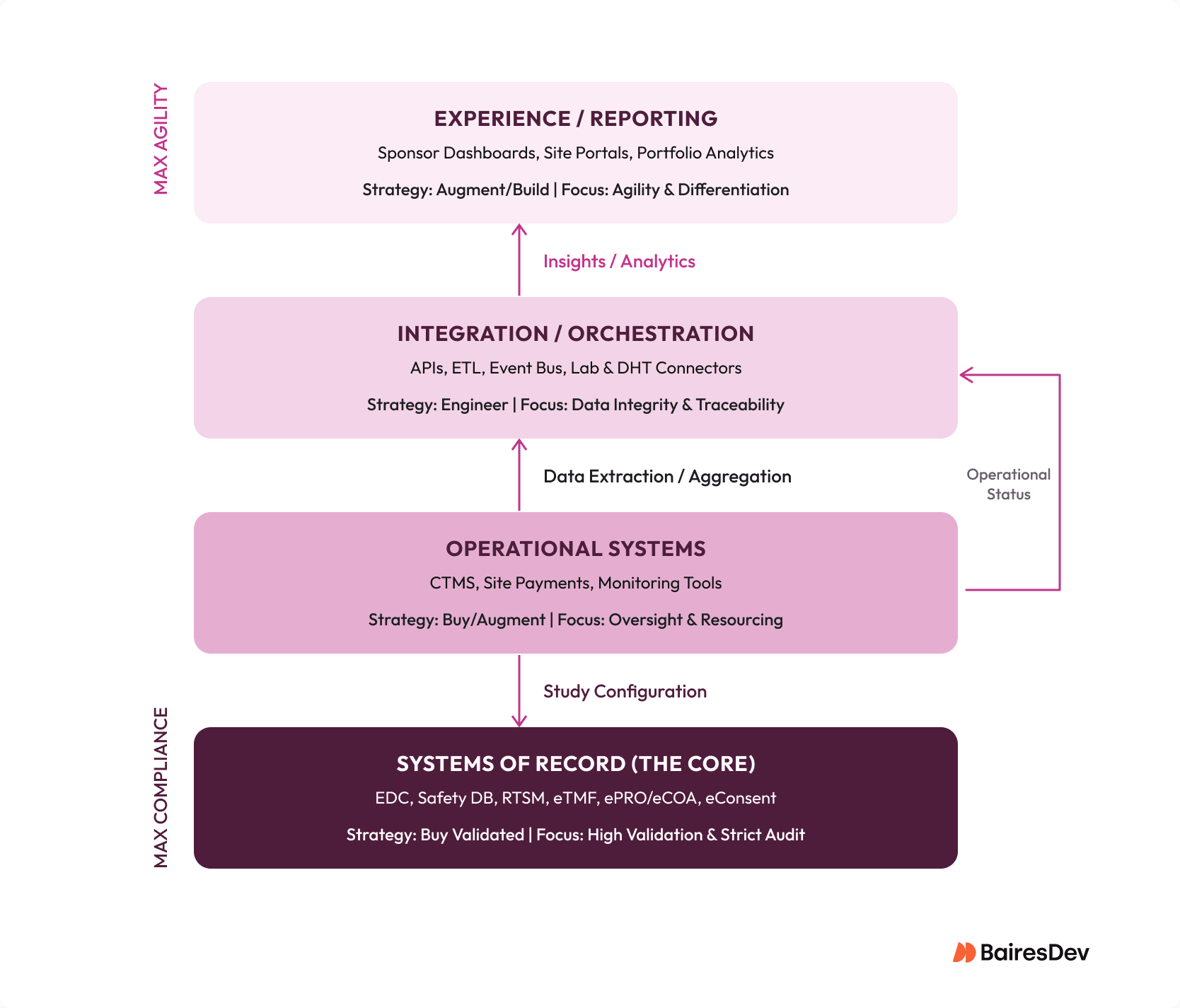
The platform has four architectural layers, each with a different compliance weight and build-vs-buy logic.
The data systems at the core include:
- EDC (Electronic Data Capture, where trial data is entered and stored),
- Safety databases (for adverse event reporting), and
- RTSM (Randomization and Trial Supply Management, which assigns patients to treatment groups and manages drug supply).
The document and operations layer includes:
- eTMF (Electronic Trial Master File, the regulated archive of all trial documents) and
- CTMS (Clinical Trial Management System, which tracks enrollment, visits, and site operations).
Patient-facing tools include:
- ePRO and eCOA (for patients to report outcomes and assessments digitally),
- eConsent (digital informed consent), and
- DHTs (Digital Health Technologies such as wearables and sensors).
| Layer | Examples | Regulatory Profile | Default Approach |
| Systems of Record | EDC, safety DB, RTSM, eTMF, some ePRO/eCOA, eConsent | High validation burden, strict audit and retention, direct impact on endpoints and safety | Buy validated commercial products; configure rather than customize deeply |
| Operational Systems | CTMS, site payments, monitoring tools | Moderate compliance expectations, important for oversight and resourcing | Usually buy, sometimes augment with targeted extensions |
| Integration / Orchestration | APIs, ETL, event bus, lab and DHT connectors | High impact on data integrity and traceability; needs flexibility and observability | Augment with a dedicated engineering layer; use vendor APIs, avoid embedding logic inside cores |
| Experience / Reporting | Sponsor dashboards, site portals, portfolio analytics | High need for differentiation and agility, lower direct regulatory burden | Augment or build depending on strategic value; keep data read-only from systems of record |
The Cost of Failure
A day of delay in a Phase III clinical trial costs up to $55,716 in direct operating costs and another $500,000 in lost prescription drug sales [1]. That is the daily cost of bad architecture decisions in this domain. Pick the wrong platform, and you will pay for it.
The clinical trial platform market reached $2.69 billion in 2025 and is growing at 13.9% annually [2]. Phase III protocols now generate an average of 5.9 million data points each, up from roughly 930,000 in 2012 [3]. The clinical research data stream can be similar to what a mid-sized SaaS company processes, and data is generated by a few hundred patients, then scrutinized by regulators line by line.
Combined with the data governance requirements of ICH E6(R3) (the international standard for clinical trial conduct, updated January 2025) [4] and the compliance expectations of 21 CFR Part 11 (the FDA regulation governing electronic records and signatures) [5], the architecture behind a platform is no longer an operational detail. It is a strategic decision.
The lowest-risk pattern for most organizations? Buy validated systems of record, augment them with a custom integration and experience layer, and build from scratch only where a workflow genuinely cannot exist otherwise.
How Should You Evaluate Build vs. Buy vs. Augment?
Engineering leaders should not treat the platform as a single RFP. Three criteria dominate most decisions: whether the system stores data that regulators will inspect (validation burden), how many other systems it must connect to (integration complexity), and whether your team can own the compliance lifecycle (internal capacity). The remaining eight refine the analysis. Here are all eleven.
| # | Criterion | What to Evaluate |
| 1 | Validation and compliance burden | Does the system store or transform data used for endpoints or safety submissions? If yes, it requires full, documented validation under FDA Part 11 and E6 regulations [4][5]. |
| 2 | Audit trails and access controls | Does it need granular, computer-generated audit trails and strict role-based access with inspection-ready logs [5]? |
| 3 | Time to deployment | How quickly must the capability go live without jeopardizing study timelines? |
| 4 | Flexibility for protocol variation | Do protocols vary enough that configuration agility matters more than custom logic in code? |
| 5 | Integration complexity | How many upstream and downstream systems must it connect to? Point solutions require 8 to 16 weeks each for integration [7]. |
| 6 | Upgrade and maintenance overhead | Who will own regression testing and validation when vendors or internal teams change schemas or infrastructure [8]? |
| 7 | Data model control | Do you need fine-grained control over schemas and semantics for advanced analytics, or is the vendor’s model acceptable? |
| 8 | Vendor lock-in risk | Will deep customization trap you on a platform or make exit migrations extremely costly? |
| 9 | Total cost drivers | Day-one license price is the least important number. Lifecycle costs dominate. See the cost section below. |
| 10 | Internal team capacity | Can your team realistically own regulated software lifecycle management across multiple inspection-critical systems? |
| 11 | Inspection readiness | Does the architecture make it easier or harder to demonstrate control of systems, data lineage, and responsibilities across sponsors, CROs (Contract Research Organizations), and vendors [4][8]? |
When Is Buying Validated Systems the Right Call?
Some components of a data platform store data that regulators will inspect directly: patient outcomes, safety events, randomization records, and essential trial documents. These systems must meet strict rules for how data is recorded, who can access it, and how changes are tracked. Building them yourself means your team owns that entire compliance burden. For most organizations, buying from a vendor that has already solved these problems is the faster and safer path.
Electronic Data Capture (EDC)
Directly holds eCRF (electronic case report form) data, including queries, data corrections, and protocol deviations used in submissions. It must meet stringent FDA Part 11 and E6 requirements for validation, audit trails, secure electronic signatures, and retention. Vendors like Medidata Rave, Veeva Vault, and Oracle Clinical One have already industrialized this compliance [9][10].
Electronic Trial Master File (eTMF)
This is the official repository for essential documents supporting trial conduct and GCP (Good Clinical Practice) compliance. It requires rigorous metadata, versioning, access control, and retention aligned with GCP and regional expectations [4].
Randomization and Trial Supply Management (RTSM)
Directly affects treatment allocation, blinding, and investigational product management. These are core to patient safety and statistical validity. Vendors offer validated systems with configuration for stratification, supply forecasting, and emergency unblinding [5].
Safety Databases
These store adverse event and pharmacovigilance data, subject to strict regulatory reporting. They require auditable workflows, coded dictionaries, and integration with EDC and external safety reporting channels [5][9].
Under E6(R3)’s emphasis on end-to-end data governance and traceability, the maintenance slope for any internally built system is steep and accelerates over time [4][8][11].
The timeline math tells the same story.
Standing up a validated commercial EDC for a new study typically takes 8 to 12 weeks from signed contract to production. Building equivalent functionality internally takes 18 to 24 months and commits at least two QA engineers to the validation lifecycle for as long as the system runs [7]. At a Phase III delay cost of up to $55,716 per day [1], the timeline delta alone is worth more than most build budgets.
What if my CRO already picked the EDC?
This is the default for most 200- to 5,000-person sponsors. The CRO brings Medidata, Veeva, or Oracle. Your bargaining power is limited. Treat their choice as a fixed input and focus engineering capacity on the augmentation layer: the integrations, dashboards, and operational tooling that connect the CRO’s stack to your internal systems. The fight is not which EDC runs the trial. The fight is whether your team can see what is happening in real time and whether data flows cleanly back into your own portfolio analytics when the trial ends.
Where Does Augmentation Create the Most Value?
Augmentation is the middle path for a clinical platform. You keep the vendor systems that store regulated data, but you build a custom engineering layer around them. That layer connects the systems to each other, pulls data into dashboards your team actually wants to use, and automates the manual work that slows studies down.
Connecting Core Clinical and Operational Systems
A 2025 Castor survey found 42% of organizations cite platform integration complexity as their top challenge when implementing decentralized trial elements [7]. The finding comes from a vendor with a commercial interest in the answer, but it matches what engineering teams report in practice.
The problem is not any single system, but what happens between them. Integrations between EDC, CTMS, eTMF, safety systems, and operational tools reduce duplicate entry and reconciliation work while improving traceability [9][12]. Event-driven flows where subject status changes in EDC drive CTMS updates. Lab and sensor feeds normalized and pushed into EDC or analytics stores. Consent and enrollment data from eConsent updating EDC, RTSM, and CTMS simultaneously.
A dedicated integration layer using APIs, webhooks, FHIR (a healthcare data exchange standard) where applicable, and monitoring lets the platform swap vendors over time without rewriting every downstream consumer [12].
Sponsor Dashboards and Reporting
Individual vendor reporting modules within a platform rarely serve centralized, near real-time dashboards well. Study teams need cross-system visibility into recruitment, data quality, protocol deviations, and site performance. An augmentation layer can aggregate data across EDC, CTMS, safety, labs, ePRO, and digital health technologies into a curated analytics store, then provide role-specific views for central monitors, study managers, medical monitors, and executives [12][13].
Because this layer reads from validated sources and does not overwrite them, compliance risk is manageable if lineage, access control, and validation of transformation logic are documented [4][9].
Automating Administrative Workflows
Study teams still spend considerable time on manual tasks that an augmentation layer can absorb. Reconciling enrollment lists between EDC and CTMS. Updating visit schedules when protocol amendments hit. Chasing missing ePRO entries. Aligning lab shipment records with site inventory.
Automation in the augmentation layer can trigger tasks when specific data patterns appear, such as overdue visits or missing safety reports. It can pre-populate operational tools from canonical data in the EDC, reducing manual re-entry. It can drive alerting and triage workflows for data quality issues. Done well, this directly reduces human error and supports the data integrity requirements of E6(R3) [4][8].
Improving Site and Team Usability
Vendor interfaces are optimized for generic use, not your organization’s specific workflows. Sites running your trials may need to log into EDC, CTMS, and eTMF separately, each with its own navigation and logic. That friction adds up. A unified site portal that aggregates tasks across systems, surfaces inline SOP guidance, and simplifies data entry where usability is the bigger constraint than feature breadth can measurably reduce site burden without replacing the core tools underneath.
Supporting Hybrid and Decentralized Trials
77% of modern clinical trials use hybrid models rather than fully virtual implementations [7].
Hybrid and decentralized trials generate continuous, heterogeneous data streams from ePRO, wearables, home devices, EHRs (Electronic Health Records), and telemedicine platforms [12][13][14]. An augmentation layer that ingests and harmonizes these feeds enables near real-time quality and safety monitoring and rapid detection of operational issues like device failures or missed visits.
Route canonical data into existing EDC and safety systems, minimize re-validation, and modernize workflows at the same time [12][14].
When Can You Justify Building from Scratch?
Building your own trial data platform from scratch is expensive and puts your team on the hook for ongoing regulatory compliance. It should be an exception. The only good reason to build from the ground up is when no commercial product can support a workflow that gives your organization a genuine competitive advantage.
Here is a good example of what can go wrong. A company used an internal program to record case report form data from its clinical sites, including adverse events, and transmit that data to the FDA for a submission. The FDA’s inspection found that the program was not validated and had no audit trail. The Form 483 (the notice FDA investigators issue at the conclusion of an inspection when they find conditions that may violate the FD&C Act and related regulations) that followed cited Part 11 directly [15].
The company’s engineering team had built software that worked. The FDA did not care that it worked. It cared that the company could not prove it worked, could not show who changed what, and could not demonstrate compliance after the fact. That is the specific risk of owning a regulated system internally. The burden of proof is on you, forever.
If your organization runs trials in a novel way (unusual adaptive designs, platform trials, or integrated care-delivery-and-research operations), a custom orchestration or scheduling engine may be warranted. Commercial CTMS or workflow tools may not express these models cleanly. If your clinical strategy depends on deeply personalized mobile experiences, novel sensors, or multi-modal data capture that vendor platforms cannot yet support, custom applications with device integrations may be necessary [12][14].
Complex organizations often have legacy CTMS, safety, or document systems that cannot be replaced quickly. Custom orchestration services can bridge legacy and modern tools, implement complex routing and transformation logic, and manage lifecycle and error handling in ways that off-the-shelf integration tools cannot.
The build zone is the integration and experience layer, not the compliance core.
What Tradeoffs Do Most Platform Discussions Skip?
Vendor demos and architecture slide decks rarely mention the problems that surface a year or two into a rollout. Four risks come up repeatedly, and each one can quietly drain engineering capacity or create compliance exposure that is difficult to reverse.
Over-customizing Vendor Platforms
Deep customization of vendor platforms (custom code plugins, unsupported schema changes, non-standard workflows) can recreate the very maintenance problem you were trying to avoid by buying. Every vendor upgrade becomes a mini-revalidation project. Between 2018 and 2021, 82% of Phase III protocols required at least one substantial amendment, up from 66% in 2013 to 2015 [16]. Add vendor upgrade regression testing on top of that amendment load, and engineering capacity drains fast.
Building Regulated Systems From Scratch
Owning an internally developed EDC, eTMF, RTSM, or safety database means owning all validation packages, SOPs (Standard Operating Procedures), change control, incident management, and inspection interactions for those systems. Part 11 and E6(R3) make it clear: sponsors own system fitness and data integrity regardless of who builds the software [4][5][8]. The ACRP (Association of Clinical Research Professionals) has noted that ensuring digital tools are validated and audit-ready is resource-intensive, and not all service providers or sites may be prepared to meet new oversight expectations [17].
Point-solution Sprawl
Proliferating tools for ePRO, wearables, eConsent, and niche workflows increases reconciliation workload, duplicate data entry, and fragmented oversight if not integrated into a coherent architecture. When EDC, CTMS, safety, ePRO, and DHT data live in isolated silos, organizations struggle to maintain consistent, cleaned, and contextualized data for decision-making and submissions. Data silos also block the risk-based monitoring and cross-platform analytics that regulators increasingly expect. By some industry estimates, manual data reconciliation can consume 30 to 40% of clinical operations time [18]. Every manual bridge between systems is also an operational bottleneck that slows safety review, data cleaning, and database lock.
Decentralized Trials Increase Governance Requirements
ICH E6(R3) explicitly acknowledges digital health technologies, remote data capture, and decentralized models, while increasing expectations for data governance, audit trails, and lifecycle control [4][8][19]. The more devices and remote channels involved, the more important integration, traceability, and metadata become. Not less.
The EU AI Act Could Reshape the Tradeoffs
Most high-risk AI obligations under the EU AI Act become enforceable on August 2, 2026, with an extended runway to August 2, 2027 for AI systems embedded in regulated medical devices [20]. If your platform uses machine learning anywhere in the data flow, for anomaly detection, protocol deviation scoring, site risk stratification, even basic eligibility screening, you now have a second regulatory regime to validate against, on top of Part 11 and E6(R3). This is not a reason to avoid ML in clinical operations. It is a reason to isolate any ML components behind the augmentation layer, where you control the code, the training data, and the audit trail, rather than embedding them in a vendor platform you cannot inspect.
What Does This Cost and Where Does the Money Go?
The sticker price of a license is the least important number in the decision. However, most organizations underestimate what follows because the costs are spread across teams and budgets. And what follows dwarfs the license fee.
Recall the delay math from the opening: $55,716 per day in direct Phase III operating costs, plus another $500,000 per day in lost prescription drug sales for the therapies that eventually launch [1]. A three-week slip on a platform integration, not uncommon when a custom build hits a validation issue, absorbs roughly $11.7 million in combined costs. That is the real budget comparison for build versus buy.
Data management alone runs $3,000 to $5,000 per patient [21]. As much as 25% of total clinical trial budgets goes to on-site monitoring and source data verification [22]. Combined CRO and technology vendor service costs grew from $10.4 billion in 2000 to $78.6 billion by 2020, while investigative site costs rose from $5.9 billion to $15.3 billion over the same period [16]. Meanwhile, 80% of trials fail to meet initial enrollment timelines [23].
Key cost categories that must factor into any platform decision: licensing (per-study, per-site, per-user, and volume-based models), implementation and configuration, validation (test planning, execution, documentation, and regression runs for both vendor updates and internal changes), integration work (API development, mapping, error handling, monitoring), upgrades and vendor release management [8], support (vendor SLAs, internal operations, incident management), change management (training, SOP updates, communications), internal staffing (product management, engineering, QA/validation, DevOps, data engineering), and long-term maintenance (technical debt, cloud costs, security, performance, eventual migrations).
A Practical Recommendation Framework
For any given component of your clinical data management solution (eConsent, recruitment dashboard, wearable ingestion, or any other element), score Build, Buy, and Augment across these criteria using a simple 1-to-5 scale based on your context.
| Criterion | Favors Buy When Score Is High | Favors Build/Augment When Score Is High |
| Validation/compliance fit | Yes | No |
| Time to deploy | Yes | No |
| Integration complexity | No | Yes (Augment) |
| Flexibility for protocol variation | No | Yes (Augment) |
| Data model control | No | Yes (Build) |
| Vendor lock-in risk | No | Yes (Build/Augment) |
| Internal capacity alignment | No | Yes (Build) |
| Strategic differentiation | No | Yes (Build) |
| Upgrade/maintenance overhead | Yes | No |
For organizations with 200 to 5,000 headcount, the right platform strategy is to buy the validated core. Invest engineering capacity in the integration and experience layer. Reserve custom builds for workflows where owning the capability changes your strategic position.
Let vendors handle the parts of your platform that regulators will inspect most closely. Point your engineers at the connective tissue between those systems and the tools your teams use every day. That is where custom work pays off.
References
[1] Smith Z, DiMasi J, Getz K. New Estimates on the Cost of a Delay Day in Drug Development. Ther Innov Regul Sci. 2024. https://doi.org/10.1007/s43441-024-00667-w
[2] The Business Research Company. Clinical Trial Platform Market Report 2026. Research and Markets. 2026. https://www.researchandmarkets.com/reports/6178341/clinical-trial-platform-market-report
[3] Getz K et al. Insights informing strategies for optimizing the collection of clinical trial data. Tufts CSDD / TransCelerate BioPharma. Therapeutic Innovation & Regulatory Science (preprint). 2025. https://www.prnewswire.com/news-releases/transcelerate-and-tufts-csdd-uncover-opportunities-to-rethink-data-collection-and-optimize-protocol-design-302556373.html
[4] International Council for Harmonisation. ICH E6(R3) Guideline for Good Clinical Practice. Step 4, adopted January 6, 2025. https://database.ich.org/sites/default/files/ICH_E6(R3)_Step4_FinalGuideline_2025_0106.pdf
[5] U.S. Food and Drug Administration. 21 CFR Part 11: Electronic Records; Electronic Signatures. Code of Federal Regulations, Title 21. https://www.ecfr.gov/current/title-21/chapter-I/subchapter-A/part-11
[6] Getz K. Rising Protocol Design Complexity Is Driving Rapid Growth in Clinical Trial Data Volume. Tufts CSDD Impact Report. January 2021. https://www.globenewswire.com/news-release/2021/01/12/2157143/0/en/Rising-Protocol-Design-Complexity-Is-Driving-Rapid-Growth-in-Clinical-Trial-Data-Volume-According-to-Tufts-Center-for-the-Study-of-Drug-Development.html
[7] Castor. Decentralized Clinical Trial Platforms in 2025: A Practical Guide for Clinical Operations. 2025. https://www.castoredc.com/insight-briefs/decentralized-clinical-trial-platforms-in-2025-a-practical-guide-for-clinical-operations/
[8] U.S. Food and Drug Administration. E6(R3) Good Clinical Practice: Guidance for Industry. September 2025. https://www.fda.gov/regulatory-information/search-fda-guidance-documents/e6r3-good-clinical-practice-gcp
[9] MED Institute. On the Record: Compliance with 21 CFR Part 11 in Clinical Trials. 2025. https://medinstitute.com/blog/on-the-record-compliance-with-21-cfr-part-11-in-clinical-trials/
[10] Clinion. Top 10 EDC Platforms for Clinical Trials in 2026. January 2026. https://www.clinion.com/insight/top-10-edc-software-solutions-for-clinical-trials/
[11] Getz KA et al. Protocol Design and Performance Benchmarks by Phase and by Oncology and Rare Disease Subgroups. Ther Innov Regul Sci. 2022;56:761-770. https://pmc.ncbi.nlm.nih.gov/articles/PMC9373886/
[12] Mpaltadoros L et al. Operationalizing Decentralized Clinical Trials: Technology Insights from the Trials@Home RADIAL Proof-of-Concept Trial. Clin Pharmacol Ther. 2025;118(5):1090-1099. https://pmc.ncbi.nlm.nih.gov/articles/PMC12598119/
[13] BioMed Nexus. 25 Digital Health Platforms Transforming Clinical Trials in 2026. 2026. https://biomednexus.com/digital-health-platforms-clinical-trials-2026/
[14] Rodriguez-Chavez IR. Top 10 Challenges and Solutions for Decentralized Clinical Trials. DIA Global Forum. March 2025. https://globalforum.diaglobal.org/issue/march-2025/top-10-challenges-and-solutions-for-decentralized-clinical-trials-technology-diversity-and-regulations-in-2025-and-beyond/
[15] Redica Systems. FDA Cites Part 11 in Clinical Trial: The Immunomedics 483. 2021. https://redica.com/pharma-medical-devices-fda-cites-part-11-in-clinical-trial/
[16] Getz K. New Insights on The Clinical Trial Industry. Tufts CSDD, presented at 2024 SCOPE Summit. https://www.clinicaltrialvanguard.com/conference-coverage/tufts-csdd-new-insights-on-the-clinical-trial-industry/
[17] ACRP. FDA Publishes ICH E6(R3): What it Means for U.S. Clinical Trials. September 2025. https://acrpnet.org/2025/09/16/fda-publishes-ich-e6r3-what-it-means-for-u-s-clinical-trials
[18] Lifebit. 9 Best Clinical Trial Data Management Systems 2026. 2026. https://lifebit.ai/blog/clinical-trial-data-management-system/
[19] Sidley Austin LLP. U.S. FDA’s Adoption of ICH E6(R3) Good Clinical Practice: Key Takeaways for Sponsors and Investigators. December 2025. https://www.sidley.com/en/insights/newsupdates/2025/12/us-fdas-adoption-of-ich-e6r3-good-clinical-practice-key-takeaways-for-sponsors-and-investigators
[20] European Commission. AI Act Implementation Timeline. Regulation (EU) 2024/1689. https://digital-strategy.ec.europa.eu/en/policies/regulatory-framework-ai
[21] Abacum. Trial Phase Costing: How Much Should Phase II Cost? 2025. https://www.abacum.ai/blog/trial-phase-costing-benchmarks
[22] Andersen JR et al. On-site monitoring in clinical trials. Cited in: Anju Software. Controlling Clinical Trial Costs. 2024. https://www.anjusoftware.com/insights/eclinical/clinical-trial-costs/
[23] Veeva Systems. 2025 Clinical Data Trend Report. 2025. https://www.veeva.com/2025-clinical-data-trend-report/