

AI-powered Clinical Decision Support (CDS) systems are a multi-billion-dollar market growing at double digits annually, yet most of them get ignored High-profile failures at IBM Watson for Oncology, Epic’s Sepsis Model, and Optum’s risk-prediction algorithm exposed the same root causes: poor data quality, workflow misalignment, lack of explainability, and absent external validation.
The implementations that work, Ochsner Health’s sepsis CDS, Yonsei’s oncology platform, ML-driven antibiotic stewardship programs, share an architectural pattern: FHIR-native data exchange, CDS Hooks for context-driven workflow triggers, event-driven microservices, and continuous co-design with frontline clinicians.
The FDA’s 2026 revised CDS guidance and the EU AI Act (high-risk requirements effective August 2026) are making explainability and bias mitigation legal obligations. For technology companies serving healthcare, the strategic takeaway is clear: workflow integration expertise and regulatory fluency now matter more than algorithmic sophistication.
Key Points
- Clinicians override 73% to 96% of CDS alerts [1][2].
- Alert fatigue compounds the problem, as one study found 2,700 alerts were needed to prevent a single adverse drug event [1].
- Fewer, higher-specificity alerts with actionable recommendations consistently outperform high-volume systems.
- Regulatory pressure in the US and EU is accelerating.
What Are Clinical Decision Support Systems?
Clinical Decision Support, or CDS, systems analyze patient data and nudge clinicians toward the right diagnosis, medication, or next step. Think of a CDS system as an automated second opinion baked into the hospital’s electronic systems. It sounds like exactly the kind of thing technology should be good at. In controlled settings, it often is.
The global CDS market was valued at roughly $2.25 to $3.65 billion in 2024 [3][20] and is projected to reach $3.9 billion by 2030 at nearly 10% annual growth [3]. By 2024, 71% of U.S. hospitals reported using some form of predictive AI integrated with their Electronic Health Record (EHR) systems [21]. An American Medical Association (AMA) survey found that 66% of U.S. physicians were using health AI tools that year, up from 38% just twelve months earlier [21].
But here’s the disconnect. Between 73% and 96% of CDS alerts get overridden by the very clinicians they’re designed to help [1][2]. One emergency department study found that only 7.3% of alerts were clinically appropriate [2].
Hospitals are buying these systems at record rates. Doctors are ignoring them at record rates too.
This is not so much an AI problem as a traditional engineering problem. Understanding that distinction is the difference between building clinical software that improves patient care and building complex systems that generate expensive noise.
What Went Wrong with IBM Watson and The Epic Sepsis Model?
Two high-profile failures tell you most of what you need to know.
IBM spent over $4 billion building Watson for Oncology, an AI system that was supposed to help cancer doctors choose the best treatments [4]. IBM partnered with Memorial Sloan Kettering Cancer Center and MD Anderson Cancer Center, two of the most prestigious names in oncology. The result was a system trained largely on hypothetical cases rather than real patient outcomes and records. Internal documents later revealed that Watson had recommended unsafe treatments in some scenarios [5]. MD Anderson alone burned through $62 million before pulling the plug. Concordance with local treatment practices was as low as 12% for certain cancers [4].
In 2022, IBM sold what remained of Watson Health for roughly a quarter of what it had invested [6][7].
The second failure is less flashy but arguably more consequential because it touched far more patients. Epic Systems, the company whose EHR software runs in the majority of U.S. hospitals, built a sepsis prediction model. Sepsis is a life-threatening response to infection that kills roughly 270,000 Americans per year. Catching it early matters enormously.
Epic’s model was supposed to flag at-risk patients before they deteriorated. A 2021 study in JAMA Internal Medicine found the model’s actual performance fell well short of what Epic had claimed [8][9]. It missed 67% of real sepsis cases. Meanwhile, it triggered alerts for 18% of all hospitalized patients, the vast majority of whom didn’t have sepsis [10]. For every patient correctly identified, clinicians chased roughly eight false leads. A 2024 University of Michigan follow-up suggested the model was partly just detecting that clinicians already suspected sepsis, rather than providing independent early warning [11].
Then there’s the bias problem. A landmark 2019 study in Science showed that an algorithm used by Optum, a subsidiary of UnitedHealth Group, to manage the care of approximately 200 million Americans was systematically under-referring black patients for additional treatment [12][13].
The algorithm used healthcare spending as a stand-in for health needs. Because black patients historically had less spent on their care, not because they were healthier, but because of systemic disparities in access, the algorithm interpreted lower spending as lower clinical risk. At identical risk scores, black patients had 26.3% more chronic conditions than white patients [12].
What Is Alert Fatigue and Why Does It Make CDS Systems Dangerous?
Alert fatigue is what happens when clinicians receive so many notifications that they stop reading them.
You need to experience one day of being a busy clinician to understand how despised false alarms are. They waste your time and effort which could be devoted to patients who really need it.
Intensive Care Unit (ICU) clinicians receive a median of 17.5 alerts per day, and more than half report they’ve become desensitized [14][15]. One analysis calculated that a hospital had to generate 2,700 alerts to prevent a single adverse drug event [1].
At that ratio, the alerts become background noise. That’s how a system designed to protect patients ends up training doctors to click “dismiss” without looking.
The irony is sharp: a tool built to prevent harm creates a new category of risk because it cries wolf too often.
Why Do Most CDS Implementations Fail?
When a CDS deployment flops, the frequent temptation is to blame reluctant clinicians. Yet, the evidence doesn’t support that. A systematic review of adoption barriers found that technology-related factors, not human resistance, were the most commonly reported obstacles [16].
Three problems show up repeatedly.
Data Quality
Patient information sits in multiple electronic systems, often in different formats. Lab results in one database, imaging reports in another, physician notes in a third. Much of the most valuable clinical context is buried in free-text notes that machines struggle to parse reliably.
When developers filter for “clean” data to train their models, they inadvertently introduce bias, selecting for patients who happen to have more complete records, who tend to be older, sicker, and disproportionately from certain demographics [17].
Workflow Misalignment
Time pressure is the single most commonly cited barrier to engaging with CDS tools, reported by 37.5% of ICU clinicians in one study [14]. Pop-up alerts that interrupt a doctor mid-task don’t just annoy; they’ve been shown to increase procedural errors in medication administration by more than 12% [15].
There’s a well-known framework called the “Five Rights” for effective clinical alerts: right information, right person, right format, right channel, right time. In practice, most systems fail at least two of those. Be aware of this.
Trust Deficit
A 2024 survey of over 2,300 nurses found that 60% didn’t trust their employer to prioritize patient safety when implementing AI [18]. Clinicians want to understand why a system is making a recommendation. Black-box models, where the reasoning is hidden, generate immediate skepticism and questions about diagnostic accuracy.
This skepticism is often justified, as 75% of AI studies in one systematic review never validated their models on data from a different institution [17]. ECRI, an independent patient safety organization, named risks from AI-enabled health technologies the number one health technology hazard for 2025 [19].
What Does the Right CDS Architecture Look Like?
The CDS systems that actually work share an architectural pattern built on three standards from Health Level Seven International (HL7), the organization that governs healthcare data exchange.
The first layer is FHIR (Fast Healthcare Interoperability Resources), a standard for exchanging healthcare data electronically. Think of it as the common language that lets different hospital systems talk to each other. The second is SMART on FHIR, a platform that allows third-party applications to run inside an EHR the same way apps run on a smartphone. The third is CDS Hooks, a specification that determines when and how decision support gets triggered during a clinical encounter [23][24].
CDS Hooks works like this: when a clinician performs certain actions, opening a patient chart, selecting a medication, signing an order, that action fires a “hook.” The hook contacts an external CDS service, which analyzes the relevant patient data and returns a “card” with a recommendation. The card appears inside the clinician’s existing workflow, not as a disruptive pop-up but as contextual information they can accept, modify, or dismiss. Response times target under 500 milliseconds [23].
This matters because the single strongest predictor of CDS success, confirmed across multiple systematic reviews, is integration into the existing workflow without requiring extra steps [15][16].
Below the application layer, event-driven microservices architecture has become the standard infrastructure pattern for complex healthcare systems.
A 2025 systematic review of 89 studies confirmed that microservices with event-driven communication, using tools like Apache Kafka, dominate modern health information systems [25]. Different CDS services (drug interaction checking, sepsis prediction, antibiotic stewardship) can be developed, deployed, and updated independently. If one service needs maintenance, the others keep running. Real-time streams handle urgent alerts; batch processing handles population analytics and model retraining.
CDS Architecture Approaches Compared
| Approach | How it works | Strengths | Weaknesses | Best for |
| Monolithic (legacy) | Single application with embedded rules engine | Simple deployment, single codebase | Any change requires full redeployment; rigid; hard to scale individual components | Small clinics with limited CDS needs |
| EHR-native modules | CDS built into the EHR vendor’s platform (e.g., Epic BPA, Cerner Discern) | Deep EHR integration, vendor-supported | Vendor lock-in; limited customization; proprietary, opaque models | Organizations committed to a single EHR vendor |
| FHIR/CDS Hooks (modular) | Standards-based, event-driven microservices communicating via HL7 FHIR and CDS Hooks | Vendor-agnostic; independently deployable services; sub-500ms response times; clinician-in-the-loop by design | Requires FHIR-capable EHR; more complex initial setup; standards still evolving | Health systems seeking interoperable, scalable, multi-vendor CDS |
| Hybrid | EHR-native for basic alerts combined with external FHIR services for advanced analytics | Balances practicality with extensibility | Two systems to maintain; integration complexity | Mid-size hospitals transitioning from legacy CDS |
Why Is Explainability Becoming a Legal Requirement for Clinical AI?
Explainability, the ability for a system to show its reasoning, is shifting from a design preference to a regulatory obligation.
The CLIX-M checklist, published in Digital Medicine in 2025, provides the first standardized 14-item framework for evaluating whether a clinical AI system’s reasoning is transparent enough for clinicians to trust [26]. Techniques like SHAP (SHapley Additive exPlanations, which shows how much each input variable contributes to a prediction) and LIME (Local Interpretable Model-agnostic Explanations, which generates simplified local explanations) are becoming standard.
The European Union’s General Data Protection Regulation (GDPR) and the new EU AI Act make this kind of transparency a legal obligation for high-risk AI, and most medical AI qualifies [27]. In the U.S., the FDA’s revised 2026 CDS guidance requires that software allow clinicians to independently review the basis for its recommendations, AI tools that can’t explain themselves fail this criterion [32].
The practical implication is straightforward. If a clinician asks “why is this system telling me to do this?” and the answer is “we don’t know, the model is a black box,” that system may not be legally deployable in either the U.S. or Europe by 2027.
Which CDS Implementations Actually Work and Why?
Not all CDS implementations fail. The ones that work share a recognizable pattern.
Ochsner Health System redesigned its sepsis CDS across 14 facilities using human factors principles: iterative testing with clinicians, weekly feedback cycles, team-wide checklists. The result was a 16.46% alert-to-action ratio, roughly double the average for best-practice CDS alerts [28]. The improvement didn’t come from a better algorithm. It came from a better design process.
At Yonsei University in South Korea, a cancer decision support platform integrated clinical, genomic, and imaging data for over 170,000 patients across 11 cancer types. It achieved 92.6% accuracy in extracting surgical pathology information using Natural Language Processing (NLP). Oncologists rated their satisfaction above 4 out of 5 [29].
In antibiotic stewardship, the effort to reduce unnecessary antibiotic use, machine-learning-augmented CDS identified 60% of candidates for antibiotic discontinuation, compared to 19% in usual care. The success rate was 98% for transitioning patients from intravenous to oral antibiotics. AI shortened de-escalation decisions by 24 hours. A deployment across 16 community hospitals showed sustained reductions in total antimicrobial use [30].
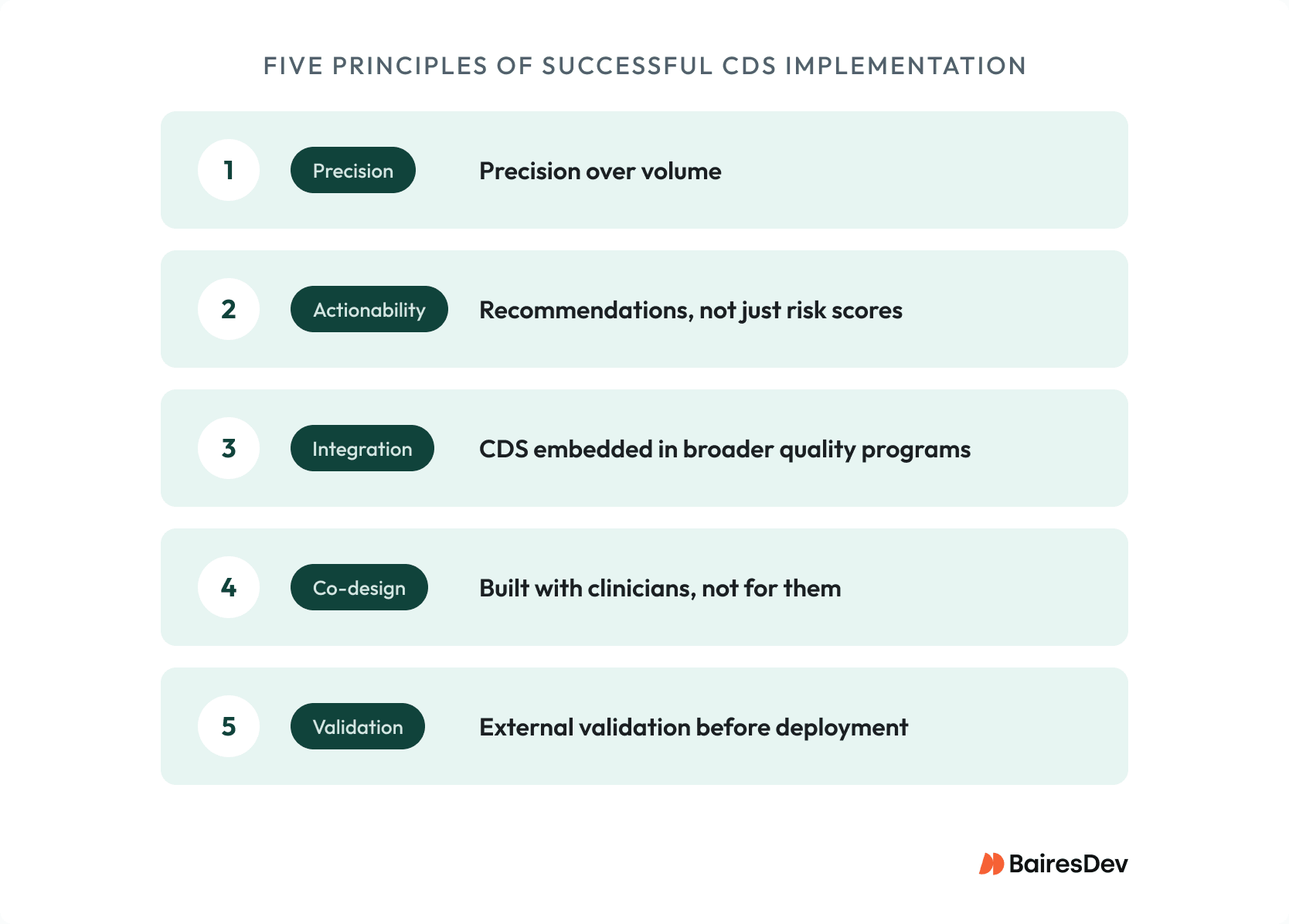
These five principles show up consistently across successful implementations:
- Precision over volume. High-specificity alerts that fire rarely but accurately outperform high-sensitivity systems that flag everything. Fewer, better alerts beat more alerts.
- Actionable recommendations, not just risk scores. A system that says “this patient’s sepsis risk is 72%” is less useful than one that says “consider blood cultures and lactate level now.” The Kawamoto meta-analysis established this finding in 2005 [31], and it has held for two decades.
- CDS embedded in broader quality programs. Standalone AI rarely changes outcomes on its own. The systems that work are part of larger improvement programs that include order sets, education, protocols, and culture change.
- Co-design with clinicians, not for them. Weekly feedback loops and human factors testing distinguish successful deployments from expensive failures.
- External validation before deployment. The Epic Sepsis Model disaster was a validation failure [8]. Models routinely lose 5 to 10 points of predictive accuracy when tested on data from institutions other than where they were developed.
How Do FDA and EU Regulations Affect CDS Software Development?
Two regulatory frameworks matter most.
In the United States, the Food and Drug Administration (FDA) issued revised guidance in January 2026 on when CDS software qualifies as a regulated medical device [32]. The test has four criteria: the software must not analyze medical images or signals directly, must display medical information, must support (rather than replace) clinician decision-making, and must allow the clinician to independently review the basis for recommendations. More than 1,250 AI-enabled medical devices have received FDA authorization as of mid-2025, with 76% of them in radiology [32].
The FDA’s December 2024 Predetermined Change Control Plan (PCCP) guidance is particularly relevant for AI developers. It allows manufacturers to pre-define certain types of model updates, retraining, performance improvements, bias corrections, and implement them without filing a new regulatory submission each time [33][34]. This addresses a fundamental tension: AI models need to evolve, but traditional device regulation assumes a static product.
In Europe, the rules are stricter. Under the European Medical Device Regulation (EU MDR), virtually all diagnostic and treatment CDS falls into Class IIa or higher, requiring a Notified Body, an independent assessment organization, to certify the product [27]. There is no European equivalent to the FDA’s CDS exemption. The EU AI Act, with high-risk requirements taking effect in August 2026, automatically classifies all Class IIa or higher AI-enabled medical devices as high-risk AI systems [27][35]. That triggers requirements for risk management, bias detection, representative training data, transparency, human oversight, and continuous post-market monitoring, on top of full EU MDR compliance.
For engineering teams, IEC 62304, the international standard for medical device software lifecycle processes, explicitly permits Agile development methodologies [36]. The key demands are traceability (linking user stories to requirements, tests, and risk controls), living documentation, and automated verification.
Companies targeting both U.S. and European markets should design for the stricter jurisdiction from day one.
Where Does This Leave Software Companies Serving Healthcare?
The CDS market is growing at double digits. The majority of deployed systems are effectively ignored by the people they were built for. That contradiction resolves once you accept that clinical AI is a systems engineering challenge, not a machine learning challenge.
The economics can work. The Agency for Healthcare Research and Quality (AHRQ) modeled CDS implementation costs at about $2.33 million over five years against cumulative savings of $4.76 million, with break-even around year three [22]. But that return depends entirely on whether clinicians actually use the system. Integrated CDS systems, those embedded directly within EHR workflows, hold 65% to 75% of the market for a reason [3]. Standalone systems consistently underperform.
The models are good enough. The engineering around them, workflow integration, explainability, validation, regulatory compliance, is what determines whether they save lives or generate noise.
References
[1] Poly TN et al. Machine learning approach to reduce alert fatigue using a disease medication-related clinical decision support system. JMIR Medical Informatics. 2020;8(11):e19489. https://medinform.jmir.org/2020/11/e19489/
[2] Chang YJ et al. Appropriateness of alerts and physicians’ responses with a medication-related clinical decision support system. JMIR Medical Informatics. 2022;10(10):e40511. https://medinform.jmir.org/2022/10/e40511
[3] MarketsandMarkets. Clinical decision support systems market size & growth forecast to 2030. https://www.marketsandmarkets.com/Market-Reports/clinical-decision-support-systems-market-18085342.html
[4] Zhou N et al. Concordance Study Between IBM Watson for Oncology and Clinical Practice for Patients with Cancer in China. The Oncologist. 2019.
https://pmc.ncbi.nlm.nih.gov/articles/PMC6656482/
[5] Watson supercomputer recommended unsafe treatments. ASH Clinical News. https://ashpublications.org/ashclinicalnews/news/4026/Watson-Supercomputer-Recommended-Unsafe-Treatments
[6] Francisco Partners scoops up bulk of IBM’s Watson Health unit. TechCrunch. 2022. https://techcrunch.com/2022/01/21/francisco-partners-scoops-up-remains-of-ibms-watson-health-unit/
[7] IBM to sell Watson Health assets to Francisco Partners. Healthcare IT News. https://www.healthcareitnews.com/news/ibm-sell-watson-health-assets-francisco-partners
[8] Wong A et al. External validation of a widely implemented proprietary sepsis prediction model in hospitalized patients. JAMA Internal Medicine. 2021;181(8):1065-1070. https://pmc.ncbi.nlm.nih.gov/articles/PMC8218233/
[9] Research suggests Epic Sepsis Model is lacking in predictive power. Healthcare IT News. https://www.healthcareitnews.com/news/research-suggests-epic-sepsis-model-lacking-predictive-power
[10] Epic Sepsis Model poorly predictive due to low sensitivity, inadequate calibration. Infectious Disease Advisor. https://www.infectiousdiseaseadvisor.com/news/epic-sepsis-model-is-poor-predictor-and-has-tendency-to-cause-alert-fatigue/
[11] Epic’s widely used sepsis prediction model falls short among Michigan Medicine patients. Fierce Healthcare. https://www.fiercehealthcare.com/tech/epic-s-widely-used-sepsis-prediction-model-falls-short-among-michigan-medicine-patients
[12] Obermeyer Z et al. Dissecting racial bias in an algorithm used to manage the health of populations. Science. 2019;366(6464):447-453. Referenced via Healthcare Finance News: https://www.healthcarefinancenews.com/news/study-finds-racial-bias-optum-algorithm
[13] Racial bias found in widely used health care algorithm. NBC News. https://www.nbcnews.com/news/nbcblk/racial-bias-found-widely-used-health-care-algorithm-n1076436
[14] Baysari MT et al. Facilitators and barriers to interacting with clinical decision support in the ICU: a mixed-methods approach. BMC Medical Informatics and Decision Making. 2023. https://pmc.ncbi.nlm.nih.gov/articles/PMC10461946/
[15] Olakotan OO, Yusof MM. The appropriateness of clinical decision support systems alerts in supporting clinical workflows: a systematic review. Health Informatics Journal. 2021;27(2). https://journals.sagepub.com/doi/10.1177/14604582211007536
[16] Benmessaoud L et al. Barriers and facilitators influencing medication-related CDSS acceptance according to clinicians: a systematic review. International Journal of Medical Informatics. 2021;156:104596. https://www.sciencedirect.com/science/article/pii/S1386505621001325
[17] Artificial intelligence in clinical decision support and the prediction of adverse events. Frontiers in Digital Health. 2025. https://www.frontiersin.org/journals/digital-health/articles/10.3389/fdgth.2025.1403047/full
[18] AI & cyber threats pose growing risks to patient safety, ECRI report warns. Health System CIO. 2025. https://healthsystemcio.com/2025/03/13/ai-cyber-threats-pose-growing-risks-to-patient-safety-ecri-report-warns/
[19] Artificial intelligence tops 2025 health technology hazards list. ECRI. https://home.ecri.org/blogs/ecri-news/artificial-intelligence-tops-2025-health-technology-hazards-list
[20] Credence Research. AI-powered clinical decision support market size, share and forecast 2032. https://www.credenceresearch.com/report/ai-powered-clinical-decision-support-market
[21] Healthcare IT spending 2024: key insights and trends. KLAS Research. https://engage.klasresearch.com/blog/healthcare-it-spending-2024-key-insights-and-trends/4508/
[22] Measuring the benefits of clinical decision support: return on investment. AHRQ Digital Healthcare Research. https://digital.ahrq.gov/health-it-tools-and-resources/health-it-costs-and-benefits-database/measuring-benefits-clinical
[23] CDS Hooks specification. HL7. https://cds-hooks.hl7.org/1.0/
[24] CDS Hooks overview. Trisotech. https://www.trisotech.com/cds-hooks/
[25] Architectural patterns for health information systems: a systematic review. Frontiers in Digital Health. 2025. https://www.frontiersin.org/journals/digital-health/articles/10.3389/fdgth.2025.1694839/full
[26] Clinician-informed XAI evaluation checklist with metrics (CLIX-M) for AI-powered clinical decision support systems. npj Digital Medicine. 2025. https://www.nature.com/articles/s41746-025-01764-2
[27] The EU AI Act and medical devices: navigating high-risk compliance. Reed Smith. https://www.reedsmith.com/our-insights/blogs/viewpoints/102kq35/the-eu-ai-act-and-medical-devices-navigating-high-risk-compliance/
[28] Alert to action: implementing AI-driven clinical decision support tools for sepsis. Ochsner Journal. 2023;23(3):222. https://www.ochsnerjournal.org/content/23/3/222
[29] Continuous multimodal data supply chain and expandable clinical decision support for oncology. npj Digital Medicine. 2025. https://www.nature.com/articles/s41746-025-01508-2
[30] Can we rely on artificial intelligence to guide antimicrobial therapy? A systematic literature review. PMC. 2025. https://pmc.ncbi.nlm.nih.gov/articles/PMC11986881/
[31] Kawamoto K et al. Improving clinical practice using clinical decision support systems: a systematic review of trials to identify features critical to success. BMJ. 2005;330(7494):765.
[32] 5 key takeaways from FDA’s revised clinical decision support (CDS) software guidance. Covington & Burling LLP. 2026. https://www.cov.com/en/news-and-insights/insights/2026/01/5-key-takeaways-from-fdas-revised-clinical-decision-support-cds-software-guidance
[33] FDA issues final guidance on predetermined change control plans for AI-enabled devices. McDermott+. https://www.mcdermottplus.com/insights/fda-issues-final-guidance-on-predetermined-change-control-plans-for-ai-enabled-devices/
[34] FDA finalizes guidance on predetermined change control plans for AI-enabled medical device software. Ropes & Gray LLP. 2024. https://www.ropesgray.com/en/insights/alerts/2024/12/fda-finalizes-guidance-on-predetermined-change-control-plans-for-ai-enabled-device
[35] Medical Devices Joint Artificial Intelligence Board. European Commission. 2025. https://health.ec.europa.eu/document/download/b78a17d7-e3cd-4943-851d-e02a2f22bbb4_en
[36] IEC 62304: medical device software lifecycle & compliance. CitrusBits. https://citrusbits.com/what-is-iec-62304/