



Executive summary
This article presents a five-dimension AI operating model drawn from real-world enterprise deployments. Across all five dimensions (workforce augmentation, AI-assisted development, agentic computer use, autonomous workflows, and AI-assisted analytics), the author argues that the technical challenge is typically solved before the organizational one. The piece maps where friction actually concentrates and what it takes for organizations to absorb, govern, and trust AI at scale.
During a meeting with SMB CXOs on GenAI adoption, I realized we were all searching for the right industry “stalwarts” to follow. But with billions pouring into the technology and leaders diverging daily, that was a dangerous bet. We needed a reliable framework to ground a long-term strategy for planning and execution. That need for structure is the defining challenge for enterprise leadership.
Most organizations have launched AI pilots. Fewer have achieved the kind of integration that changes how work actually gets done. As companies move from experimentation to AI software development at scale, the operating model becomes as important as the tools themselves. The friction is rarely where the strategy documents say it will be. Across the industry, five dimensions have emerged as the architecture of a genuine AI operating model. The lesson that each one carries is that the technical challenge is usually solved before the organizational one.
Traditional competitive advantages are eroding faster than most leadership teams have internalized, and GenAI adoption is accelerating that erosion. But urgency without a clear operating model produces acceleration in the wrong direction.
In this article, I will walk through a framework for diagnosing where AI adoption stalls and what it takes to move it forward. It involves five interdependent dimensions that map the full surface area an organization has to develop in order to move from isolated pilots to an operating model where AI is embedded in how the business runs.
What The Industry Has Learned
The technology, in most cases, works. What catches organizations off guard is a mixed bag of challenges. Among them, cultural resistance that has nothing to do with capability, governance built for a slower pace, and the discovery that automating a workflow is faster than reorganizing the team that used to run it. These lessons cluster around five dimensions that, taken together, form the operating model organizations are building toward.
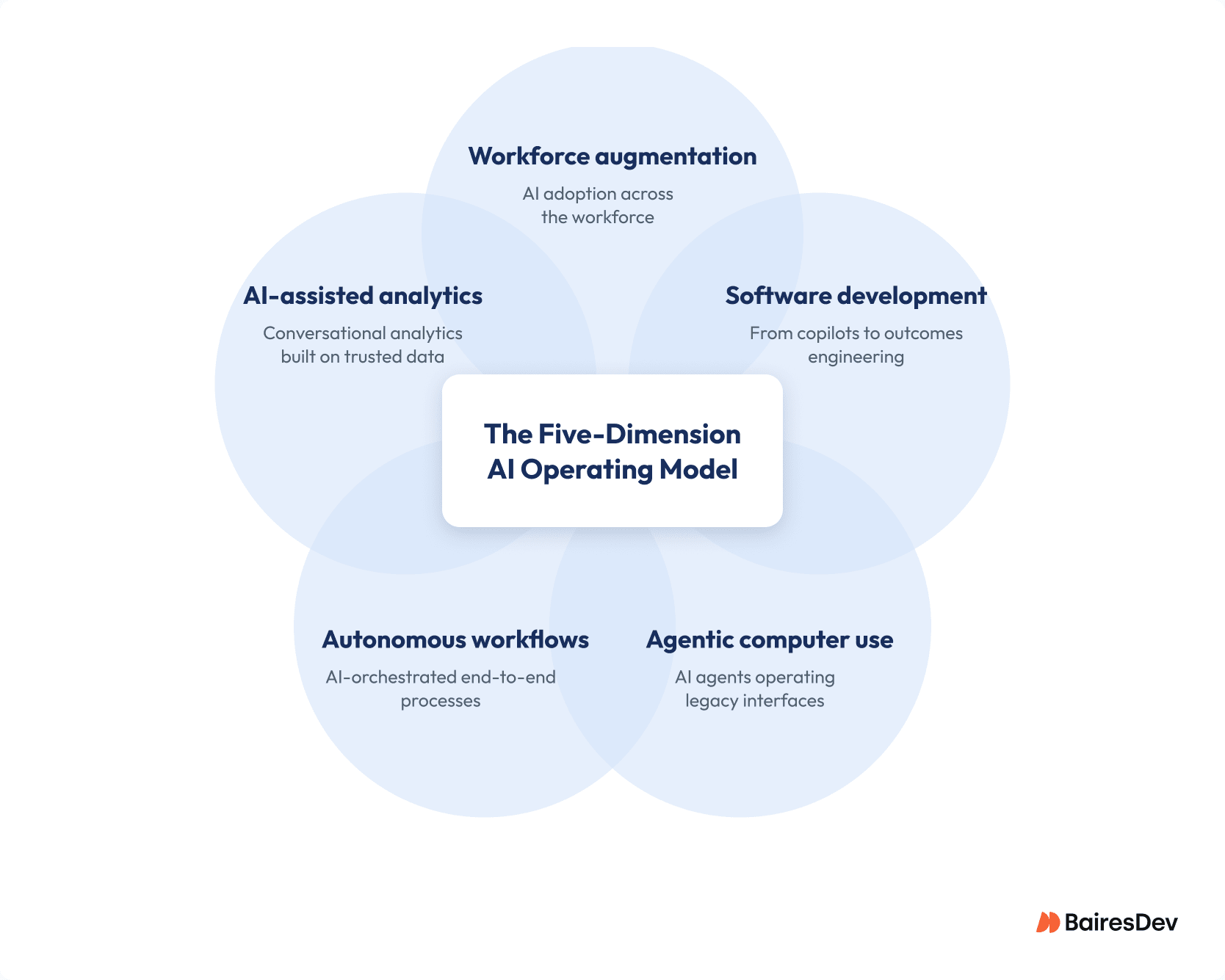
These dimensions are interdependent. A company may have strong AI-assisted development practices, for example, but still stall if governance, data quality, or workforce adoption cannot keep pace.
Dimension 1: Workforce Augmentation
The prevailing assumption when organizations approach workforce augmentation is that the challenge is technological. Deploy the tools, run the training, and the productivity gains follow. The tools, in most cases, are genuinely good. That is where the difficulty stops being technical.
What organizations consistently underestimate is how personal the transition feels. Employees do not resist AI because they cannot use it. They resist because they are uncertain what using it well means for their standing. High performers are often the most hesitant. They have built professional reputations on capabilities that AI now replicates in seconds, and augmentation can feel less like a promotion than an exposure. The variance in adoption across equally talented teams tends to trace back not to technical aptitude but to whether people feel genuinely licensed to experiment and permitted to fail without consequence.
The rollout is only a portion of the work. The rest is about investing as much in the cultural narrative around it. Frame AI as infrastructure that raises the floor on what every employee can achieve. The goal is a workforce of augmented professionals who treat AI as a partner in their decision-making rather than a threat to their value. That framing has to be built deliberately. It does not arrive with the tools.
Dimension 2: AI-Assisted Software Development
Engineering teams tend to be early and willing adopters of AI-assisted development. The concern going in is usually about capability. Will the tools be good enough? In practice, that question resolves quickly. The harder question is whether quality and security practices can keep pace with how fast AI generates code.
The AI-assisted SDLC is evolving in stages. It started with copilots. Now practitioners are calling the next phase “vibe coding,” where developers shape structure through intent and natural language. Next is outcomes engineering, where engineers set business logic and success criteria while AI handles execution. At every stage, review practices frequently lag behind. AI-generated code moves faster than traditional code review was designed to handle. The subtle issues it introduces are often not the kind that conventional processes catch. Security is a persistent concern. Automated vulnerability detection exists but is rarely embedded in the workflow from the start.
There is also an identity dimension that tends to go unaddressed. Moving experienced engineers from writing code to directing AI raises their strategic influence, but it can feel like a reduction in craft. Engineering excellence needs to be redefined explicitly in this context, where fewer lines of code produced is not the metric. Better judgment about what the AI should and should not control is.
Dimension 3: Agentic Computer Use
For organizations carrying decades of legacy infrastructure, like applications with no modern APIs, workflows held together by people manually transferring data between systems, or navigating interfaces built in another era, the prospect of AI agents that interact with UIs the way humans do is genuinely compelling. It offers a path to automation that does not require ripping out and replacing existing systems.
The technology works. What requires more preparation than most organizations plan for is the orchestration layer around it. Define which workflows get automated first, how to build exception-handling for states the agent has not encountered or how to maintain meaningful human oversight in processes outpacing traditional review cycles. A pattern that surfaces repeatedly is the discovery that legacy workflows encode institutional knowledge that no documentation captures. Automating them without first understanding why they operate the way they do introduces failure modes that are harder to diagnose precisely because they look like edge cases rather than systemic gaps.
The standard RPA approach failed on most of these workflows because the processes were more complex than they appeared. AI agents operating with broader contextual awareness change what is automatable. But the prerequisite is still the same, with time spent with the people who currently run those workflows, extracting the knowledge that exists only in practice.
Once that foundation is in place, the question shifts from whether individual workflows can be automated to whether entire processes can be orchestrated end to end.
Dimension 4: Autonomous Agentic Workflows
AI-orchestrated systems, where agents think, plan, and carry out multi-step business processes autonomously, represent the clearest path to the scale gains that make AI transformation economically compelling. And organizations consistently find that the agents reach capability before the organization is ready to absorb them.
The bottleneck is staffing and structure. Internal teams are not typically organized to absorb the pace at which automation becomes available. When an agentic system begins managing processes that humans previously owned, those humans land in an ambiguous position. The work is moving too fast for traditional oversight, but the organization has not yet defined what their role becomes. Autonomous workflows can be built in weeks. Restructuring the teams that previously ran those workflows, upskilling them, redeploying them into meaningful functions, takes months. That gap produces anxiety, resistance, and in some cases deliberate friction as people protect workflows they are uncertain about losing.
The AI Center of Excellence is where this gets addressed. Its most important function is not building agentic systems. It is helping the organization absorb capability at a pace that does not outrun its people. A useful diagnostic is what might be called an execution absorption rate. It answers the question, how quickly are newly automated workflows genuinely integrated into team operations, rather than merely deployed? Autonomous systems running alongside humans who are shadow-checking every output represent deployment. That is not transformation.
Dimension 5: AI-Assisted Modeling and Analytics
Organizations that have invested seriously in data infrastructure tend to approach AI-assisted analytics with confidence. The assumption is that NLQ interfaces, conversational intelligence, and automated data preparation are relatively straightforward gains on top of a solid foundation. The foundation is rarely as solid as it appears.
AI models surface data quality problems that static dashboards quietly obscure. A dashboard built on noisy data still produces a chart. An AI model built on the same data produces confident-sounding conclusions that may be wrong in ways that are difficult to detect. The process of automating data preparation that includes cleaning, labeling, and organizing unstructured data, consistently surfaces issues that organizations did not know they had. That is a reason to treat data readiness as a prerequisite rather than a parallel workstream.
The demand side is equally underestimated. Business leaders who have spent years learning to be skeptical of dashboards do not immediately extend that trust to conversational AI. Adoption of NLQ interfaces requires a track record. Leaders need to confirm the AI is right in verifiable, lower-stakes situations before they will rely on it for consequential decisions. The path to genuine conversational intelligence, where business leaders can access complex insights directly, without waiting for a data scientist to respond, runs through that trust-building sequence. There is no shortcut around it.
Trust, in fact, is the thread that runs through all five dimensions. Building it is a cultural problem before it is a technical one.
Cultural Transformation and Governance: What Keeps Enterprise AI Moving
Technology is the tractable problem. Culture is where AI transformations stall. And the most common cultural failure mode is the perfectionist mindset that treats failure as disqualifying rather than informative. Punishing unsuccessful experiments does not stop experimentation, it drives it underground or eliminates it entirely, leaving teams defaulting to safe, low-value work.
What AI requires is genuine psychological safety reflected in explicit space for experimentation, visible tolerance for early failures, and leadership behavior that models a willingness to try things that might not work. Saying the right things in town halls does not count. People watch what gets rewarded and what gets punished, and they calibrate accordingly.
This is a governance question as much as a culture one. Slow, checklist-driven compliance is structurally incompatible with the pace AI demands. The governance model that works is flexible, automated, and focused on outcomes rather than process checkpoints. Clear standards for data privacy, bias reduction, and cost management, combined with the authority to act within those standards without requiring approval at every step. If a governance model is slowing down adoption, it is the problem that needs to be solved.
Getting the governance right clears the path. What follows is the execution layer that addresses how to structure the work, measure progress, and keep the operating model honest.
How to Measure Whether Enterprise AI Is Actually Scaling
Execution is where frameworks become honest about their assumptions. The Five-Dimension AI Operating Model requires a structural home, an empowered AI Center of Excellence that functions not as a research lab but as an organizational force multiplier. The CoE’s role is to share best practices across departments, provide shared infrastructure, and hold the organizational design questions that autonomous systems continuously generate.
Progress needs to be tracked through a set of nested OKRs that span the full operating model:
| Level | Metrics | What They Tell You |
|---|---|---|
|
Business |
ROI, time to market |
Lagging indicators. They confirm the transformation is working but do not show where it is stuck |
|
Operational |
Toil reduction (hours of manual work eliminated) |
Leading indicator of autonomous workflow maturity. |
| Talent | AI fluency scores, execution absorption rate |
The most important and the last consistently tracker Organizations that deploy AI capability faster than their people can absorb it will find every other metric eventually hits a ceiling. |
Pay attention to the talent row. AI fluency and execution absorption rate are the first numbers to move when something is off. If the gap between what has been deployed and what teams have actually absorbed keeps growing, every other metric in the table will eventually reflect it. That is the difference between transformation and activity.
From AI Pilots to AI Operations
The five dimensions are a map of the terrain organizations actually encounter when they move from AI pilots to AI operations. The technical problems in each one are largely solved. What remains is the harder, slower work of reshaping teams, governance, culture, and incentives to match the pace of what the technology now makes possible.
Key Takeaways
- AI tools generally work. The friction that stalls enterprise adoption is organizational, not technical.
- Workforce augmentation fails when employees feel exposed rather than empowered, and that perception is shaped by culture, not training.
- AI-generated code moves faster than traditional review processes were designed to handle, making security and quality infrastructure the real bottleneck in AI-assisted development.
- Legacy workflows encode institutional knowledge that no documentation captures. Automating them without extracting that knowledge first creates failure modes that look like edge cases.
- Organizations consistently deploy AI capability faster than their teams can absorb it. Tracking that gap is the most important and least common measurement practice.