

Hiring a senior developer in the US costs $170k-$250k fully loaded: salary, benefits, and overhead. Although tech job postings are down from their 2022 highs, most of this decline is attributed to low demand for entry-level talent. However, demand for senior engineers remains robust, and compensation reflects this. If you need seniors, you are looking at a 3-6 month hiring cycle, if you can find the right person at all.
A decade ago, outsourcing meant accessing inexpensive junior talent, but the market has moved on. The tech sector in Eastern Europe and Latin America has matured, allowing US-based companies easy access to an ever-growing pool of experienced engineering talent.
The Economics of Outsourcing by Delivery Model
When evaluating software outsourcing costs, the comparison that matters is total annual cost, not just hourly rates. In-house hiring comes with salary, benefits, payroll taxes, equipment, recruiting, and management overhead. According to the U.S. Bureau of Labor Statistics, the median salary for software developers in the United States in 2024 was $131,500. That figure reflects the broader market and should not be treated as a proxy for senior engineering talent specifically.
Nearshore software development often reduces direct cost by roughly 30% to 50% compared with equivalent US-based talent, while preserving substantial timezone overlap. That usually makes collaboration easier and helps teams move faster on sprint-based work.
Offshore teams may reduce direct costs by roughly 50% to 70%. The tradeoff? Limited timezone overlap can increase coordination overhead and slow feedback loops. This makes offshore a better fit for work that is more clearly scoped or tolerant of async execution.
| Model | Relative direct cost vs. US in-house | Timezone overlap | Best fit |
| In-house | Baseline | Full | Core product ownership, long-term institutional knowledge |
| Nearshore | 30%–50% lower | High | Sprint-based product work, collaborative development |
| Offshore | 50%–70% lower | Low | Async-tolerant work, maintenance, clearly scoped modules |
Note: Actual costs vary by role, seniority, provider, and engagement structure.
Coordination overhead is where offshore starts to break down.
With a nearshore team, a blocked PR at noon gets reviewed by 5pm. With offshore, it waits until tomorrow. Multiply that across every code review, every clarification, every context handoff, and you’re looking at a lot of managerial drag on your internal team.
That’s the hidden cost of async. Your senior engineers waste time unblocking and re-explaining context instead of focusing on high-value work.
Building the Business Case for Outsourcing
If you’re presenting this to a CFO or board, cost-per-engineer comparisons won’t be enough. Finance wants to see total cost of ownership, risk-adjusted: What’s the fully loaded cost of a failed hire or a bad vendor? What does a three-month delay cost in lost revenue or market timing?
Frame outsourcing as risk transfer, not just cost reduction. The vendor absorbs recruiting, retention, and backfill risk. You convert fixed headcount into variable capacity, while you focus your best (and most expensive) engineers on more important tasks. That’s an argument that gets budgets approved.
Software Development Outsourcing Models: Onshore, Nearshore, and Offshore
In a perfect world with endless budgets, no work would be outsourced at all. However, not even FAANG companies do everything in-house. Some projects are outsourced to gain quick access to niche specialists, not for arbitrage.
| Model | What it Means | Timezone Overlap | Best for | Cost |
| Onshore | Outsourcing within the same country | Full
(+/- 1hr) |
Regulated industries, government work, projects with on-site requirements | High
(Baseline) |
| Nearshore | Outsourcing in the same or similar timezone | High (6-10hrs) | Sprint-based product work, collaborative development, projects requiring rapid iteration | Medium
(30-50% lower) |
| Offshore | Outsourcing overseas | Low
(0-4hrs) |
Ongoing maintenance, well-scoped independent modules, async-tolerant work | Low
(50-70% lower) |
Onshore is the baseline model: Experienced long-term partners with exceptional institutional knowledge, sometimes just a short drive away. But budgets are limited, especially in the current high-interest rate environment.
This is why nearshore partnerships are gaining popularity. For teams based in the US and Canada, Latin America offers significant timezone overlap coupled with more affordable rates. The quality of LATAM talent is good, and cultural alignment is typically better than when you offshore.
The industry is taking note, too. According to Statista and Grand View Research, the LATAM nearshore market is poised to grow at a 9-10% CAGR through 2030, outpacing the global outsourcing market, which is projected to grow at 6.51% from 2025 to 2030.
Nearshore vs. Offshore: What Are the Key Differences?
The most obvious difference between nearshore and offshore is timezone overlap. Nearshoring keeps your outsourced engineers inside your working hours, while offshoring does not (bar some exceptions).
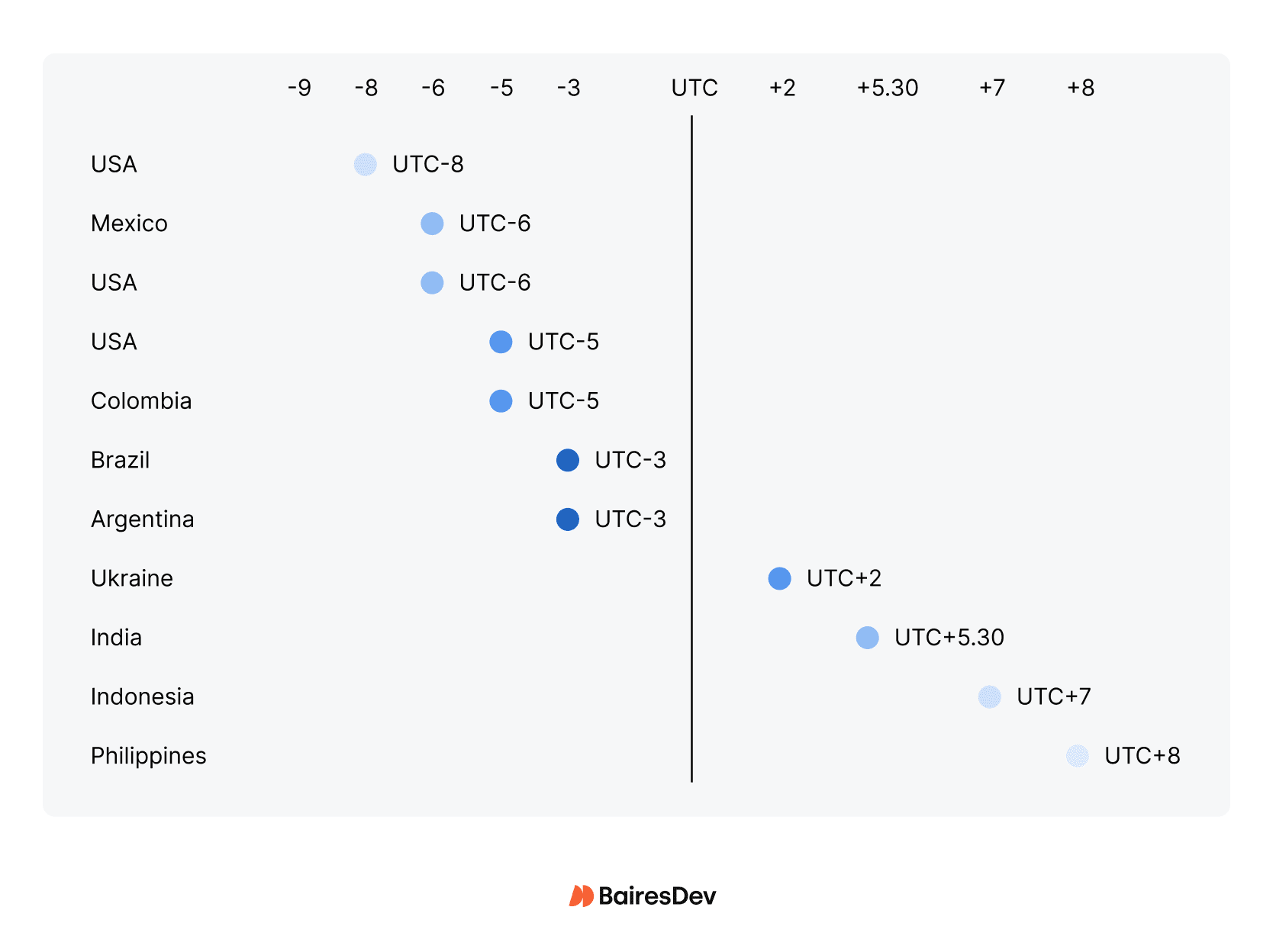
That difference shows up everywhere. If your team identifies an issue, a nearshore engineer can get started immediately, while their offshore counterpart typically cannot. Additionally, if the handoff isn’t smooth and involves back-and-forths, you could lose another day to a handoff that would have taken minutes without async communication.
| Factor | Nearshore | Offshore |
| Timezone gap | 0 to 3 hours (US and LATAM) | 8 to 14 hours (US and Asia) |
| Collaboration style | Supports daily standups, same-day reviews, and live problem-solving | Relies more on async handoffs, delayed feedback, and stronger documentation |
| Working style alignment | Typically closer to US work rhythms, communication expectations, and meeting cadence | More dependent on vendor practices, documentation quality, and comfort with async collaboration |
| Talent access | Strong talent pools across LATAM | Broad talent availability, but varies more by country and provider |
| Cost vs. US in-house | 30% to 50% lower | 50% to 70% lower |
| Best for | Sprint-based product work and teams that need daily collaboration | Projects with async-tolerant workflows |
The table shows the obvious tradeoffs. The hidden cost tends to show up in heavier documentation, more context transfer, and slower clarification loops.
However, as a rule of thumb:
- Choose nearshore when the work requires frequent iteration, deep context, and same-day problem solving. Most collaborative product engineering falls into this category.
- Choose offshore when the work can be handed off with clear specifications and can tolerate delayed clarification. Good fits include maintenance backlogs, standalone modules, and QA on stable features.
Why US Companies Choose Latin America
Two decades ago, LATAM was the place US companies went for cheap junior developers straight out of university. Today, those engineers are enterprise-grade seniors. Many have worked with US or global brands, while others have created successful startups.
Brazil and Mexico currently produce more STEM graduates than Germany or Japan, creating a vast talent pool.
Cultural Alignment in Practice
Technical skills will only get you so far. Most LATAM engineers are used to working with US companies and share the same business culture. They know what “end of day” means, and they don’t overpromise or agree to unrealistic timelines.
English Proficiency
English is by far the most popular second language in LATAM, the lingua franca of business, not just software development. Argentina and Colombia traditionally have the strongest English fluency in the region, with Mexico close behind. Brazil has historically lagged, but is improving fast. If fluency is critical, ask for it during vetting. It’s a non-issue for most experienced professionals.
Timezone Overlap
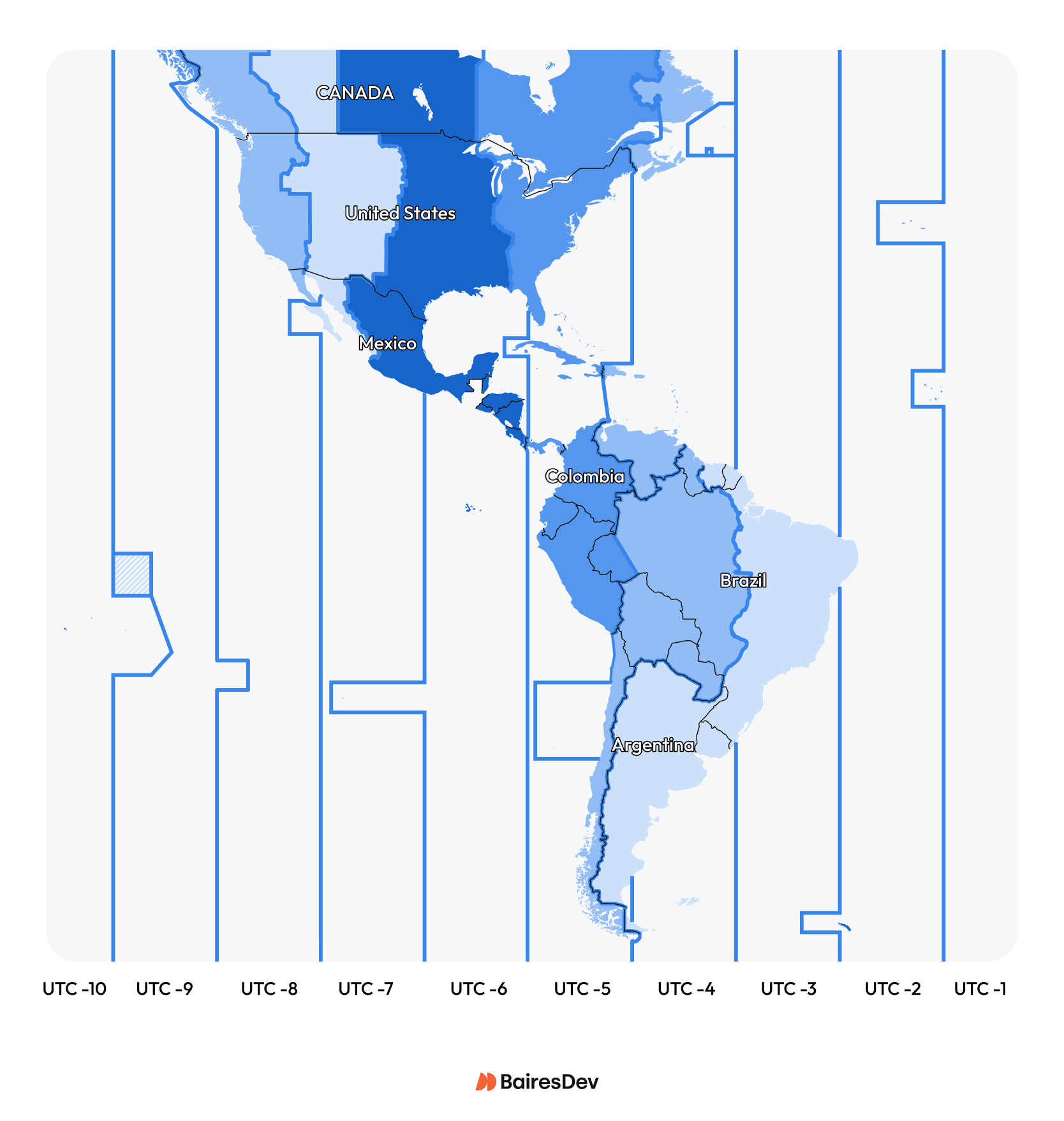
For Agile, sprint-based teams, timezone overlap isn’t a nice-to-have. It determines whether your outsourced engineers are part of your team or a separate workstream you manage through handoffs. The latter results in more managerial overhead.
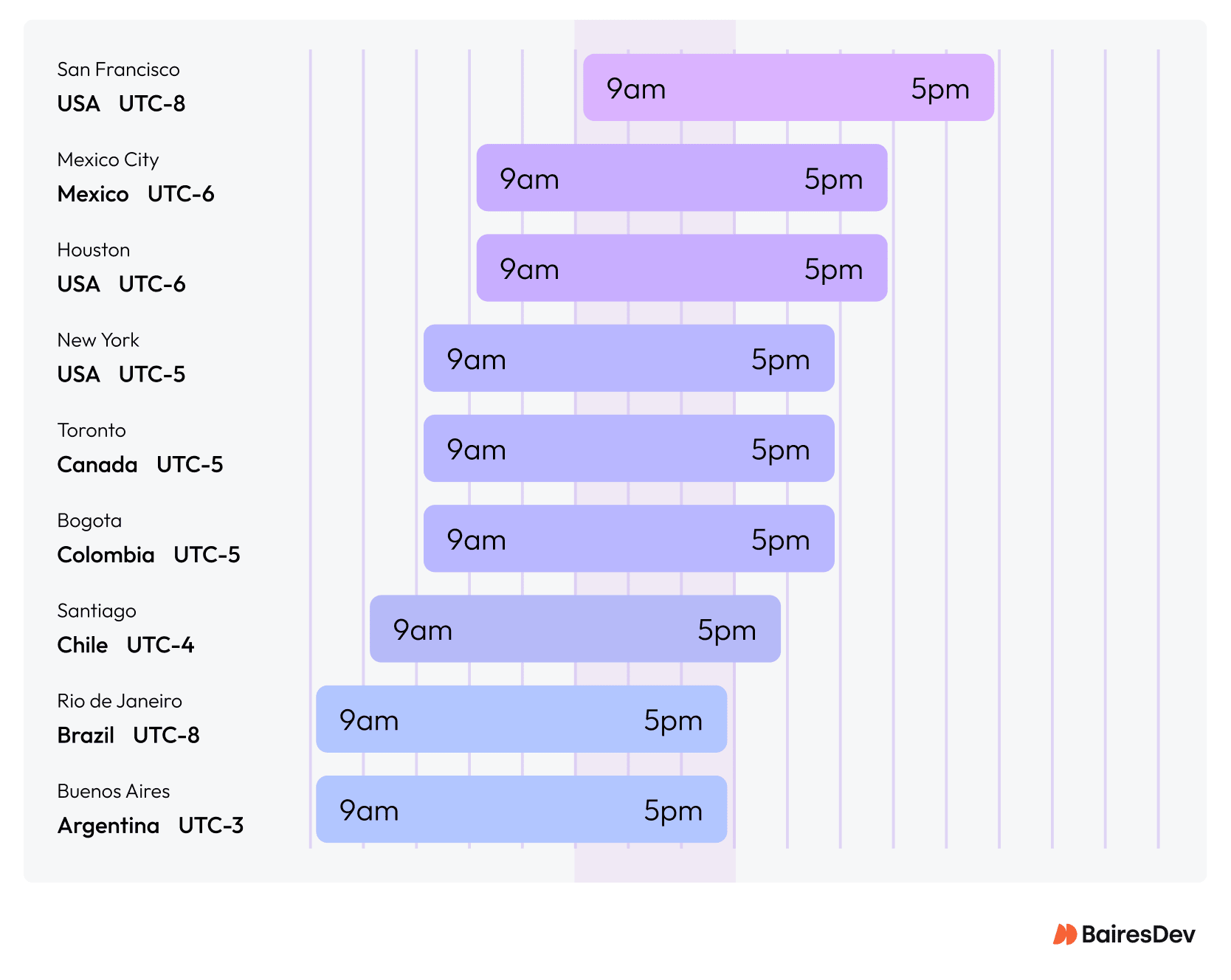
Competitive Rates, Minimal Overhead
We covered the numbers and discussed cost efficiency earlier. The short version: LATAM offers 30-50% savings compared to in-house hiring. You keep most of that because coordination overhead is very low, i.e., there’s no async communication or added project management effort. You’re not paying an offshore discount rate and then losing 20% of it to friction.
Outsourcing vs. In-House Development
The comparison above covers geography and value, but outsourcing also differs from in-house development in ways that have nothing to do with location or cost, such as knowledge retention and control.
Management overhead: In-house engineers absorb company context over time. They know the codebase, the stakeholders, the unwritten rules and nuances that wikis and AI can’t capture. That context reduces management load. Outsourced engineers need that context transferred explicitly, resulting in more documentation, onboarding, and communication in the first few months. If your engineering leadership is already stretched thin, the ramp-up investment could be a problem.
Knowledge retention: When an in-house engineer leaves, institutional knowledge walks out with them. When an outsourced engagement ends, you keep the code but lose the context. Neither model solves this problem. The difference is whether you’re building long-term institutional depth or solving a temporary capacity problem.
Control and autonomy: In-house teams operate within your culture by default. Outsourced teams need explicit expectations: How much autonomy do they have? Who approves architectural decisions? What’s the escalation path? This has to be defined upfront.
Get your senior engineers back: When your best people are grinding through maintenance backlogs and mundane software development tasks, they’re not doing the work you hired them for. Outsourcing frees your internal team to focus on architecture, product direction, and the problems only they can solve. This means you use your best people for the most important work and keep the knowledge in-house.
When Each Model Fits
| Scenario | Better fit |
| Core product development, long-term | In-house |
| Specialized skills unavailable locally | Outsourcing |
| Time-sensitive capacity gaps | Outsourcing |
| Building institutional knowledge | In-house |
| Defined project scope, clear deliverables | Outsourcing |
| R&D, ambiguous requirements | In-house |
Most Companies Use Both
Few companies run purely in-house or purely outsourced (don’t conflate outsourced with remote/distributed). Most try to reap the benefits of software outsourcing services while nurturing strong in-house teams. The practical question is which approach belongs where.
Core architecture, product direction, and institutional knowledge stay in-house. Execution on defined roadmaps, specialist skills, and overflow capacity go external. The line depends on your team’s bandwidth and what you can’t afford to get wrong.
The Challenges of Outsourcing and How to Mitigate Them
If you’ve outsourced before, you’re aware that things don’t always work out. In fact, many of our clients approached us after experiencing outsourcing failures, and it would be tempting to blame everything on bad vendor choices. However, clients also need to do their best to help vendors succeed.
Let’s examine some common challenges.
| Challenge | How to address it |
| Communication delays |
|
| Knowledge transfer gaps |
|
| Cultural misalignment |
|
| IP and security risk |
|
| Quality inconsistency |
|
| Vendor over-dependence |
|
How to Structure an Outsourcing Engagement
Teams often focus on vendor selection and overlook other failure points. Yes, vendor selection is crucial, but it’s just one step. Internal prep is just as important, and without it, you risk setting up the vendor to fail.
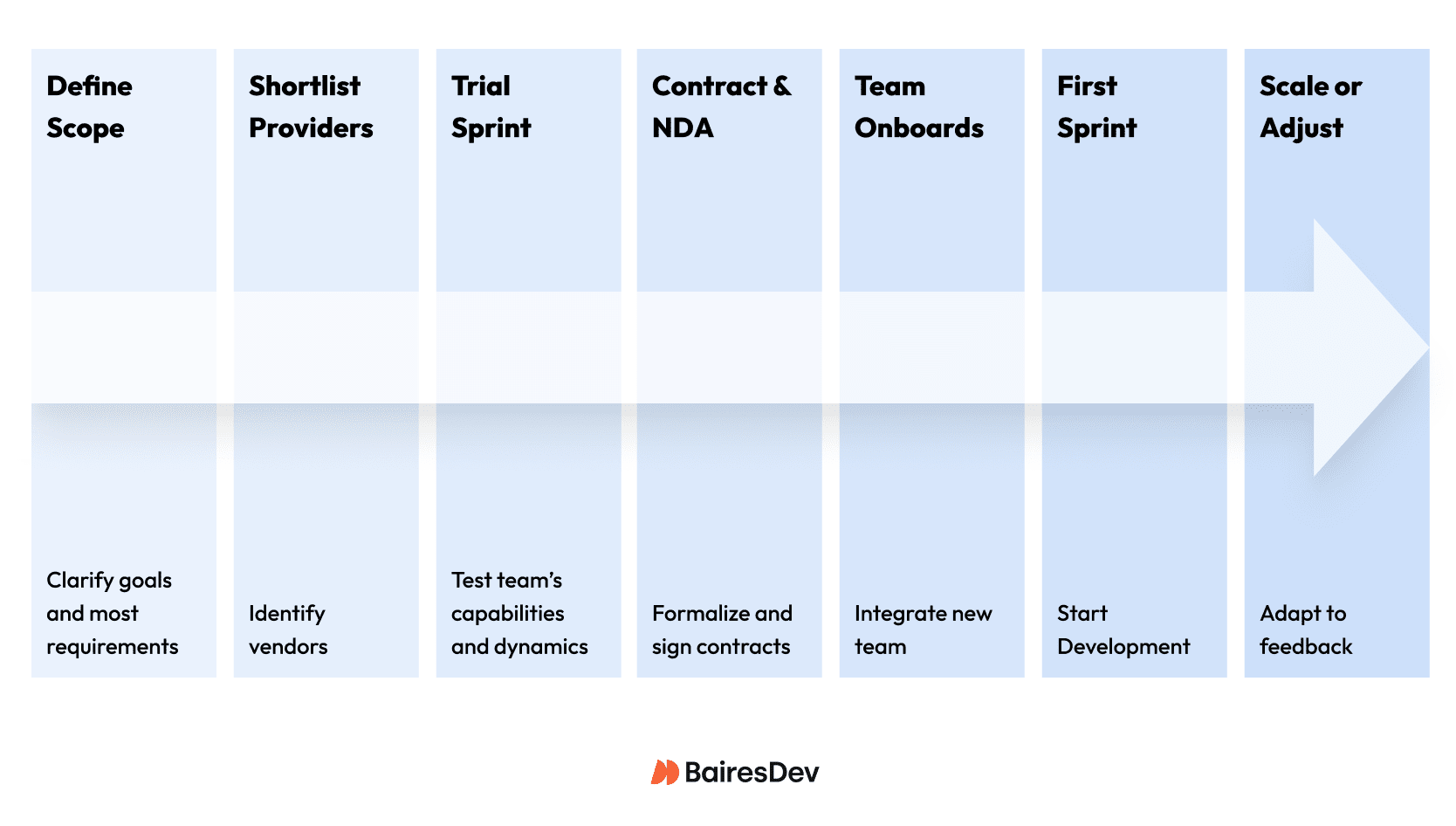
- Align internally before you go to market: Define the engagement model based on your business needs (staff augmentation, dedicated development team, or end-to-end delivery), required seniority, tech stack, and timeline. But also: Who owns vendor selection? What’s the budget approval path? If your CFO or procurement team will review contracts, involve them immediately. Outsourcing decisions that stall at legal review waste everyone’s time.
- Shortlist providers: Evaluate based on retention, swap policy, and whether you can interview actual engineers before signing. (More on evaluation criteria in the next section.)
- Request proposals and meet the engineers: Insist on technical interviews with the outsourced development team, or at the very least, team leads.
- Run a paid trial sprint: Two weeks of real work beats two months of evaluation calls.
- Sign and execute contracts: NDAs, IP assignment, performance guarantees, termination terms. (We covered the specifics in Challenges above.)
- Onboard the team: Provide tool access, architecture documentation, and introductions to the people they’ll work with daily. Treat ramp time as an investment and don’t cut corners.
- Validate in the first sprint: Velocity matters, but watch the leading indicators throughout the software development process. For example, are blockers surfaced and resolved the same day? Are PRs reviewed in hours or days? Is code passing review without extensive rework?
- Establish review cadence: Organize weekly syncs for tactical work. Monthly or quarterly business reviews to assess whether the engagement is delivering value. If you focus only on measuring tickets closed, you could miss the dysfunction until it becomes too expensive.
How to Choose a Software Outsourcing Company
As for vendor selection, there are a few key areas you need to consider, along with red flags that signal something is off. Most vendors look similar on paper, so it’s up to you to dig deeper and check what’s real and what’s marketing.
| Criterion | What to evaluate | Red flags |
| Technical depth | Stack expertise, architecture samples, code review process | Generalists with no domain focus |
| Team seniority | Senior-to-mid ratio, tech lead availability | Junior-heavy teams, few architects |
| Portfolio | Live references from successful projects, demonstrable experience in your industry | No referenceable clients, outdated case studies |
| Continuity | Turnover rate, transition handling, team stability | Constant churn, evasive answers |
| IP and compliance | NDA, IP assignment, SOC 2, ISO 27001 | Ambiguous ownership terms, no security documentation |
| Engagement flexibility | Multiple models, scope adaptability | Single rigid model, contract-first responses to change requests |
Important patterns may show up during the sales process itself, so be on the lookout for them:
- Estimates without discovery: If the sales team quotes a budget and timeline before understanding the software project, the delivery team inherits a commitment they can’t keep. Realistic providers ask questions before they quote.
- No qualifying questions: A provider that takes every lead is chasing revenue too hard. If they didn’t ask about your constraints (e.g., budget or timeline), they’re clearly not setting the engagement up to succeed.
- Sales can’t explain the work. If the sales team can’t walk through how they’d approach the project or what roles would be needed, they don’t understand what they’re selling (and they’re obviously not coordinating with their engineers). That disconnect surfaces during delivery.
Choosing a software development partner is a cost-and-risk decision. When you factor in rework, delays, and re-architecture, choosing the wrong partner can undo months of progress. A single bad hire burns a six-figure hole in your budget. A bad vendor is a seven-figure hit.
Next Steps
BairesDev has been delivering nearshore software development services since 2009. If you’re exploring outsourcing, we can help you figure out the right model.