


Does GraphQL improve delivery predictability and scalability in your specific context? Gartner had predicted that enterprise adoption of GraphQL would accelerate sharply through 2025, and that forecast largely shaped how platform teams evaluated API strategy. That signals real, enterprise‑level momentum, but usage alone doesn’t make GraphQL the right architectural choice.
Key Points
- GraphQL shifts responsibility from endpoints to the execution layer.
- Operational maturity determines whether GraphQL helps or hurts.
- GraphQL simplifies aggregation across services.
- GraphQL is a fit when clients need flexibility and teams can support the operational model.
GraphQL changes the contract between frontend and backend teams. It gives clients precise control over how they request data, but it also shifts responsibility into the execution layer. For organizations under pressure to ship faster, without increasing operational risk, that tradeoff deserves careful scrutiny.
Understanding GraphQL
At its core, GraphQL is an open source query language for APIs combined with a server-side runtime that executes those queries. It’s not tied to any particular database or storage engine. Instead, it sits as a GraphQL service layer over upstream services and databases.
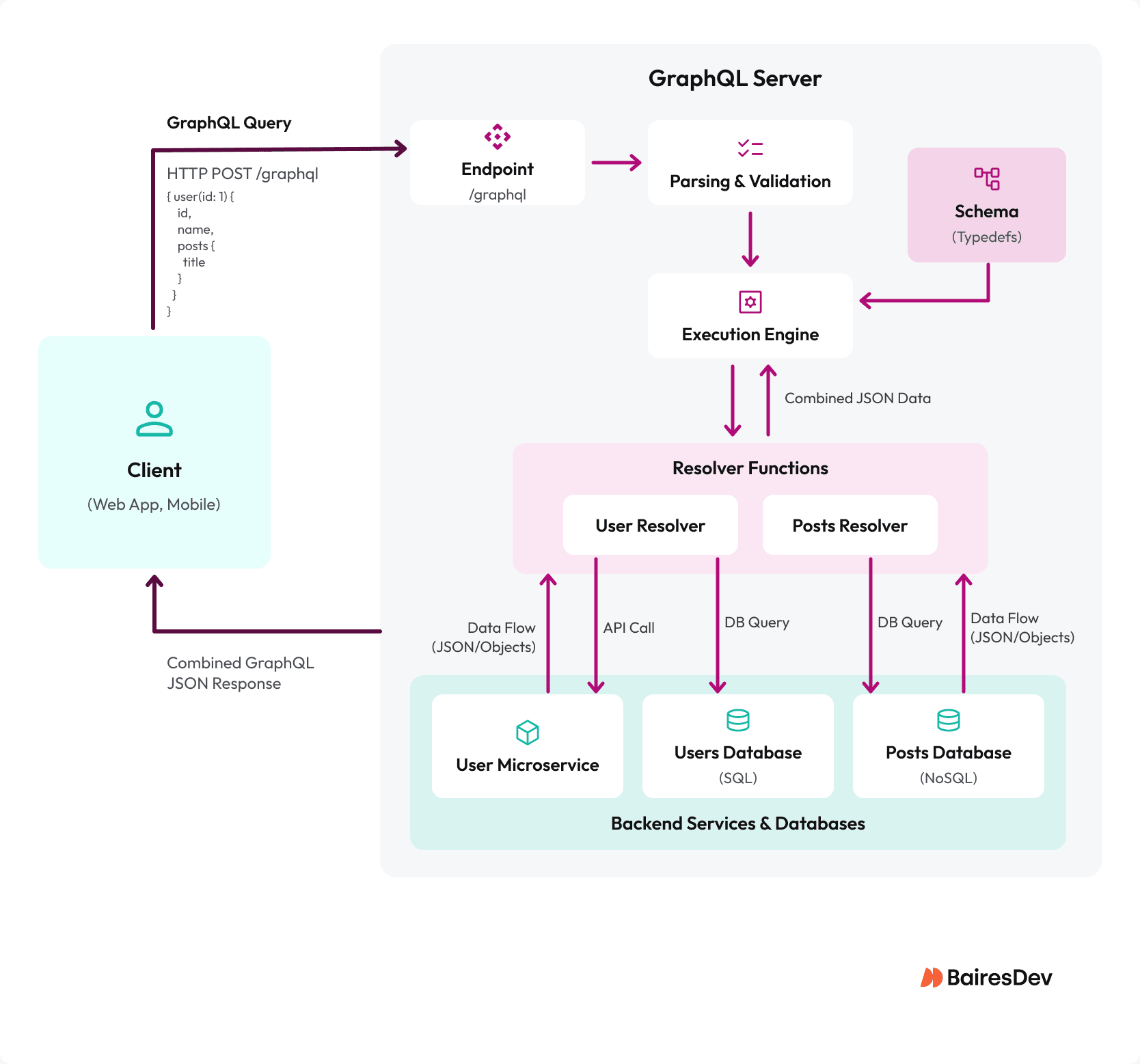
Clients send GraphQL requests to a single endpoint. The structure of the response is defined in the query itself. Rather than retrieving predefined resources from separate REST routes, clients specify exactly what data they want and how it should be structured. The server validates the query against a strongly typed GraphQL schema and resolves each field through a resolver function.
The GraphQL schema is the contract. It defines object types, scalar types, relationships, and available operations. This schema definition is written using the GraphQL Schema Definition Language. A schema definition includes:
- The object types that represent the data structure
- The fields and their data types
- The query type, mutation type, and subscription type
- Rules governing how clients can read or change data
This typed model allows clients to perform a data query that returns only the data they ask for. Instead of underfetching or overfetching, a client can retrieve data in a single query, even when the data spans multiple resources or aggregates information from different upstream services.
Key Components of a GraphQL API
A GraphQL API typically includes:
- The GraphQL schema, which defines the data structure and operations
- Resolvers, which map schema fields to underlying data fetching logic
- A GraphQL server, which validates and executes GraphQL queries
- Optional tooling for caching strategies, cost analysis, and observability
Unlike REST APIs that rely on multiple URLs and endpoints, GraphQL uses a single endpoint. Every request includes the query. That query may contain multiple queries, fragments, or nested fields, but it’s processed through the same endpoint.
GraphQL’s strongly typed schema lets clients define exactly what data they want, and even discover what fields are available through introspection. That flexibility shifts responsibility to the server: every request must be validated against the schema, and the server must enforce which fields, types, and operations each client is allowed to access.
GraphQL Operations
GraphQL operations fall into t
hree primary categories:
- Queries for reading data
- GraphQL mutations for creating, updating, or deleting data
- Subscriptions for real-time updates
Each operation type is explicitly declared in the schema definition. This structure allows clients to request data, modify data, and subscribe to new data using a consistent API query language.
Another defining feature is GraphQL introspection. The schema is self‑describing, which means clients can programmatically discover available types, fields, and operations. Introspection accelerates tooling but requires careful access control in production environments.
How GraphQL Differs from REST APIs
The defining difference between GraphQL and REST APIs is not syntax. It’s responsibility.
REST APIs are resource-oriented. Each endpoint corresponds to a resource and returns a predefined representation. If a client needs data from multiple resources, it makes multiple requests, often across several backend routes, and combines the results client-side. That may require manual parsing code and additional orchestration.
GraphQL is query-oriented. Clients send one request to a single endpoint and define the shape of the response. The server orchestrates data fetching across multiple data sources. Instead of multiple API calls or separate requests, a complex screen can often be satisfied with just one query.
REST vs GraphQL Responsibility Model
| Dimension | REST APIs | GraphQL API |
| Endpoint model | Multiple endpoints | Single endpoint |
| Data retrieval | Fixed resource shape | Client-defined data structure |
| Network pattern | Multiple requests common | Often one request |
| Caching | Native HTTP caching | Requires custom caching strategies |
| Authorization | Endpoint-level common | Field-level frequently required |
| Governance complexity | Distributed across services | Centralized in schema and resolvers |
The tradeoff becomes clear. REST distributes complexity across endpoints. GraphQL centralizes it in the schema and execution layer. For organizations managing dozens of services, that shift changes how APIs evolve and how risk is controlled.
Where GraphQL Improves Delivery
GraphQL solves a real problem in systems with complex data requirements.
First, it reduces coordination overhead between frontend and backend teams. If a frontend team needs new fields, those can often be added to the GraphQL schema without creating entirely new endpoints. That reduces friction when data requirements evolve rapidly.
Second, it minimizes overfetching and underfetching. Clients receive only the data they ask for. For mobile devices operating on constrained networks, eliminating unnecessary payload can improve performance.
Third, GraphQL work often simplifies aggregation. Because resolvers can pull from multiple data sources, it becomes easier to aggregate data across microservices or existing APIs. A GraphQL service can sit on top of underlying systems of record and unify access without exposing backend topology.
Fourth, GraphQL’s transition path is incremental. It can be layered over existing REST or gRPC services. Teams don’t need to rewrite their current backend services to adopt it.
These benefits are most pronounced when:
- Multiple client types exist (web, mobile, internal tools)
- UI requirements change frequently
- Data spans multiple resources
- Backend services are already distributed
In these contexts, reducing multiple API calls into a single request can materially simplify client logic.
Operational Tradeoffs and Risks
GraphQL shifts complexity to the GraphQL server. That shift introduces operational risk that must be managed deliberately.
Resolver Complexity and the N+1 Problem
Each field in the schema maps to a resolver. Poorly designed resolvers can create inefficient data fetching patterns. The classic N+1 issue occurs when a query retrieves a list, and each item triggers an additional backend call. Without batching, commonly implemented with tools such as DataLoader, latency and backend load can increase quickly.
In production systems, batching and caching at the resolver layer are foundational patterns, not optional optimizations.
Authorization at Field Level
REST APIs commonly enforce access at the endpoint level. GraphQL often requires field-level authorization. Different roles may be permitted to view different scalar fields within the same object types.
This increases implementation complexity. In regulated industries, where compliance and auditability matter, fine-grained control must be explicit and testable.
Query Cost and Abuse
Because clients define the query, they can construct complex queries with deep nesting. Without safeguards such as depth limiting, complexity scoring, persisted queries, and rate limiting, a single malicious or poorly designed query can degrade system stability.
In enterprise environments, GraphQL operations should be monitored with query cost controls enabled by default.
Observability and Incident Response
A single GraphQL request may fan out into dozens of backend calls. Without tracing at the resolver level, debugging becomes difficult.
Distributed tracing is essential in GraphQL environments because a single query can fan out into dozens of backend calls. Teams that implement resolver‑level tracing resolve incidents faster and gain clearer visibility into where latency originates.
Schema Governance
The GraphQL schema is a shared contract. As teams add new fields and types, schema growth can become unwieldy. Without domain ownership and a clear review process, it becomes difficult to evolve APIs safely.
Additive changes are generally safe. Breaking changes require explicit deprecation policies, versioning discipline, and usage analytics. A schema registry and CI checks that block breaking changes are commonly implemented safeguards.
Is Your Organization Ready for GraphQL?
GraphQL changes how API contracts are governed and how backend load scales under client-defined queries. Before adopting it, organizations should assess whether they have the operational maturity and governance structures required to run it safely.
GraphQL Adoption Readiness Checklist
- Clear API ownership model
- Strong schema design discipline
- Field‑level authorization strategy
- Query cost management in place
- Distributed tracing enabled
- Defined caching strategy
- Performance SLIs/SLOs established
- Mature observability practices
- Versioning and deprecation workflow
- Cross‑team collaboration norms
- Security posture defined
- Fallback plan for partial failures
If more than two of these are missing, GraphQL’s transition will likely introduce operational instability.
Testing and Operating GraphQL at Scale
Testing differs for GraphQL APIs than testing typical REST APIs.
Schema validation is foundational. Changes must be validated against existing GraphQL queries. Automated checks should fail builds when breaking changes are introduced.
Testing GraphQL APIs should focus on real usage patterns. Common queries must be optimized, but worst‑case high‑cost queries should also be load tested. Because a single query may execute multiple execution paths, performance testing is more critical than in many REST environments.
Mutation testing must validate not only database changes but also cache invalidation. Observability instrumentation should log query identifiers and relevant variables while respecting privacy requirements.
Without disciplined testing and tracing, GraphQL systems become opaque under load.
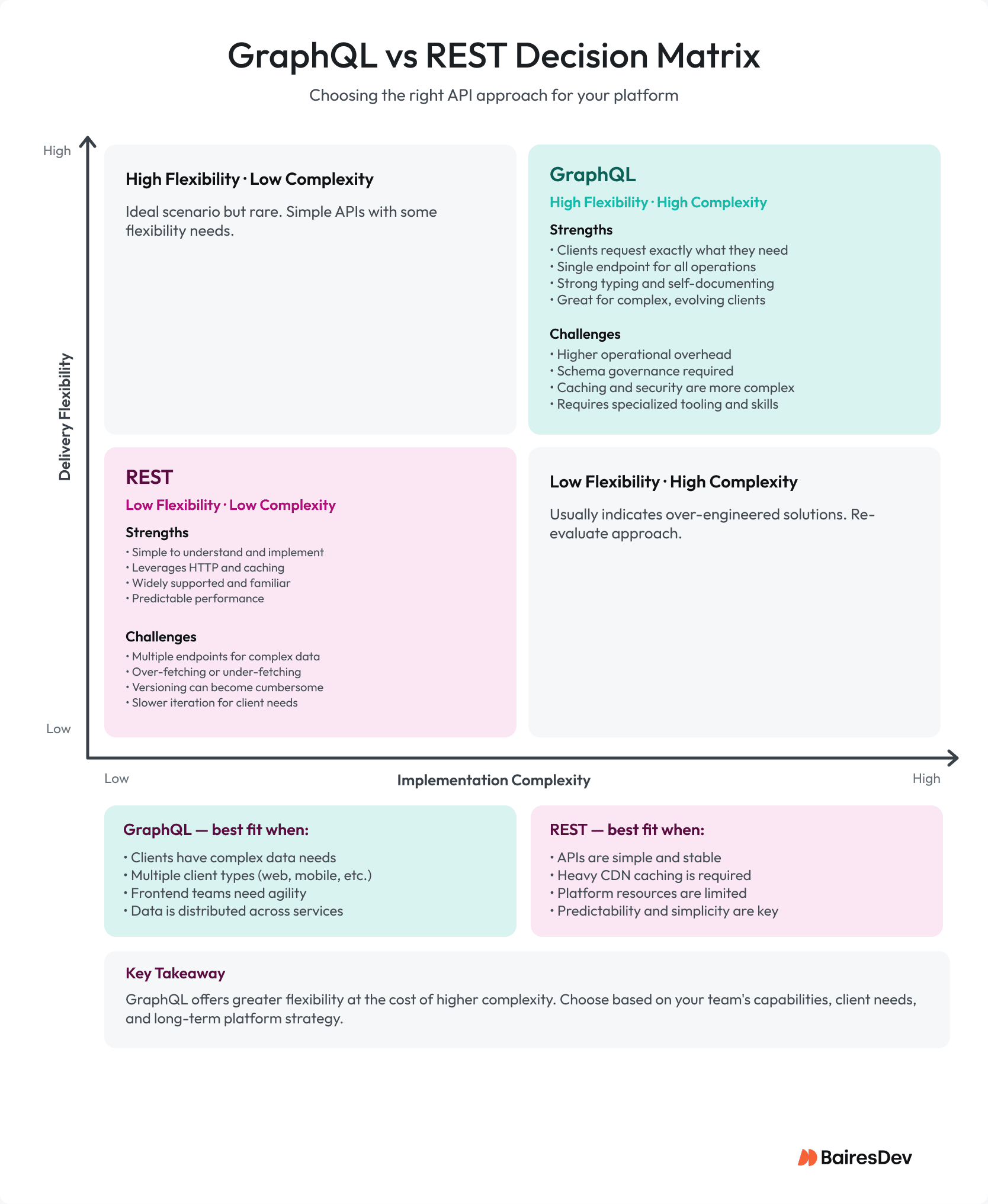
When GraphQL Is the Right Choice
GraphQL is a strong fit when:
- Clients require flexible and nested data structures
- Multiple client types need different slices of the same data
- Frontend teams are constrained by endpoint churn
- Data must be aggregated across services
GraphQL is commonly implemented as a gateway layer in microservice architectures, unifying access while shielding clients from internal service boundaries.
GraphQL is less suitable when:
- APIs are simple and stable
- Heavy CDN caching is a primary requirement
- Strict performance predictability is mandatory
- There is no clear platform ownership
In these cases, REST APIs may remain simpler and more predictable.
The Strategic Decision
Adopting GraphQL is not a purely technical choice. It’s an organizational one.
GraphQL provides meaningful delivery benefits when frontend velocity is constrained by rigid resource models. It can reduce multiple requests, allow clients to request exactly what data they need, and simplify data fetching logic.
But it concentrates responsibility in the GraphQL server. Schema governance, query cost control, resolver efficiency, and observability must be treated as first-class concerns. Without dedicated ownership, the flexibility that enables clients can destabilize backend systems.
A pragmatic approach is to start with a focused pilot. Layer GraphQL over your established service layer in a bounded domain. Measure latency, payload size, backend load, and developer productivity. Evaluate how schema changes are governed. Track how deeply nested queries behave under load.
If the pilot demonstrates improved delivery without increasing incident frequency or operational burden, expand deliberately. If not, simpler REST patterns may be the more reliable path.
GraphQL doesn’t automatically make APIs better. It changes how they work. Whether that change is beneficial depends on your team’s maturity, architecture, and appetite for centralized governance.