


Adopting a runtime for backend services is a multi-year decision, and Node.js shows up in nearly every shortlist for I/O-heavy work. The same architecture that makes it fast for concurrent connections imposes real constraints on CPU-bound tasks. This guide explains where Node.js belongs in an enterprise stack and the operational discipline that keeps it predictable.
Key Points
- Node.js earns its place on I/O‑bound workloads where concurrency is the bottleneck.
- CPU‑bound work blocks the event loop, image processing and ML inference belong on worker threads or another runtime.
- A unified JavaScript stack lets frontend engineers move to backend work without retooling, compressing ramp time and widening the hiring pool.
- The npm supply chain is Node.js’s main operational risk, private mirroring and automated audits are non‑negotiable for production use.
Enterprise adoption isn’t about syntax, it’s about outcomes. You already run a business on deadlines, margins, and customer expectations. Your software should pull the same weight. Node.js helps you do that by letting your teams write JavaScript code on the server side with a fast V8 JavaScript execution engine, an event-driven architecture, and a single-threaded event loop that keeps throughput high even when the system fields thousands of multiple concurrent requests.
In practical terms: more responsive web apps, APIs that don’t choke under load, and product teams that move faster because the frontend and backend share one scripting language and one stack for web development.
Why Node.js Appeals to Enterprise Architecture
What is Node.js?
A cross-platform JavaScript runtime environment that uses the V8 JavaScript engine to run JavaScript outside the browser. Node.js relies on an event-driven architecture and non-blocking I/O to process concurrent requests efficiently on modest hardware.
Node.js introduces a concurrency model based on an event loop, allowing it to handle thousands of simultaneous connections without the need for multithreading. A callback function resumes work when I/O completes, so the loop keeps serving incoming requests.
This architecture minimizes resource consumption and eliminates the overhead associated with traditional thread-based servers, making Node.js particularly effective for high-throughput applications and modern server-side application design.
Key architectural traits:
- Event-driven, non-blocking I/O: Ideal for managing concurrent network requests without spawning new threads.
- Single-threaded concurrency: Reduces context-switching overhead while handling asynchronous operations efficiently.
- Modular ecosystem: Encourages the development of discrete services and reusable components, which align well with enterprise microservice strategies.
Strategic Benefits for the Enterprise
Here’s how a JavaScript runtime environment turns into tangible wins for your P&L and product strategy.
Fewer handoffs, faster releases
A unified JavaScript stack reduces cognitive overhead. Teams write JavaScript once, share types and validation between browser and server, and reuse a core library across services. Less context switching, fewer translation bugs, quicker QA.
A marketplace of building blocks
The node package manager (npm) provides battle-tested middleware and integrations for auth, observability, queues, and cloud SDKs, over a million packages you can compose safely with policy and automation.
Performance where it counts
Event-driven servers handle bursts of concurrent connections, webhooks, WebSockets, GraphQL subscriptions, without linear hardware costs. That elasticity keeps user experiences snappy during campaigns and peak traffic, and it trims spend when demand ebbs.
Talent flexibility
Because JavaScript ranks among the most popular programming languages, moving engineers between frontend and server-side work becomes straightforward. Hiring gets easier, onboarding gets shorter, and cross-functional squads can truly own outcomes from UI to API.
Cloud-native by default
Small memory footprints and quick startup times make Node.js a fit for containers, serverless functions, and edge runtimes. That’s how you ship closer to users, reduce cold-start pain, and improve global latency without rewriting your stack.
Architectural Fit and Technical Advantages
| Guidance | What to do (practical steps) |
|---|---|
| Adopt the right concurrency mindset | Treat Node.js as a platform JavaScript runtime with async as the default. Design APIs around non-blocking operations. Use a small thread pool for offloaded work. Push durable, long jobs to queues/workers. Keep handlers short; avoid CPU bursts that block the event loop. |
| Structure for resilience | Split monoliths only where seams are clear: customer-facing latency paths, third-party integrations, reporting. Keep services stateless to scale horizontally. Standardize WebSockets or SSE for real-time, with backpressure and a shared session strategy. |
| Observability from day one | Add tracing and metrics to a shared core library. Use OpenTelemetry for distributed traces, centralized logs for correlation, and Grafana/Prometheus or your APM for alerts. Aim for request-scoped visibility across every async hop. |
| Lean into npm, safely | Automate dependency audits and provenance checks in CI. Mirror critical packages and enforce 2FA for internal maintainers. Maintain an allowlist, lockfiles, and review gates for new transitive deps in critical paths. |
| Optimize for the single-threaded event loop | Keep hot paths async and fast. Offload heavy work (e.g., large CSV parsing, compression) to worker threads or separate services in languages that leverage multiple cores. Use clustering/containers for multi-core scaling. |
| Invest in shared ergonomics | Provide a “golden path” template: TypeScript, linting, tests, structured logging, health checks, CI/CD. Include Helm charts and IaC modules. Add a ready-to-run hello-world script to bootstrap local dev and reduce variance. |
Business Value and Operational Outcomes
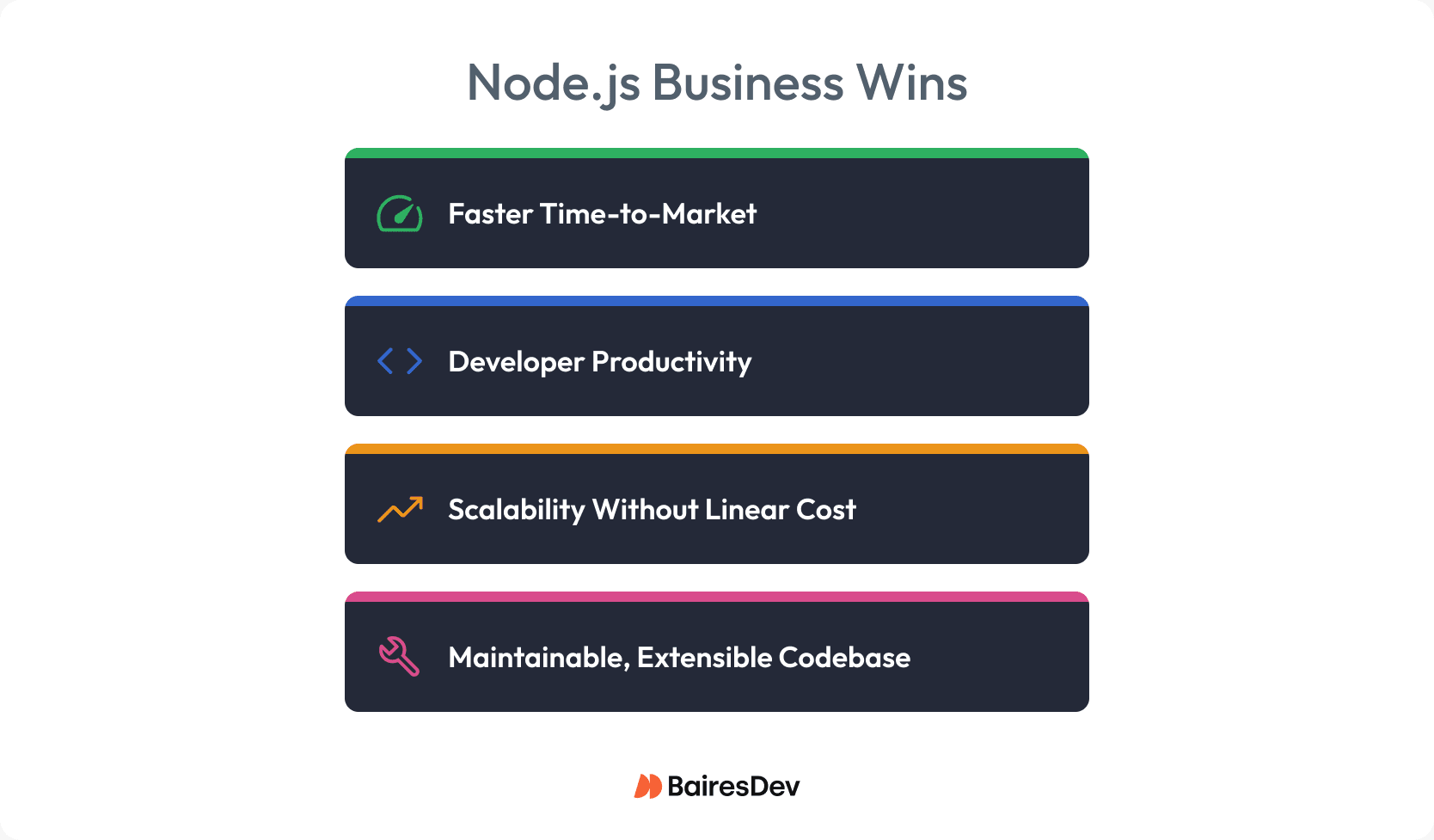
- You move from idea to release sooner when teams build on Node.js and modern DevOps. Continuous delivery and quick experiments become the norm, not the exception.
- One language across the stack means less context switching. Your squads keep a tight feedback loop, collaborate more smoothly, and trim QA cycles.
- Stateless services and async I/O let you serve heavy traffic and real-time interactions without scaling compute at the same rate as demand.
- Clear patterns, dependency injection, middleware chaining, layered architecture, make onboarding faster, debugging simpler, and long-term evolution safer as teams grow and change.
Where Node.js Fits Best (and Where It Doesn’t)
Below is a short, practical view you can share with product owners when scoping initiatives.
Sweet spots
- API gateways and BFFs (Backend for Frontend) that adapt services for web applications and mobile apps
- Event-driven architecture: messaging, streaming, and orchestration layers
- Real-time apps: chat, presence, collaborative editing, live analytics, push notifications
- High-I/O services: proxying, webhooks, ingestion services with concurrent requests
- Edge services: personalization, AB tests, authentication, and rate limiting at the perimeter
Proceed with caution
- CPU-bound jobs: image/video processing, heavy ML inference; consider worker threads, Rust, Go, or offloading to specialized services
- Large in-process analytics: streaming is fine, crunching big datasets in one Node.js process isn’t
- Long-lived memory-intensive tasks: tighten profiling and leak detection or isolate into short-lived worker
Implementation Roadmap You Can Run This Quarter
Pick an LTS version and standardize. Add it to developer images and CI. Document the baseline: Node version, node package manager, TypeScript config, test runner, and lint rules. Production apps should track Active LTS.
Create a service template. Include HTTP web server setup, health checks, structured logging, error boundaries, OpenTelemetry, and a sample “hello world” endpoint that returns build info for a server-side application.
Harden dependency management. Stand up a private npm proxy, enforce lockfiles, and set automated audits. Add human review for new transitive dependencies on critical services because the cost of a bad package dwarfs the extra hour.
Design for scale from the start. Use stateless services, externalize session state, implement circuit breakers, and prefer idempotent handlers for retries.
Measure what matters. Define SLOs: p95 latency per endpoint, error budgets, and saturation signals tied to the event loop. Hook alerts to on-call rotations.
Educate the team. Run focused sessions on the event loop, non-blocking patterns, and backpressure. Add a brief “learning Node” track for frontend engineers; the jump from browser to server-side application is smaller than you think.
Conclusion
Adopting Node.js where the fit is strong, APIs, event-driven services, and real-time apps, compresses lead time from idea to customer impact. The combination of a single-threaded event loop, non-blocking I/O, and a massive package ecosystem unlocks speed without sacrificing reliability. It gives your teams full control over how they run JavaScript code in production.
LTS cadence and foundation governance provide the stability enterprises demand.
With a clear policy for dependencies and a good developer experience, you’ll see faster feature delivery, improved scalability under load, and lower unit costs per request. Node.js delivers speed and flexibility, but governance determines whether that agility scales safely.