A former enterprise technology professor at TEC de Monterrey, Enrique has an 18-year track record of delivering complex ERP and digital transformation projects. He has commanded over 20 such initiatives for both corporate and government organizations.


Key Points
- Your biggest risk with architecture and modernization decisions is making them before an outside perspective can change them.
- If your team already knows what to build and how to build it, engineers are the right hire.
- Consultants brought in after a decision is made deliver validation, with limited opportunity to influence the outcome.
- A good engagement leaves behind decision-grade artifacts, such as architecture decision records, risk assessments and a sequenced roadmap, not just a slide deck.
- Judge your consultant by whether their recommendations changed a technical outcome rather than how many documents they produced.
What Is Software Development Consulting?
Software development consulting (SDC) is a particular form of engagement where experienced engineers and architects are brought in to help an organization make high-stakes technical decisions.
Specifically, software consulting services distinguish themselves from other forms of outsourcing agreements by their deliverable, as the output is usually a decision or an execution plan, with code delivery handled separately. The client, of course, still owns the final decision, but the consultants support the decisions with research, analysis, and recommendations.
When Consulting Is the Right Call
By the nature of its deliverable, software consulting creates the most value when there is uncertainty in the proper path forward. This could be a “should we” call, like when the organization is deciding if they should pursue a project in alignment with their business objectives, or a “when should we” call, where the team needs to decide on longer-term plans around resource allocation and strategic planning. This is also where the consulting role shifts from advisory to actively shaping architecture — when the team needs to properly architect a large-scale project or scope out a complex challenge before committing resources and direction.
Practically, software development consulting services are what you bring in before a decision, not after. When you’re struggling with architecture design, technology selection, or modernization decisions, software consultants can provide guidance before you invest significant resources. Let’s look at some specific examples where SDC is the right call.
Scenario 1: Architecture modernization/digital transformation
The team at a medical insurance company has been working with a legacy system that has gradually become unmaintainable. They want to refactor the current system from outdated technologies into a more modern and sustainable software architecture, but the existing team is biased by familiarity and divided on the best way to proceed. The team engages consultants to propose new solutions, plan out the new architecture, and establish consensus before investing significant resources.
Scenario 2: Technology Selection
A B2B SaaS company needs to add new AI functionality to their existing systems. AI delivery has grown more complex as agentic AI frameworks — purpose-built systems where AI models take autonomous, multi-step actions — become a core part of modern software products rather than an optional add-on. While the team already has capable software and AI engineers, it is the first time they are building this specific functionality, so they engage a consultant to advise on the right agentic frameworks, models, tech stacks and cloud computing providers. Additionally, the consultant helps identify parts of the application that can be bought instead of built, saving the team significant time.
Scenario 3: Building Scalable Platforms
A D2C e-commerce platform has been seeing accelerating growth over the last few years, and now needs to scale their technology stack and cloud platforms to improve reliability and availability during peak times. The team wants to understand how best to analyze load profiles, identify bottlenecks, and set up for future growth. They engage an experienced consultant to walk through options, from the perspective of someone who has scaled large software solutions in the past.
Scenario 4: Technical Due Diligence
A large manufacturing company undergoing digital transformation is looking into acquiring an automation technology company to vertically integrate their operations and improve operational efficiency. However, the in-house development team is ill-equipped to understand the technology at the target company. They engage a team of consultants to analyze the code, identify risks and assess the value of the technology before committing to the acquisition.
Notice that in each scenario, the client hires consultants to deliver clarity and decision support rather than capacity and implementation support.
When Not to Use Software Development Consulting, and What to Use Instead
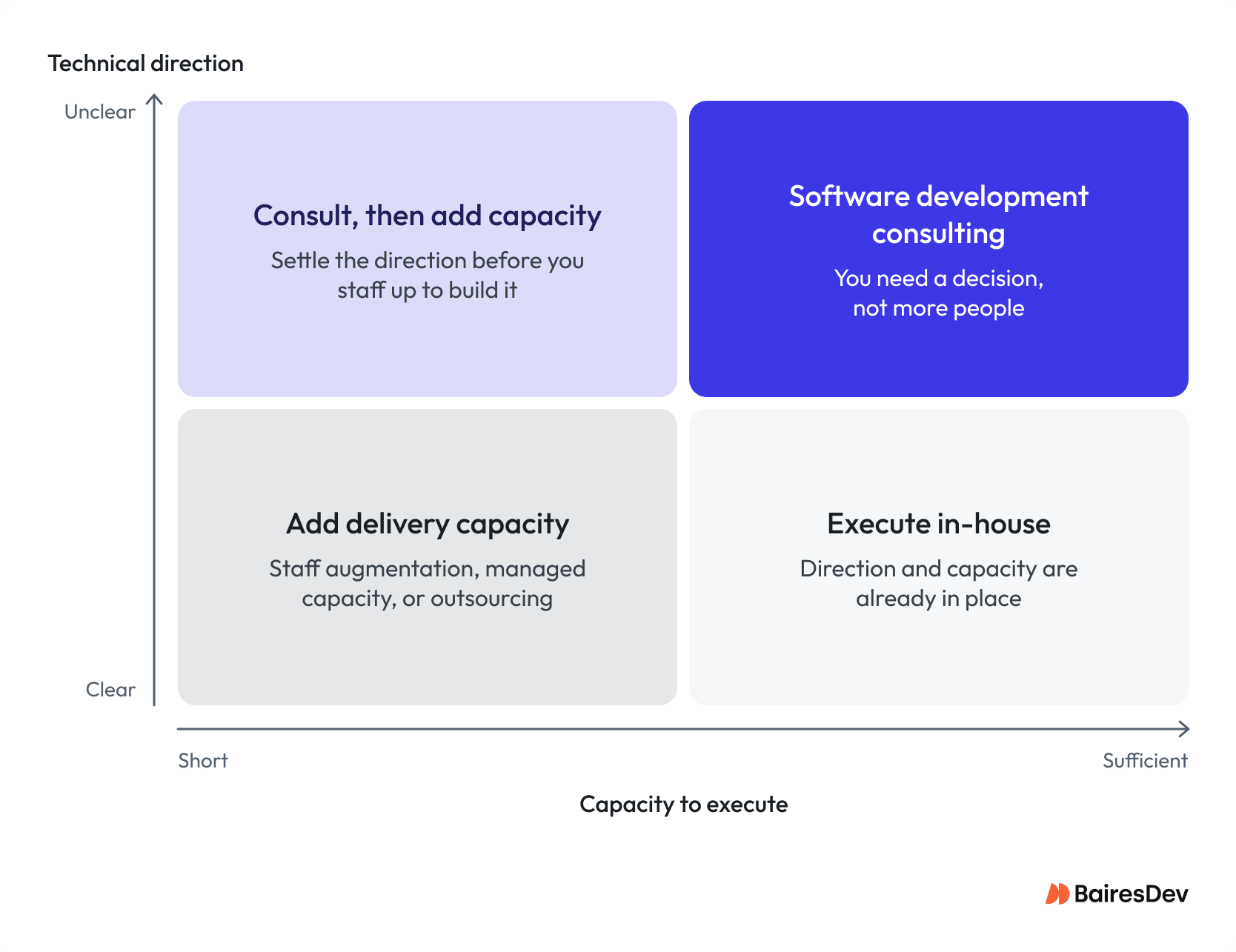
Conversely, software development consulting is not well suited for software development projects where the bottleneck is implementation rather than decision-making. When a technical decision has already been made, and the client just needs to execute, the best path forward is usually another outsourcing engagement model. Let’s look at some examples where SDC is not the optimal engagement model, and what to use instead.
Scenario 1: Capacity Gap-fill
A data analytics SaaS company is building out a new visualization feature, but two of their senior software developers leave the company for a competitor, delaying the delivery timeline. The development team lead initially considers engaging a software consultant, but decides instead to pursue staff augmentation, onboarding two new software developers instead. This model is much more cost effective for acquiring capacity for hands-on work, when the direction of the project has already been decided.
Scenario 2: End-to-End Implementation
A clinic chain needs an efficient way to manage patient data and improve data security, and they have decided on custom software development as the best way forward. They initially consider engaging a software consultant to help plan out the implementation, but choose project outsourcing or custom software development instead, since capacity to implement the design is also required. This model is more effective when planning and implementation need to happen together.
Scenario 3: Skill Augmentation
A commodities trading company hires a new portfolio manager who specializes in high-frequency trading. In order to support their role, they need to build out bespoke software for trade execution. They initially consider engaging a software consultant, but ultimately decide on the managed capacity model instead, since consistent, ongoing support from specialists will be required to support this build-out.
Note that in each of these situations, the client needs more than direction and recommendations. They need capacity, implementation and support. When that becomes a requirement, the best model is often something other than software development consulting.
How to Decide: A Decision Framework
In the real world, situations are rarely so open and shut. A consultant’s recommendations are only useful if the development team has the capacity and expertise to execute the plan, and research can often involve building prototypes and trial implementations, which can look a lot like added capacity.
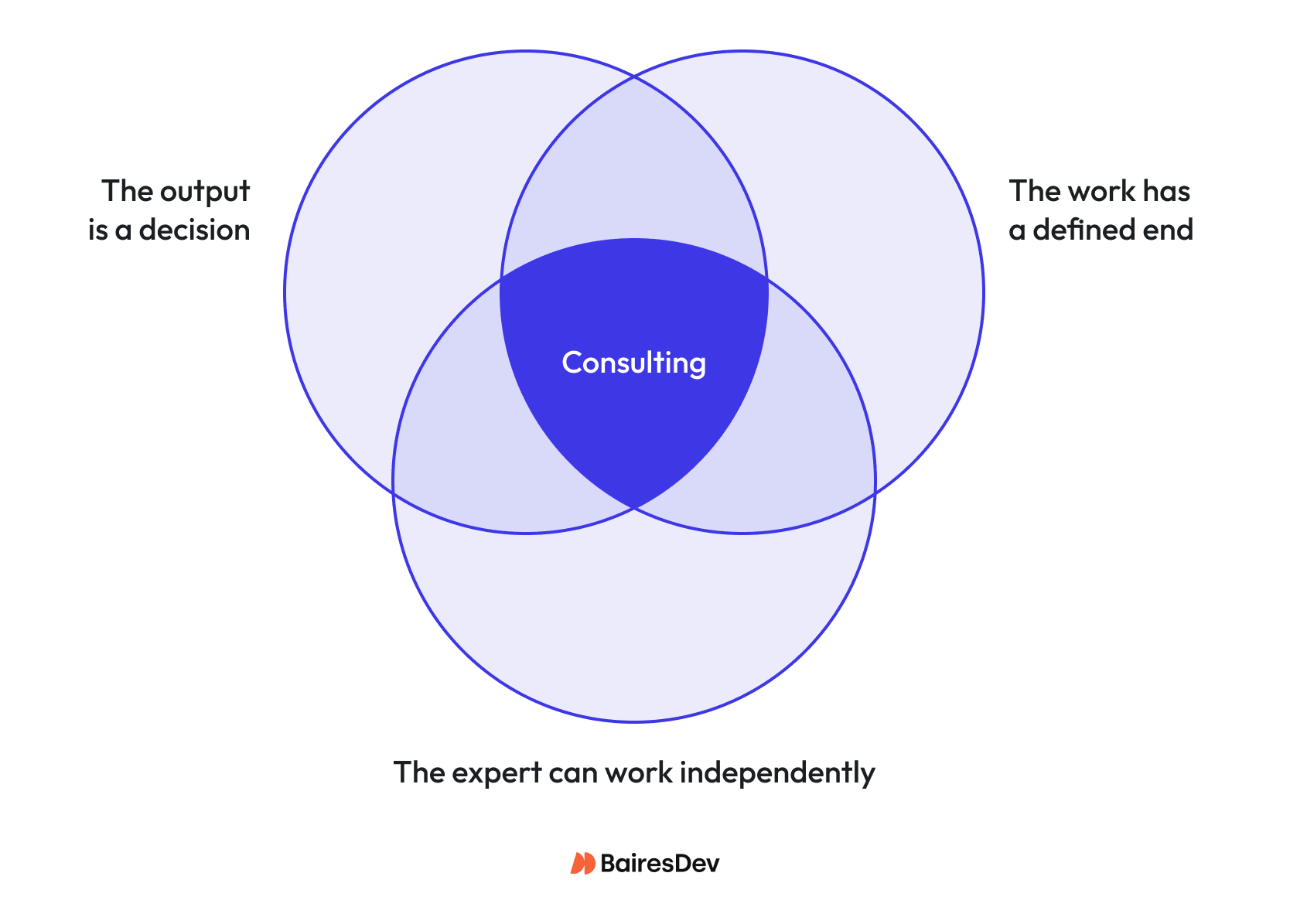
However, the decision usually comes down to a particular set of questions, because SDC is specifically optimized for that use case. The questions pertain to the deliverable, timeline and independence.
The Deliverable:
The first question to ask is, what is the final deliverable: a decision, an implementation, or both? This is probably the biggest determination of whether software development consulting is the right choice. When the final deliverable is a decision or clarity around a decision, software development consulting is the right engagement. When implementation is also a final outcome, for example, when the goal includes a working prototype, a different arrangement is likely the better fit.
The Timeline:
The timing question is tied into the deliverable question. By design, software development consulting has an ending point. Once the research or the recommendation has been delivered, the engagement ends, and there are often limited options available for support. When the project requires ongoing support or capacity, a more continuous arrangement is likely more appropriate, even when the outcome is research and recommendations.
Independence:
Software consultants expect, and are often optimized for, independence in the way they operate. They often bring their own perspectives, processes, and resources to an engagement, allowing them to ramp up quickly. However, all of this turns into a liability when they must work within an organization’s software development processes and constraint sets, since integration takes considerably longer. When the outside resource is expected to work within a team, an arrangement designed for integration is the better choice.
Comparison: Consulting vs. The Alternatives
Now that we understand the pros, cons and decision points for whether SDC is the right choice, let’s look at how we might choose one type of engagement over others in comparison to one another. One thing worth noting: AI tools and frameworks, from code generation assistants to automated testing suites to LLM-based architecture analysis tools, are increasingly relevant across all four models, speeding up research in consulting engagements, accelerating delivery in outsourcing arrangements and augmenting individual contributors in staff augmentation scenarios.
| SDC | Managed Capacity | Staff Augmentation | Software outsourcing | |
| Primary purpose | Improve a technical decision through research, recommendation and perspective | Provide a specific expertise or capacity configuration without management overhead | Additional capacity or expertise through direct staffing support, analogous to full-time hires | A defined software product or a specific project scope |
| What the client receives | Assessments, recommendations, roadmap and decision records | A team and a project manager who interfaces with the client | An engineer working within the team structure | Tangible software deliverables against an agreed-upon scope |
| Ownership of technical decisions | Client makes the final decision, supported by consultant deliverables. | Client drives strategic decisions, provider owns project management and staffing | Client drives all technical decisions, including project management | Provider drives technical decisions based on negotiated contract |
| Internal management required | Low: the consultant works independently and interfaces with stakeholders | Moderate: must make strategic decisions but only one point of contact | High: client owns day-to-day direction of the talent. | Moderate: vendor management, SLA enforcement, and milestone acceptance |
| Ideal use cases | Strategic decisions: software modernization, scalability, technology selection and redesign | Backlog acceleration, skill augmentation, capacity scaling and non-core maintenance | Backlog acceleration, skill augmentation and long-term projects | Well-scoped projects, (often) non-core technologies and toolchains. |
| When it’s inappropriate | You need implementation, support, or integrated capacity | You need direct management of the engineers | The team has limited management capacity | Core systems and systems where the specs are unclear |
Conclusion: Making a Consulting Engagement Count
This article defined the idea of software development consulting, the pros and cons, as well as occasions where this arrangement is preferable over other outsourcing arrangements. In general, SDC works best when the outcome is a decision, the timeline has a defined end point, and the consultant is able to act in an independent capacity.
Even after you decide that software consulting services are the right option for you, though, the work is not over. You will want to set up your engagement so the consultant has the best chance to succeed, ensuring they are aligned on the deliverable, they have the access and independence they need and the outputs are reviewed so they actually provide what the client needs. Knowing the components of a successful SDC engagement helps you assess whether the model fits your specific situation.
This article covered the what, when, and why of software development consulting. Because it is so unique among the various outsourcing arrangements, care should be taken to determine whether it is the best course of action. If you feel like software development consulting is what you need for your project, reach out to explore whether it fits your situation.
Frequently Asked Questions
How long does a typical consulting engagement last?
It depends on scope. Focused engagements like technology selection can be short, while due diligence or architecture modernization can stretch to several months. Don’t let a vendor push a fixed timeline before the scope is defined. The engagement ends when the deliverable is done, not when a calendar slot runs out.
What's the difference between a software consultant and a software architect?
In-house software architects own the technical decision and course-correct over time. Software development consultants assist with that decision with research, recommendation and best practices at one point in time.
Can the same firm consult and then build the solution?
Yes, outsourcing providers and software consulting companies often provide both software consulting services and capacity augmentation services, but these engagements should be scoped separately to maximize the value of both. Alternatively, look at engaging bundled services, like project outsourcing or staff augmentation teams that bring technical decision making and capacity in a sustained fashion.
Do consultants replace an in-house CTO or architect?
Software consultants are not intended to replace an in-house CTO, who would own the technical decision over the long term. The purpose of software consulting is to bring outside perspective and decision support, upon which the CTO can make more informed decisions aligned with business objectives.
A former enterprise technology professor at TEC de Monterrey, Enrique has an 18-year track record of delivering complex ERP and digital transformation projects. He has commanded over 20 such initiatives for both corporate and government organizations.