


Software projects don’t blow their budgets by accident. Overruns come from a short list of predictable causes: unpriced scope, estimates frozen into commitments, and dependencies that turn into queues and rework. The leaders who hold budgets are the ones who catch the early signals and price in the changes before they compound.
Key Points
- Overruns are predictable, and each driver has an early warning sign.
- Treat every scope change as a priced tradeoff, not a favor.
- Set the real budget only after prototypes resolve the biggest unknowns.
- Run a forecast-to-complete cadence so drift surfaces while you can still act.
By the time a project surges over budget, the money’s already spent. The only thing left to do is explain things to Finance. The frustrating part is that overruns rarely come out of nowhere. They trace to a short list of recurring causes: scope creep, early estimates that harden into commitments, and dependencies that turn into rework.
If you lead multi-team delivery, a lecture on scope creep is preaching to the choir. What you need is a short list of the causes that push costs up in SSO, RBAC, and audit-logging programs, and signals that tell you when an epic or program is drifting into danger.
Spot Patterns
Most software project budget overruns don’t happen all at once. They start small: a tiny scope change stretches delivery time, that increases coordination and defect risk, and slow decisions eventually force rework that eats up the budget. The fix is to spot the pattern early.
The risk is bigger than most budget models assume. A 2025 peer-reviewed study of more than 11,000 projects across 23 industries, published in Project Management Journal, found that IT projects carry a fatter, more unpredictable cost-overrun tail than any other project type studied, including nuclear waste storage. In the IT subset of more than 5,300 projects, the mean cost overrun was 73%, while 18% of projects landed in the extreme tail, where the average overrun was 453%.
One pattern shows up in a platform program with two product development teams plus a nearshore squad that slips a dependency by a week, then loses another week to a steering-committee decision. Watch for rising work in progress, repeated re-estimation, and escalating cross-team handoffs.
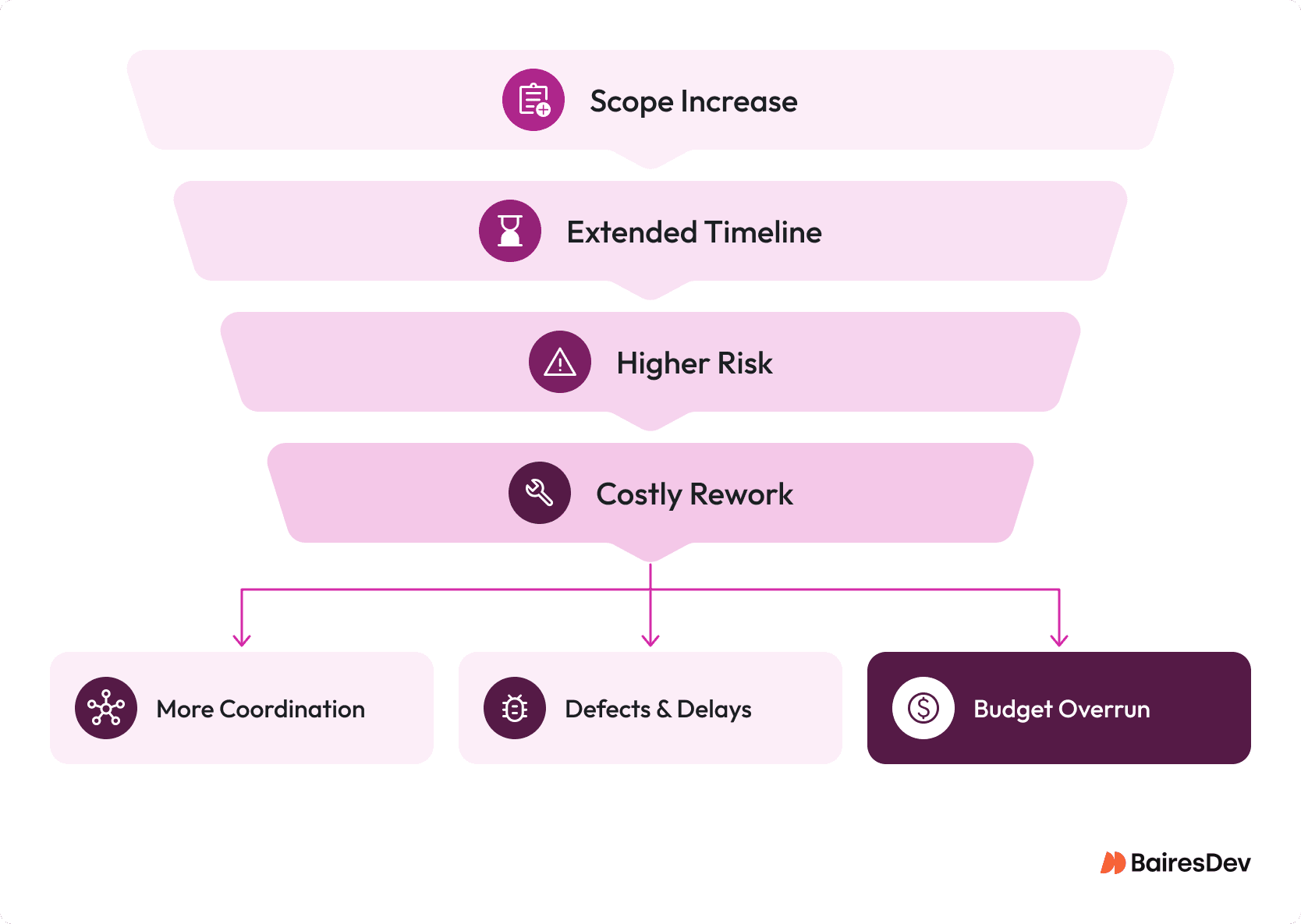
By the time these effects show up as a budget problem, several smaller delivery problems have already compounded: scope increased, the timeline extended, risk rose, and rework became more expensive.
Fix Scope Creep With Better Budgets
“Just one more thing” is how budgets die. You can hit every sprint goal and still lose control of spend if you keep letting small asks slip in. By the time Finance asks why spend is up, the change is already baked into a dozen tickets, and it costs more to undo than it would have to price in upfront.
Scope creep doesn’t happen just because you add a feature. The real issue is approving new work without removing something else. Those small, harmless-looking changes form an invisible second backlog that eats your capacity. Governance should track the cost of changes in real time.
Multi-team initiatives make this worse, because coordination scales your project costs. Say a product leader asks for “one more role” in a permissions model: APIs, UI states, audit logging, regression suites, and environment parity all get touched. No single ticket looks outrageous, but the program just bought another round of cross-team coupling.
Until your scope decisions are explicit, you’re running a fixed budget with an unfixed scope. Redefine scope as a financial control:
- Require every change to name a tradeoff: adds $X, slips Y weeks, or removes Z.
- Create a visible change budget, in capacity or dollars, per quarter, and exhaust it deliberately.
- Tighten “done” into testable acceptance criteria before a story enters the sprint, especially for integrations.
- Watch for rising work in progress and blocked work, including acceptance criteria that expand mid-sprint and a growing share of “small” tickets that touch multiple systems.
Why Estimates Don’t Warn You
There’s a good reason your software project estimates for an ERP rollout or a data-platform migration fail to warn you about overruns. You’re pricing the work before the highest-cost unknowns are even visible. Worse, Product and Finance treat that early number as a contract.
The issue usually isn’t that your developers are too optimistic. It’s that integration and organizational dependencies don’t add up like line items. They turn into queues and waiting, and each one pushes back delivery.
Case in point: your platform team estimates SSO, RBAC, and audit logs as a few sprints based on known code changes and dependencies. Two weeks later you learn another organization controls the identity-provider configuration, and the audit schema needs legal approval. None of that looks like feature work, but it consumes capacity and forces you to change the timeline.
Longer-running programs also accumulate overhead and risk. McKinsey and Oxford’s analysis found that every additional year a project was scheduled to last increased cost overruns by 15%. Treat this as a historical risk benchmark rather than a current industry average.
“We’ll just extend the timeline” is one of the most expensive decisions a leadership team can make.
There must be equivalent contract clauses that enable the Delivery team to pursue concrete actions on top of these practices so that there are no loose ends that leave room to improvisation on ways to proceed forward.
Cost Drivers and Early Signals
Large IT projects in McKinsey and Oxford’s 2012 analysis averaged 45% over budget, with 17% becoming extreme “black swan” cases exceeding 200%. More recent research puts the tail risk even higher: the 2025 Project Management Journal study cited above found IT’s worst-case overruns averaging 453%. The research is older in one case and newer in the other, but the message is consistent: an average variance hides much larger failures.
Good estimates alone aren’t enough; business acumen matters, too. PMI’s 2025 Pulse of the Profession found that professionals with high business acumen reported better budget adherence than their peers, 73% versus 68%, as well as lower project failure rates, 8% versus 11%. The system below should flag the first signs of cost growth right away, so you can adjust the schedule or trade scope before the number gets away from you.
Below is a practical decision matrix of causes, ordered by how early each driver affects cost and delivery. When you screen a vendor, ask about the signals they watch and the controls they’ll use for each.
| Cost Driver (Ranked) | How It Inflates Cost | Earliest Warning Sign | First Line of Defense |
| 1. Scope creep (unpriced change) | Adds work and coordination without removing anything. Multiplies through integration touchpoints, QA, and acceptance-criteria expansion. | “Small” requests start landing mid-sprint; stories get reopened because “done” changed; more tickets touch multiple repositories and teams than planned. | Put changes through an explicit trade: add dollars, move the date, or drop scope. Enforce testable acceptance criteria before work starts. |
| 2. Weak or incomplete estimates (unknowns treated as knowns) | You budget for build tasks but pay for discovery, waiting, rework, and cross-organizational dependencies. Longer horizons add overhead and risk. | Blocked work spikes around dependencies, access, or environments; integration and data tasks appear after sprint 1; throughput stays flat while headcount grows. | Timebox discovery and kill unknowns early with spikes and integration prototypes. Re-forecast on actuals, not the original baseline. |
| 3. Misalignment and weak sponsorship (slow decisions, moving targets) | Creates rework loops: build, review, reinterpret, rebuild. Decision latency forces engineers to context-switch or build the wrong thing “to keep moving.” | Steering decisions slip repeatedly; escalation paths don’t resolve blockers; UAT feedback reads like new requirements, not defects. | Name a single accountable sponsor, define decision SLAs, and lock a definition of done that Product, Legal, Security, and Delivery all sign. |
| 4. Technical debt and skipped QA (deferring cost) | Defects discovered late cost more to diagnose and fix; brittle architecture increases the cost of change; manual regression becomes a tax every sprint. | Escaping defects trend up; release hardening expands; teams start negotiating quality (“we’ll test later”) to hit dates. | Make quality non-negotiable: automate critical regression, enforce code-health budgets, and treat defect trends as a financial metric. |
| 5. Late detection and no contingency (no financial feedback loop) | You discover the overrun only after the money is largely spent, forcing painful choices: stop, de-scope radically, or fund a bailout. | Forecasts don’t update with burn and scope; no contingency reserve; status stays “green” while milestones slip. | Establish a monthly or biweekly forecast-to-complete review with scope and risk adjustments; reserve contingency explicitly and spend it deliberately. |
Budget Controls That Work
A platform rebuild can look on track in Jira and still bleed budget. The usual suspects are slow security decisions and manual testing that piles up with every sprint. The controls below make those drivers measurable and actionable while you still have options.
Visible Gates
Start by installing clear controls for the top cost drivers. Think of them as predictable checkpoints where costs try to sneak in:
- Change gate: Every scope change carries one of three outcomes: remove equivalent scope, move the date, or add budget.
- Estimate gate: Set a rough initial budget, then adjust it once you’ve answered the big unknowns (integration, data, security, environments). Lock the real budget in a formal review, and change it only by re-running that review.
- Decision gate: Name an owner for every steering item and set decision SLAs: 48 hours for clarifications, a week for material scope calls. Escalations must resolve, not just get discussed.
- Quality gate: Set quality rules and stick to them so teams can’t cut testing or let technical debt grow to hit a date. Automate tests for all critical paths, and build debt paydown into sprint time.
Real-Time Forecast-to-Complete
When the forecast moves in small, explicit steps, you get to trade deliberately instead of doing it under duress: de-scope, resequence safely, or stop before the spend becomes unrecoverable. Use a lightweight cadence that ties delivery to dollars, updated often enough that you can still trade.
Consider a biweekly or monthly forecast-to-complete review, as simple as: “If nothing changes, we finish on X date at $Y, because of Z.” Share it with Product, Finance, and your nearshore vendor or systems-integrator partner.
What to Instrument
| Metric | What It Reveals |
| Plan vs. actual burn | Run rate by team or vendor, and forecast burn through completion. |
| Scope movement | Points, epics, or acceptance criteria added or removed, and what you traded to absorb it. |
| Blocked work and decision latency | Days blocked, count of aged dependencies, and unresolved steering items. |
| Quality trend | Escaping defects, time spent in hardening, and manual regression hours. |
| Horizon risk | Anything extending duration, since longer schedules correlate with higher overrun risk. |
If your forecast-to-complete doesn’t change behavior, tighten the trigger. For example: “If the forecast moves by more than 10% or two sprints, we must either de-scope or re-plan.” That rule helps project management stay on budget.
Vendor and Resourcing Choices
A lower rate doesn’t necessarily produce a lower total cost. Delivery models affect how quickly teams resolve dependencies and make tradeoffs. When ownership is fragmented, savings on the rate card can disappear into coordination overhead and rework.
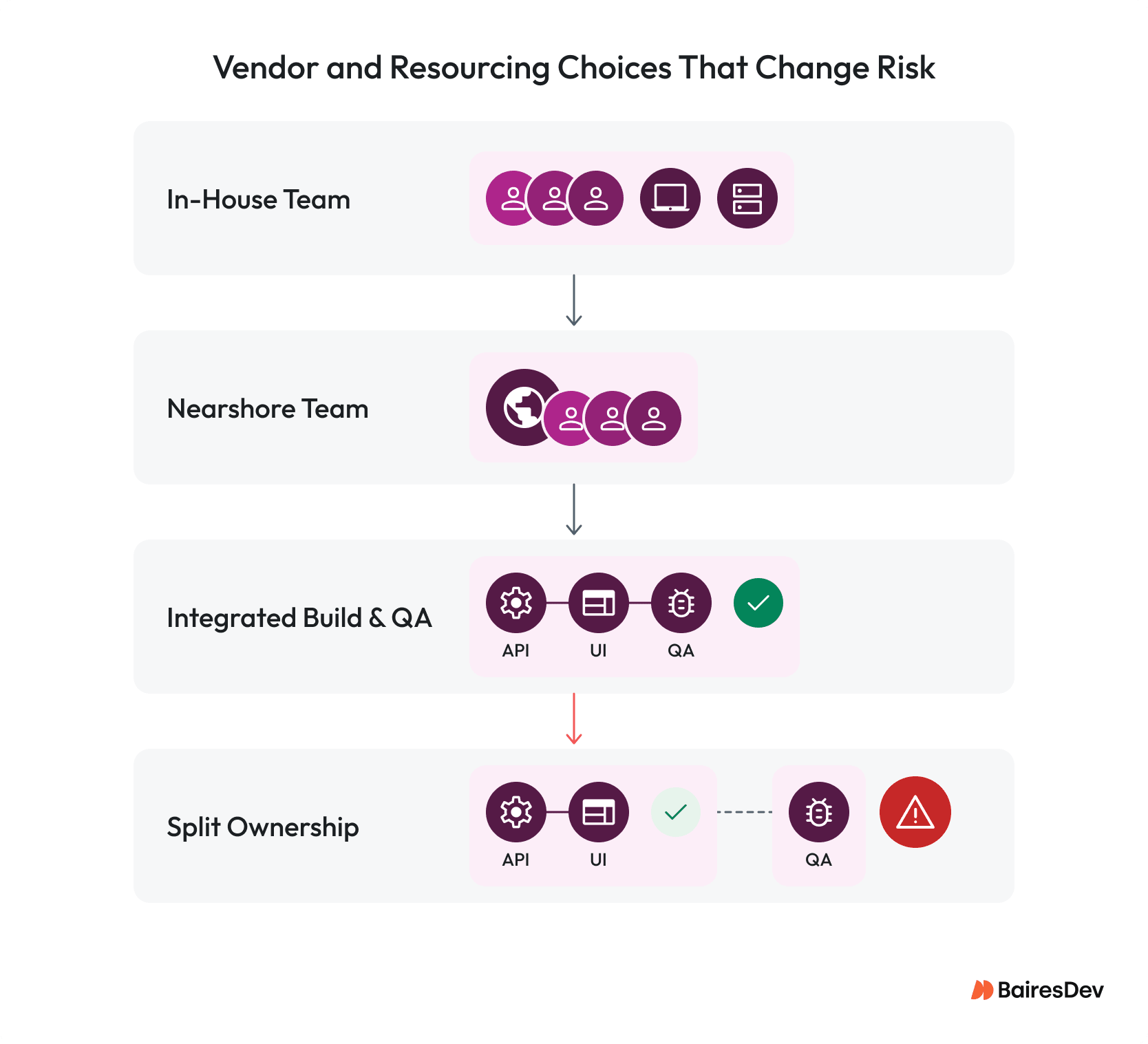
Consider a platform program where the internal team owns development while a nearshore partner handles integration testing. A defect crosses several boundaries before anyone fixes it: QA documents the issue, the internal team reproduces it, another group clarifies the expected behavior, and the vendor retests the change. Each handoff adds delay, and no single team is accountable for the full outcome.
External teams reduce overrun risk when they have clear ownership, direct access to the people making decisions, and enough context to resolve issues without routing every question through the client.
When evaluating a software delivery partner, ask how the partner will:
- Assign accountable ownership for each product or platform outcome.
- Surface blocked work, dependency risk, and forecast changes.
- Integrate engineering, QA, and release responsibilities.
- Maintain team continuity as the program scales.
- Escalate decisions before engineers lose time waiting or building against assumptions.
- Report forecast-to-complete changes in terms Product, Engineering, and Finance can all act on.
Your staff-augmentation or systems-integrator delivery model affects both your rate structure and how quickly you can see cost growth. If you’re splitting platform build internally and integration testing with a nearshore team, you lower overrun risk by keeping single-threaded ownership from API to UI to QA and shortening the feedback loop. Assign one accountable owner per outcome, and make quality a joint responsibility across engineering and QA.
Make Budget Risk a Managed Variable, Not a Surprise
The most expensive decision on a software project is often not a single large scope change. It’s allowing a series of small changes, unresolved dependencies, delayed decisions, and deferred quality work to accumulate without forcing an explicit tradeoff.
The delivery models that protect budgets pair clear ownership, from API to UI to QA, with a forecast-to-complete discipline that leadership actually uses. Get those two things right, and scope changes, weak estimates, and slow decisions stop being surprises. They become tradeoffs you see coming and price in before they cost you the budget.