


Key Points
- Unreal Engine is Epic Games’ real-time 3D creation engine for games, simulations, virtual production, visualization, and other interactive experiences.
- Unreal Engine 5.8, released in June 2026, is the final planned major version of the UE5 generation, while Epic has officially announced Unreal Engine 6, with Early Access targeted for the end of 2027 and a roadmap that brings together UE5, UEFN, and the Verse programming language
- Games pay a 5% royalty only after exceeding $1 million in lifetime gross revenue, with a reduced 3.5% rate available to qualifying storefront debuts. Qualifying non-game businesses use a seat-based subscription model.
- Modern Unreal development centers on C++, Blueprints, Nanite, Lumen, MetaHuman, Chaos Physics, PCG, and Substrate, with Verse becoming increasingly important as Epic moves toward Unreal Engine 6.
Unreal Engine now powers far more than the biggest games on the market. For engineering leaders evaluating a real-time 3D platform, the decision touches licensing costs, staffing, technical capabilities, and long-term platform risk, not just graphics quality.
This guide explains what Unreal Engine is today, how its pricing and roadmap work in 2026, what capabilities matter most, and how it compares with Unity so engineering and product teams can make an informed technology decision.
What Is Unreal Engine and Who Makes It?
Unreal Engine is Epic Games’ real-time 3D creation platform for building games, simulations, films, visualizations, and other interactive digital experiences.
Epic Games created Unreal Engine, which has evolved from a game engine into a broader real-time 3D development environment. The platform combines rendering, physics, animation, audio, world building, visual scripting, and content creation.
For engineering leaders, the distinction matters. Unreal Engine isn’t simply a graphics engine. It provides a production environment in which engineers, technical artists, designers, and other contributors can work on the same real-time 3D product.
Written primarily in C++, Unreal Engine combines performance-oriented programming with Blueprints, its visual scripting system. This lets engineering teams keep performance-critical systems in C++ while giving designers and artists a lower-code way to create and iterate on gameplay behavior.
What Version Is Unreal Engine on in 2026, and What Is Unreal Engine 6?
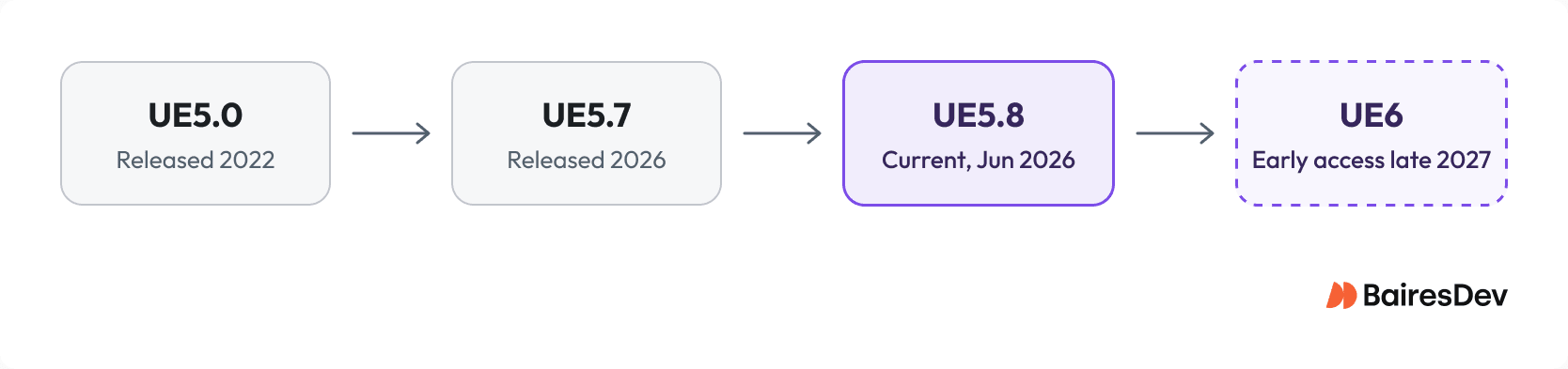
Unreal Engine 5.8 is the latest production build as of June 2026 and the final planned major version of the UE5 generation, while Unreal Engine 6 is in development with Early Access targeted for the end of 2027.
Epic’s current rollout approach is therefore better understood as an evolving cadence rather than a rigid historical schedule. Epic has generally delivered major UE5 releases roughly every six months, while continuing to develop the capability that will lead into Unreal Engine 6.
| LATEST PRODUCTION VERSION
Unreal Engine 5.8 | June 17, 2026 |
Epic says Unreal Engine 5.8 is the last planned major update for Unreal Engine 5, although it has reserved the option to release a 5.9 if needed. This update focuses on performance and the maturation of core features, including improvements to Lumen, world building, character and animation workflows, and several production-ready systems.
For teams planning a multiyear project, this creates an important distinction. UE5.8 is the current production platform, while UE6 is a future platform that should influence architectural planning without being treated as an immediate migration requirement.
Epic officially announced Unreal Engine 6 at State of Unreal 2026. The company says UE6 will bring together the AAA game development capabilities developed in UE5 with technology developed through Fortnite and UEFN, while moving the gameplay programming model toward Verse.
Epic also plans to make content, code, and economies more portable and interoperable across games, ecosystems, and engines. Its UE6 development pipeline will include tools such as Model Context Protocol integrations intended to let AI models work more directly within Unreal workflows.
For engineering leaders, the practical takeaway is timing. Teams starting a project today can build on UE5.8 while designing their architecture so that engine-specific capabilities can evolve without forcing unnecessary rewrites later.
Which Programming Languages Does Unreal Engine Use?
Unreal Engine primarily uses C++ and Blueprint visual scripting, while Verse is becoming increasingly important to Epic’s future Unreal Engine and UEFN ecosystem.
C++ remains central to Unreal Engine development because it provides the control needed for performance-critical gameplay, rendering, physics, networking, and engine-level systems. It also gives developers access to the engine’s extensive APIs and source code.
For engineering leaders, the implication is primarily a talent and delivery question. Unreal’s performance ceiling depends heavily on C++ and engine expertise, so organizations should assess whether they can hire, retain, or augment engineers with graphics, systems, rendering, physics, networking, and engine experience before committing to the platform.
Blueprints provide a complementary visual scripting system. Designers, technical artists, and developers can connect visual nodes to create gameplay logic and other behaviors without implementing every system directly in C++.
Verse is the emerging part of the programming model. Epic says UE6 will move gameplay programming toward Verse, building on the language’s role in UEFN and aiming to make large-scale, persistent experiences accessible to much larger development communities.
Because Unreal Engine is built on C++ and relies on it for performance-critical gameplay and rendering, the real challenge is often finding engineers with deep graphics and engine expertise. Organizations that work with teams that ship production C++ for graphics-heavy and real-time systems can adopt major Unreal Engine releases without slowing product delivery.
Scaling an Engineering Team for Real-Time, Graphics-Intensive Work
Standing up a team with deep C++ and graphics expertise rarely happens overnight, and it often needs to scale quickly once a platform proves out.
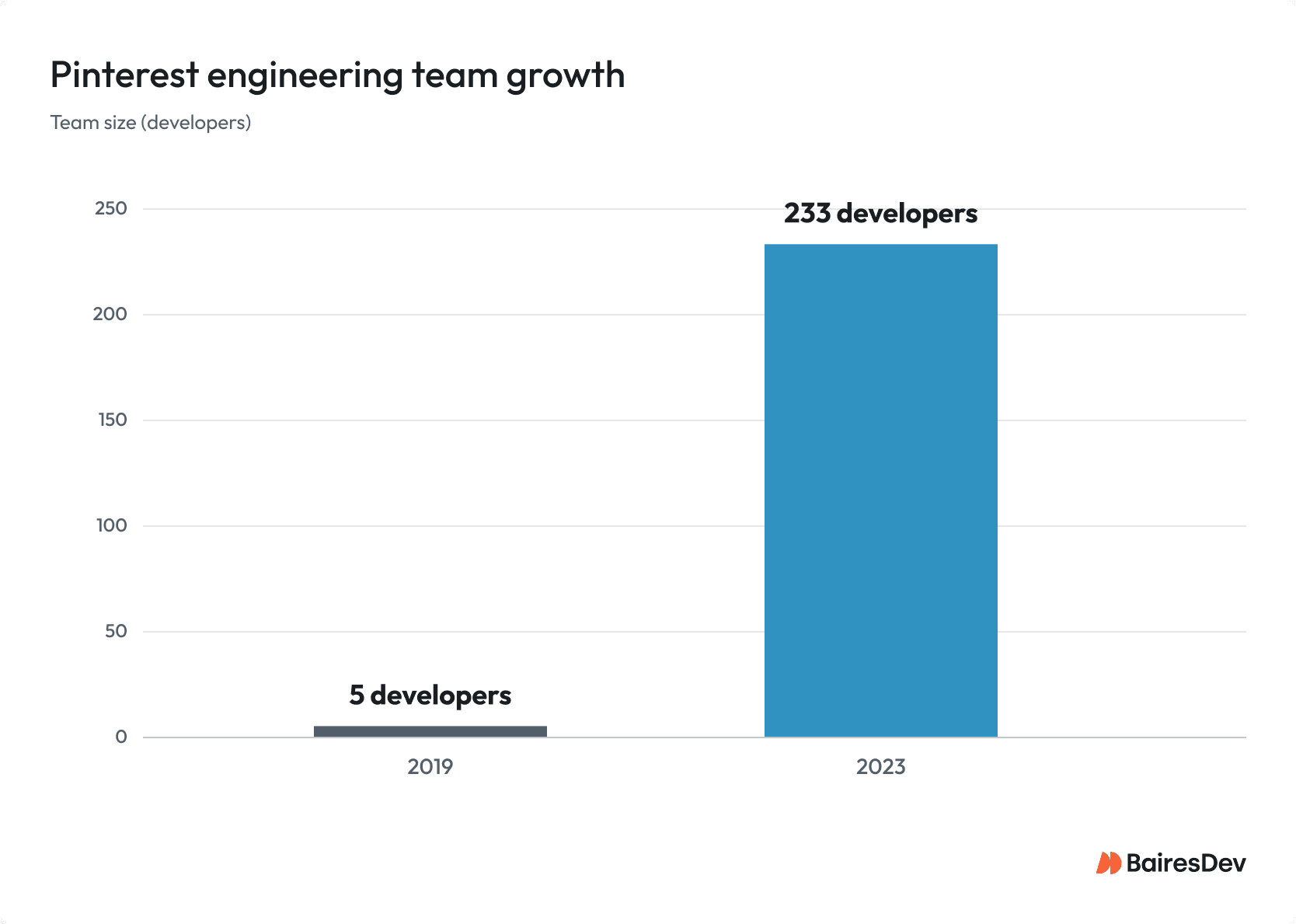
In its Pinterest engagement, BairesDev grew a specialized engineering team from 5 developers in 2019 to 233 developers by 2023, illustrating the scale at which specialized engineering teams can grow when a large technology organization needs additional development capacity.
| PINTEREST ENGAGEMENT TEAM GROWTH
5 developers (2019) → 233 developers (2023) |
 Source: BairesDev Pinterest Case Study.
What Features Does Unreal Engine Offer?
Unreal Engine combines rendering, physics, animation, procedural world building, visual scripting, content creation, and other development tools in a single production environment.
For engineering leaders, the important question is not how many features Unreal Engine has, but which capabilities can reduce internal development effort or enable requirements that would otherwise be difficult to meet.
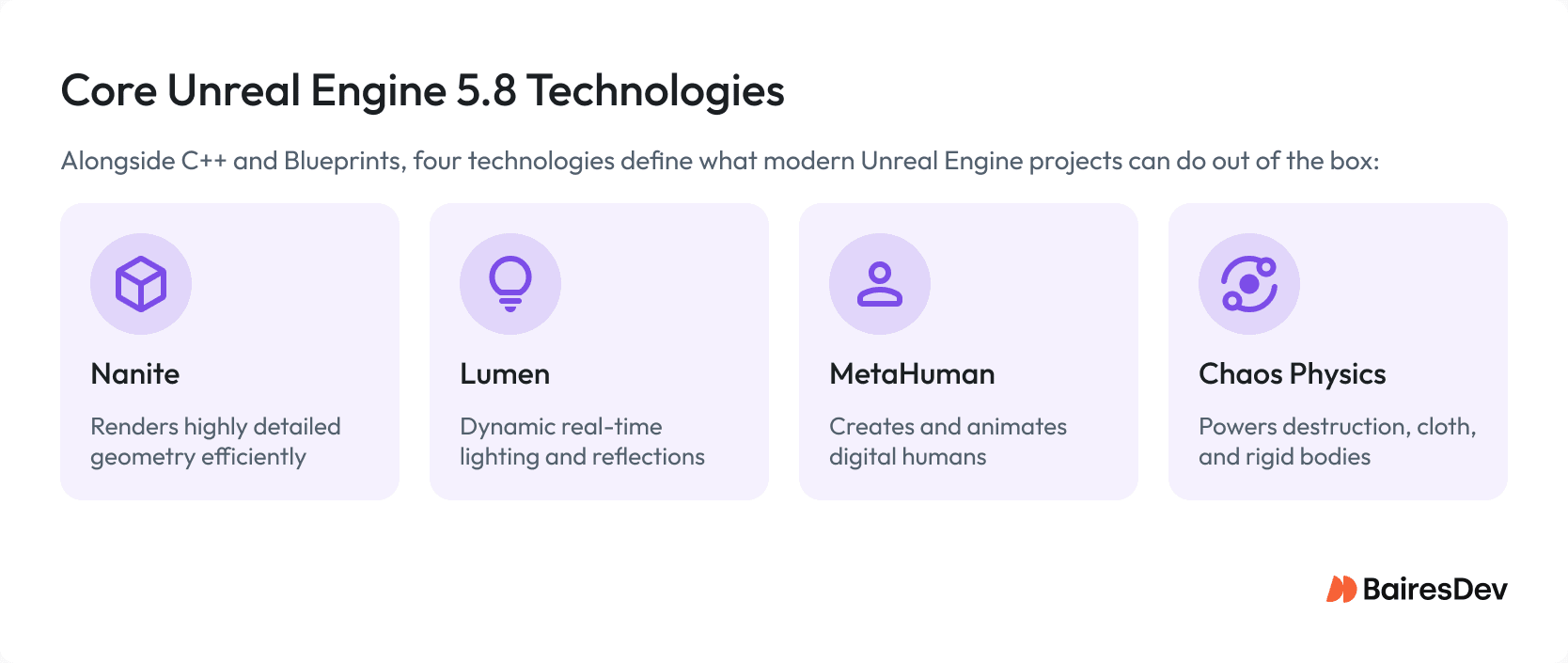
The systems most relevant to those decisions include:
| Technology | What It Does |
| Nanite | Unreal Engine’s virtualized geometry system for rendering highly detailed assets and large numbers of objects efficiently. |
| Lumen | Dynamic global illumination and reflections for real-time lighting. |
| MetaHuman | Tools and workflows for creating, animating, and working with highly detailed digital humans. |
| Chaos Physics | Physics and simulation systems supporting destruction, rigid bodies, cloth, vehicles, ragdolls, and other interactions. |
| PCG | Procedural Content Generation tools for populating and creating large, varied environments. |
| Substrate | A modular material authoring and rendering framework for complex layered materials. |
| Blueprints | Visual scripting for gameplay and other behaviors without requiring every system to be implemented directly in C++. |
| Unreal Editor | The primary development environment for creating, editing, testing, and managing Unreal projects. |
Nanite is designed to render pixel-scale detail and high object counts while using visibility and streaming techniques to manage geometry efficiently. Lumen provides dynamic lighting and reflections, while Chaos provides the physics and simulation foundation for many interactive systems.
Epic made PCG and Substrate Production-Ready in Unreal Engine 5.7. PCG provides tools for procedurally populating environments, while Substrate provides a more expressive and modular approach to material authoring.
These capabilities illustrate why Unreal Engine can be attractive for large projects. Teams can use a common engine for systems that would otherwise require substantial internal investment in rendering, physics, world building, materials, animation, and tooling.
How Does Unreal Engine Pricing and Royalties Actually Work?
Unreal Engine’s commercial cost depends on whether a team is creating a game, a non-game application, or another type of commercial experience.
For games, the standard royalty model applies after a product exceeds $1 million in lifetime gross revenue. Epic’s standard royalty rate is 5% of gross revenue above that threshold.
Qualifying products that go live through the Epic storefront can receive a reduced 3.5% royalty rate under Epic’s Launch Everywhere with Epic program.
For qualifying non-game businesses generating more than $1 million in annual gross revenue, Epic uses a seat-based Unreal Subscription rather than the standard game royalty model. The current subscription price is $1,850 per seat annually.
| Use Case | 2026 Pricing Approach |
| Students, educators, hobbyists, and qualifying smaller businesses | Free |
| Games | 5% royalty after $1 million in lifetime gross revenue |
| Qualifying storefront debuts | 3.5% royalty under Launch Everywhere with Epic |
| Qualifying non-game businesses | $1,850 per seat annually |
| Qualifying non-game applications licensed to third-party end users and relying on Unreal code at runtime | 5% royalty after $1 million in lifetime gross revenue |
| ROYALTY THRESHOLD
5% after $1M lifetime revenue | 3.5% for qualifying Epic Games Store launches |
The distinction matters because the two $1 million thresholds apply to different things. The game royalty threshold is based on a product’s lifetime gross revenue, while the Unreal Subscription threshold for qualifying non-game businesses is based on the organization’s annual gross revenue. Engineering leaders should account for both the product’s revenue model and the organization’s licensing status when evaluating total cost.
How Does Unreal Engine Compare to Unity?
Unreal Engine tends to fit projects where high-fidelity real-time 3D, advanced rendering, simulation, or virtual production are primary requirements, while Unity can be a better fit for teams prioritizing mobile, 2D, cross-platform development, or a C#-based workflow.
| Engine | Primary Language | Best For | Rendering Standout | Pricing Model in 2026 |
| Unreal Engine | C++, Blueprints, with Verse becoming important for UE6 | AAA games, photorealistic 3D, virtual production, simulation | Nanite + Lumen | Free under $1M lifetime game revenue, then 5% royalty, or 3.5% for qualifying storefront debuts; qualifying non-game companies use seat-based subscriptions |
| Unity | C# | 2D games, mobile development, cross-platform applications, accessible 3D development | HDRP / URP | Unity Personal is free up to $200K in revenue and funding; Unity Pro is $2,310 per seat annually above that threshold |
The strategic difference is less about which engine is universally better and more about which technology matches the product and team. Unreal Engine has a particularly high ceiling for high-fidelity real-time 3D, while Unity can offer a more familiar C# development model and a lower barrier to entry for some teams.
Engineering leaders should evaluate rendering requirements, target hardware, developer expertise, existing assets, performance requirements, tooling, licensing, and the expected lifetime of the project before selecting an engine.
What Is Unreal Engine Used for Beyond Games?
Unreal Engine has expanded well beyond game development, particularly in industries that need interactive, high-fidelity 3D spaces or real-time visualization.
Common use cases include:
- Virtual production and film: Creating real-time scenes, virtual sets, visual effects, and digital filmmaking experiences.
- Architecture and design: Building interactive architectural visualizations and spaces.
- Automotive: Supporting vehicle visualization, design reviews, configurators, and interactive experiences.
- Simulation and training: Creating realistic settings for industrial, defense, training, and other simulation applications.
- Digital twins: Representing physical assets, facilities, and surroundings in interactive 3D.
Epic’s Unreal Engine ecosystem includes dedicated use cases for architecture, automotive and transportation, film and television, broadcast and live events, and simulation.
What Is Fab, and How Does It Help Unreal Engine Developers?
Fab is Epic’s digital marketplace for Unreal Engine and other creative assets, including worlds, characters, materials, animation, and other production content. For development teams, its primary value is acceleration: reusable assets can reduce internal content-production requirements and allow engineers and artists to focus on product-specific systems.
For engineering leaders, the consideration is whether external assets reduce development time without creating unacceptable dependencies around licensing, quality, performance, maintenance, or technical integration.
When Should You Use Unreal Engine, and When Should You Not?
Unreal Engine is a strong choice when high-fidelity real-time 3D, advanced rendering, sophisticated simulation, or large-scale interactive experiences are central to the product.
Use Unreal Engine when:
- High-quality real-time 3D is central to the product.
- The team needs technologies such as Nanite and Lumen.
- The project requires sophisticated physics, animation, or simulation.
- The product targets AAA or high-end interactive experiences.
- The organization needs virtual production or real-time visualization.
- The engineering team can support experienced C++ developers.
- The project is expected to evolve over several years and requires a mature production ecosystem.
Consider another engine when:
- The project is a simple 2D game with limited rendering requirements.
- The team has little C++ experience and does not need Unreal’s deeper capabilities.
- The product’s requirements are better aligned with Unity or a specialized engine.
- The overhead of Unreal’s feature set would create unnecessary complexity.
The breadth of Unreal Engine is both an advantage and a potential cost. A large production may benefit from its extensive systems and tools, while a small project may spend more time learning and managing capabilities it does not actually need.
How Should Engineering Leaders Approach Unreal Engine Development?
Engineering leaders should treat Unreal Engine as a production engineering platform rather than simply a tool developers download and start using.
A practical evaluation can follow five steps:
- Define the technical requirements.
Establish target devices, frame-rate requirements, rendering quality, simulation needs, networking requirements, and expected content scale. - Assess engineering capabilities.
Determine whether the team has the C++, graphics, engine, physics, networking, and technical-art expertise required for the project. - Separate engine-specific code from product logic.
Keep core gameplay and business rules as modular as practical so future engine releases do not automatically become large rewrite projects. - Prototype the highest-risk systems.
Test rendering, performance, physics, networking, asset pipelines, and other systems that could create architectural constraints. - Evaluate the commercial model.
Account for royalties, seat subscriptions, distribution strategy, support, tooling, infrastructure, and the expected lifetime of the product.
For long-lived projects, version management should be part of the architecture discussion. Epic’s documentation notes that after a project is updated to a newer Unreal Engine version, it cannot be opened in an older version, making upgrade planning and source control particularly important.
What Are the Key Takeaways for Engineering Leaders?
Unreal Engine 5.8 is the final planned major version of the UE5 generation, while Unreal Engine 6 is already in development with Early Access targeted for the end of 2027.
Modern Unreal development combines C++, Blueprints, Nanite, Lumen, MetaHuman, Chaos Physics, PCG, and Substrate, with Verse becoming increasingly important as Epic moves toward UE6.
Unreal’s commercial model differs substantially by use case. Games use a royalty model based on product lifetime gross revenue, while qualifying non-game companies use seat-based subscriptions based on the organization’s annual gross revenue.
The platform has also become relevant far beyond games. Engineering organizations can use Unreal Engine for virtual production, architecture, automotive visualization, simulation, digital twins, and other real-time 3D applications.
For a long-lived project, the strategic question is not simply whether Unreal Engine is powerful. It is whether its capabilities, licensing model, development workflow, and talent requirements align with the product roadmap and the team’s ability to support the platform over time.