


Medtech doesn’t suffer from a lack of developers. It suffers from a lack of the developer, the one who can write production-grade software inside a regulated environment without slowing your pipeline, your submission, or your risk posture.
Key Points
- The broad developer pool keeps expanding, but engineers with medical-device regulatory experience remain a much narrower talent segment.
- The rare profile combines modern software engineering with IEC 62304, ISO 14971, and clinical-risk judgment.
- An unfilled regulated-software role creates more than recruiting expense. It can delay development, validation, submissions, and product milestones.
- Organizations can choose among three practical models: direct hire, hire-and-train, or specialist augmentation.
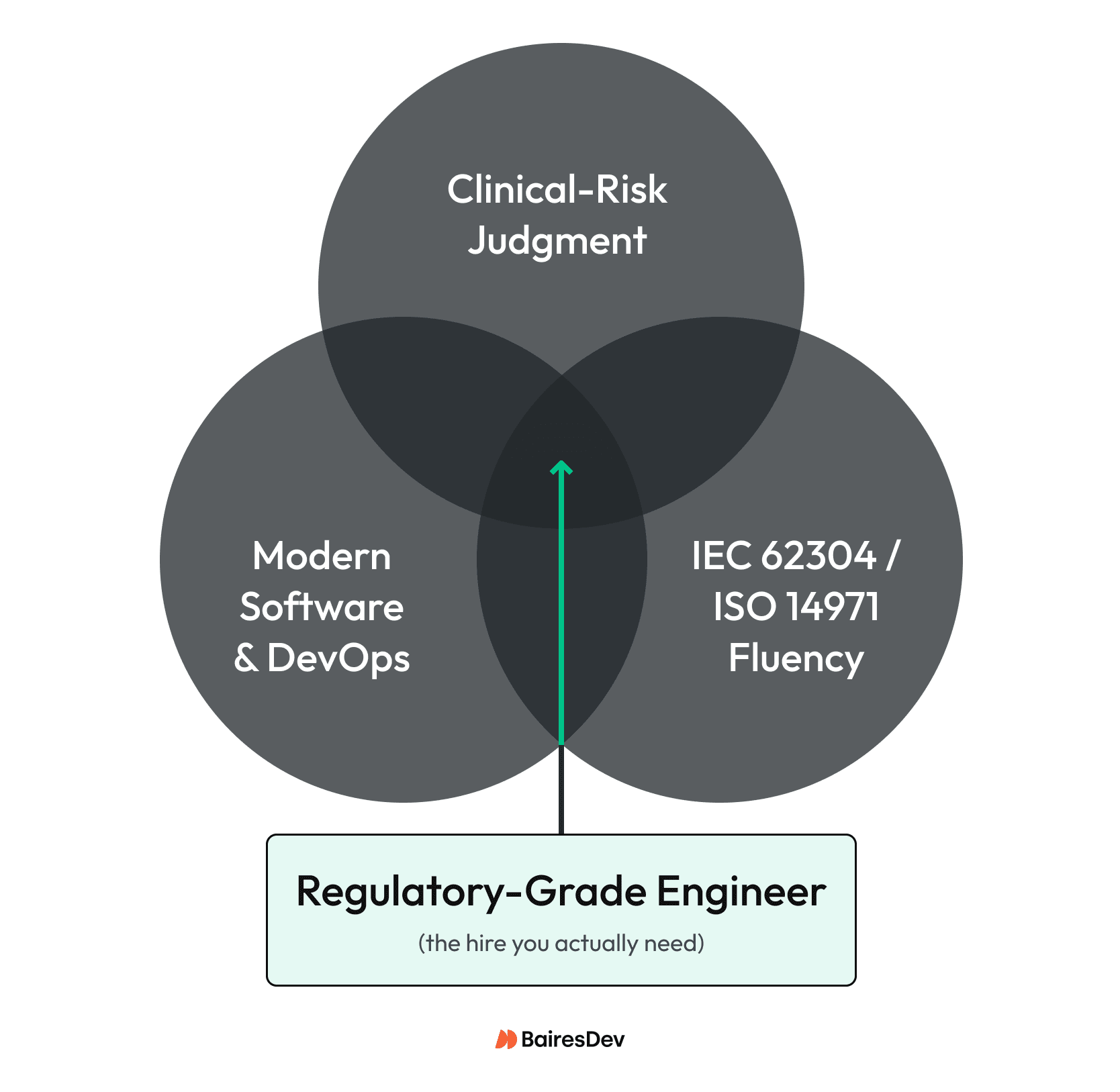
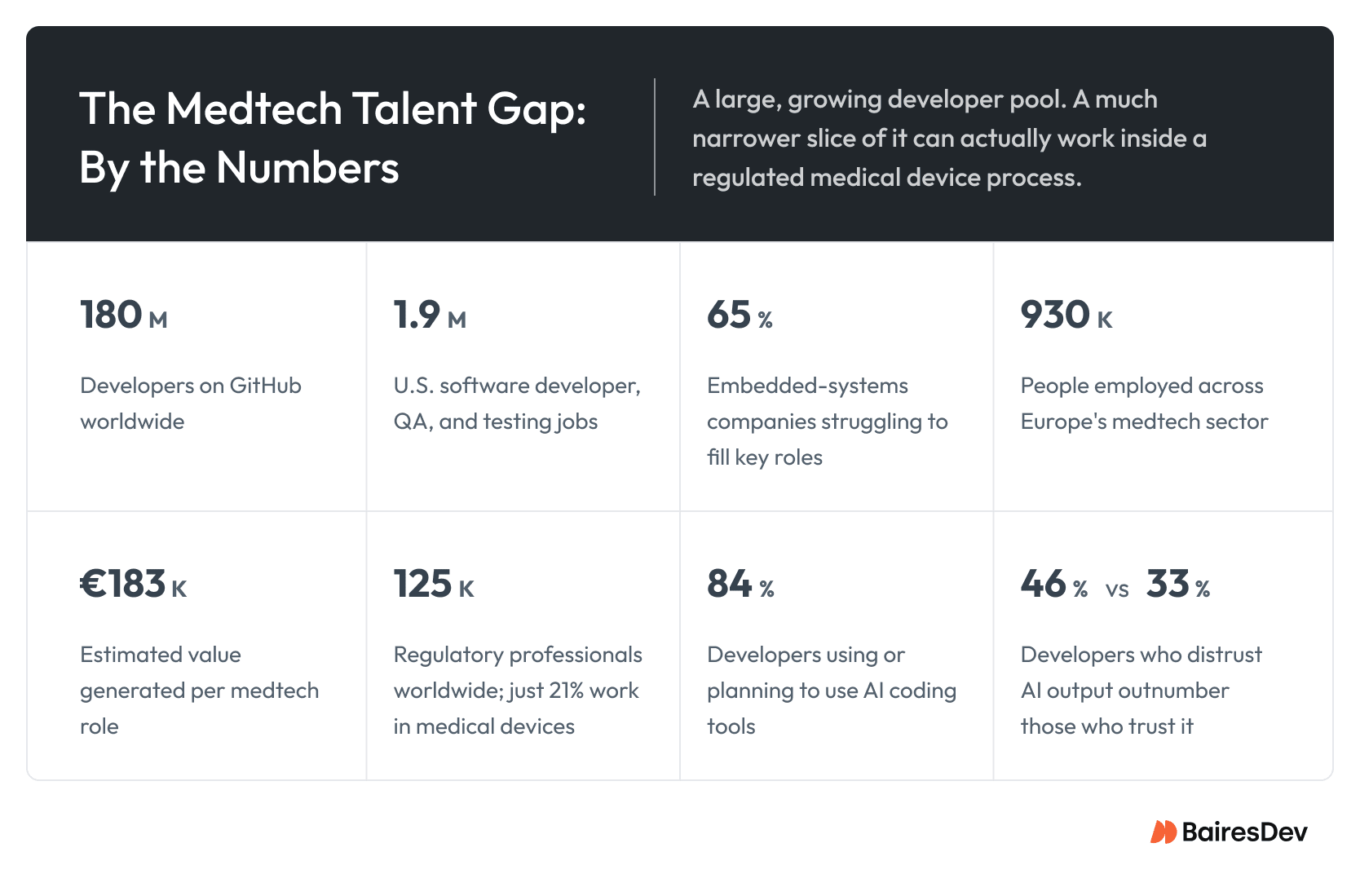
The talent pool is enormous. GitHub reports more than 180 million developers on its platform. That abundance doesn’t help when the role you need is effectively a statistical outlier. You’re not seeking a developer. You’re looking for the one profile that almost never surfaces: an engineer fluent in modern software and DevOps, in IEC 62304 and ISO 14971, and in the clinical-risk judgment that tells you when a line of code can turn a patient’s bad day into a dangerous one.
The U.S. software developer workforce is already massive and projected to keep growing. The Bureau of Labor Statistics counts 1.9 million software developer, QA, and testing jobs in 2024, projected to grow 15% through 2034. But that data does not break the pool out by regulatory experience. BLS has no category for developers who have worked inside an IEC 62304 process. The aggregate growth numbers say nothing about how many of those developers could actually do this job. The pool being large and growing is exactly why it is easy to overestimate how many of them are qualified.
Leaders who solve this problem don’t simply search harder. They decide how they’ll assemble the engineer they cannot reliably catch on the open market. They choose among three practical models: direct hire, hire-and-train, or specialist augmentation. Then they price the empty seat before they choose.
The Developer Pool Is Huge: the Talent You Need Is Not
The shortage is real. It just lives somewhere narrower than the headline suggests.
A senior software engineer who can build production systems isn’t automatically qualified to develop software for a medical device. The role requires knowledge of regulated software lifecycles, risk management, verification and validation, cybersecurity, documentation, and the specific product and clinical context. Those capabilities narrow the market considerably.
Europe’s medical technology sector illustrates the scale of the underlying industry. MedTech Europe reports more than 930,000 people employed across more than 38,000 companies in its 2025 Facts and Figures, with each role generating an estimated €183,000 in value.
So set aside the 180 million. The ocean is vast. The whale you actually need surfaces rarely, and every rival who wants it is rowing the same waters.
What Makes a “Regulatory-Grade” Software Engineer So Rare?
A senior software engineer and a medical device software engineer can write the same programming language and still hold very different jobs. The difference is everything that surrounds the code.
- IEC 62304 establishes a framework for medical device software lifecycle processes. The standard organizes software safety classification into Classes A, B, and C, with the applicable processes and rigor determined by the classification. The engineer isn’t simply responsible for writing software. The development process has to produce evidence that the software was designed, implemented, verified, and maintained according to the applicable lifecycle requirements.
- ISO 14971 sits alongside that lifecycle. The current ISO 14971:2019 standard establishes a systematic process for identifying hazards, estimating and evaluating risks, controlling those risks, and monitoring the effectiveness of the controls throughout the medical device lifecycle. It explicitly applies to medical devices, including software as a medical device.
- The regulatory landscape adds another layer. The FDA’s June 2023 guidance replaced its 2005 recommendations for the content of premarket submissions involving device software functions. The current guidance addresses recommended documentation for FDA evaluation of the safety and effectiveness of device software functions and reflects the agency’s current regulatory thinking.
- In Europe, software classification under the EU Medical Device Regulation (MDR) moves well beyond Class I. MDR Rule 11 considers the intended purpose and the information provided by software when determining classification, with many software functions falling into Class IIa, IIb, or III depending on their impact and intended use.
None of this shows up in a standard computer science degree. Engineers typically develop this competence after entering medical device software development, through internal training, practical experience, specialist education, and exposure to regulated development teams.
You’re not seeking a faster runner. You are looking for one person who combines modern programming languages and software design, CI/CD practices, standards fluency, clinical-risk judgment, and documentation discipline. That is materially narrower than a senior software engineer role.
Who’s Competing for these Engineers?
Medtech isn’t the only industry competing for engineers who understand safety-critical software. Automotive, aerospace, rail, industrial automation, and other environments rely on similar capabilities.
Automotive software operates under standards such as ISO 26262. Aerospace uses frameworks including DO-178C. Rail and industrial systems have their own safety standards. An engineer who understands deterministic systems, resource constraints, verification, and safety requirements has options beyond medical devices.
The broader embedded market also has a documented talent problem. A UST survey of 200 embedded-systems companies found that 65% struggled to fill key roles in areas including IoT, microcontroller programming, and embedded software development.
This matters to medtech because embedded systems remain fundamental to many medical devices. A company is often competing for the same engineers against organizations that can offer a different technical environment, compensation structure, or development process.
There’s also a positioning problem. Medtech often reads to software graduates as biomedical engineering rather than software engineering. And cloud-native architectures, DevOps, automated delivery, and other development practices that attract modern software engineers do not always appear in medical device job descriptions, even when the organization increasingly depends on them. The result is a role that looks misaligned with the engineer you are trying to hire.
The regulatory affairs workforce provides another indication of how specialized the broader talent base is. RAPS and Elemed’s 2024 Global Regulatory Affairs Professionals Workforce Report counted nearly 125,000 regulatory professionals globally, with 21% working in medical devices. The share of professionals seeking new opportunities rose from 15% in 2021 to 25% in 2024.
Regulatory professionals aren’t interchangeable with software engineers. But the figures reinforce the broader point. Regulated medical device work draws on specialized talent pools, and those pools aren’t as deep as the general software market.
What an Unfilled Regulated Role Actually Costs
Most cost of vacancy claims in this space come from recruiters with something to sell. Build the number yourself instead, out of inputs you can defend.
MedTech Europe’s 2025 figure of €183,000 in value generated per employee provides one possible productivity proxy. It shouldn’t be treated as a precise calculation of the loss caused by one vacant engineering seat. An empty role affects the rest of the team differently depending on the product, stage of development, and responsibilities of the position.
The economics are straightforward. A vacant engineer isn’t simply an unfilled payroll line. The organization can lose development capacity while existing engineers absorb the work, validation activities wait for implementation, technical decisions are deferred, and product milestones move.
Time to capacity becomes a more useful management metric than salary alone.
| Cost driver | Illustrative measure | What it tells a VP of Engineering |
| Productivity value | €183,000 annual value per medtech role | Provides a broad productivity proxy, not a direct vacancy-loss calculation |
| Vacancy duration | 30, 60, 90+ days | Shows how long the organization is carrying the capacity gap |
| Team impact | Work redistributed across existing engineers | Reveals the hidden cost of overtime, context switching, and delayed work |
| Schedule impact | Delayed development, testing, validation, or submission work | Converts an HR problem into a product and delivery problem |
| Replacement cost | Recruiting, interviewing, onboarding, and training | Shows costs beyond the vacant salary |
The point isn’t the exact euro figure. The point is that the cost compounds as the vacancy persists.
This changes the hiring question. Instead of asking only what the engineer will cost, an engineering leader should also ask what another 60 or 90 days without this capability will cost.
Three Models for Scaling Regulated Engineering Capacity
You have three practical ways to close the gap. Most companies drift into one by accident. The better move is to choose, because each carries a different time to capacity and a different exposure to the empty seat.
Direct Hire
You search the open market for the finished engineer who already holds the necessary software, regulatory, and domain experience. When it works, you get permanent internal capability and full organizational control.
The problem is that you are searching for the narrowest version of the talent profile. The engineer may already be employed, may not be actively looking, and may have several options.
Direct hire makes the most sense when the role is strategically permanent, the organization can sustain the search, and the product roadmap can tolerate the time required to find and onboard the right person.
Hire-and-Train
You bring in a strong software or DevOps engineer with the underlying technical capability and build the regulatory layer through structured training, mentoring, and hands-on work.
This can be the most durable answer for a standing product line because the organization develops the capability internally. But it takes time. Familiarity with IEC 62304, ISO 14971, quality processes, verification, validation, and the organization’s own design controls develops through practice rather than a single course.
You’re growing your own crew, not catching the whale.
The model works best when the organization has enough internal regulatory expertise to train engineers properly and can afford the ramp period.
Specialist Augmentation
You bring in external engineers or a dedicated team that already carries relevant medical device software development experience. Depending on the need, that can mean staff augmentation, a managed engineering team, or a specialist development or validation partner.
This model can provide capacity faster than a traditional search or internal training program. It is particularly useful for a fixed deadline, a submission, a product surge, or a capability gap that the internal team cannot close quickly enough.
The risk is dependency. The discipline is to transfer knowledge, documentation, processes, and ownership to the internal team rather than allowing external capability to become a permanent black box.
Here’s how the three compare on the dimensions a VP of Engineering actually weighs.
| Model | Time to Productive Capacity | Cost-of-Vacancy Exposure | Regulatory Risk | Best For |
| Direct hire | Typically the longest because the organization must locate and close a highly specialized candidate | Highest while the role remains vacant | Depends heavily on the individual’s actual regulated experience | Permanent senior roles where the organization can wait for the right hire |
| Hire-and-train | Faster than searching indefinitely, but regulatory maturity develops over months | Medium during the ramp | Moderate during training; requires experienced oversight | Standing product lines that need durable internal capability |
| Specialist augmentation | Potentially weeks rather than months, depending on availability and scope | Lowest when external capacity can begin quickly | Depends on the partner’s documented processes, experience, and quality controls | Fixed deadlines, peak demand, submissions, or bridging a capability gap |
The decision threshold isn’t which model is cheapest. It is which model gets the required capability into the product organization at an acceptable level of risk and within the roadmap.
If a critical regulated software role has remained open long enough to threaten a milestone, continuing to treat the situation as an ordinary recruiting problem may be the more expensive decision.
Can DevOps and IEC 62304 Coexist?
A recurring objection keeps some medical device organizations frozen. DevOps does not work in medtech.
It is half true, and the false half is where the opportunity lies.
The standards and regulatory expectations do not eliminate modern software engineering. They change how it has to be controlled and evidenced.
Continuous deployment straight into a clinical environment can conflict with the verification, documentation, change control, and regulatory requirements applicable to medical device software. But continuous integration and delivery practices can be used within a controlled development and release process.
AAMI TIR45:2023 addresses the use of Agile practices in medical device software development. FDA recognized AAMI TIR45:2023 as a consensus standard in 2025, describing it as guidance for using Agile practices while complying with international standards and FDA guidance.
The goal isn’t to make regulated development behave exactly like a consumer software organization. It is to automate as much of the engineering and evidence generation process as the regulatory framework allows.
The practical pattern is building regulatory compliance evidence into the pipeline: traceability, automated testing, coverage analysis, software component inventories, and appropriate controls for third-party and open-source components. The more evidence engineering teams can generate as part of normal development, the less work is left for a late-stage documentation scramble.
The underlying engineering model isn’t Agile versus compliance. It is controlled software development that uses Agile and DevOps practices where they improve delivery without weakening the required controls.
AI Doesn’t Remove the Regulatory Bottleneck
AI coding tools add another reason to rethink how these teams are staffed.
The 2025 Stack Overflow Developer Survey found that 84% of respondents were using or planning to use artificial intelligence tools in their development process. Yet more developers reported actively distrusting AI output (46%) than trusting it (33%).
That distinction is especially important in medical device software.
AI can help an engineer generate code, tests, documentation drafts, or other development artifacts. It does not eliminate the need for someone who understands the intended use of the device, the applicable risk controls, the software lifecycle, verification requirements, and the consequences of a defect.
The bottleneck shifts rather than disappears. As software production becomes easier to accelerate, engineering judgment, validation, regulatory knowledge, and accountability become more important.
Stop Hunting the Whale; Build the Crew Instead
The gap between general software talent and regulated medical device engineering capability is unlikely to disappear simply because the overall developer population keeps growing. Engineers who combine these skills play a crucial role in medtech’s shift toward more software-intensive devices.
Medical devices are becoming more software intensive, while AI-enabled functionality introduces additional technical, regulatory, and risk management considerations. For companies building software that affects diagnosis, treatment, monitoring, or other essential functions (e.g., software that controls an infusion pump or monitors a patient), the cost of getting the engineering model wrong can extend well beyond a missed hiring target to patient outcomes themselves.
Talent strategy becomes part of product strategy.
Three moves follow.
- Pay for genuinely regulated experience when you need it. Don’t pay a premium simply for a senior title. Look for evidence of IEC 62304, ISO 14971, verification and validation, cybersecurity, quality system integration, and actual medical device software development.
- Build the stack internally when the capability is strategic. Hire strong engineers and give them a structured path into regulatory and clinical domain knowledge rather than waiting indefinitely for a finished candidate who has everything.
- Use specialist capacity when the roadmap cannot wait. Staff augmentation or a dedicated engineering team can bridge a capability gap while the organization develops permanent internal expertise. The goal should be knowledge transfer and durable ownership, not indefinite dependency.
Companies that keep chasing the white whale will lose months to an increasingly narrow search. The ones that decide how to build the capability have more options.
You can grow this talent slowly, or bring in experienced capacity while you do. Either way, the strategic question isn’t whether the perfect candidate is somewhere in the ocean. It is how quickly you need the capability on board.