


Key Points
Here’s what engineering leaders need to know before evaluating resource augmentation:
- Resource augmentation lets you add specialized skills to your in-house team without the overhead of permanent hiring. You keep ownership of technical direction and project delivery.
- The model works best when work is bounded, ownership is clear, and your internal team has enough bandwidth to onboard and direct augmented resources.
- The three engagement models, staff augmentation, dedicated team, and managed delivery, solve different problems. Choosing the wrong one can create coordination overhead and unclear accountability.
- Evaluating a resource augmentation partner on screening rigor, bench depth, continuity SLAs, and IP posture, rather than rate and logos alone, helps keep throughput predictable.
Resource or talent augmentation is a flexible hiring model in which external engineers join your team, you direct their day-to-day work, and you retain accountability for outcomes. Rather than buying a project with a vendor’s scope and timeline, you’re extending your delivery system with skilled professionals who operate as embedded engineering capacity inside your existing team.
For engineering leaders under pressure to accelerate project timelines, support ongoing client projects, respond to unexpected workload spikes, or fill hard-to-hire technical roles, the model offers a practical way to access external expertise while keeping architecture, roadmap ownership, and project delivery in-house.
That distinction matters more than it sounds. Resource augmentation succeeds or fails based on how well external talent integrates into your existing processes: who owns architecture decisions, what happens during incidents, and how quickly external engineers move from onboarding to productive work.
The Control and Accountability Split
Resource augmentation works when you treat it as a delivery-capacity model with a clear ownership split. You control the work that determines outcomes, and you’re accountable for those outcomes.
The augmentation provider supplies backend, frontend, and platform engineers, along with the employment and compliance wrapper. In a pure resource augmentation model, your team still owns the roadmap, architecture decisions, and production-risk calls.
To make that concrete: if you add two nearshore backend engineers to accelerate a payments refactor, you can increase throughput, but you haven’t transferred accountability for a bad data migration or a risky release window. What’s changed is capacity. More contributors can affect a sensitive surface area, so your internal owner needs to define migration approvals and rollback criteria before work starts.
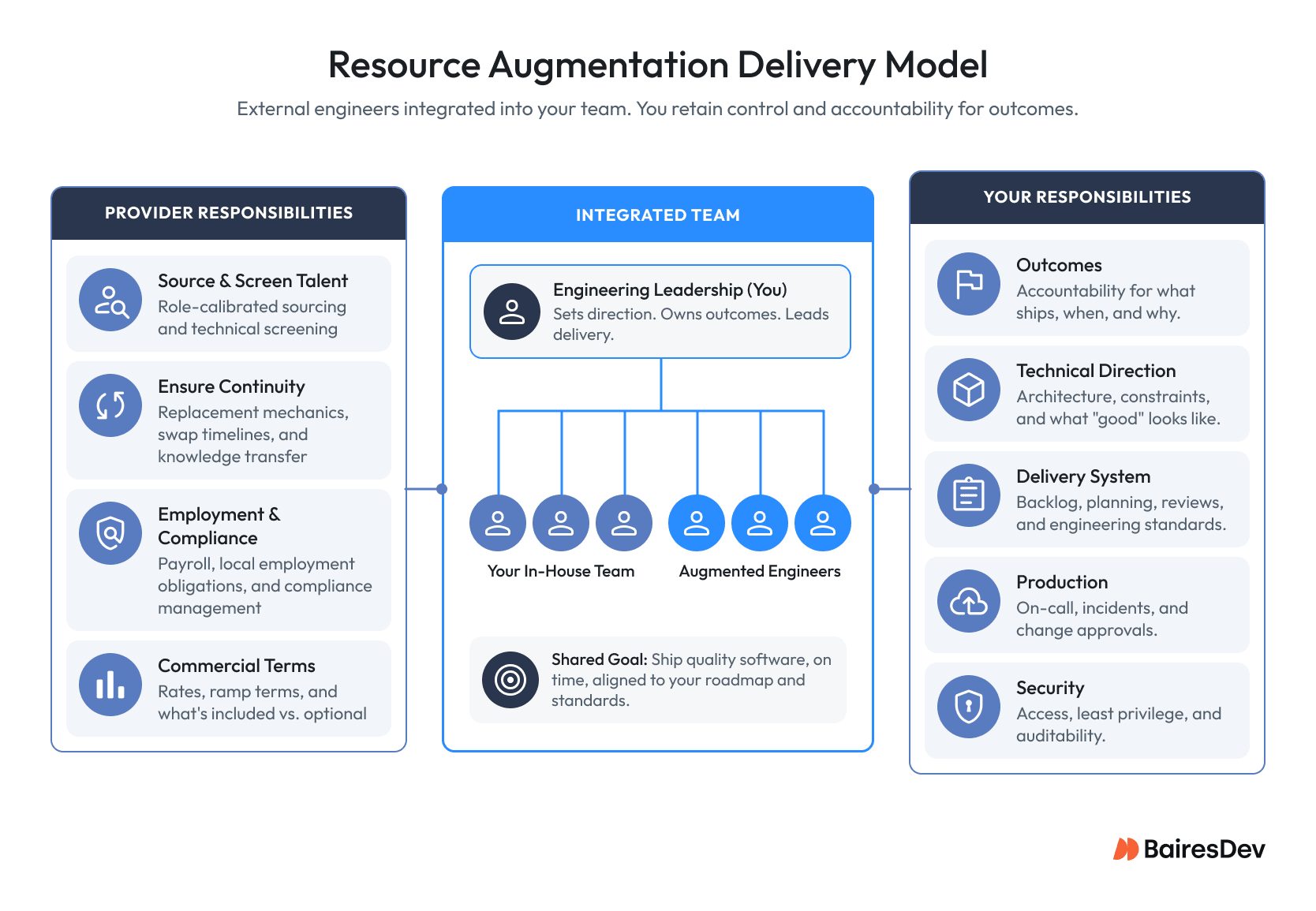
The table below maps who owns what across the key areas of an augmented engagement.
| Area | You Own | Provider Owns |
| Outcomes | Accountability for what ships, when it ships, and scope or sequencing calls when reality shifts. | — |
| Technical direction | Architecture decisions, key constraints, and what “good” looks like in code and operations. | — |
| Delivery system | Backlog quality, planning discipline, review standards, and the path from merge to production. | — |
| Production | On-call expectations, incident roles, and who can approve changes under pressure. | — |
| Security | Identity lifecycle, least-privilege access, and auditability for repositories, CI/CD, and environments. | — |
| Staffing quality | — | Role-calibrated sourcing and screening against your stack and seniority requirements, rather than keyword matching. |
| Continuity | — | Replacement mechanics, swap timelines, and knowledge-transfer handling. |
| Employment wrapper | — | Payroll, local employment obligations, and the contractual wrapper. |
| Commercial terms | — | Rate structure, ramp-up/ramp-down terms, and what’s included versus optional. |
Buying Capacity vs. Buying an Outcome
The clearest dividing line is simple: in resource or talent augmentation, you’re buying capacity that operates under your engineering leadership. In outsourcing, you’re buying an outcome the vendor agrees to deliver.
That difference shows up most clearly when things change. If a new compliance requirement mid-quarter forces a redesign, augmented staff will pivot as part of your existing team, but you still own the tradeoff and the release risk. In project outsourcing, more of that delivery responsibility typically shifts to the vendor. The common procurement distinction is resource-based engagement versus a statement-of-work outcome.
Governance shifts toward contract terms, acceptance criteria, and change control, and the vendor may absorb more sequencing and coordination. But don’t expect a vendor to own timelines and scope while you retain sprint-level control. That creates an escalation loop where delivery issues become contract debates.
Many engagements are hybrid. Time-and-materials work can include vendor leads, and outsourced projects can still depend heavily on your product and platform teams. The important thing is to make ownership explicit before work starts: who makes priority calls, who approves architecture changes, who owns scope decisions when requirements shift, and who carries delivery risk.
Choosing an Engagement Model
Teams often collapse these models into one bucket, then are surprised when the engagement still consumes as much engineering-manager and tech-lead time as before. The practical difference is who absorbs coordination and accountability when things change. If you don’t choose based on that distinction, you can increase the workload on the internal people you were trying to protect.
Resource or Staff Augmentation
You add individual engineers and run them like other engineers in the squad. You own planning, architecture, and release decisions day to day. This is the highest-control, highest-accountability model and the best fit for teams with strong internal ownership and bounded skill gaps.
Dedicated Team
A dedicated team is a vendor-supplied pod that can absorb more coordination within itself, for example through a vendor tech lead or QA lead coordinating execution. You still need clear interfaces to your architecture, security, and release processes. This works well for longer-horizon product work where the scope and operating model are relatively stable.
Managed Delivery or Project Outsourcing
The provider takes responsibility for delivering an agreed outcome. You govern through the statement of work, acceptance criteria, and change control rather than sprint-level direction. This is the right model when you want the vendor accountable for project delivery, not simply for providing people.
A useful selection test is this: if your organization can’t reliably provide backlog clarity and technical decision-making bandwidth, adding augmented resources won’t fix the problem. It will expose the gap faster because every unanswered question becomes blocked work.
Engagement Model Comparison
| Model | Who Runs Day-to-Day | Who Owns Delivery Accountability | Best Fit |
| Staff augmentation | Your engineering leads | You | Bounded skill gaps, surge capacity, time-boxed migrations |
| Dedicated team | Vendor TL + your architecture input | Shared through clear interfaces | Longer-horizon product work with relatively stable scope |
| Managed delivery | Vendor PM or delivery lead | Vendor, governed by SOW | Discrete outcomes where you want to govern through acceptance criteria |
How the Resource Augmentation Model Works
Engagements can drift when speed becomes the only selection criterion. Resource augmentation is a two-part system: a provider supplies screened engineers and the employment wrapper, while you run those engineers through your development process. When “how fast can they start?” crowds out “how well will they integrate?”, your tech leads can end up carrying the onboarding load themselves.
Calibrate the Role to the System
Start by defining the role against the actual work, not the job title. “Senior backend engineer” means something different when the work involves payment flows with PCI constraints than when it involves a low-criticality internal service.
Define the specific skills, experience, and operating context the role requires before recruiting augmented resources. The right resources are not simply people who match a technology list. They need the skill sets required for the specific project and the ability to work within your development process.
If the resource augmentation provider can’t put actual candidates in front of your tech leads, rather than representative profiles, you’ll only learn about gaps after your engineers are doing the cleanup.
Treat Onboarding as the Critical Path
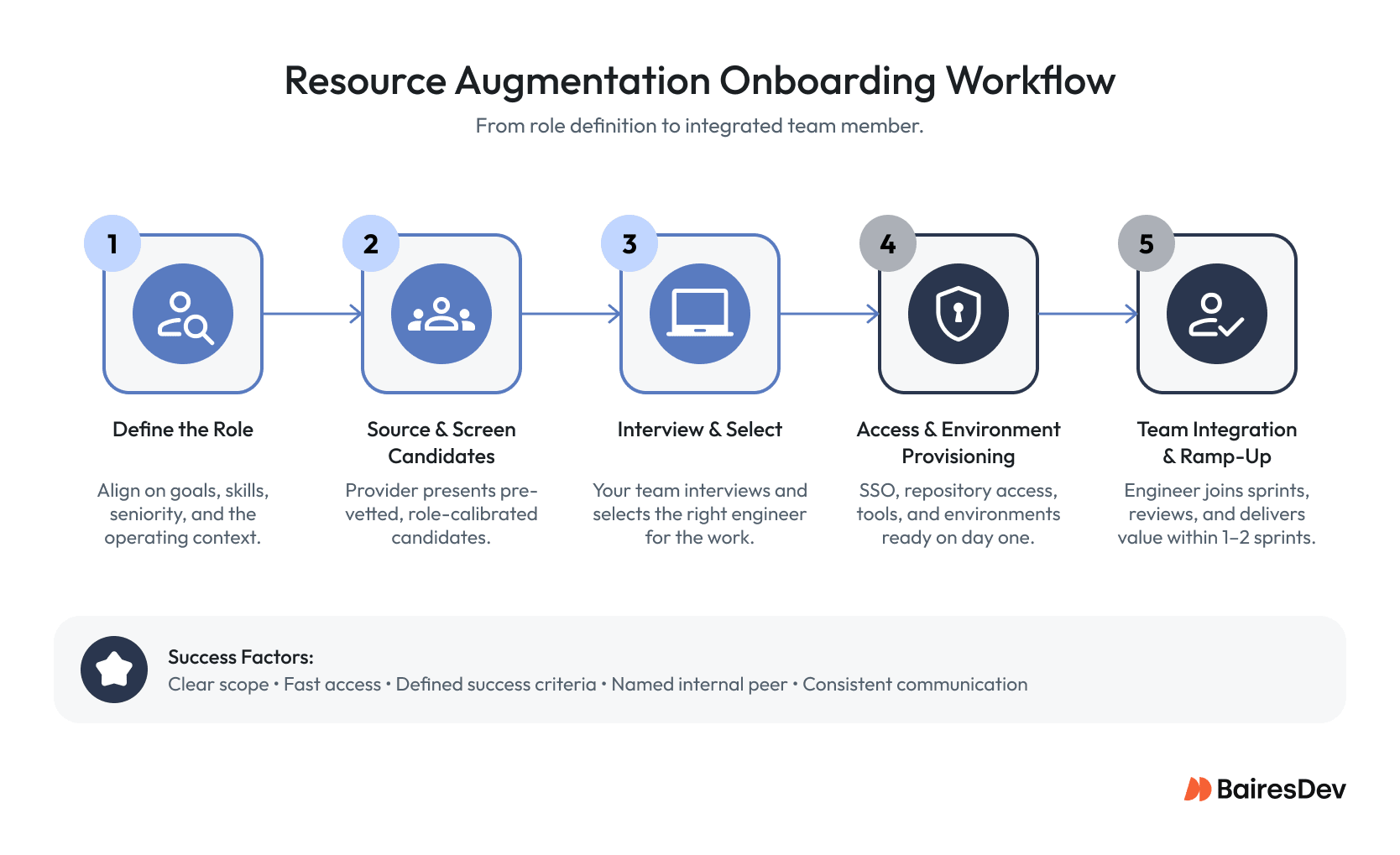
Include SSO and repository access, clear success criteria, and a defined ramp period in your onboarding plan. If pull requests queue because access tickets haven’t cleared, lead time won’t improve regardless of how many engineers you add.
This is where resource augmentation engagements can lose weeks they never recover. The goal isn’t simply to get external professionals through the door. It’s to get them contributing to the development team with the context, access, and decision paths they need.
Get Commercial Terms Right
Resource augmentation pricing typically runs on time-and-materials rates and can be a cost-effective strategy for organizations that need flexibility without long-term hiring commitments. Before signing, validate that the resource augmentation partner can repeatedly deliver skilled IT talent without creating onboarding friction, review bottlenecks, or unnecessary operational costs.
The commercial terms should also cover ramp-up and ramp-down, replacement procedures, continuity expectations, and what ongoing support the provider supplies. A lower rate does not create cost efficiency if your engineering managers and tech leads spend their time compensating for weak sourcing or integration.
The Business Case: Why Organizations Use Resource Augmentation
The talent shortage is one factor driving interest in resource augmentation. According to ManpowerGroup’s 2025 Talent Shortage Survey, 72% of IT employers globally report difficulty filling skilled technical roles, the highest shortage rate of any tracked industry. In the US, engineering roles average 62 days to fill, and nearly 40% of senior-level positions take 90 days or more. For organizations evaluating engineering outsourcing options, the cost and speed comparison against permanent hiring can be significant.
The cost-efficiency case depends on what you’re comparing. Recruitment fees, employee benefits, payroll taxes, onboarding costs, and ramp-up time all contribute to the fully loaded cost of hiring in-house. The first-year cost of a senior US-based engineer can exceed $200,000.
Resource augmentation can provide access to comparable experience without the long‑term costs associated with permanent hiring, and organizations report meaningful reductions in labor and overhead expenses when using external talent for time‑bound work.
For a short-lived workload, the economics can favor augmentation because you’re paying for capacity during the period you need it rather than adding a permanent employee to the workforce. For longer-term needs, the calculation becomes more dependent on rates, utilization, continuity, management overhead, and the value of retaining knowledge internally.
For teams that are already overcommitted, a 62-day hiring cycle isn’t simply a recruiting problem. It can become a delivery problem. A staffing partner that can provide pre-vetted, role-calibrated engineers quickly can shorten the time between identifying a capacity gap and beginning the work. With a well-run onboarding process, many engineers can begin contributing meaningfully within one to two sprints.
Where to Use Resource Augmentation, and Where to Avoid It
Resource augmentation solutions fit when you can bound the surface area, define project objectives clearly, and match the right external professionals to a specific workload.
Pulling in two senior data engineers for a 10-week CDC pipeline build, or bringing in augmented engineers to close a compliance deadline or support a product launch sprint, works because ownership and interfaces are already established.
Avoid resource augmentation when the work lacks clear ownership, stable project management, or alignment around business goals. If you don’t have a stable product owner, clear architecture direction, or sufficient bandwidth within your internal teams, adding external resources may increase coordination overhead instead of accelerating project delivery.
Use this as a quick fit filter:
- Good fit: Time-bound skill gaps, on-demand engineering capacity for a known backlog, and migrations with clear internal design authority.
- Likely to break: Architecture-defining roles on core systems such as identity, billing, or shared platform primitives, where decisions create long-lived constraints.
- High-friction zones: IP-sensitive R&D or novel product bets where tacit context and tight iteration matter more than raw capacity.
- Moderate fit with active management: Ongoing feature development on a stable product with a named internal tech lead.
Common Reasons Resource Augmentation Fails
Resource augmentation and staff augmentation services are often presented as a straightforward way to add engineering capacity, but unsuccessful engagements frequently fail for operational reasons rather than talent reasons. The engineers aren’t necessarily the problem. The delivery environment is.
Unclear Ownership
When product priorities, architectural direction, or decision-making authority aren’t clearly defined, augmented staff spend more time waiting for answers than delivering value. Adding external engineers doesn’t eliminate ambiguity. It amplifies it.
Weak Onboarding and Access Processes
Many organizations underestimate how much productivity depends on access provisioning, documentation, and team integration. Delays in repository access, environment setup, or review permissions can consume the first several weeks of an engagement.
Insufficient Review Bandwidth
Adding engineers increases output only if the development process can absorb additional contributions. When code reviews queue behind a small number of internal approvers, lead time can stay flat despite increased headcount.
Treating Capacity as Strategy
Staff augmentation can help execute a plan. It can’t create one. Organizations that use external resources to compensate for unclear product direction, unresolved architectural questions, or weak engineering leadership rarely achieve the outcomes they expect.
The strongest engagements combine skilled external engineers with strong internal ownership, clear project objectives, and a delivery process capable of integrating new contributors efficiently.
Operating Model: Integrating External Engineers Into Sprints, Reviews, and On-Call
Resource augmentation pays off once you standardize how augmented engineers participate in planning, reviews, releases, and incident response. If you onboard them as temporary capacity but expect production-grade outcomes, review backlogs can grow, pull requests can queue on a single internal reviewer, and sprint commitments can slip.
An augmented platform engineer might draft meaningful CI improvements on day three, but if they don’t know your rollout gates or aren’t included in incident drills, you’ve made the process slower and riskier. The minimum operating rules below are the same ones that govern high-performing distributed engineering teams.
The Minimum Operating Rules
Once responsibilities are clear, the next challenge is consistency. Successful augmentation engagements establish a small set of operating rules that govern planning, reviews, releases, and incident response.
- Sprints and planning: Put augmented engineers in the same planning sessions, standups, and retrospectives as the squad that owns the code. Assign a bounded service, component, or platform capability, not just a queue of tasks.
- Review authority and merge rights: Define who can approve what. Letting augmented engineers approve changes within their owned module can be reasonable; requiring an internal owner for cross-cutting changes such as shared libraries, authentication paths, or data-model migrations provides an important guardrail.
- One definition of done: Make tests, observability, and rollout steps non-negotiable for everyone. If “done” means something different for external engineers than for internal ones, you’re creating rework debt.
- On-call and incident participation: Decide upfront whether augmented engineers are secondary-only, primary after a ramp period, or not on-call. Even if they’re not paging, include them in incident channels and postmortems for systems they touch.
- Security and access: Treat identity and permissions like production changes. Use SSO where possible, least-privilege role-based access, and auditable logs for repositories and cloud consoles. IP protection starts here, not only in the contract.
What to Measure So You Know It’s Working
You don’t need a separate scorecard for augmented resources. Watch whether delivery speed improves without damaging reliability. Track your DORA metrics before and after adding staff augmentation capacity. If the numbers move in the wrong direction, inspect the integration points before assuming you need more headcount.
- Lead time for changes: If it doesn’t improve, look for review queues, environment friction, or unclear ownership within the development team.
- Deployment frequency: If it stays flat, your release gates or handoffs may not have scaled with the added contributors.
- Change failure rate: If it rises, your definition of done, test strategy, or blast-radius controls may not be holding.
- MTTR: If it worsens, examine incident roles, access, and operational context sharing.
A useful test is simple: if an augmented engineer’s change causes a Sev2 during off hours, is there a clear, agreed-upon path for who triages it? If the answer is unclear, the resource augmentation operating model isn’t ready, regardless of how good the engineers are.
Beyond metrics, look for operating signals. A named internal owner should be able to make priority calls without escalating outside engineering. Negative movement in lead time, failure rate, or MTTR is an integration signal, not necessarily a headcount signal.
What to Look for in an Augmentation Partner
Before signing, validate that the resource augmentation provider can repeatedly deliver engineers without creating review drag or onboarding friction. Rate and logos are incomplete filters. They tell you something about commercial positioning and market presence, but not necessarily about delivery quality.
| Evaluation Criteria | What to Verify |
| Screening rigor | Who runs technical interviews? Can you see role-relevant exercises, rubrics, or pass-rate information? |
| Senior coverage | Who unblocks P0 incidents, data migrations, and performance regressions? Ask about staff/principal access, escalation paths, and time to engage. |
| Bench depth | How quickly can they source the same Staff iOS engineer, Kubernetes SRE, or Kafka specialist again if you need to add or replace one? |
| Named resources | Do you interview the exact engineers who will start, and are they the ones who show up on day one? |
| Continuity SLA | What’s the replacement timeline in practice, and what structured handover do you receive during a swap? |
| IP and security posture | How are NDAs structured? What access governance, data-residency controls, and audit trails does the provider maintain? |
| Time-zone alignment | How many overlapping hours are available each day? What’s the protocol for sprint ceremonies and urgent escalations outside core hours? |
| Onboarding support | Does the provider assign a delivery contact during the first 30 days, or does integration become your problem entirely? |
What This Model Can and Can’t Do for Your Team
Resource augmentation is a well-established delivery model for organizations that need to scale engineering capacity while retaining operational control. Its potential advantages include faster access to specialized skills, flexibility around changing project demands, and the ability to address skill gaps without immediately committing to permanent hiring.
What it doesn’t do is absorb ambiguity, compensate for weak internal ownership, or substitute for the architectural judgment your team needs to carry. Organizations that treat external engineers as a fix for unclear strategy can simply end up with more people waiting on decisions they can’t make.
Used correctly, with clear ownership, a resource augmentation partner that matches the operating standard you need, and an onboarding process that treats integration as the critical path, the model can provide a practical alternative to hiring in-house.
The real advantage is not simply access to more people. It’s the ability to add the right resources for the work at hand while keeping the technical and delivery decisions where they belong.