



Executive Summary
This article argues that AI adoption fails when treated as a headcount reduction strategy. It proposes a role architecture for AI-first teams built around two archetypes, AI Product Builders and AI Operators, supported by explicit governance ownership. It also outlines a three-step model for mapping AI adoption to business outcomes.
Many companies are making the same mistake with AI: they are treating it as a headcount reduction strategy before redesigning how work actually gets done.
At first, the math looks compelling. If AI can absorb more work, why should the organization stay the same size? But cutting roles does not automatically remove the work those roles were coordinating. In practice, the work redistributes quickly.
AI-driven QA automation needs better structured requirements before it can be useful. AI-assisted design needs a more holistic design system so the tools understand context, patterns, and constraints. AI-generated code still needs senior engineers to review it. Sometimes those engineers add missing non-functional requirements. Sometimes they rewrite large portions of the output entirely.
I have seen this show up as a productivity gain that looked real in the sprint report but fragile in the review queue. The team had AI producing more tests, designs, and code, yet two senior engineers were quietly absorbing the judgment work: tightening non-functional requirements, correcting architecture assumptions, and rewriting output that looked complete but was not safe to ship. That was the signal that the cut had changed staffing, not the production system.
The real challenge for AI-first software teams is whether the company has redesigned roles, workflows, data, and governance around the way AI actually changes production. As companies scale AI software development, the operating model matters as much as the tools themselves.
This article lays out a role architecture for making that transition. I’ll discuss two role archetypes that anchor AI-first teams, the data and governance conditions they depend on, and a practical ownership model for mapping AI adoption to business outcomes.
What is an AI-first team?
An AI-first team is designed around outcomes, with clear ownership for AI-enabled workflows, governance, data quality, exception handling, and human judgment. The goal is to improve throughput and reliability rather than reduce headcount.
How AI Exposes Organizational Debt
Most AI productivity efforts start at the task level.
Teams use AI to write code faster, generate tests, summarize meetings, draft specs, create release notes, or speed up support responses. These are useful gains, but they do not automatically improve end-to-end delivery.
A developer may generate code faster, but if requirements are unclear, architecture is inconsistent, design patterns are fragmented, test data is unreliable, and review standards are undefined, the bottleneck simply moves. AI accelerates the visible work while exposing the hidden dependencies that were holding the system together.
This is where many companies quietly recreate the layers they tried to remove.
Senior engineers become the review layer. Product leaders become the context layer. QA becomes the requirements correction layer. Designers become the design-system enforcement layer. Operations teams become the exception-handling layer.
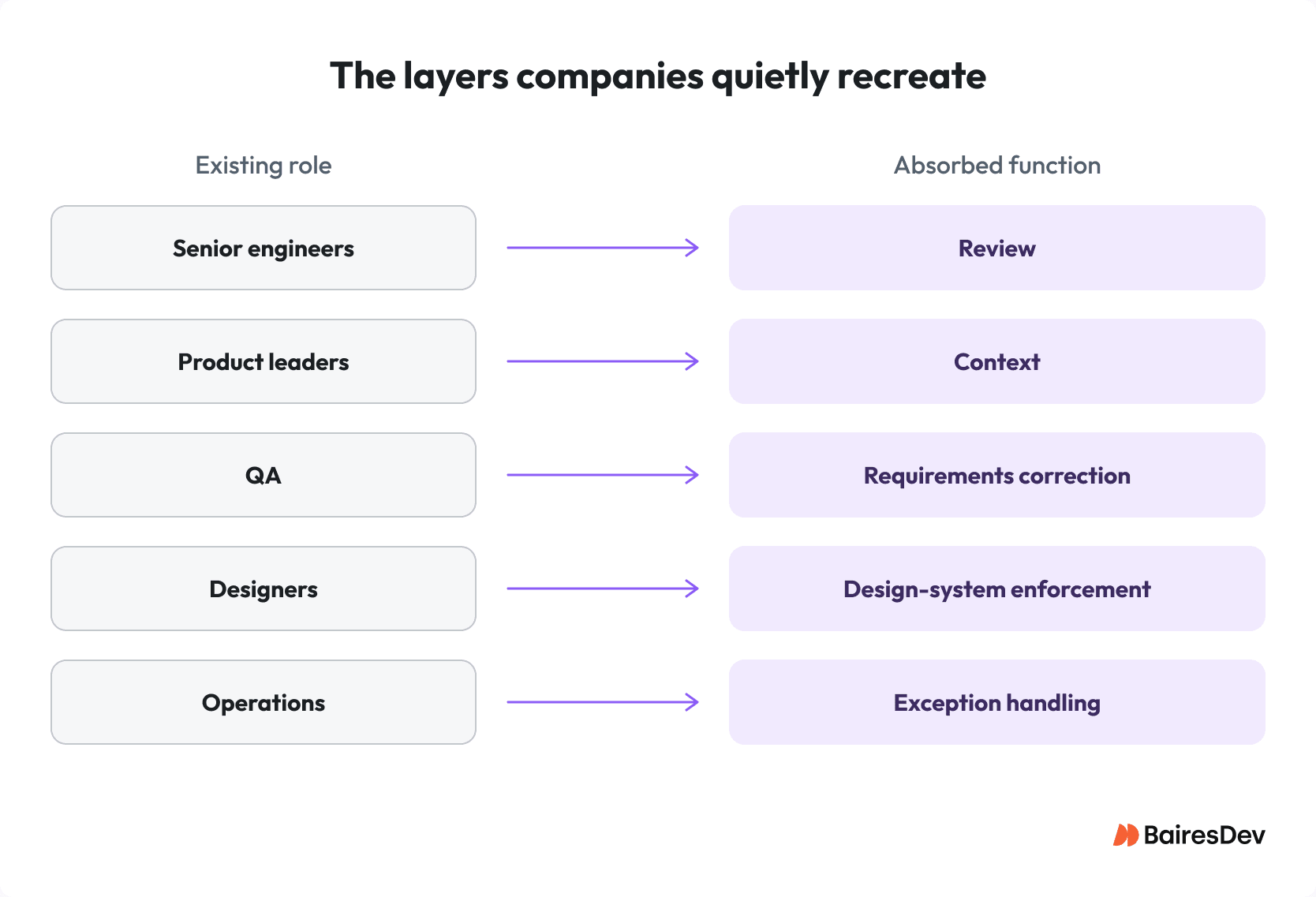
None of this means AI failed. It means the company applied AI to tasks before redesigning the operating model.
The Two Roles AI-First Teams Need
A more durable approach is to organize around outcomes. For most software organizations, two role archetypes are becoming essential. These are the AI Product Builders and AI Operators.
AI Product Builders turn AI capability into shippable product outcomes. They combine engineering judgment, product context, and architecture awareness to compress the distance between a customer problem and production software. They use AI throughout that cycle, but their value is the compression itself, resulting in fewer handoffs, faster iteration from concept to measurable result.
I saw the impact of this role during an incident in a legacy payment gateway integration. A major partner flagged a payload discrepancy that was causing transaction failures. Under a traditional model, the fix would have taken weeks of spec writing, schema reviews, and manual field mapping. An AI Product Builder fed the partner’s 100-page integration spec into a coding assistant, isolated the validation requirements, and generated a unit-testing suite within two hours. Human effort focused on code review and architecture safety. The production-ready fix shipped in under 24 hours.
AI Operators, on the other hand, make sure AI-enabled workflows stay reliable after deployment. They monitor outputs, manage exceptions, validate performance, and identify where human intervention is still required. As AI moves into product, support, QA, data operations, and customer workflows, the operator’s job is to ensure the system produces auditable, customer-safe results.
I saw of this during an automated client onboarding rollout. Billing notifications confused several new users, and the AI support bot treated the resulting questions as standard queries, resolving them individually. An AI Operator monitoring the weekly onboarding cohort spotted a spike in account setup stalls and recognized the pattern as broader user anxiety the bot was not equipped to address. The Operator paused the messaging pipeline and coordinated with the product team to adjust the notification template before the confusion turned into churn.
Together, these roles create a tighter loop, from building and deploying the workflow to monitoring performance and improving the system.
Both roles depend on the quality of the environment they operate in. And for most organizations, that environment has gaps.
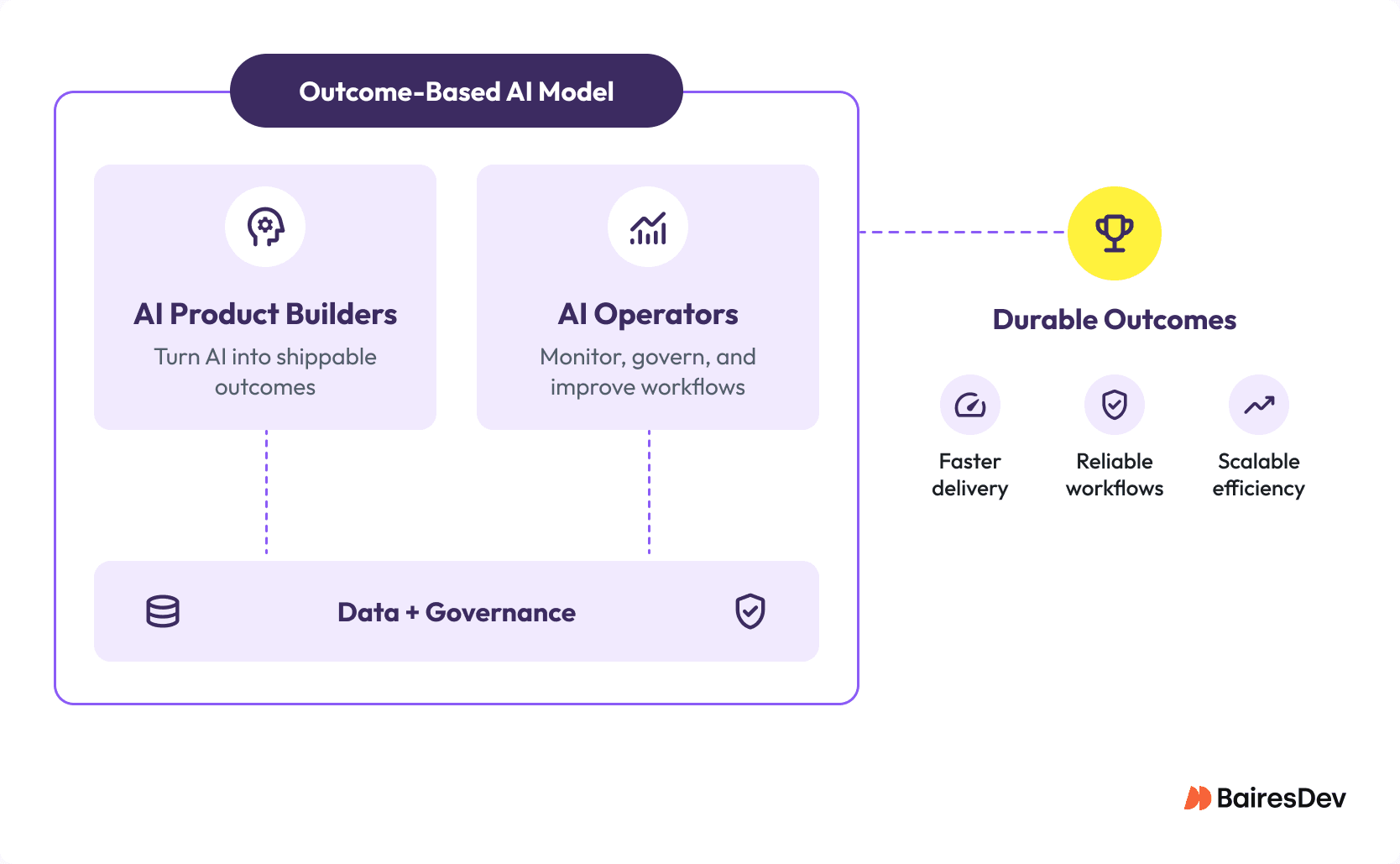
An outcome-based AI model connects AI project builders, AI operators, and the data and governance foundation required for durable outcomes.
Governance Is Not Optional
The roles described above depend on the quality of the environment they operate in, and most organizations have gaps. The most consequential gap is usually governance.
For CTOs and engineering leaders, governance needs to be built into the architecture from the beginning. The goal is defining the rules that allow teams to move faster without creating uncontrolled risk.
At minimum, every AI-enabled workflow needs clear answers to four questions:
- What is the AI system allowed to do?
- What data is it allowed to use?
- Who validates the output?
- Who owns the outcome when something goes wrong?
These questions apply everywhere AI touches the product development cycle. Requirements, designs, code, tests, and customer-facing workflows all need review standards, guardrails, and escalation paths appropriate to the risk they carry.
When the team gets smaller, these governance gaps don’t shrink proportionally. They surface unevenly. Operational teams move faster with the tools while compliance holds back because risk was never scoped into the workflow. The result is AI adoption that varies by team appetite rather than process readiness. That is how a headcount decision becomes a process quality problem.
Governance gaps become manageable once ownership is explicit.
How to Map AI Roles to Business Outcomes
Companies do not need to reorganize overnight. A practical starting point is to map AI adoption against outcomes.
Map the Business Outcome
Start with the business outcome. What is the organization trying to improve? That could be delivery speed, operational reliability, or customer experience. The business outcome anchors every decision that follows.
Identify the Constraining Workflows
Then identify the workflows constraining that outcome. For example, if the target outcome is shorter implementation cycles, the model should name the workflow owners explicitly.
AI Product Builders might own configuration automation, integration templates, and implementation tooling. AI Operators would monitor exception patterns, customer-specific overrides, and handoff quality. Governance owners would define which configuration changes can be automated, which require human approval, and how decisions are logged. The outcome is faster implementation with clearer controls.
Assign Explicit Ownership
Every AI-enabled workflow needs clear ownership across three areas:
- AI Product Builders own the productized workflow, technical implementation, architecture, and delivery outcome. Data architecture is part of their scope. If the data foundation is unreliable, the workflow built on top of it is unreliable.
- AI Operators own monitoring, exception handling, workflow performance, and operational feedback. Their scope includes data quality, exception rates, and override patterns, not just whether the AI system produced an output.
- Governance owners define review standards, risk thresholds, data access, auditability, and escalation rules.
This structure prevents the common trap of using AI to create more output without improving throughput.
It also makes the hidden work visible. When AI-driven QA, design, or code generation exposes a gap like weak requirements, an incomplete design system, or missing non-functional standards, that gap becomes a named problem with an owner instead of an informal burden absorbed by senior engineers.
Where External Engineering Teams Fit
For many companies, the limiting factor is capacity.
Internal engineering teams are already balancing delivery commitments, technical debt, and the operational friction created by AI adoption itself. Asking them to simultaneously redesign workflows, modernize foundations, and build the governance structure around AI-generated output can slow adoption before it scales.
This is where external engineering teams can play a practical role.
The right partner adds experienced capacity around the areas where AI redistributes work, from upstream quality improvements like requirements structure and code review standards to infrastructure investments like data modernization and workflow observability.
Tightly collaborative teams are especially useful when speed and working rhythm matter. Time-zone alignment, communication quality, and day-to-day overlap make it easier for external engineers to work alongside internal teams as the operating model evolves. External teams are most valuable when they extend execution capacity without taking ownership of the judgment that makes the business distinct.
That distinction matters.
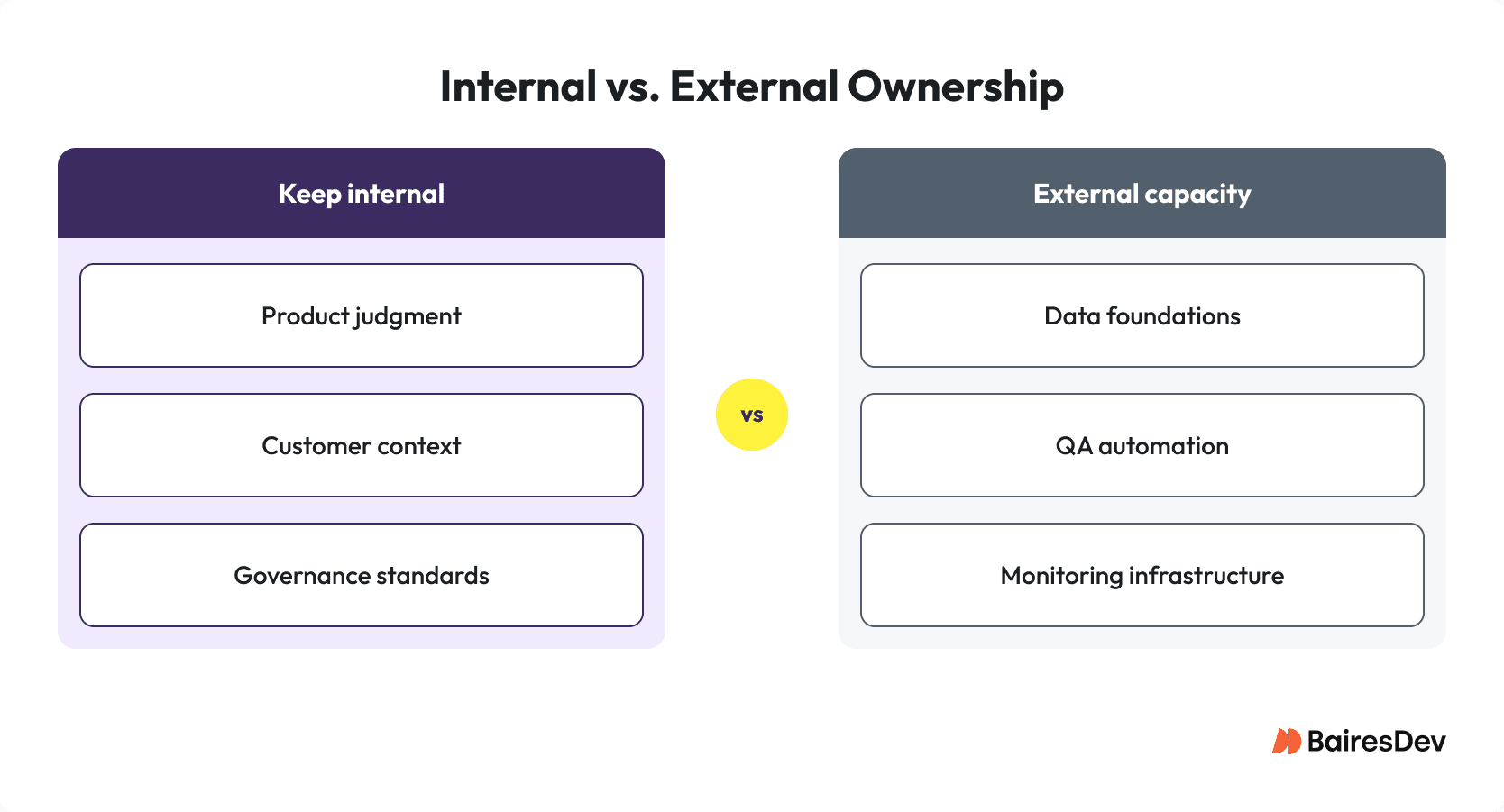
Companies should retain the tribal knowledge that defines how their product works, how customers operate, where risk lives, and which exceptions matter. They should also retain control over the decisions that shape customer trust and company risk, from product judgment and governance standards to core technical direction.
The better use of an external partner is to help turn those internal decisions into working systems. That could mean building the data foundations AI tools need, the QA automation that makes AI-generated code safer to ship, or the monitoring layer that gives AI Operators visibility into workflow performance.
In this model, internal teams own the controls. External teams help build the operating leverage.
From Fewer People to Better Outcomes
Companies that choose to reduce headcount without first redesigning the operating model will watch the same work reappear informally. The ones benefitting the most from AI will be the ones that decide deliberately where judgment must stay human, where automation can safely scale, and how workflows are measured against the outcomes they are supposed to produce.
That is the shift from labor savings to operating leverage.
Key Takeaways
- Cutting roles does not remove the work those roles were coordinating; it redistributes the burden upstream and downstream onto senior engineers and operators.
- AI Product Builders compress the distance between customer problem and production software; AI Operators ensure AI-enabled workflows stay reliable after deployment.
- Governance must be built into AI-enabled workflows from the start, with clear answers to who validates output and who owns the outcome when something goes wrong.
- A practical role architecture maps AI adoption in three steps: define the business outcome, identify constraining workflows, and assign explicit ownership across Builders, Operators, and governance.
- External engineering teams are most valuable when they extend execution capacity without taking ownership of the judgment, customer context, and strategic direction that make the business distinct.