

Key Takeaways
- Kubernetes architecture separates the control plane from worker nodes, and that split determines how failures behave, how incidents unfold, and who needs to respond.
- The control plane components collectively enforce desired state and represent the cluster’s most critical operational dependency.
- Worker nodes run the actual containerized applications, and their reliability depends on kubelet health, container runtime stability, and correct network rules via kube-proxy.
- Most operational risk stems from misconfiguration and weak platform governance, so leaders need strong engineering discipline around networking, cluster state, access control, and cloud integration layers.
Running applications at scale has always been difficult. Servers fail, traffic spikes, deployments break, and teams spend more time firefighting than shipping. Kubernetes was designed to reduce that burden by providing a distributed control system that manages containers across multiple nodes, enforces desired state, and automates recovery.
But Kubernetes introduces architectural complexity. Its internal components interact in ways that aren’t always obvious, and when something goes wrong, the root cause often sits several layers below the surface.
For engineering leaders, understanding Kubernetes architecture isn’t about becoming an operator. It’s about knowing how the control plane governs cluster state, how worker nodes execute workloads, and where systemic risk concentrates. That clarity helps you evaluate delivery risk, define ownership boundaries, and make informed decisions about staffing, tooling, managed services, and long-term platform strategy.
Kubernetes Architecture at a Glance
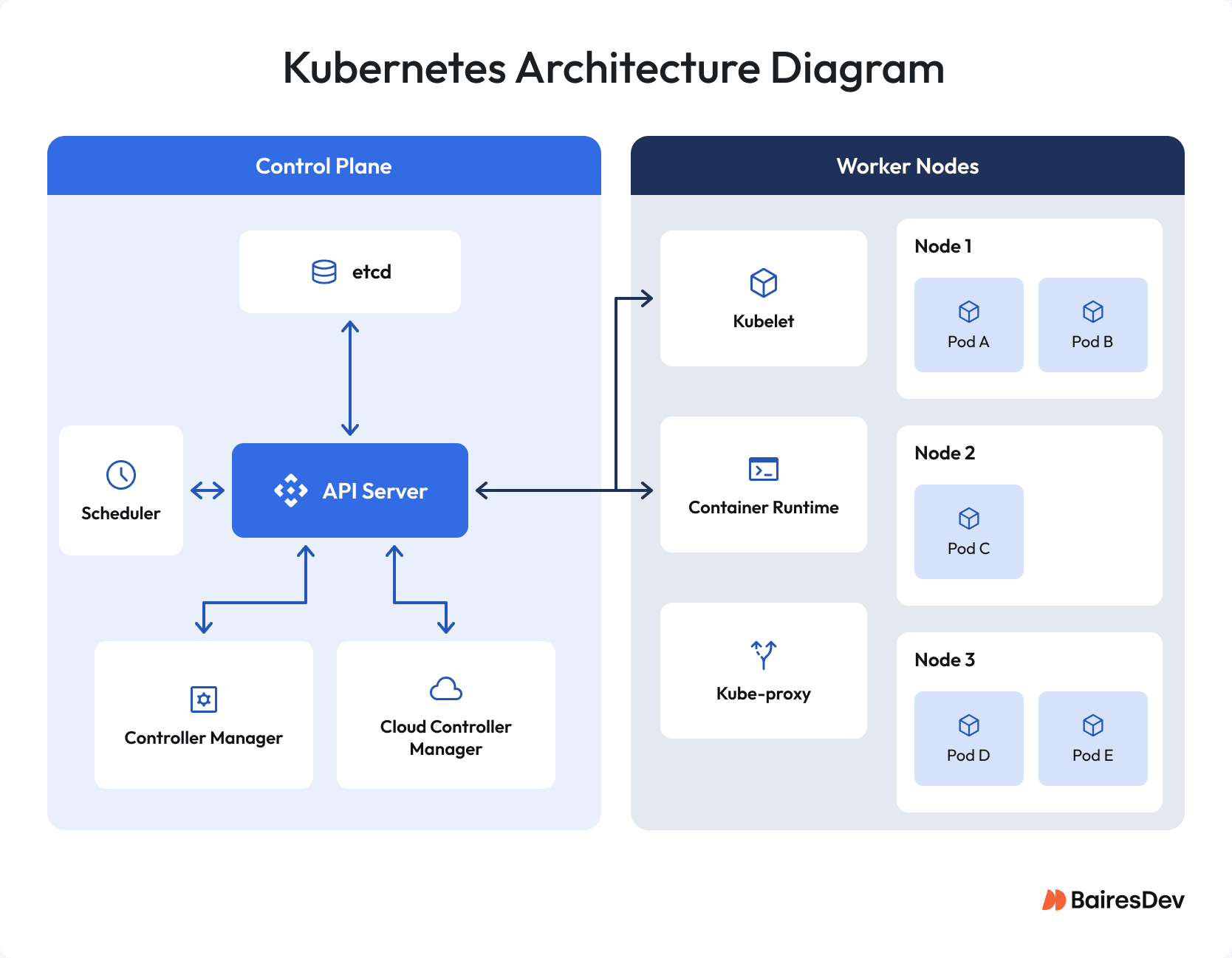
Kubernetes architecture consists of two major layers: the control plane and the worker nodes. The control plane manages the desired state of the cluster, while worker nodes run the containerized applications.
This separation is foundational. It determines how failures behave, how recovery works, and how responsibilities should be divided across teams or vendors.
Control Plane vs. Worker Nodes
The control plane is the brain of the Kubernetes cluster. It stores cluster state, makes scheduling decisions, and continuously reconciles what’s running with what should be running. It doesn’t run application workloads; it governs the logic that ensures they run correctly.
Worker nodes are the muscle. They run containers, report health, and execute the instructions sent by the control plane.
When a worker node fails, Kubernetes reschedules workloads to other nodes. When the control plane fails, the cluster stops responding to changes, even though existing workloads may continue running. That distinction matters during incidents.
A node failure is operational. A control plane failure is systemic.
If you’re using a managed Kubernetes service like GKE, EKS, or AKS, the cloud provider operates the control plane. Your team owns the worker nodes and everything that runs on them. This division of responsibility affects incident response, compliance scope, SLA evaluation, and cost management. Many leadership teams underestimate how much operational ownership remains on the customer side.
Control Plane Components
The control plane consists of several components that work together to manage cluster state: the Kubernetes API server, etcd, the scheduler, the controller manager, and the cloud controller manager. Together, they implement Kubernetes’ reconciliation model.
Kubernetes API Server
The Kubernetes API server (kube-apiserver) is the single entry point for all cluster operations. Every request, whether from kubectl, internal controllers, CI/CD systems, or external tools, flows through the API server.
This centralization makes the system auditable and predictable. It also creates a critical dependency. If the API server becomes unavailable or degraded, deployments stall, autoscaling decisions pause, and configuration changes cannot be applied.
The API server exposes the Kubernetes API over secure protocols and enforces authentication, authorization, and admission control. Access tokens determine who can perform which actions. Admission controllers validate or block requests before they’re persisted.
For regulated environments, audit logging at the API layer isn’t optional. It’s the authoritative record of who changed what and when.
etcd: The Distributed Key‑Value Store
etcd is the distributed key‑value store that holds the entire cluster state. It stores Kubernetes objects, configuration, secrets, and metadata. Only the API server communicates directly with etcd.
In production, etcd typically runs as a highly available cluster that relies on quorum. If quorum is lost, write operations fail and the cluster effectively becomes read-only. Running workloads may continue, but no new workloads can be scheduled and no configuration changes can be applied.
Aqua Security’s 2023–2024 investigation found more than 350 exposed Kubernetes API servers in the wild, and over half had already been breached with active malware or backdoors. This is a reminder that securing the control plane and its data stores, including etcd, is critical.
Backing up etcd and testing restoration procedures are essential practices in any production Kubernetes environment. Without a recoverable cluster state, disaster recovery plans are theoretical.
Scheduler
The Kubernetes scheduler assigns pods to nodes. It evaluates resource availability, constraints, affinity rules, taints, tolerations, and current cluster conditions before making a placement decision.
The scheduler doesn’t start pods; it records where they should run. The kubelet on each node handles actual execution.
A pod stuck in Pending usually indicates a scheduling or resource availability issue, e.g., insufficient CPU, memory, or conflicting constraints. A pod stuck in CrashLoopBackOff typically reflects a node‑level or application‑level problem.
For leadership teams, persistent Pending states are often early signals of capacity planning gaps or autoscaling misconfiguration.
Kube Controller Manager
The kube controller manager runs Kubernetes controllers, control loops that reconcile desired state with actual state. These include the deployment controller, node controller, endpoints controller, and token controllers.
Controllers continuously monitor the cluster and take corrective action when something drifts from the declared state. This reconciliation model is what gives Kubernetes its self-healing behavior.
If a node fails, the node controller detects it and reschedules affected pods. If a deployment loses replicas, the deployment controller restores them.
This automation reduces manual intervention, but only if the desired state is correctly defined. Misconfigured deployments replicate mistakes at scale.
Cloud Controller Manager
The cloud controller manager integrates Kubernetes with cloud providers. It provisions load balancers, manages network routes, and synchronizes node metadata with the cloud provider’s API.
If you’re running Kubernetes in a private data center, you don’t need the cloud controller manager, but you will need alternative solutions for load balancing, routing, and infrastructure integration.
Misconfiguration at this layer can create subtle but costly issues, such as orphaned load balancers, misrouted traffic, or unnecessary cloud spend.
Worker Node Components
Worker nodes run the workloads that users interact with. Each node includes the kubelet, the container runtime, and kube-proxy.
Kubelet
The kubelet is the node agent responsible for running containers. It receives pod assignments from the scheduler and instructs the container runtime to start containers. It also reports node and pod health back to the API server.
If nodes appear healthy but workloads aren’t starting or reporting correctly, kubelet logs are often the first place to investigate.
At scale, kubelet instability can cascade into broader availability issues, especially in tightly resourced clusters.
Container Runtime
The container runtime runs containers on each node. Kubernetes communicates with it through the Container Runtime Interface (CRI), which allows runtime implementations to be swapped.
Popular runtimes include containerd and CRI-O.
Runtime choice rarely changes core Kubernetes behavior, but it can influence image lifecycle management, security tooling compatibility, and operational debugging workflows.
Kube‑proxy
kube-proxy manages network rules for Kubernetes services. It ensures traffic reaches healthy pods even as pods are added, removed, or rescheduled.
As the cluster changes, kube-proxy updates routing rules to maintain service stability. When networking behaves unpredictably, kube-proxy configuration and interaction with the CNI layer are common investigation points.
Networking and the Container Network Interface
Every pod in a Kubernetes cluster receives its own IP address. The Container Network Interface (CNI) plugin handles pod-to-pod networking and enforces network policies.
Most organizations use CNI plugins such as Calico, Cilium, or Amazon VPC CNI. According to Cilium’s 2025 Annual Report, Cilium represents over 60% of CNI deployments, more than double the next alternative.
Networking is one of the most common sources of production issues in Kubernetes environments. Policy misconfiguration, overlapping CIDR ranges, or inconsistent routing rules can create outages that are difficult to diagnose.
Services provide stable addresses for pods, and ingress controllers route external traffic into the cluster. Ingress is also where SSL termination, authentication, and URL-based routing are typically implemented, making it a common enforcement point for security and compliance controls.
How a Request Moves Through the Kubernetes System
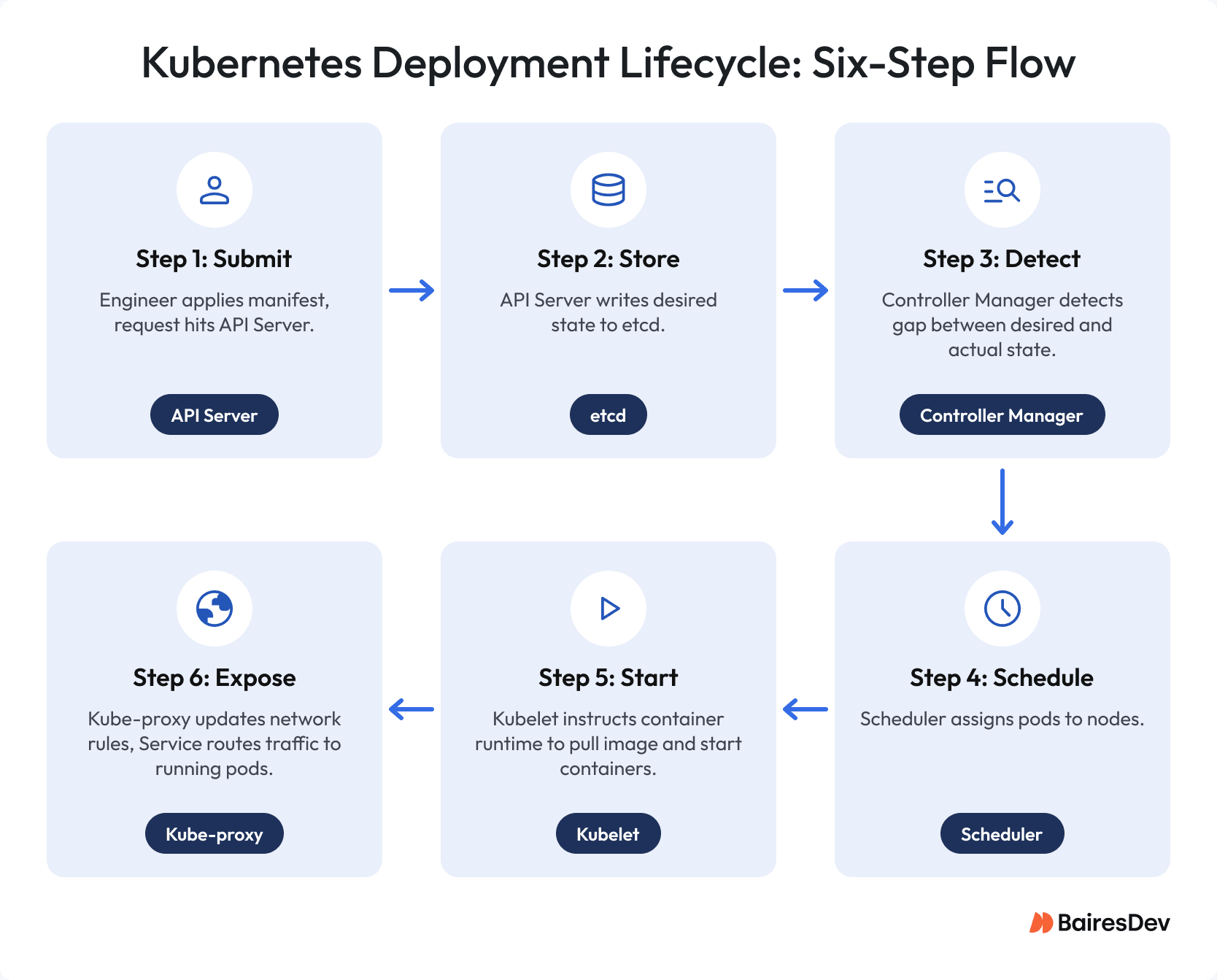
When an engineer submits a deployment, Kubernetes records the desired state in etcd via the API server and begins reconciling it with the current state.
The scheduler assigns pods to nodes. Kubelets start containers. kube-proxy updates routing rules so traffic can reach the new workloads. Controllers monitor drift and restore declared state if necessary.
Under normal conditions, this process completes in seconds. At scale, control plane latency, resource pressure, or networking bottlenecks can introduce delays that directly affect deployment frequency and developer productivity.
Operational Risks Leaders Should Watch
Kubernetes simplifies orchestration, but it also introduces new operational risks. Engineering leaders should pay attention to:
- Control plane availability and API server saturation
- etcd durability and quorum health
- CNI plugin complexity and network policy sprawl
- Node lifecycle management and autoscaling configuration
- Misconfigured cloud controller integrations
- Resource exhaustion on worker nodes
- Weak RBAC and excessive cluster-admin access
Gartner estimates that by 2026, 90% of organizations running containers will have faced a security incident caused by misconfigurations. That statistic reinforces a pattern: most outages and breaches are not caused by Kubernetes itself, but by inconsistent governance, unclear ownership, and configuration drift.
Clusters rarely fail because “Kubernetes broke.” They fail because responsibility boundaries weren’t clearly defined.
What This Means for Engineering Leaders
Kubernetes isn’t just a container orchestrator. It’s a distributed control system that governs how applications are deployed, scaled, and recovered.
Understanding the architecture helps leaders:
- Evaluate systemic delivery risk
- Define platform ownership and escalation paths
- Plan staffing and specialization needs
- Improve incident response readiness
- Optimize cost and capacity planning
- Make informed decisions about managed versus self-managed clusters
In organizations without a clearly defined platform function, Kubernetes often becomes an invisible tax on product teams. With strong ownership and governance, it becomes a force multiplier.
Where Kubernetes Shines and Where It Doesn’t
Kubernetes excels when:
- You need to run containerized applications at scale
- You require high availability across multiple nodes or regions
- You want automated recovery and declarative deployment workflows
- You need consistency across environments
It’s less suitable when:
- Workloads are small and operational overhead outweighs scaling benefits
- The organization lacks the maturity to manage distributed systems responsibly
- Multi-node scaling and automated failover are unnecessary
- Simpler managed platforms can meet reliability requirements with less complexity
Kubernetes is powerful, but it’s not free. The architectural flexibility it provides comes with operational cost.
The Strategic Bottom Line
Kubernetes gives engineering teams a consistent, automated way to run containerized applications across multiple nodes. It standardizes deployment and recovery, and it centralizes cluster state through a declarative model.
But it also introduces architectural complexity that requires clear ownership, disciplined configuration management, and strong platform engineering practices.
When the foundation is healthy, the cluster becomes resilient and predictable. When those layers are neglected, issues compound quickly.
Understanding how the control plane and worker nodes interact isn’t an academic exercise. It’s a prerequisite for running Kubernetes responsibly at scale.