


Executive Summary
AI and better tooling are compressing the old incremental learning path for junior engineers. Developing the next generation means building around end-to-end ownership, structured feedback loops, and mentoring environments that treat AI as a tool for deepening understanding rather than bypassing it. The senior engineers you’ll have in five years depend on the development system you build now.
Earlier this year, BairesDev put a pointed question to 26 senior tech leaders: in five years, where do your senior engineers come from? I’ve been sitting with that question since, because it describes exactly what I’m navigating on my own team. The decline in junior hiring, the shifting expectations, the growing pressure on early-career engineers to operate at a higher level faster. These are operational realities, and they deserve leaders’ attention.
The decline in junior roles reflects a shift in what “junior engineer” even means. Early-career engineers are being hired into a different job than the one many of today’s seniors grew up in. The center of gravity is moving away from incremental coding tasks and toward problem definition, systems thinking, and using AI to accelerate execution.
The result is a new kind of engineering edge. The people who thrive will be the clearest thinkers.
The End of the Linear Pipeline
For a long time, we treated engineering career growth as a fairly linear pipeline. You start with bug fixes and small tickets, slowly graduate to owning features, and eventually get to design systems and influence roadmaps. Implicit in that model is time: if you stay in the pipeline long enough and keep shipping, you’ll eventually become “senior.”
That premise no longer holds.
When I look at how teams today actually work, I don’t think senior engineers in five years will simply be the “survivors” of today’s junior ranks. They’ll be developed through a different system altogether.
What’s changing is the shape of early-career development. The gradual on-ramp is giving way to a much steeper curve. Junior engineers are dropped into higher-leverage problems earlier, and they’re supported by AI tooling, better abstractions, and tighter feedback loops rather than long apprenticeships in the bug tracker. Those who adapt to this environment will progress much faster. Those who don’t will struggle to find footing, even if they’re smart and hard-working. Time served matters less than judgment earned.
How the “Senior Engineer” Role Is Being Redefined
At the same time, the definition of “senior” is shifting. As more execution work becomes automated or heavily assisted, from boilerplate code to test scaffolding, the value of a senior engineer moves upstream. The job becomes less about manually producing outputs and more about steering the system.
You can see that shift in what the most effective seniors already spend their time on. They focus on system design over isolated coding tasks, thinking through the full flow of information rather than one feature at a time. They invest in problem framing before committing to implementation, spending time on “why this, why now, for whom?” before deciding “how.” And they bring user experience and product intuition alongside technical depth, anchoring decisions in user impact and business constraints rather than technical elegance alone.
If that’s the job you need your future seniors to do, then it follows that the next generation will likely be fewer in number, because AI, better tooling, and higher leverage mean you don’t need as many people doing the same work. They’ll be broader in skillset, combining technical depth with product thinking, systems thinking, and communication. And they’ll be developed through high-intensity, apprenticeship-like experiences rather than long, gentle ramps of narrowly scoped tasks.
Building is still essential. The differentiator is where and how you think before you build. That accounts for where the role is heading. It doesn’t account for what gets lost along the way.
The Institutional Knowledge Risk Leaders Can’t Ignore
There’s another piece of this story that’s easier to ignore, and that is institutional knowledge. In the old model, juniors learned by osmosis. They read code, fixed bugs, sat near seniors, and absorbed context. Knowledge lived in people and in the codebase, and there was enough overlap between generations that hand-offs happened gradually and organically.
When you compress or remove the junior layer, you create a knowledge gap that will show up three to five years from now. Who understands the weird corners of your systems? Who remembers why a counter-intuitive decision was taken? Who can reason about the long-term trade-offs embedded in your architecture?
If you aren’t deliberate, that knowledge leaves with people or gets buried in code that nobody feels confident touching. The risk is that the seniors you do have will be operating without the accumulated context that makes their judgment valuable.
How to Treat Engineering Knowledge as a System
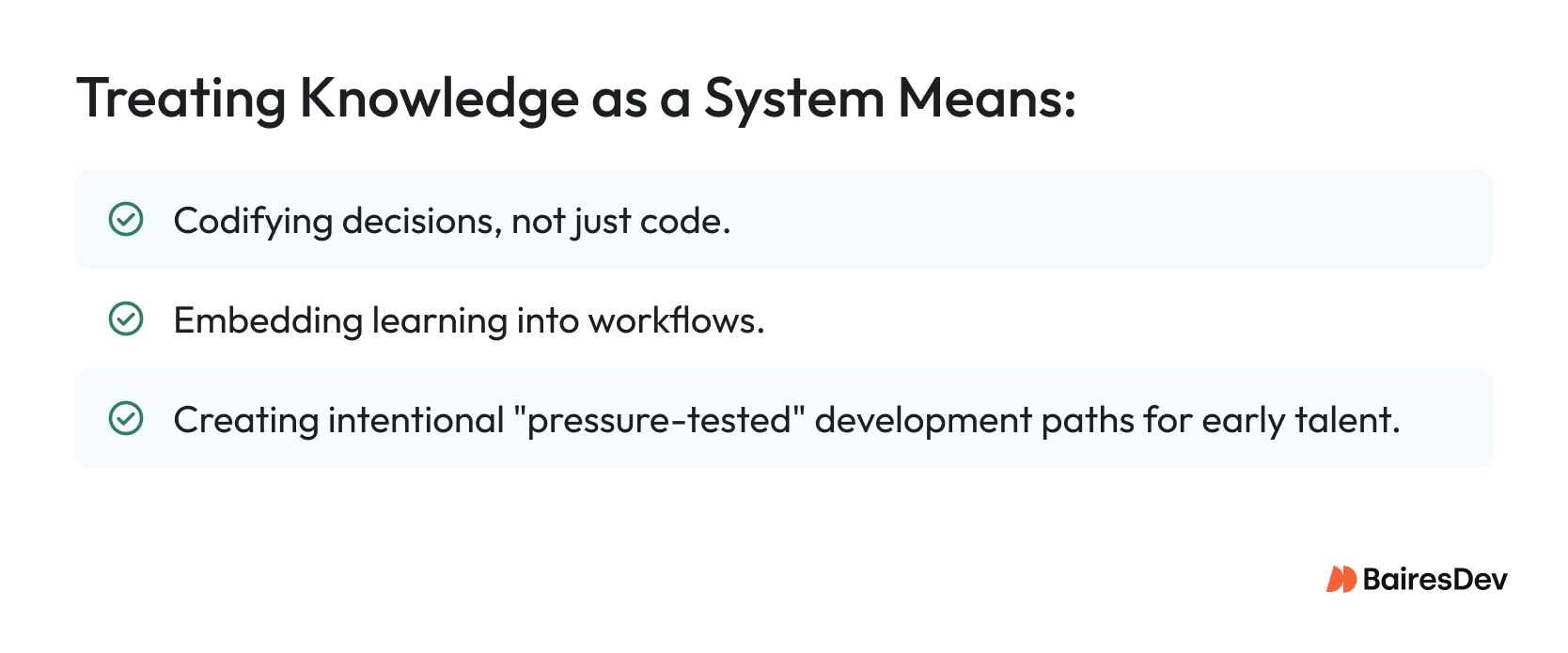
Getting this transition right means treating knowledge itself as a system rather than leaving it to chance.
That starts with codifying decisions. Capturing why you chose a particular design, what alternatives you considered, and what trade-offs you accepted matters as much as the code itself. Lightweight architecture decision records, design docs, and post-mortems make that information durable and searchable instead of trapped in someone’s head.
It also means embedding learning into workflows. Code reviews, retrospectives, design reviews, and AI-assisted documentation can all become recurring opportunities for people, especially juniors, to understand the reasoning behind the work. This means creating intentional, pressure-tested development paths for early talent with real, challenging experiences that force juniors to engage with systems and trade-offs rather than isolated tasks.
The question worth asking is whether we’re designing a system that produces senior engineers on purpose.
How to Screen Junior Engineers for Systems Thinking
If the future depends on junior engineers who can think in systems, you have to start looking for those signals much earlier, sometimes even before they’ve done much professional coding.
When my team evaluates whether a junior engineer can think in systems, we start with behavioral questions, well before anything touches a whiteboard.
A favorite prompt is: “Tell me about a time you tried to improve something, a process at work, a club you ran, a logistics problem, even a part-time job, and it turned out to be way more complicated than you expected. What happened?”
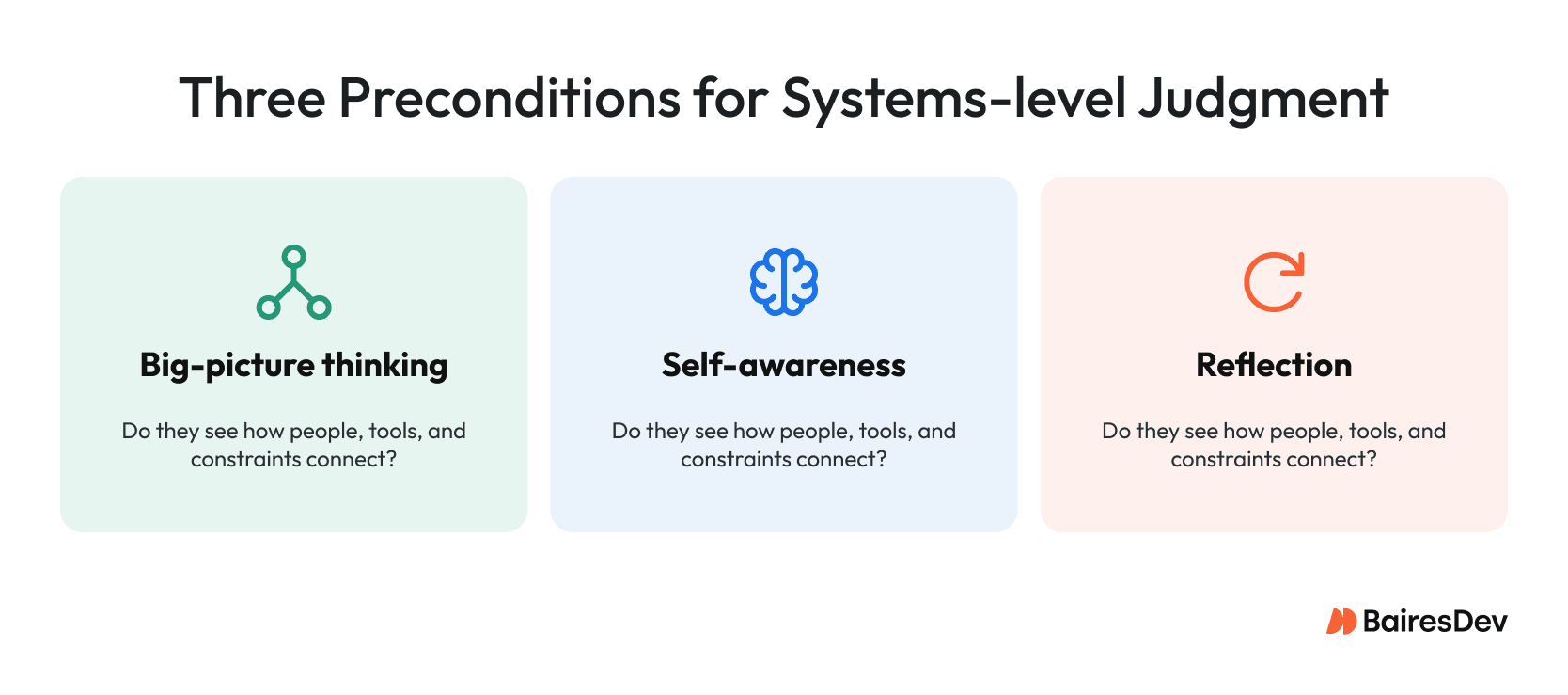
I’m listening for three specific things:
- Big-picture thinking. Do they move beyond their own task and talk about how different people, tools, and constraints were connected? Do they notice upstream inputs and downstream consequences?
- Self-awareness. Do they clearly admit, “My first assumption was wrong,” and show how their understanding evolved as they learned more?
- Reflection. Do they end with what they’d do differently next time, or do they just narrate events until things worked out? Are they extracting reusable lessons?
You don’t need a fancy example to see this. A strong answer might be reorganizing staff schedules at a retail job. They started by just shuffling shifts on a calendar. Then they realized foot traffic patterns, inventory deliveries, and staff skills all interacted in non-obvious ways. They changed how they collected data, involved the manager, tried a new rotation, and iterated on the schedule over a few weeks. In hindsight, they might say, “If I did it again, I’d start by mapping the constraints and peak times before touching the schedule.”
That story tells you they can zoom out beyond their immediate task, update their mental model as new information appears, and turn experience into improved future behavior. You can see early signs of systems thinking in how someone tells that story, how they sequence it, where they place blame or responsibility, and whether they see interdependencies or only isolated actions. The on-the-job work just makes that signal louder.
When AI Helps Junior Engineers Learn, and When It Doesn’t
I have seen junior engineers use AI at the execution layer to genuinely speed up meaningful work, but only when code reviews and architecture discussions function as genuine mentoring conversations.
The strongest junior engineers treat AI as a power tool they control. They show up to code reviews able to explain what they asked the model for, what the code does, and what they changed. That moment becomes a chance to talk about structure, trade-offs, and system impact. In design discussions, they bring AI-generated options alongside their own opinion: “Here are three approaches; here’s what I’d choose and why.” That gives us something concrete to critique and lets us coach their judgment.
The juniors who struggle look very different. They paste in whatever the model returns with minimal editing. Their pull requests read like unfiltered AI output, with inconsistent style, weak tests, and unclear structure. In review, they can’t explain why the code is written that way or what will happen if requirements change. The best they can offer is, “That’s what the model gave me.”
The gap between these two groups comes down to mindset and environment. One group uses AI to get to the interesting questions faster. The other uses AI to avoid engaging with those questions at all.
As a leader, your leverage point is how you design the environment around AI use. Set the expectation that engineers own the code, regardless of who or what typed it. Use reviews and design sessions to interrogate reasoning and trade-offs. Encourage juniors to ask AI for explanations and alternatives rather than treating it as a source of final answers.
In that environment, AI compresses the early-career learning journey rather than replacing it, if you’re intentional.
If Incremental Tasks Disappear, What Becomes the Training Ground?
Historically, incremental coding tasks were the de facto training ground. Juniors got piles of low-risk tickets, slowly absorbing the system by touching a lot of small pieces. If AI and better tooling absorb a lot of that work, you have to answer: what replaces it?
On my team, we’re replacing years of incremental ticket work with tight loops on real, smaller-scope problems where juniors own something end to end. Concretely, that means giving them small features that touch real systems. They might own a modest slice of functionality, but it’s wired into the actual architecture, with real users and real constraints, which forces them to understand the surrounding system and the design choices behind it.
It means running regular after-action reviews and post-mortems, especially for bugs that slip past verification. Those sessions walk through what actually happened, what signal we missed, and how we’d design or monitor it differently next time. And it means hands-on debugging sessions where they trace issues through logs, services, and data flows, seeing how the architecture behaves under real pressure. The emphasis shifts from “did you close the ticket?” to “what did you learn about the system?” and “how did your mental model change?”
Instead of years of low-stakes grunt work, juniors build judgment by repeatedly cycling through a simple loop. They form a hypothesis about how the system behaves, make a change, observe the impact and feedback, and update their mental model. That loop is where systems thinking and problem sense are actually built. The goal is to expose juniors to complexity in controlled, teachable chunks.
But that loop doesn’t sustain itself. It depends on how the team around it is structured.
Why Product Development and Talent Development Are the Same System
When I say teams need to adapt their development models, I mean both how they build products and how they develop people. Treating those as separate systems is part of what’s breaking down.
How the Work Is Designed
On the product development side, we’ve learned to design so humans do the thinking work and tools handle repeatable execution. Engineers focus on framing the problem, clarifying constraints, and defining success, while AI and automation take on much of the boilerplate. We also build observability and documentation from day one so that when juniors ship something or debug an issue, they can see how the system actually behaves and learn from real data.
How Growth Is Defined
On the people development side, we’ve shifted to defining growth around problem-finding and system impact. We ask, “What problems did you help define or de-risk this quarter?” instead of measuring progress purely in story points. And we explicitly teach how to think by breaking down problems, asking good questions, evaluating trade-offs, and using AI as part of a deliberate workflow rather than a shortcut around understanding.
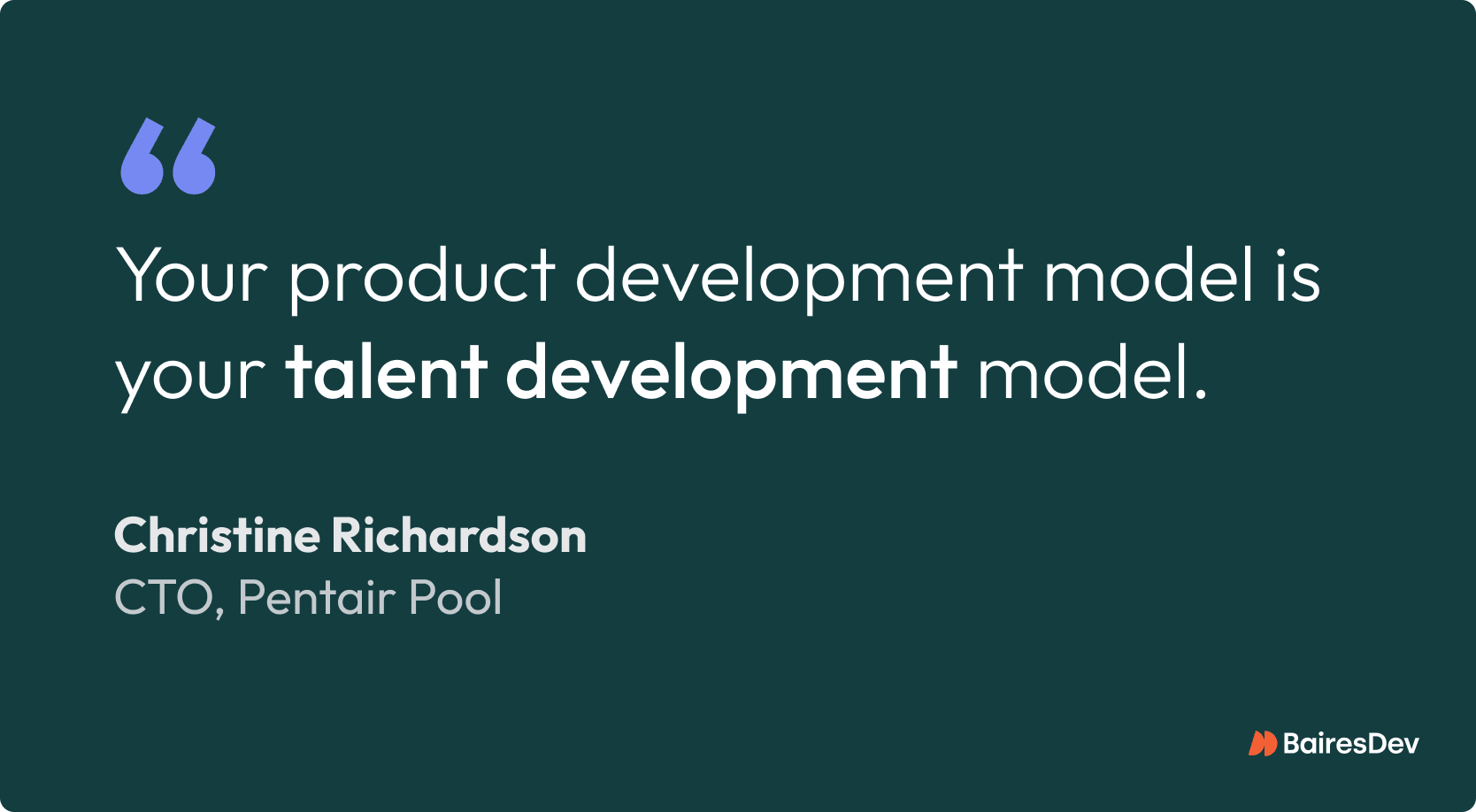
Your product development model is your talent development model. How you work is how people learn. If your process optimizes only for short-term throughput, you will de-optimize for long-term capability. If you don’t intentionally design opportunities for juniors to reason about systems, frame problems, and exercise judgment, you shouldn’t expect to end up with the kind of senior engineers you say you want in five years.
How to Design the Next Generation of Senior Engineers
If you trace these shifts together a pattern emerges. The industry is moving away from a model where junior engineers were primarily builders, shipping lots of small changes and learning slowly through repetition, and where senior engineers were valued as strong builders who also held context who knew the code, the systems, and the history.
What’s emerging looks different. Junior engineers need to be emerging thinkers from day one, capable of seeing beyond their own task, using AI to accelerate execution, and learning quickly from feedback. Senior engineers become multipliers and stewards who shape systems, frame problems, guide others’ thinking, and preserve institutional knowledge in a form that can be passed on.
The open question for most organizations is whether they’re willing to redesign their own systems to match this shift. That means examining hiring criteria and the way AI is being used. It means asking whether juniors are getting real ownership and feedback or sitting in a ticket queue that doesn’t serve them, and whether product development practices are functioning as talent development.
The senior engineers you’ll have in five years are being shaped right now. The pipeline is no longer linear, and it’s no longer guaranteed. Designing a system that deliberately produces the next generation of senior talent is an edge that no tool alone can provide.
Key Takeaways:
- The linear bug-fixes-to-seniority pipeline is giving way to steeper, higher-leverage development paths where judgment matters more than time served.
- As senior roles shift toward system design and problem framing, junior development needs to build those muscles from day one.
- Compressing or removing the junior layer creates institutional knowledge gaps that surface three to five years later.
- Systems thinking can be screened for early, through behavioral questions that reveal how candidates handle complexity and update their assumptions.
- AI compresses the early-career learning journey if the environment around it is intentional, considering ownership of code, mentoring through reviews, and encouragement to seek explanations rather than final answers.