



Engineering leaders spend a lot of time debating front‑end frameworks, but the real cost of that decision rarely shows up in the first sprint. It shows up years later—when operating cost, architectural variance, and coordination overhead begin to compound. According to PWC, 52% of technology leaders cite integration complexity as a top barrier to realizing value from digital investments, which is a useful reminder that coordination, not rendering mechanics, is usually the real constraint. React gives teams a flexible, assemble‑your‑own ecosystem. Angular leans the other way, offering a more consistent, batteries‑included framework model.
This guide looks at how React and Angular behave inside large application portfolios, what they demand from platform owners, and why governance—not framework features—tends to determine long‑term success.
Key Points
- React gives organizations flexibility for building user interfaces, but that flexibility requires stronger platform governance as the ecosystem grows.
- Angular reduces variation through built‑in structure, shared conventions, and integrated tooling.
- Most front‑end rewrites fail because the underlying issue is ownership and coordination—not the framework.
- At scale, framework decisions become operational decisions long before technical differences matter.
Most Angular vs. React comparisons get stuck on technical mechanics—virtual DOM performance, two‑way data binding, one‑way data flow, or which ecosystem moves faster. Those details matter when developers are building isolated features. They matter far less to a VP of Engineering responsible for long‑lived applications, multiple product groups, and years of accumulated architectural decisions.
The more durable question is where your organization wants to absorb complexity.
React approaches UI development as a flexible layer for building user interfaces, with most architectural decisions living outside the core library. Angular takes a more structured approach, packaging routing, static typing, and common engineering patterns into a more comprehensive framework from the start.
Smaller product groups can usually absorb front-end changes without much process overhead. In larger organizations, though, those same changes often spill into release coordination, shared ownership questions, and upgrade planning surprisingly quickly.
Google’s DORA research reinforces this point: delivery performance correlates far more with engineering practices and platform maturity than with specific languages or frameworks.
Angular vs. React at a Glance
| Decision Area | React | Angular |
| Core posture | An open‑source JavaScript library for building user interfaces, assembled into a broader application stack. | A complete framework with routing, dependency injection, forms, TypeScript support, and CLI workflows included. |
| Architecture ownership | Your organization selects the app framework, routing, data fetching, form handling, state model, and UI component libraries. | Provides built‑in tools and patterns that reduce variation, though teams still need architecture standards. |
| Development speed | Supports faster development once project setup, reusable components, and deployment paths are standardized. | Often accelerates development when teams adopt its opinionated framework model and built‑in workflows. |
| Learning curve | React itself is smaller, though real applications typically rely on several third‑party libraries. | Steeper learning curve around Angular’s template syntax, RxJS patterns, and framework conventions, with TypeScript as the primary language. |
| Mobile adjacency | React Native enables mobile development using familiar component patterns and workflows. | No first‑party mobile framework, though teams can still build mobile apps through other approaches. |
| Best default | Flexible product organizations with strong front‑end platform ownership and large development teams. | Governance‑heavy enterprise platforms with low tolerance for fragmented patterns. |
The table underscores a simple point: the real distinction isn’t rendering performance. It’s organizational posture. React rewards organizations that can align around shared patterns without centralizing every decision. Angular rewards organizations that prefer consistency through stronger defaults. Either model can work. Both can drift badly without ownership.
React: Flexible by Design, Demanding in Practice
Architectural Tradeoffs
React intentionally presents itself as an open-source JavaScript library for building user interfaces—not a complete framework that dictates how teams should structure applications. That flexibility is one reason the React ecosystem became so large. Teams can assemble React applications around their preferred routing model, state management approach, data model, and developer tooling. React Router, Zustand, Redux Toolkit, React Query, and Next.js all exist partly because React leaves architectural decisions relatively open.
That openness is valuable, especially for teams moving quickly. It also creates more room for architectural drift once multiple teams start solving the same problems differently.
Standardization Becomes the Real Constraint
Hiring React developers usually isn’t the hard part. React’s popularity ensures a broad talent pool, and the 2025 Stack Overflow Developer Survey continues to rank React among the most widely used web frameworks. The harder problem is standardization. Fragmentation is visible even inside the React ecosystem. The 2025 State of React survey shows teams spread across Redux Toolkit, Zustand, XState, Jotai, Context, and several other approaches to state management.
That flexibility gives product groups room to optimize locally. In larger engineering organizations, though, platform owners eventually have to standardize many of the decisions React intentionally leaves open.
Drift Usually Happens Gradually
Most larger React organizations eventually end up creating an internal paved road, even if nobody planned for one at the beginning. Shared project templates, reusable components, accessibility rules, release standards, and testing conventions tend to emerge after enough teams solve the same problems differently.
How Architectural Drift Accumulates in React Estates
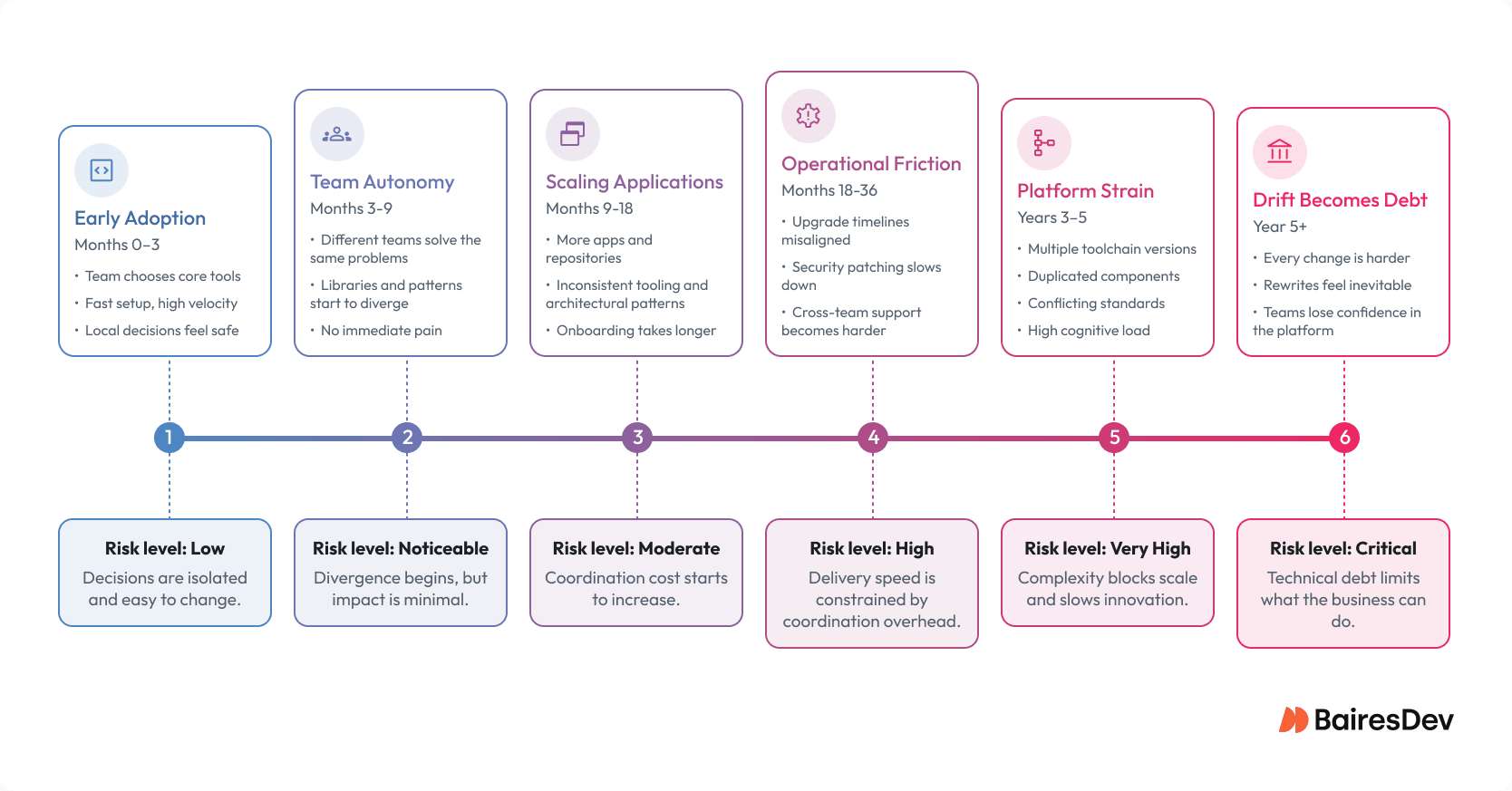
A company running ten or fifteen React apps may eventually discover that different groups upgraded routing libraries, testing frameworks, and shared component systems on completely different timelines. None of those decisions feel especially risky in isolation. Together, they complicate onboarding, security patching, and cross‑team support.
That’s the part most framework comparisons miss.
Mobile Strategy Changes the Equation
Mobile development adds another dimension. React Native gives organizations a plausible path from web development into mobile applications using familiar component patterns and engineering practices. That adjacency can simplify staffing strategy for companies already invested in React. It also creates another platform surface that needs governance and long‑term ownership.
Angular: Structure as a Management Tool
Settling More Decisions Earlier
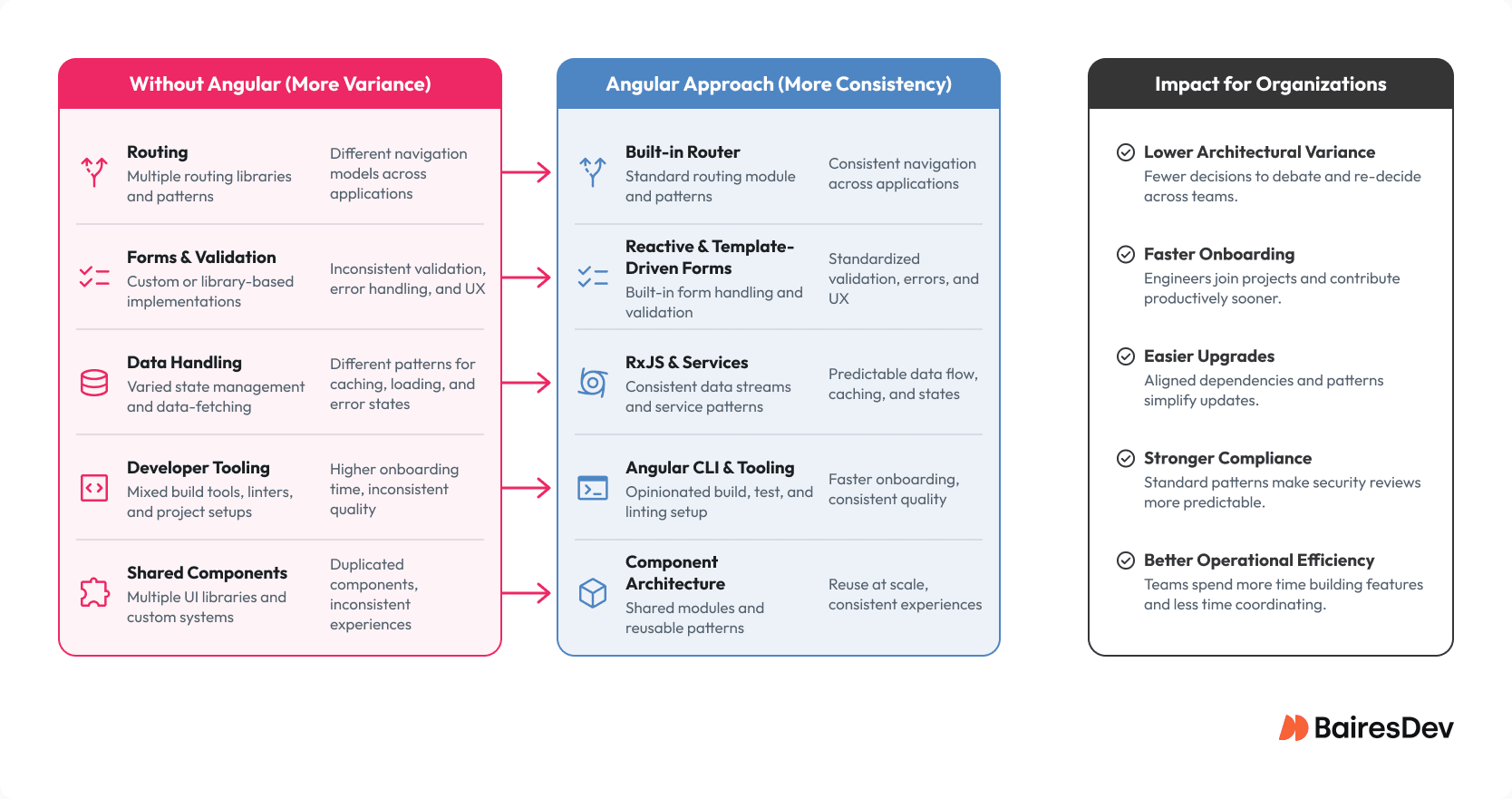
Angular makes more architectural decisions up front than React does. Routing, Angular CLI tooling, static typing, and structured form handling are already part of the framework conversation. For organizations trying to reduce variance across teams, that tradeoff can make sense quickly.
Consistency Matters
In regulated industries, engineering leaders usually care less about maximum UI flexibility and more about keeping architectural variance under control across applications and teams. Angular’s built‑in structure narrows the number of decisions groups repeatedly make around validation, asynchronous data streams, shared services, and common engineering tasks. That consistency becomes more valuable once applications and coordination paths start multiplying.
The Learning Curve Is Real
Angular still comes with a steeper learning curve than React. Engineers usually need to understand RxJS patterns, Angular components, decorators, and Angular‑specific architecture concepts before becoming productive. In some hiring markets, the available pool of React developers is simply broader.
Structure Doesn’t Eliminate Drift
Angular applications drift too, particularly after years of custom abstractions and framework workarounds layered into the codebase. Large organizations absolutely over‑engineer Angular applications sometimes. The difference is that architectural drift becomes visible earlier because more applications start from the same conventions. That matters because drift is easier to correct when teams spot it early.
Where Angular Reduces Variance by Default
What Actually Breaks in Large Front-End Estates
Most front-end failures at scale have very little to do with rendering mechanics or framework benchmarks. Organizations running many applications across multiple teams rarely struggle because a framework couldn’t render quickly enough. The pressure usually comes from coordination overhead instead.
The problems are operational:
- Shared components drifting across teams
- Different approaches to validation and form handling
- Upgrade coordination slipping across repositories
- Multiple interpretations of common engineering patterns
- Existing projects accumulating incompatible assumptions over time
That’s true in both React and Angular environments.
A front‑end platform spanning twenty repositories will eventually need coordinated security patching, release sequencing, and dependency governance regardless of framework choice. The architectural burden simply shows up in different places. React leaves more decisions to surrounding tooling and team conventions. Angular handles more of those decisions inside the framework itself.
Neither approach removes the need for ownership.
Where React vs. Angular Decisions Usually Go Wrong
Most unsuccessful framework migrations aren’t really framework failures. Migration often becomes a proxy for broader frustration inside the engineering organization.
A slow Angular application gets rewritten in React because leadership assumes flexibility will improve development speed. Eighteen months later, the organization still struggles with release coordination because the real bottleneck was API architecture, inconsistent testing practices, or unclear platform ownership.
The reverse happens too. Some organizations choose Angular for enterprise seriousness, then bypass framework conventions with enough custom abstractions that every application feels different anyway.
Framework choices matter. But after enough teams, repositories, and release cycles, most long-term friction comes from coordination problems rather than rendering models. React and Angular can both scale successfully. They can also both accumulate years of avoidable operational overhead if governance maturity never catches up to growth.
Five Years From Now
Five years from now, the framework decision will matter far less than whether your operating model kept pace with your front-end estate.
If your priority is flexibility, broad ecosystem support, and adjacency to mobile development, React is often the pragmatic choice. If your priority is consistency, built‑in patterns, and reducing variance across large engineering groups, Angular can lower long‑term coordination cost.
If your real constraint is unclear ownership, neither framework will solve it.