
By Renata Matos
Renata is a product manager with 18+ years of experience combining technical expertise with strategic product vision. She has worked at Accenture and advanced from quality assurance to product ownership at CESAR.
Expertise



Shift left testing promises fewer production defects and faster releases, but it isn’t automatic and it isn’t free. This guide walks through what shift left testing actually involves, when it’s worth the investment, and what needs to be true on your team before you commit engineering time to it.
Key Points
- Shift left testing means moving appropriate tests in your existing test library to earlier levels so more defects can be caught at the unit and integration level instead of later in the lifecycle.
- Catching defects earlier can reduce the cost of rework; a fix made in production can consume far more engineering time than the same fix made during code review.
- Shift left testing works best on teams that already use test automation, test doubles, and test driven development, or are ready to build those capabilities.
- Shift left isn’t the end state. Pairing it with shift right testing helps preserve coverage for defects that only emerge at the system or production scale.
When a VP of Engineering hears “shift left,” it can sound like a testing philosophy rather than a concrete engineering decision. In practice, it’s a refactoring project: you’re changing where in the development lifecycle a defect gets caught, and that change carries real costs and real payoffs.
This guide breaks down what shift left testing is, why teams adopt it, and where it fits alongside shift right testing and traditional testing. It also covers the development practices that make shift left testing stick, the cultural shift it requires, and how to tell whether the investment is paying off.
What Is Shift Left Testing?
In our blog article Software Testing Strategies: A Guide for Leaders, we described shift left testing as a test approach focused on test levels, with the goal of moving test cases to levels that occur earlier in a project. The term comes from visualizing test levels from left to right: unit testing, integration testing, and system testing, through to acceptance testing.
Shift left is a software test refactoring activity. It involves examining an existing library of test cases as a whole and moving appropriate test cases at levels on the right to new tests at levels on the left. After you apply a shift left testing approach to an existing test library, you should end up with more unit tests and integration tests than before, and fewer system and acceptance tests where those tests can be reliably replaced at an earlier level.
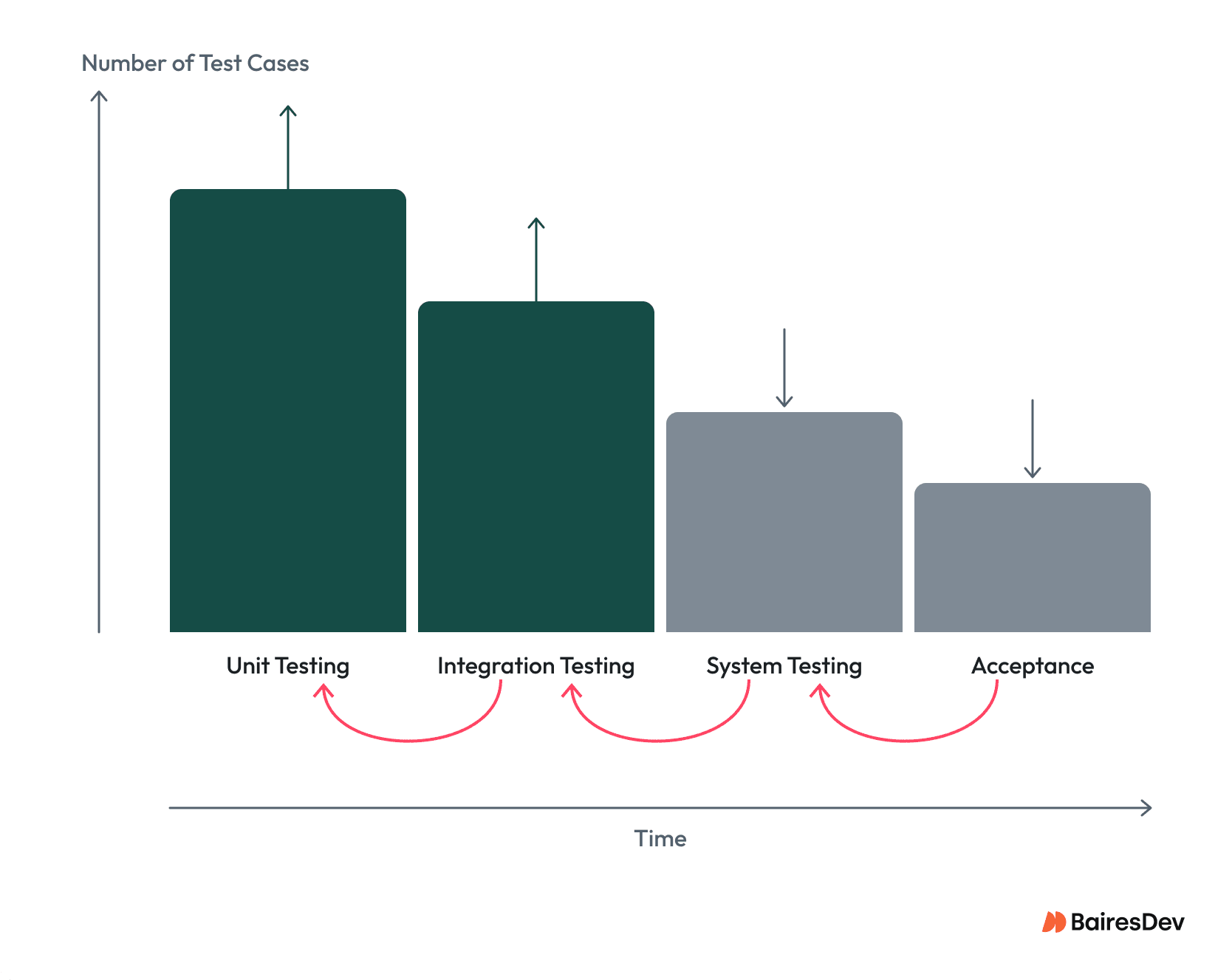
In the shift left testing approach, appropriate test cases move earlier in the project lifecycle.
Why Teams Shift Testing Left
Shift left testing can provide several benefits to a software development organization:
- Reduces the cost of software defects by finding and fixing them earlier.
- Enables faster release cycles by replacing slower tests with faster ones.
- Encourages closer collaboration between developers and testers on a team.
- Improves the team’s understanding of what the test case library actually covers.
- Increases overall quality and confidence in software releases.
Let’s look at the first benefit, reduced cost of software defects, in more detail.
Benefit: Reduced Cost of Software Defects
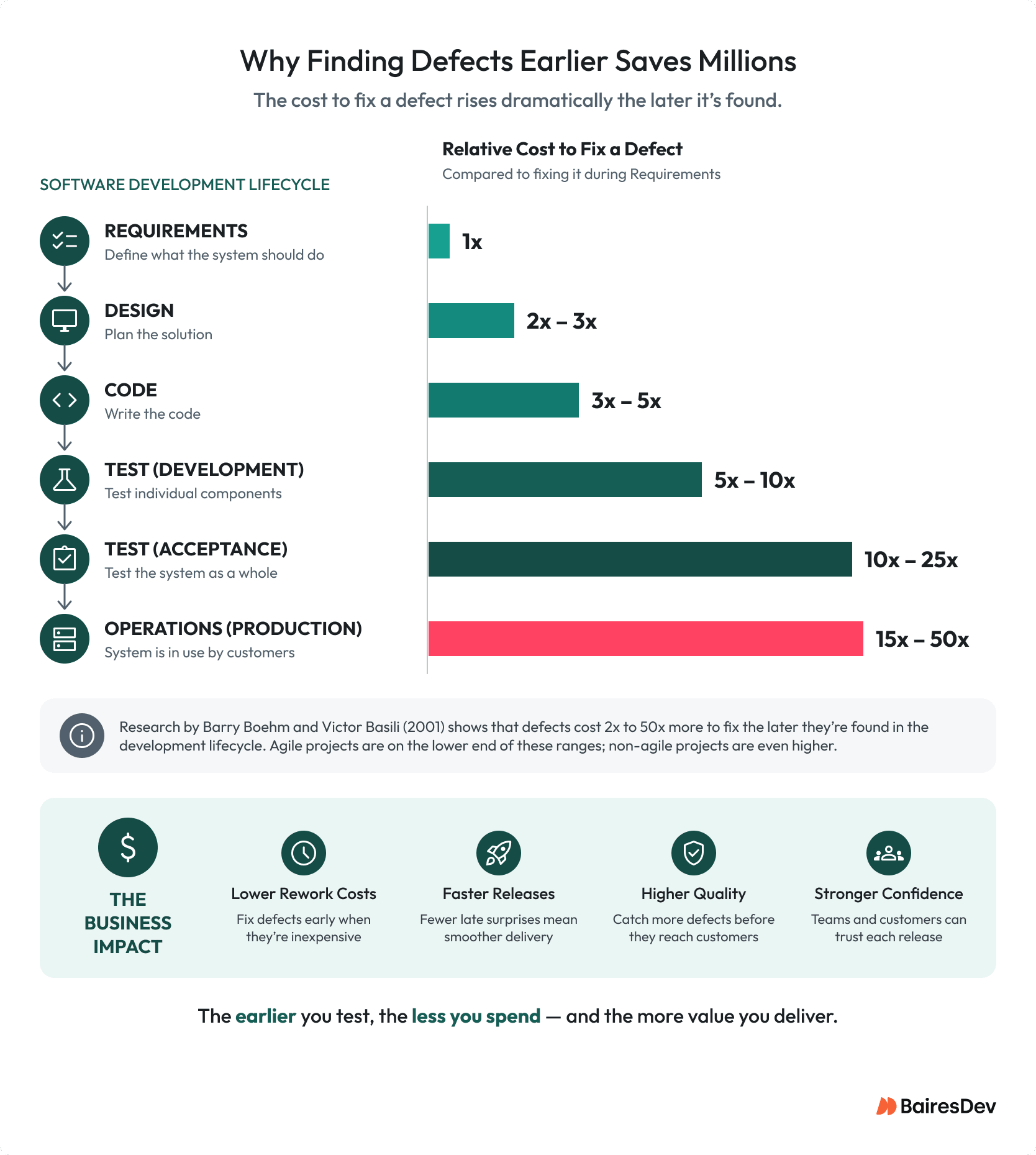
The most direct cost of a software defect is the cost of rework. Foundational research by Barry Boehm, first published in his 1981 book Software Engineering Economics and later refined with Victor Basili in a 2001 IEEE Computer paper, found that the cost of fixing a defect generally increases the later it’s caught in the development lifecycle.
| The earlier you catch a defect in the software development lifecycle, the cheaper it is to fix it.
— Barry Boehm |
Boehm and Basili’s 2001 analysis evaluated projects using agile methods and continuous integration separately from large projects in regulated, non-agile environments. For agile projects, resources summarizing Boehm and Basili’s 2001 revision put the relative multipliers in roughly this range:
| Development Phase | Cost Multiplier vs. Requirements Phase |
| Design | 2x to 3x |
| Code | 3x to 5x |
| Test (development) | 5x to 10x |
| Test (acceptance) | 10x to 25x |
| Operations (production) | 15x to 50x |
Non-agile projects showed even steeper multipliers. These figures are historical estimates, not current universal cost ratios, but they illustrate the economic principle behind finding defects earlier.
More recent evidence points in the same direction. A 2025 analysis from cloud security platform Wiz found that remediating a critical vulnerability in production can require 10 to 100 times more engineering hours than fixing the same issue during code review, once you factor in cross-team coordination, rollbacks, and forensic work. The same analysis found that shift left testing can move detection roughly 10 times earlier in the pipeline.
Software defects also carry indirect costs beyond rework: slower feature development, heavier regression testing, and tester burnout. Defects caught close to a release, or after one, can mean missed release commitments, roadmap shifts, higher support and operations costs, and reduced customer trust.
Avoiding these direct and indirect costs is one of the main reasons organizations adopt shift left testing.
Is Shift Left Testing Always the Best Choice?
Before adopting shift left testing, leaders should weigh the alternatives, including the levels, phases, and defect types each test approach covers, along with the skills testers need to apply it successfully.
| Test Approach | Test Levels | Phases | Defects Caught | Where It Fits |
| Traditional Testing | Unit, Integration, System, Acceptance | Code, Test (development), Test (acceptance) | API, Compatibility, Component, Documentation, Functionality, Installation, Module, Performance, Security, UI, Workflow | Projects using continuous integration, with testers skilled in APIs, functional testing, infrastructure automation, test doubles, performance testing, security testing, test automation frameworks, and test environment setup. |
| Shift Left Testing | Unit, Integration | Code, Test (development) | API, Component, Functionality, Module | Projects with teams using agile processes, continuous integration, and test driven development, with testers skilled in APIs, test doubles, functional testing, and test automation frameworks. |
| Shift Right Testing | System, Acceptance, production or production-like environments | Test (development), Test (acceptance), operations | Compatibility, Documentation, Installation, Performance, Security, UI, Workflow, and other issues that emerge under realistic system conditions | Organizations needing testing of multiple systems at production scale. Testers skilled in infrastructure automation, installation, performance testing, security testing, and test environment setup. |
At first glance, the traditional approach may look like the best option, since it can find a range of defect types at every testing level. In practice, it can require testers with an extraordinary breadth of skill, whether as individuals or as a team, on every project. It can also require more test infrastructure to support test environments at multiple levels and create significant context switching as testers move from one type of testing to another from week to week, or even day to day.
One of the motivations for shift left or shift right is that both approaches can give testers more focused responsibilities rather than requiring every tester to cover every testing level.
How to Evaluate Projects for Shift Left Refactoring
Some projects are better candidates for refactoring than others. Here are questions to ask about each project to identify the best candidates.
| Questions | Takeaway |
| What is the expected longevity of this project? Is it a one-time project that may not be worked on again for several years, or will it require sustained engineering effort for a long time? | Projects with an expected longevity of at least several years are more likely to recover the investment of a test refactoring effort. |
| What are the current practices of the team, and the skills of the testers on the project? Do the teams already have the skills needed for shift left testing? If not, what tools and training do they need to get there? | Projects with teams closest to the skills and practices of shift left testing are the best candidates for the first test refactoring effort. |
| What testing gaps might result after the project shifts left? What defects found during testing today might go undetected after the shift? How might these defects affect customers? | Projects that shift left may leave testing gaps that lead to future escaped defects that only appear in the full system at production scale. Risk based testing can help mitigate the risks these gaps create. |
Questions like these can help determine which projects and teams are the best candidates for your organization’s first shift left refactoring effort.
Practices That Make Shift Left Testing Work
Shift left testing is more likely to succeed when it’s paired with development and testing practices that reinforce it, including:
- Test Driven Development
- Test Automation Frameworks
- Test doubles, including mocks and stubs
- CI/CD Pipelines
- Static Code Analysis
- Security Testing
- Risk Based Testing
Let’s look at a few of these practices in more depth.
Practice: Test Driven Development
Test Driven Development, also called TDD or test-first development, is the practice of writing a unit test case before writing the code meant to make it pass. The test captures the developer’s original understanding of how the code they’re about to write should behave.
By contrast, shift left refactoring at the unit level means adding unit tests after the code has already been written without them. The developer or tester writing those tests may have to work out the code’s intent through inspection, documentation, or simply running it.
While it’s a different practice, shift left refactoring shares TDD’s goals. You can think of shift left refactoring as one way teams can address the testing gaps left when test driven development wasn’t used from the start. For new projects, starting with TDD is an efficient way to get shift left’s benefits without the cost of some later test refactoring.
Shift left refactoring can be what teams have to do later when test driven development wasn’t done from the start.
Practice: Test Automation Frameworks
Testing practices beyond the unit level have evolved toward test automation frameworks since the 1980s: from handwritten manual test procedures, to handwritten automated test scripts, to scripts generated by model-based testing tools, and most recently to test scripts created with generative AI.
The Software Development Engineer in Test (SDET) role emerged to meet the need for engineering expertise in test automation frameworks, so other developers can focus on building the product and testers can focus on testing it. SDETs can be particularly valuable to shift left teams because moving appropriate tests toward earlier levels increases the importance of reliable test automation. But shift left doesn’t inherently require a larger SDET organization; developers, QA engineers, and SDETs can share automation responsibilities depending on the team’s structure and skills.
DORA’s guidance similarly emphasizes fast, reliable automated tests and rapid feedback. Its continuous integration guidance recommends that automated tests provide feedback within a few minutes, with about 10 minutes as an upper limit for the build and test cycle.
Practice: Mocks or Test Doubles
Test doubles are simulated objects or components that stand in for real modules or dependencies during testing. Mocks are one type of test double; stubs and fakes are others. While mocks are commonly used with TDD at the unit testing level, test doubles can also be used at integration or system-testing levels when appropriate.
Test doubles are useful for shift left refactoring because, without them, the module or component under test may have to be stood up along with all of its neighboring objects or components. They can let the module or component be tested in isolation. Automated tests can run more quickly and need fewer resources because the substituted dependencies can be simpler and more controlled than the real components they replace. Test doubles can also help characterize defects faster than standing up an entire system, where the root cause of a failure can be harder to isolate.
They should still be used carefully. Overly coupled mocks can make tests brittle or validate implementation details rather than actual behavior.
Practice: Risk Based Testing
Risk based testing is a testing approach that involves assessing the high-risk areas that could affect a project’s success and focusing more testing resources on those areas. Risk based testing can be layered on top of other test approaches.
As mentioned earlier, shift left refactoring can create testing gaps at the system and acceptance testing levels, raising the risk of escaped defects. That’s because some defects don’t manifest easily except when the entire system is running at production scale. Performance defects are one example. Others include functional defects tied to complex workflows, compatibility with other software, and end-user documentation defects.
One strategy for mitigating the risks created by shift left testing gaps is a stabilization or hardening period before release. During this period, no new features get developed; developers join testers to focus on end-to-end testing, exploratory testing, or bug bashes. This activity needs to be highly structured, with everyone clear on their role, or stabilization periods can fall flat.
A more reliable mitigation strategy is to keep some testers focused on the system and acceptance testing levels throughout the development process. A team of system and acceptance test specialists, made up of SDETs and QA, can provide a specialized quality gate for other development teams when their products are ready for release. This team can focus on activities such as performance testing, soak testing, compatibility testing, and installation testing. In essence, one team adopts shift right testing so that other teams can shift left.
This pairing is becoming more important as teams use production evidence to improve their testing strategy. The World Quality Report 2025-26 found that 94% of organizations review production data or trends for testing purposes, but 45% say they struggle to apply those insights effectively to improve quality. The finding reinforces the value of treating shift right as a feedback loop: production issues and telemetry can reveal gaps that teams can then address through new or improved tests.
Keep some testers focused on the system and acceptance testing levels to find defects that only manifest in the entire system at production scale.
A Cultural Shift
A final ingredient for applying shift left testing successfully is a change in mindset. The balance of roles across developers, SDETs, and QA testers looks different in shift left, shift right, and traditional testing. In both shift left and shift right testing, testers can focus more and context switch less, although the exact division of responsibilities depends on the team’s operating model.
Frame these shifts to your engineering staff as opportunities for growth and job satisfaction, because that’s what they should be. Don’t be surprised if individuals want to try different roles. Embrace it, and you’ll find your engineering staff happier and more productive over time.
Turning Shift Left Testing Into a Measurable Advantage
The full benefits of shift left refactoring can take time to show up. Escaped defects, in particular, are a lagging indicator. Here are questions you can ask to tell whether your teams are implementing shift left testing correctly, and whether it’s having a positive effect:
- Does traceability exist between the tests being replaced and the new tests that replace them?
- Is the number of test cases at the unit and integration levels increasing over time?
- Is the number of test cases at the system and acceptance levels decreasing over time?
- Are replaced tests disabled so they can’t be executed?
- Are new tests executing faster than the tests they replaced?
- Are new tests more reliable than the tests they replaced?
- Can developers get useful automated-test feedback quickly enough to act on it during the development process?
Questions like these can help you tell whether your shift left refactoring effort is on track.
Another way to measure results early is to organize the refactoring work into small tasks, each with an expected, visible improvement. Track those improvements consistently, and shift left testing stops being a matter of faith and becomes a data-backed part of your delivery strategy.
For engineering leaders deciding where to invest limited testing capacity, that data is often what separates a shift left initiative that sticks from one that quietly reverts under deadline pressure.
Frequently Asked Questions
What's the difference between shift left and shift right testing?
Shift left testing moves appropriate testing earlier in the software development lifecycle, often toward unit, integration, and automated acceptance testing. Shift right testing extends validation into later stages, production-like environments, and production, where teams can detect issues that don’t reliably appear earlier. The two approaches complement each other rather than simply reversing one another.
How early should testing start in the development cycle?
Testing should start as early as practical, including during requirements and design when teams can identify risks and testability concerns. At the implementation level, unit testing can begin alongside or before production code, including through practices such as test driven development.
Does shift left testing replace a dedicated QA function?
No. Shift left testing requires greater reliance on test automation and earlier collaboration between developers and testers, but it doesn’t necessarily mean teams need more SDETs. Developers, QA engineers, and SDETs can share responsibility for automated testing based on the organization’s structure, skills, and testing requirements.
What does it take to adopt shift left testing without slowing the team down?
Organize shift left refactoring into small units of work that the team can pull in whenever it has capacity. Each unit of work should show faster, more reliable test execution, so the team still completes its feature work as expected. Keep automated feedback fast and reliable, and avoid moving tests earlier when the earlier level can’t reproduce the risk accurately. Over time, the team’s velocity and feedback cycle should improve.
How do you measure whether shift left testing is working?
Shift left testing should result in faster test execution, more reliable tests, earlier defect detection, and fewer escaped defects over time. Also measure whether developers trust and act on automated-test feedback, whether useful test coverage is increasing at earlier levels, and whether the testing suite remains maintainable.
By Renata Matos
Renata is a product manager with 18+ years of experience combining technical expertise with strategic product vision. She has worked at Accenture and advanced from quality assurance to product ownership at CESAR.
Expertise