


Choosing a software architecture pattern can be intimidating. It sets the high-level structure of the system, defines how teams collaborate, and constrains what is easy or expensive for years to come. Unlike design patterns, which are localized and reversible, architecture decisions shape the entire application and are costly to unwind once deployed with real data, and large teams are involved.
The goal is not to pick the “best” architecture, but to optimize the architecture pattern for the priorities of your system or workflow, within the constraints you actually have. That includes team composition, legacy systems, regulatory pressure, and delivery timelines. In modern enterprise systems, this usually leads to hybrid architectures rather than pure textbook patterns.
This guide offers a compact decision framework to help you make that choice faster and with lower risk.
Architectural Patterns versus Design Patterns
Architectural patterns describe the overall structure of software systems. They define major components, how responsibilities are split, and how those components communicate. Design patterns, by contrast, can be thought of as best-practice recipes used by developers to solve specific coding tasks inside a module.
The architecture is the system’s blueprint and determines how components are distributed, where data lives, how services are deployed, who runs them, etc. Altering the architecture is costly and disruptive. Changes typically require coordinating changes across teams, infrastructure, and operational processes.
Architecture choices are costly, strategic decisions. Long-term goals should determine trade-offs. Any hard constraints should be documented so teams can make aligned implementation choices. In the early phases, prototypes help validate architectural direction before committing. For existing systems, incremental migrations reduce risk.
In either case, major architectural shifts should have clear and measurable benefits to justify the cost.
A Practical Selection Framework
The best strategy is to pick an architecture by working backwards based on the outcomes you need. Work through this checklist to make trade-offs explicit, reveal blocking constraints, and decide which architecture or hybrid approach to adopt.
Quality Attributes and Priorities
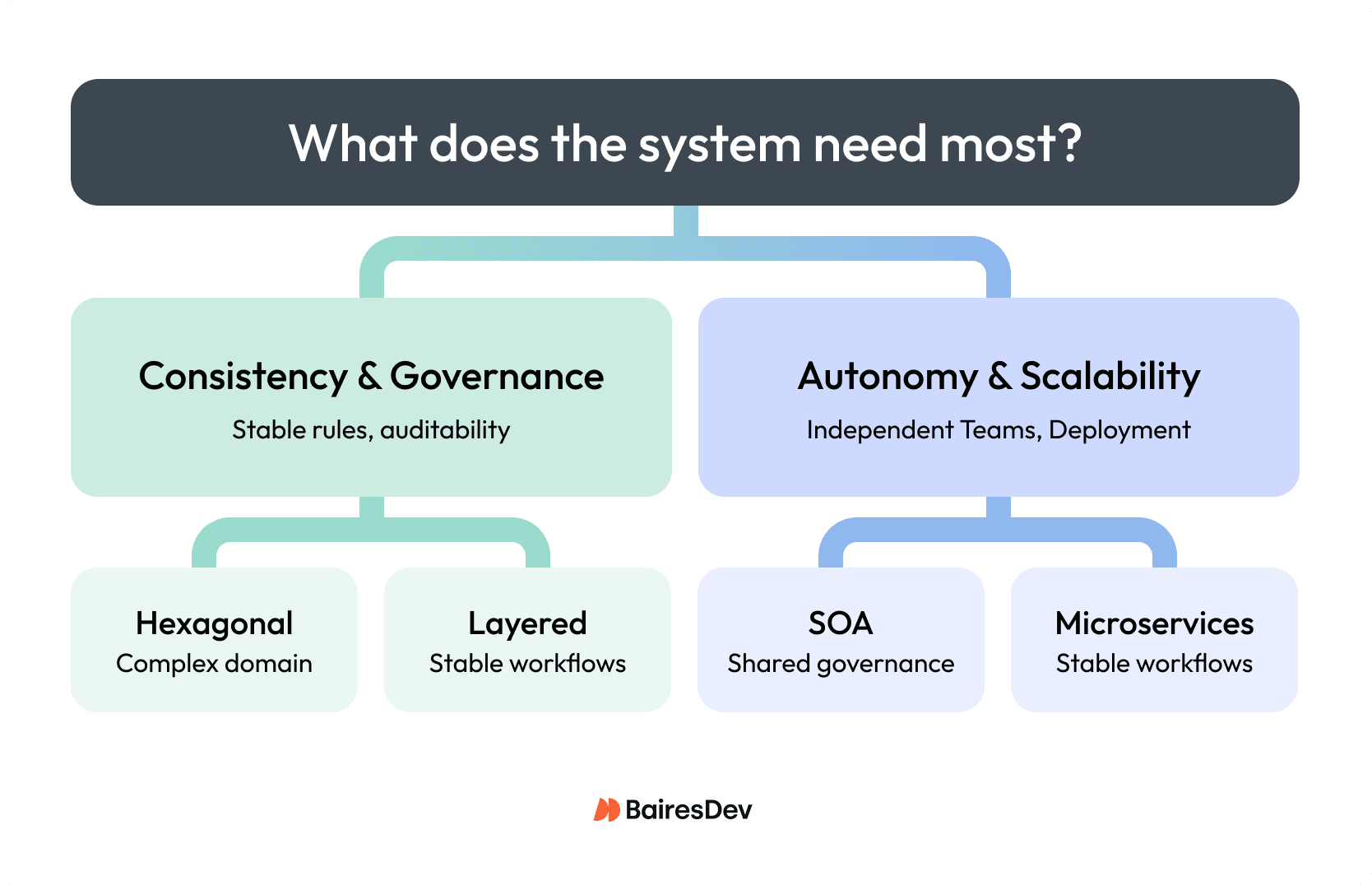
What must the system be good at? Latency, availability, fault tolerance, data consistency, cost efficiency, security, and ease of change are common drivers. Prioritize this explicitly. You cannot optimize for everything.
Constraints to Watch Out For
Constraints cover things like legacy systems (which may force you to keep older interfaces, limit schema changes, or require phased migrations), regulatory rules, deployment targets, cloud-native readiness, and third‑party dependencies. Also consider people constraints (e.g., team headcount, skills, and support/on‑call load) since they determine how fast and safely you can change the architecture.
Organizational Topology
Architecture and organization are tightly coupled. Count teams, map ownership boundaries, and ask how independently teams must move. If many small teams need autonomy, favor patterns that minimize cross-team coupling; if a centralized team drives most changes, a more monolithic topology may be acceptable.
Pattern Fit and Anti-Signals
Evaluate which architecture pattern supports your prioritized attributes and which actively works against them. Identify anti-signals (conditions that will make a pattern painful in practice) and use them to rule options out quickly.
Hybrid Approaches
Applying this framework honestly often produces hybrid architectures: different parts of a system use different patterns to match their distinct requirements (e.g., event-driven pipelines for async processing, a layered module for transactional workflows, and services for independently deployable domains).
Hybrids allow local optimization while keeping system-wide complexity in check. Make boundaries between the architecture and ownership explicit to prevent components from becoming unintentionally entangled.
Common Software Architecture Patterns
Most modern applications are built on a client-server model, with user interface concerns separated from server-side business logic. The architecture patterns discussed below shape how the server-side is structured, not whether the system uses client-server communication.
| Pattern | Scalability | Data consistency | Team autonomy | Operational complexity | Change cost |
| Layered | Low | High | Low | Low | Low (within layers) |
| Hexagonal | Low | High | Moderate | Moderate | Low (at edges) |
| Event-driven | High | Eventual | Moderate | High | Moderate |
| SOA | Moderate | Moderate | Moderate | Moderate | Moderate |
| Microservices | High | Eventual | High | High | High (cross-service) |
Layered Patterns and N-tier Architectures
The layered architecture pattern, often implemented as an N-tier architecture, is still widely used in enterprise applications and web applications. It organizes the system into horizontal layers such as user interface, business logic, data access layer, and data storage.
This pattern works well when:
- Business rules are relatively stable
- Ensuring data consistency is critical
- Centralized management and governance are required
- Development teams are structured around functional ownership
Layered architecture provides clear separation of concerns and easier maintenance in systems with well-understood workflows. It is particularly effective for internal enterprise systems where transaction processing and auditability matter more than extreme scalability.
Anti-signals appear when teams try to force strict layering in highly distributed systems. Network latency, communication overhead, and direct dependencies between layers can slow delivery. When every change flows through multiple layers owned by different teams, throughput suffers.
Hexagonal Architecture
Hexagonal architecture (sometimes called ports and adapters) is a pattern that keeps your core business logic isolated from external changes. Put the domain rules and use cases in the center, and move things that change often (e.g., databases, message systems, third‑party APIs, and UI design) to the outer layers so they can be replaced or updated without touching the core.
This pattern is valuable when:
- The core domain is complex and long-lived
- You expect technology evolution at the edges
- You want to decouple domain logic from infrastructure choices
- Testability and change isolation are high priorities
Hexagonal architecture is often adopted inside a single service or bounded context rather than across an entire application. It pairs well with both layered and service-oriented architectures, especially in systems with significant legacy components that need gradual modernization.
The cost is additional abstraction and careful design. Teams must be disciplined to avoid leaking infrastructure concerns back into the core. When done poorly, it can feel like unnecessary indirection.
Event-Driven Architecture
Event-driven architectures let components communicate by sending and receiving events instead of calling each other directly. This reduces direct dependencies among system components, making it easier to scale, change, and recover from failures. They are often used when you need loose coupling, higher throughput, or resilience to partial outages.
This pattern is a strong fit when:
- You have multiple services reacting to data changes
- Real-time processing matters
- You need to scale independent services separately
- Temporary inconsistency is acceptable
Event-driven systems shine in environments like e-commerce platforms, file sharing systems, and multiplayer online games, where user activity fans out across distributed components.
The tradeoff is operational complexity. Debugging becomes harder. Ensuring data consistency across multiple nodes requires careful thought. Service versioning and schema evolution must be managed explicitly. This is not free architecture.
Service-Oriented Architecture and Microservices
Service-oriented architecture (SOA) predates microservices and remains relevant, especially in large enterprise systems. Both approaches decompose software architecture into services, but they differ in how much autonomy and operational complexity they assume.
Service-oriented architecture typically emphasizes stable contracts, shared infrastructure, and centralized governance. This aligns well with systems where consistency, transaction integrity, and coordinated change matter more than rapid independent deployment.
Microservices, by contrast, push autonomy further. They favor smaller services, independent deployment, and localized ownership, accepting higher communication overhead and distributed failure as the cost of that flexibility.
In practice, many successful organizations stop well short of full microservices. They invest instead in clear modular boundaries, strong internal APIs, and disciplined ownership within a traditional architecture. Even teams that do adopt microservices rarely apply them everywhere. Core transactional workflows often remain centralized, while less critical parts are broken out where added independence is worth the overhead.
Microservices work best when:
- You have multiple autonomous development teams
- Services can own their data
- Operational maturity is high
- Failure isolation is more important than simplicity
Anti-signals include premature decomposition, excessive network calls, and distributed transactions. Many teams underestimate the cost of operating numerous independent services, especially around observability, incident response, and data consistency.
Hybrid Architectures in Practice
Most modern enterprise systems are hybrid architectures, whether or not teams label them that way. A typical system might combine:
- A layered architecture for core transactional workflows
- Hexagonal architecture inside critical services
- Event-driven integration between major subsystems
- Client-server interactions at the edges
Hybrid approaches allow teams to apply different patterns where they add value, without forcing uniformity across the entire application.
Common hybrid pairings:
| Hybrid pairing | Why teams use it |
| Layered + Hexagonal | Keeps business logic isolated while preserving a simple, understandable overall structure. Common when teams want testability and change isolation without reorganizing the entire system. |
| Layered + Event-driven | Allows core transactional workflows to remain synchronous and consistent, while offloading side effects like notifications, search indexing, and analytics. Reduces coupling without compromising reliability. |
| SOA + Event-driven | Decouples enterprise systems that must integrate but cannot change in lockstep. Events reduce direct dependencies and make versioning and gradual migration safer. |
| Microservices + Event-driven | Enables independent services to scale and evolve without tight runtime coupling. Often used to avoid synchronous call chains and reduce cascading failures in distributed systems. |
| Hexagonal + SOA | Protects domain logic in long-lived systems while still fitting into centralized governance and shared infrastructure models. Common in regulated or compliance-heavy environments. |
The key is intentionality. Hybrid does not mean accidental architecture
Use Cases
E-commerce Platforms
An e-commerce platform often uses a layered architecture for core workflows like order processing, payments, and inventory, keeping the main business logic clear and predictable. Event-driven components handle side tasks like notifications, search indexing, and analytics, letting these parts evolve independently without affecting reliability in the core system. This hybrid approach balances stability and flexibility.
Stock Trading Platforms
A trading platform needs extremely low latency, high availability, and strict consistency for trade execution. The core system is usually layered or hexagonal to keep business rules clear and tightly controlled, while event-driven processes manage market data, risk calculations, and monitoring without slowing or risking the critical trade path. The key is using asynchronous processes only where they won’t compromise performance or reliability.
File-Sharing System
File-sharing systems must handle frequent data changes and remain resilient when parts of the system fail. Event-driven workflows handle updates between components like metadata, access control, and syncing, while the main state and authorization logic stay in a layered or hexagonal structure. This keeps the system manageable, protects core functionality, and allows different parts to evolve independently.
These examples are not prescriptions. They illustrate how the same framework leads to different architecture choices based on quality attributes and constraints.
Making the Decision
Don’t try to follow the latest trends. Focus on what matters for your project, even if it seems boring and conservative.
Choosing the right architecture pattern is all about aligning architecture with delivery risk, operational reality, and long-term ownership. Be honest about constraints and design for your teams, not someone else’s.
If a pattern increases cognitive load, communication overhead, or on-call burden without a clear benefit, it is probably the wrong architecture for your context.