

Executive Summary
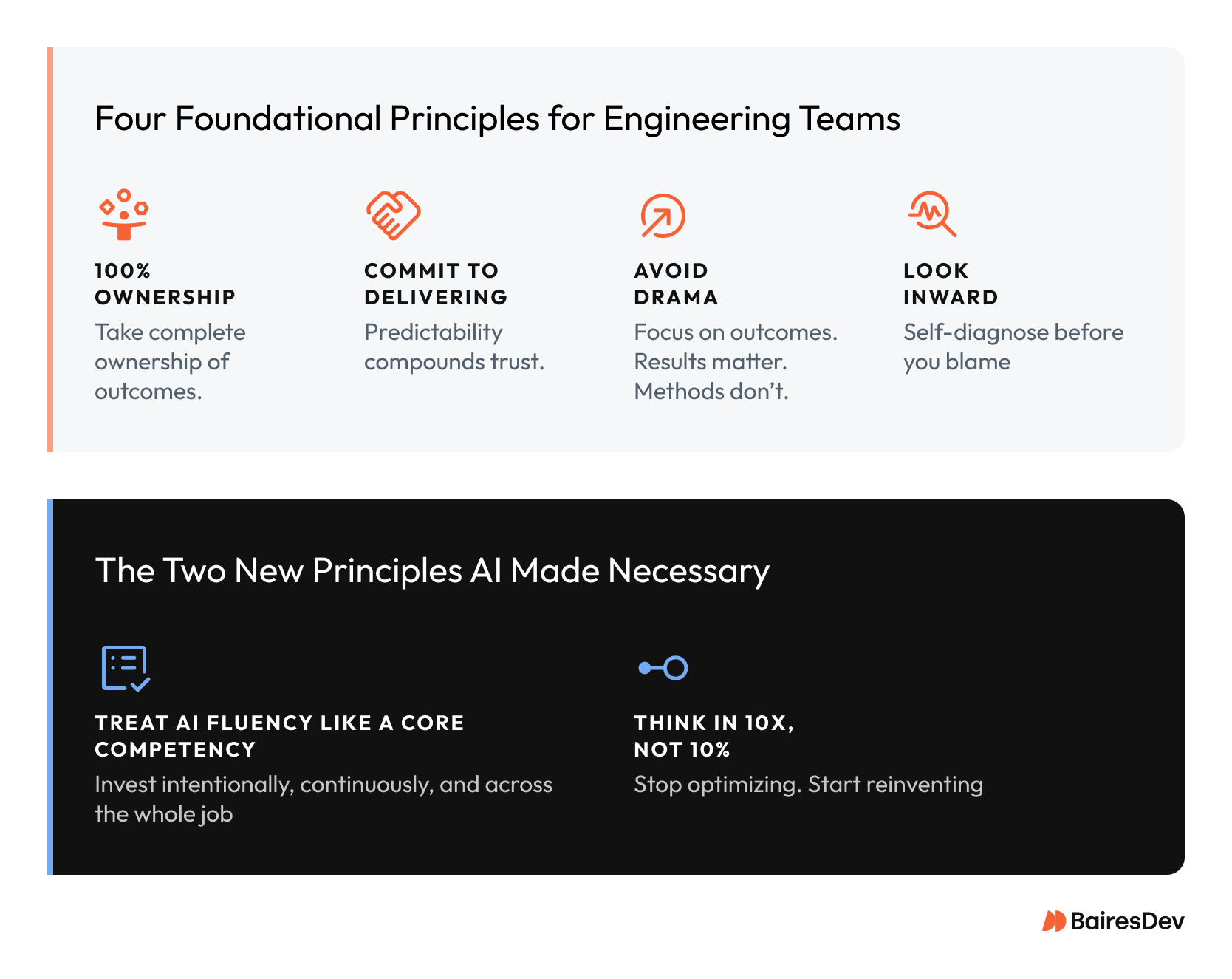
This article argues that the principles behind high-performing engineering teams have been expanded by AI. The four fundamentals of ownership, commitment, low drama, and self-reflection still hold. What’s new is that teams now need to treat AI fluency as a core competency and orient around step-function improvements.
I’ve been building engineering teams for a long time. Over the years I developed a pretty clear framework for what makes a team great. It came down to four things. Number one, take 100% responsibility; second, commit and follow through; third, cut the drama, and fourth, always look inward before pointing outward. These ideas were heavily influenced by 15 Commitments of Conscious Leadership and they served me well for years. I built high-performing teams around these principles at multiple companies.
Then AI happened, but not in the way most people talk about it. Not the “AI is going to take your job” version either, but the real version. The one where an engineer on your team ships in a day what used to take a sprint. Where the gap between a good team and a great team isn’t just about talent or culture anymore. It’s about how fast you learn to work differently.
I realized my playbook needed an update. The foundation still holds, but the game has changed enough that if you’re still running the old plays, you’re going to get left behind.
The Leadership Principles That Still Drive High-Performing Teams
Let me start with the stuff that hasn’t changed, because I think people are too quick to throw the baby out with the bathwater when a new technology shows up.
Ownership Still Defines High-Performing Engineering Teams
The best people I’ve ever worked with take complete ownership of their outcomes. They don’t blame the tools, the process, or the other team. They look at a problem and say “that’s mine to fix.”
This hasn’t changed with AI. If anything, it matters more. I see teams where half the engineers are waiting for someone to tell them how to use AI, what tools to adopt, what workflows to follow. And I see other teams where individual contributors are just figuring it out. They’re experimenting on their own, sharing what works, pushing the whole team forward. The difference is ownership. The people who take 100% responsibility for their productivity are the ones finding ways to dramatically increase their output right now.
Predictability and High Commitment Rates Still Matter
The best teams I’ve been on are predictable. When they say they’ll get something done, they get it done. We tracked this at DAIS in the form of sprint commitment rates and GSD completion percentages. The teams that were predictable were the teams that shipped the most value.
AI raises the stakes here. When you can potentially move faster, the temptation is to over-commit. “We have AI now, we can take on more.” But the principle is the same. Commit to what you can deliver, then deliver it. Every time. That compounding trust is what lets you move fast without breaking things. The teams using AI well are delivering more against the same level of commitment. There’s a real difference.
Why Low-Drama Teams Move Faster
Low-drama teams move faster because they focus on outcomes, not process debates. Every hour spent on interpersonal friction and fairness disagreements about AI-written code is an hour not spent shipping.
Drama kills velocity. I’m talking about the interpersonal stuff, the gossip, the passive-aggressive Slack messages, the “well that’s not MY job” mentality. The best teams I’ve been a part of have almost zero drama. People talk directly to each other. They disagree openly, pick a path, and commit fully.
AI has introduced a new category of potential drama. “That person is using AI and I’m not, is that fair?” or “They just generated that code, they didn’t really write it.” Or debates about whether AI-assisted work counts as “real” engineering. High-performing teams don’t have time for this. They focus on outcomes. If the code works, it’s tested, it’s maintainable, and it shipped fast, who cares how it was written?
High-Performing Teams Solve Problems Internally First
When things go wrong, the best teams look in the mirror first. They don’t blame the requirements, the deadline, or the other department. They ask, “What could we have done differently?”
Looking inward is a muscle. The first few times a team does it, it’s uncomfortable. Nobody wants to admit they could have handled something differently. But once a team builds that habit, something shifts. They start solving their own problems. They stop waiting for someone else to fix things. And once a team gets good at solving the problems inside their walls, they develop the confidence and capability to start solving problems outside their purview too. The best teams I’ve worked with reach across boundaries because they’ve built the problem-solving muscle internally first.
With AI in the mix, there are more things to blame than ever. The model hallucinated. The AI-generated code had a bug. The tool didn’t integrate well. Sure, all of that can be true. But the team that looks inward asks different questions: “Did we review the output properly? Did we set up the right guardrails? Are we using the right tool for this job?” That’s how you get better. Blaming the AI is just the new version of blaming the compiler.
The New Principles for AI-Native Engineering Teams
Here’s where things get interesting. The four principles above will get you a solid team. But solid isn’t enough anymore. The teams pulling ahead have added new muscle that didn’t exist two years ago.
AI Must Become a Core Team Competency
Most teams I talk to are “using AI.” Someone has a Copilot license. A few people use Claude or ChatGPT when they get stuck. That’s dabbling, not investing.
High-performing teams treat AI adoption the way they’d treat any other critical skill. They’re intentional about it. They allocate time for experimentation. They share what’s working and what isn’t. They have opinions about which tools work best for which tasks, not because a vendor told them, but because they’ve tested it.
This goes beyond code. The best teams I’m seeing are using AI to improve how they write documentation, review PRs, plan sprints, onboard new hires, and debug production issues. If your team’s AI strategy is “everyone has a Copilot license,” you’re bringing a knife to a gunfight.
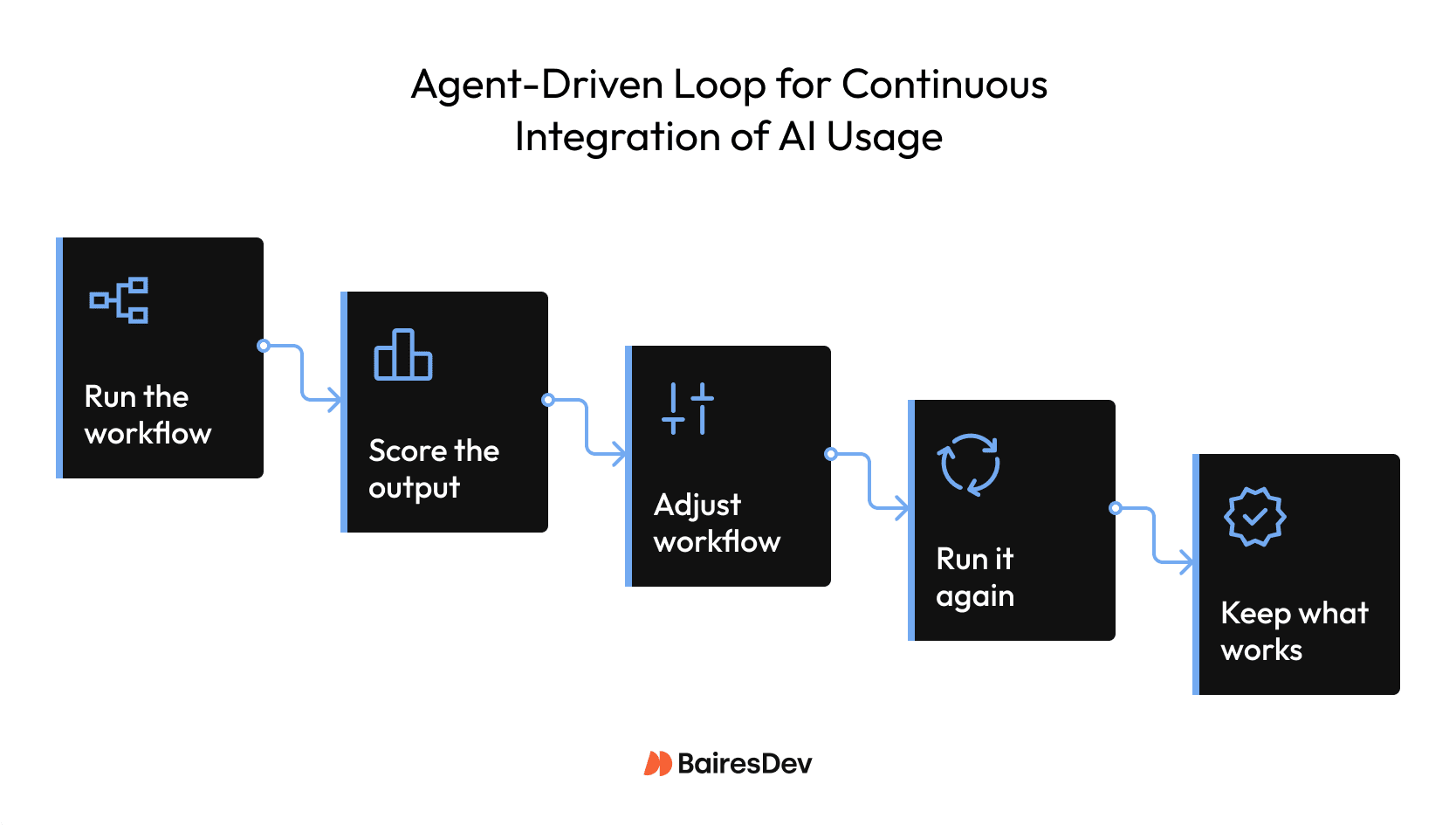
Investing in AI also means iterating on how you use it and I don’t mean trying new tools every quarter. I mean letting AI build on AI. You set up a loop where an agent runs a workflow, scores the output, makes a small adjustment, runs it again, and keeps what works. This is continuous integration for your AI usage. I’ve seen a workflow that was producing good results about half the time get pushed to over 90% accuracy through this kind of automated iteration, with no manual effort. The agent just kept tightening on its own.
That’s the mindset shift. The way your team uses AI today should look different from three months ago. If it doesn’t, you’ve stopped learning. Treat your AI workflows the way you treat your codebase — something that gets continuously refactored, tested, and improved, sometimes by the team and increasingly by the AI itself.
Why the Best Teams Optimize for 10x Gains
The best teams optimize for 10x gains because AI has made step-function improvements actually achievable. Teams still playing for incremental wins are leaving compounding advantages on the table.
For years, good engineering management was about incremental improvement: shipping a little faster, reducing bugs by 15%, cutting onboarding time by a week. Those gains compound and they matter.
But AI has changed the math. We’re in a moment where step-function improvements are actually possible — not on everything, but on more things than most teams realize. I see engineers generating entire test suites in minutes instead of days. Teams are standing up proof-of-concepts in an afternoon that would have taken a quarter. Documentation that used to be an afterthought is now getting written comprehensively, because the cost of producing it has dropped to nearly zero.
The teams with the right mindset are asking “how do we 10x this?” about every part of their workflow. Not every answer will be AI. Sometimes it’s a process change. Sometimes it’s removing a bottleneck that’s been there for years. But looking for step-function improvements instead of incremental ones is what separates the best teams from the rest.
This applies beyond engineering. Your QA process, sprint planning, incident response, customer feedback loop — all of it should be examined through that lens. If someone on your team automates a workflow that saves everyone 5 hours a week, that’s the kind of thing that used to get a pat on the back. Now it should be expected. The bar has moved.
The Updated Playbook for High-Performing Teams in the AI Era
So here’s the updated playbook with six principles instead of four.
- 100% Ownership. Own your outcomes and your AI adoption. Don’t wait to be told how to use these tools.
- High Commitment Rate. Stay predictable. Use AI to deliver more against your commitments, not to over-promise.
- Avoid Drama. Focus on Outcomes. The “is AI-written code real code?” debate is a waste of everyone’s time.
- Look Inward. When AI-assisted work goes sideways, ask what you could have done differently. Build the problem-solving muscle internally, then extend it outward.
- Invest in AI as a Core Competency. Be intentional, allocate time to experiment, let AI improve AI, and apply it to every part of the job.
- Think in 10x, Not 10%. Stop optimizing for incremental gains. Ask “how do we 10x this?” about everything.
The rules for building a high-performing team haven’t been thrown out. They’ve been expanded. Ownership, commitment, and self-awareness still matter as much as they ever did. The teams that will define the next era of software are adding AI fluency and a 10x mindset on top of that foundation.
If you’re leading a team right now, don’t wait for the perfect tool, a company-wide AI strategy, or someone to hand you a playbook. Start. Experiment. Iterate. Share what works.
Key Takeaways
- The foundation of high-performing teams like ownership, commitment, no drama, and looking inward, still holds in the AI era.
- Teams that are winning with AI aren’t overpromising; they’re delivering more against the same commitments.
- AI fluency is a core competency, not a perk. Teams need to experiment intentionally, iterate constantly, and let AI improve their AI workflows.
- The way your team uses AI today should look different from three months ago. If it doesn’t, you’ve stopped learning.
- The shift from incremental improvement to step-function thinking is what separates high-performing teams from the rest right now.