



Here’s what matters most if you’re deciding how to manage staff augmentation risks on your next engagement:
Key Points
- The five recurring staff augmentation risks are integration gaps, skill mismatches, security and compliance exposure, hidden costs, and knowledge drain at the end of the contract.
- Each risk tends to surface at a predictable stage of the engagement, which means each one can be caught early with the right process.
- Most mitigations are contractual and procedural rather than technical, and they cost far less than the failure they prevent.
- A single data breach now costs $4.44 million on average, which is why access reviews and IP assignment clauses belong in every staff augmentation partner agreement.
There’s no denying that staff augmentation is effective. Bringing in external professionals to work under your management is the fastest way to close a capacity gap without waiting months to hire. That’s why engineering leaders turn to staff augmentation services when project demands outpace their existing team.
But the model carries a specific set of staff augmentation risks, and they don’t all show up at once.
How These Risks Unfold Over an Engagement
After twenty years of building assessment systems and growing engineering teams, I’ve seen the same five problems come up again and again: augmented team members who never get enough context to be effective, people whose skills don’t match their resumes, external access that turns into a security risk, projects that end up costing far more than expected, and important knowledge that walks out the door when contracts end. Integration gaps happen most often in my experience, and security issues are the most costly. The other risks slowly drain your budget.
These risks are manageable because each one tends to show up at a certain stage of the engagement. Vetting problems surface before work starts. Integration issues appear in the first month. Security exposure accumulates across the life of the project. Cost overruns show up in the middle, and knowledge loss hits at the end. The table below maps that timeline, so you know exactly when to start watching for each one.
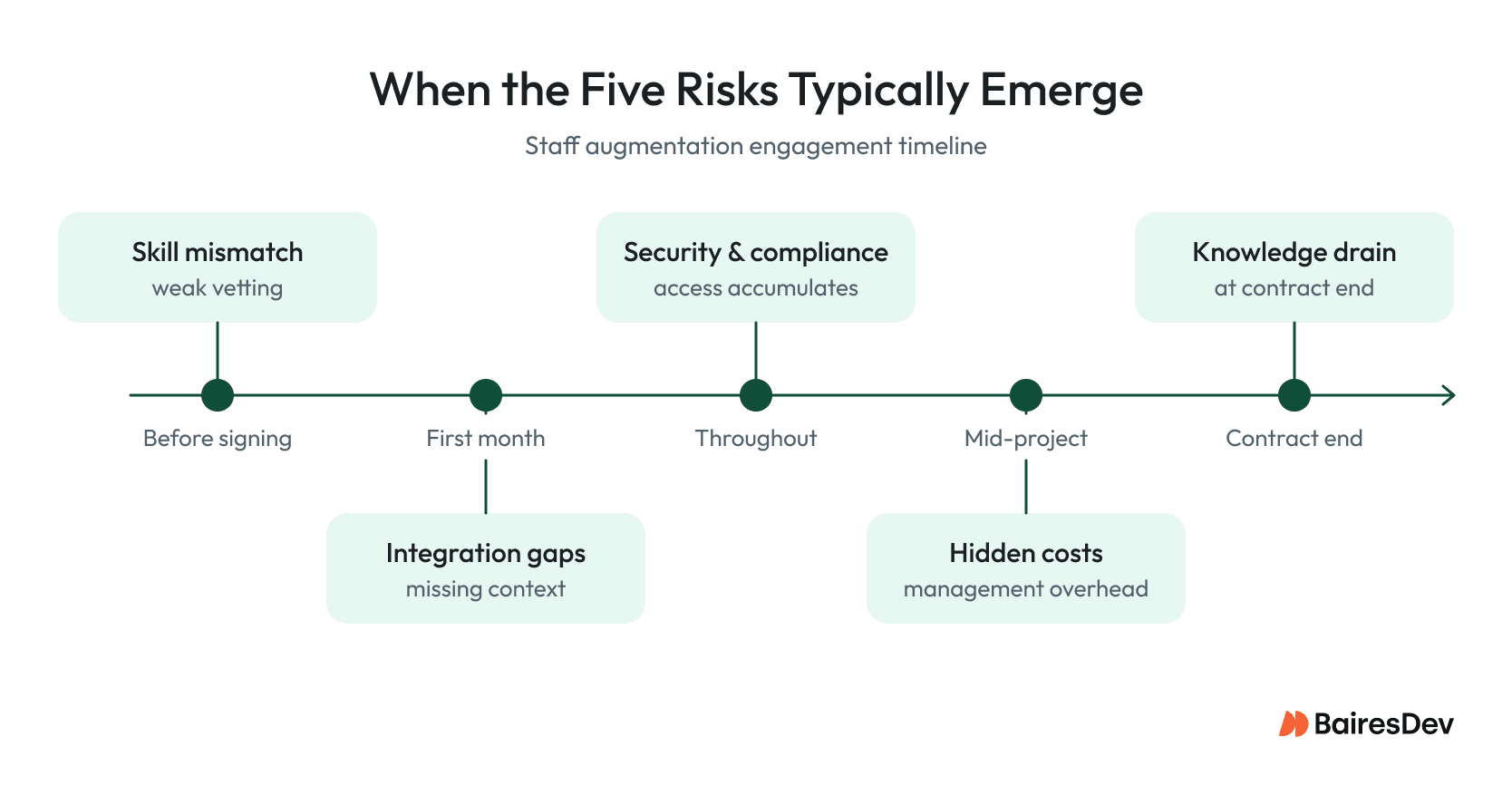
| Stage of Engagement | Risk | What Typically Triggers It |
| Before the contract is signed | Skill mismatch and weak vetting | Resume claims that don’t hold up under a real work sample |
| First month | Communication and cultural integration gaps | No context-sharing built into onboarding |
| Throughout the engagement | Security, IP, and compliance exposure | Access that outlives its purpose |
| Middle of the project | Hidden costs and management overhead | Onboarding, review time, and tooling nobody budgeted for |
| Contract end | Knowledge drain | No documentation or transfer plan in place |
Communication and Cultural Integration Gaps
This risk is often the hardest to notice. An augmented engineer might join every meeting, take on tickets, and ship code, but after three months, they still don’t understand why the product works the way it does. They follow instructions rather than addressing the customer’s real need, because no one explained the bigger picture.
The cost shows up as rework and slower delivery. Features pass code review but miss what was actually needed, and senior staff spend time clarifying things a fully integrated engineer would already know. Time zone differences and cultural habits around disagreement can make it worse; an engineer used to never questioning a client may quietly build the wrong thing instead of asking for clarification.
The earliest warning sign is passivity. If an augmented engineer hasn’t asked a tough question about the system or the requirements in their first two weeks, they’re not really integrating; they’re just following instructions.
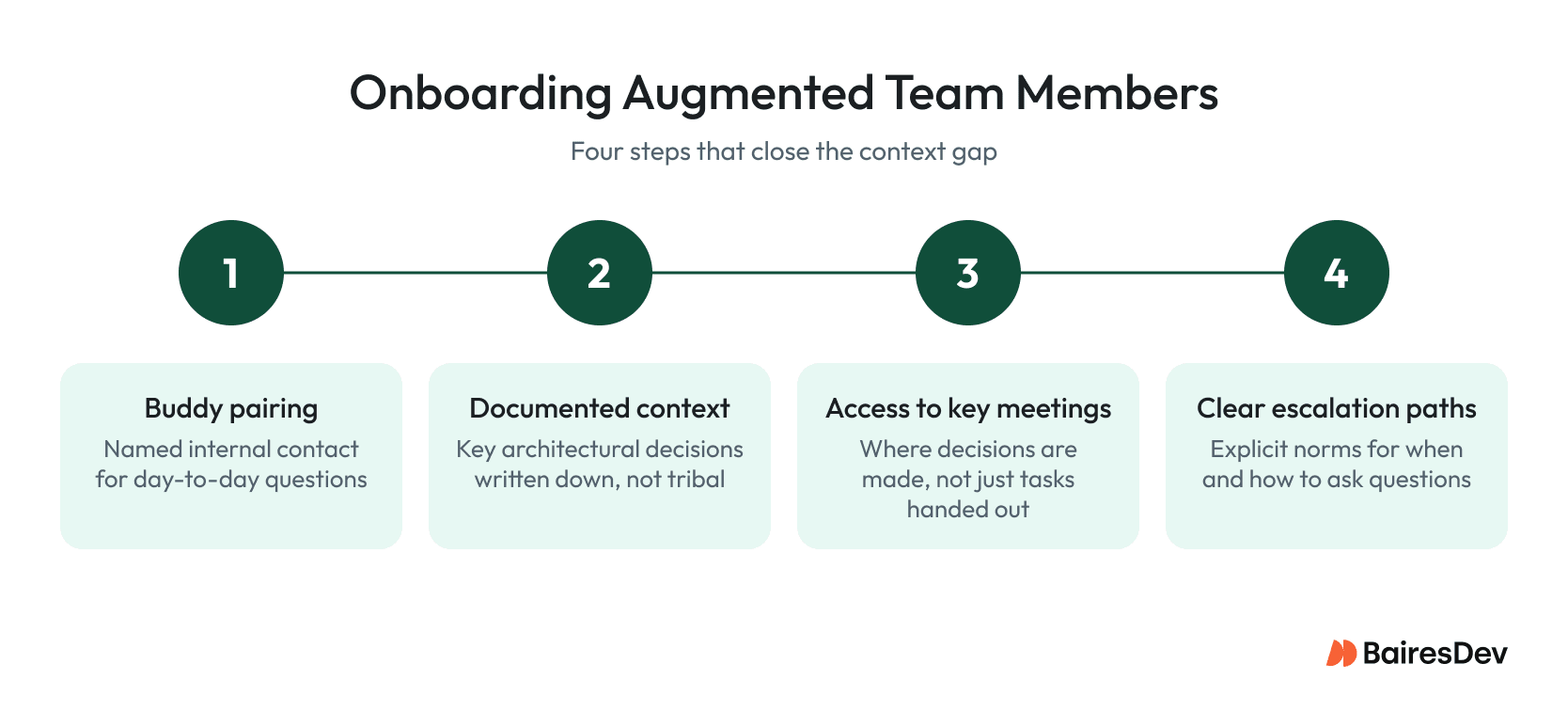
The fix is to make context-sharing an explicit onboarding goal, not a byproduct. Assign a buddy, document the architectural decisions that matter, and invite augmented staff to the meetings where the reasoning happens, not just the ones where tasks get handed out. Treat augmented staff as task-doers only, and that’s all you’ll get from them.
Skill Mismatch and Weak Vetting
A resume might claim eight years of experience with distributed systems, but the first code review often tells a different story. Skill mismatches are a top reason staff augmentation doesn’t work out, and it usually comes down to weak vetting, not bad luck.
There’s a newer wrinkle. AI coding tools let candidates produce convincing code for take-home tests, or even during live interviews with a second device running quietly. Someone who can’t design a system can still generate code that runs. If your vetting process hasn’t changed since 2019, it isn’t testing for today’s reality.
| Every vetting process I’ve built starts from the same assumption: every claim on a candidate’s resume is unverified until they demonstrate it on a problem and explain their reasoning as they go. |
There are warning signs you can catch before you sign anything. If a provider won’t let you interview the actual people joining your team, or swaps them out after the deal closes, they’re retaining control over vetting instead of letting you verify skills yourself.
The fix is layered verification. Interview the real engineers, not a sample from the talent pool. Use work samples that allow AI tools, and watch how candidates use, check, and correct the tool’s output; that judgment is the actual skill now. Secure contractual approval rights over any substitutions, and treat the first two weeks as a paid trial with defined success criteria. Skip these steps, and you may pay for it later in delivery.
Data Security, IP, and Compliance Exposure
This is the risk with the largest downside, because its costs are set by regulators and attackers, not by your project budget. IBM’s Cost of a Data Breach Report 2025 puts the global average cost of a data breach at $4.44 million, and external workers with production access widen the attack surface those numbers are built on.
| Almost every access review I’ve run at remote teams turned up a credential belonging to someone whose contract had ended. Nobody decided to leave it active. Nobody decided anything. And that’s the problem. |
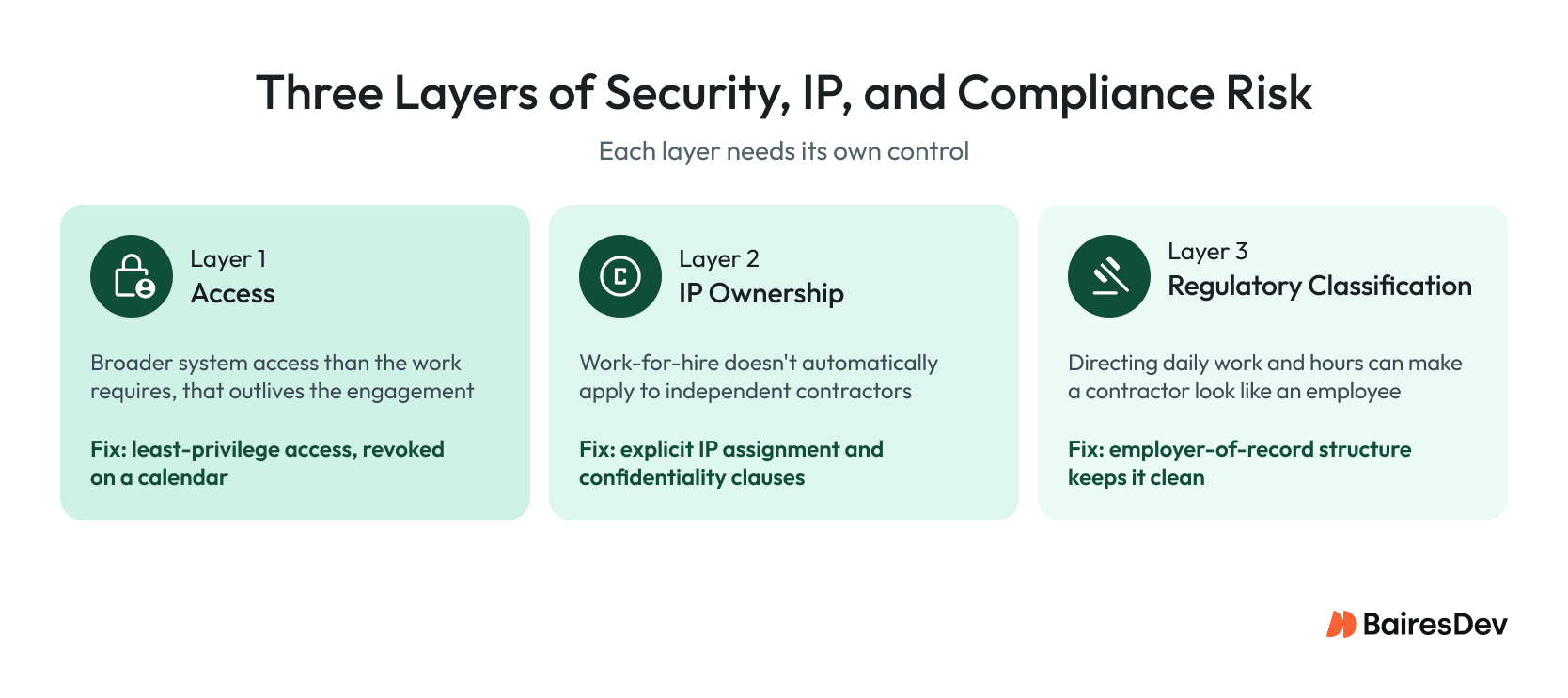
The exposure builds in three layers.
Access
Augmented engineers frequently receive broader system access than the work requires, and that access frequently outlives the engagement. The same IBM research found that shadow AI, meaning unsanctioned AI tools handling company data, played a role in roughly one in five breaches studied. An external engineer pasting proprietary code into a personal AI tool account is a data transfer your security team never sees. The answer is least-privilege access, provisioned per engagement and revoked on a calendar rather than on memory, plus a written policy naming which AI tools and accounts external staff may use.
Ownership
In many jurisdictions, work-for-hire doesn’t automatically apply to independent contractors, so without explicit assignment clauses, the code an augmented engineer writes may not cleanly belong to you. This tends to surface at the worst possible moment: due diligence for an acquisition or a funding round. Every contract needs explicit IP assignment and confidentiality clauses, reviewed by counsel in each relevant jurisdiction.
Regulatory
If you direct an external engineer’s daily work, set their hours, and integrate them like an employee, labor authorities may decide they are one. The federal test is in flux: the Department of Labor proposed in February 2026 to rescind its 2024 classification rule. The liability isn’t going anywhere, though. Misclassification brings back taxes, FICA liability, and per-worker penalties, and states apply stricter standards of their own. The cleanest containment is structural, usually a provider acting as employer of record, so classification never becomes a question.
The earliest warning sign spans all three layers: an access review you can’t complete. If nobody can produce a current list of which external engineers can reach which systems, the exposure already exists.
Where Do the Hidden Costs Come From?
The listed rate isn’t the real cost. An augmented engineer who costs 60% of a local salary might still land more expensive than a direct hire, because the rate doesn’t include onboarding, management time, tools, licenses, or the extra work caused by missing context. In a mid-sized company running several staff augmentation engagements at once, the gap between the rate and the true cost often goes unnoticed.
Leaders routinely underestimate the management workload. Senior engineers end up reviewing code, answering questions, and handling extra coordination, which pulls time away from their own delivery work. Bring in too many augmented staff members without planning for this, and your senior staff can end up spending most of their time managing external workers instead of shipping their own projects.
There’s a morale cost, too. When internal employees watch external talent brought in at higher rates while their own requests for headcount get ignored, retention suffers.
| Cost Component | Why Teams Miss It |
| Contract rate | The number in the statement of work, not the total spend |
| Onboarding | Ramp time before the engineer becomes productive |
| Management and code review | Senior engineers’ time, redirected from their own delivery work |
| Tools and licenses | Seats, environments, and access provisioning |
| Coordination overhead | Meetings, hand-offs, and time zone friction |
| Rework from missing context | Features that pass review but miss the actual need |
The first warning sign is a drop in a senior engineer’s productivity after an augmented engineer joins the team. To manage this, run a full cost analysis before signing anything, including onboarding, review time, and tool costs. Set a ceiling on augmented staff per team, and review actual costs after 90 days against your estimates.
Knowledge Drain When Contracts End
Every augmented engineer picks up important context: why certain payment logic is unusual, which integrations fail under pressure, how to handle undocumented deployment steps. Skip the effort to capture that knowledge before the contract ends, and it leaves with them.
| I’ve watched teams lose more velocity to a badly executed offboarding than to a bad hire. The engineer did everything right, but the organization never asked them to write anything down until the last week, and by then it was archaeology. |
The earliest warning sign is discoverable long before the exit: pick any system the augmented engineer owns and ask an internal engineer to explain it. If they can’t, the knowledge is already siloed.
The fix is to plan for continuity. Pair augmented engineers with internal staff on any work that continues after they leave. Make documentation a required contract deliverable, not a nice-to-have. Build knowledge transfer sessions into the final month as a contract requirement, and stagger contract end dates so you don’t lose all the context at once.
The Risks, Side by Side
The table below compresses the five risks into a decision aid. Notice the pattern: every warning sign is observable within the first weeks, and every mitigation costs less than the failure it prevents.
| Risk | How It Bites | Earliest Warning Sign | How to Mitigate |
| Communication and integration gaps | Rework, slow delivery, features that miss intent | No hard questions from the engineer in the first two weeks | Structured onboarding, named buddy, documented context, explicit escalation norms |
| Skill mismatch and weak vetting | Missed deadlines, early contract termination | Provider resists interviews with named individuals or substitutes personnel | Interview actual engineers, AI-inclusive work samples, substitution approval rights, paid evaluation period |
| Security, IP, and compliance exposure | Breach costs, lost IP ownership, regulatory fines | No current inventory of external access | Least-privilege access with scheduled revocation, IP assignment clauses, AI-tool policy, clean classification structure |
| Hidden costs and management overhead | Engagement quietly exceeds the cost of hiring | Senior engineers’ own output drops after augmentation starts | Total-cost model before signing, augmented-to-internal ratio ceiling, ninety-day cost review |
| Knowledge drain at contract end | Velocity collapse after offboarding | Internal staff can’t explain systems the external engineer owns | Pairing, documentation as a contractual deliverable, scheduled transfer sessions, staggered end dates |
When Staff Augmentation Is the Right Call, and When It Isn’t
Staff augmentation works best when you already have strong engineering and product leaders, a clear need for more capacity, and projects that benefit from close teamwork. It fits scaling up on a set roadmap, bringing in specialized expertise for a defined project, or bridging the gap while you hire full-time employees. In these situations, the five risks stay manageable because the right management is already in place.
It’s the wrong choice if you don’t have enough senior engineers to guide and review the work. In that case, you’re handing your project to people who lack context and supervision.
Managed delivery teams or project-based outsourcing tend to work better here, since the provider handles management directly. Staff augmentation also isn’t a great fit for work that’s central to your long-term success, where you want people who stay with the project for years, or for environments with strict compliance rules that don’t allow outside access. Match the structure to the model, or pick a different approach.
The real decision isn’t just staff augmentation versus hiring. It’s choosing the right hiring model based on your management capacity, the sensitivity of the work, and the project’s duration.
Make the Five Risks Someone’s Job
None of these five risks should keep you from using staff augmentation. They’re reasons to approach it deliberately. The problems are predictable, the warning signs show up early, and most of the fixes are contractual and procedural: interview the real engineers, grant only the access they need, include IP clauses, calculate the true cost, and require knowledge transfer. Teams that build this into their staff augmentation process capture the benefits of staff augmentation quickly. Teams that skip it tend to become the example everyone else studies.