By Pablo Bassil
Pablo is a senior software engineer with 15+ years of experience in full-stack development. He serves as tech lead at Red Ventures, building serverless architectures using React, Go, Node.js, and AWS. Pablo has also worked with Paychex on mobile and web applications.
Expertise



Key Points
- Your hook pays for itself only when the work it skips costs more than its per-render dependency check.
- Your useCallback call prevents nothing if the receiving child is not wrapped in React.memo and no Hook depends on that function.
- React Compiler v1.0 memoizes at build time so your new code should treat manual hooks as the exception rather than the default.
- Your team should require every manual hook to name either a measured render cost or a specific identity requirement before it merges.
- A hook saving 0.3ms inside a 2ms render affects neither your frame budget nor your INP threshold.
The short answer: React has two hooks for memoization: the useMemo hook, which caches the result of a calculation and reuses it on each render, and the useCallback hook, which caches the function itself so the same reference survives re-rendering. Use useMemo when a calculation takes a measurable amount of time and runs far more often than its input values change. Use useCallback when something further down the line depends on the function keeping the same identity from one render to the next.
Many production React applications have more useMemo and useCallback calls than their actual performance issues require. The reason is that teams add them as a stylistic preference, rather than after an analysis of where and why a specific bottleneck occurs. As a result, many applications pay the cost of memoization throughout the codebase but see little or no confirmed benefit.
For engineering leaders, the real questions are: whether a hook belongs there at all, what criteria decide whether it stays, and whether a team of thirty can apply those criteria consistently.
What These Hooks Cost and What They Prevent
Memoization is an effective performance optimization technique that comes with additional overhead. Both useMemo and useCallback add a dependency check to every render and both store some state. You pay this cost on the initial render and every render after it, so it only pays off when the work the check prevents is more costly.
What the useMemo Hook Caches
useMemo caches the result of a calculation between re-renders, rreturning a value that only changes when a dependency does. During a render cycle, useMemo checks if any of the dependencies have changed. If none of them have, the hook returns a cached version of the results; otherwise, the calculation re-runs.
On the initial render both hooks do their work and store the result. On subsequent renders they compare the current dependencies against the previous render, and the hook returns the cached value or discards it and computes a new value.
Memory use and comparison time versus re-computation time determine where the line is drawn as far as memoization goes. Memoization is worthwhile only when you are avoiding an expensive calculation.
React has made its position clear regarding memoization: “unless you’re creating or looping over thousands of objects, it’s probably not expensive.”
What the useCallback Hook Returns
useCallback caches a function definition between re-renders, returning the same reference until a dependency changes. The useCallback hook caches only the function reference; the function body still executes each time it is called.
Whether referential stability matters depends on how the receiver uses the reference. Child components wrapped in React.memo compare prop identity on re-render; components without that wrapper skip the comparison entirely, making a stable reference irrelevant to those consumers.
Both useMemo and useCallback share a common mechanism, so the differences that matter are their failure modes.
Table: useMemo vs. useCallback Comparison
| Dimension | useMemo | useCallback |
| What Is Cached | The return value of a computation function (react.dev) | useCallback caches the function reference itself, not its return value (react.dev) |
| Return Value | The memoized result, such as a filtered array or a derived object | The memoized function definition; calling it still executes the body |
| Primary Purpose | Avoid repeating an expensive calculation when inputs have not changed | Maintain referential stability of a function across renders |
| Common Use Cases | Filtering or sorting large datasets, complex calculations that become derived state and heavy object construction passed as props | Handlers passed to memoized children and functions used as dependencies of other Hooks |
| Dependency Behavior | The cached value is re-created when any dependency changes; an incomplete array silently returns the previous value | Re-creates the function definition when any dependency changes; captures closure values at creation time |
| Performance Cost | Dependency comparison every render plus memory for the cached value; pays off only when recomputation exceeds comparison cost (react.dev) | Dependency comparison every render plus memory for the cached function; prevents work only when a consumer checks referential equality (react.dev) |
| Common Misuse | Applied to cheap work such as string formatting, where comparison overhead exceeds the computation avoided | Applied when the receiving component lacks React.memo and no Hook depends on the function |
The last two rows of the table above carry the most diagnostic weight for anyone evaluating a codebase for proper usage. Instances of useMemo in the misuse row indicate that excessive complexity was added to work that did not need it. Instances of useCallback directed toward un-memoized children indicate stability that prevents no component re-renders and is consumed by no one.
When the Conditions Are Actually Met
Expensive Calculations With a Frequency Mismatch
If a component runs an expensive calculation, like sorting a huge list, and its inputs change far less often than it re-renders, useMemo saves it from doing the whole thing again. React frames the test the same way in its guidance on when memoization helps.
The frequency mismatch is the whole condition: a component renders far more often than its inputs change. An operations dashboard that re-sorts fifty thousand rows on every keystroke in an unrelated filter field is a good example of a candidate. A component that formats a timestamp has barely any calculation happening.
Application type matters too. A very interactive application, like a drawing program where users move individual shapes around, benefits from memoization; an app that swaps out whole pages generally does not.
Memoized Callbacks Passed to Child Components
React.memo uses Object.is to compare the props passed to a component. Two JavaScript functions, including arrow functions, created separately are never identical under that comparison, even when their bodies are the same.
So if a parent component creates a new function during a render and passes it down as a prop, it has just defeated the child’s memoization, even when that child is otherwise structured as a pure component.
This is why data grids are the textbook example of when useCallback earns its place. Picture a grid that renders eight hundred memoized child components, each receiving its parent’s onSelect handler. Without useCallback on that handler, every parent re-render invalidates all eight hundred comparisons at once.
The order matters. First, apply React.memo to the child. Then check whether the handler needs stabilizing with useCallback.
The same logic applies to objects and arrays. Say a component builds a filter config object during render: it is a new object every time. That makes useMemo the best choice when a memoized child or an Effect depends on that config.
Referential Equality in Hook Dependencies
Whenever a function sits in a useEffect dependency array, each new function definition counts as a distinct reference, which forces the Effect to resync after every render.
Unstable identity in these scenarios can lead to real behavioral problems, such as redundant network connections or update loops. Even so, React still considers useCallback a performance optimization and suggests fixing the structure first: move the function inside the Effect, or move a static function outside the component entirely.
useCallback is the right tool when the function can’t move inside the Effect because other handlers in the same component share it.
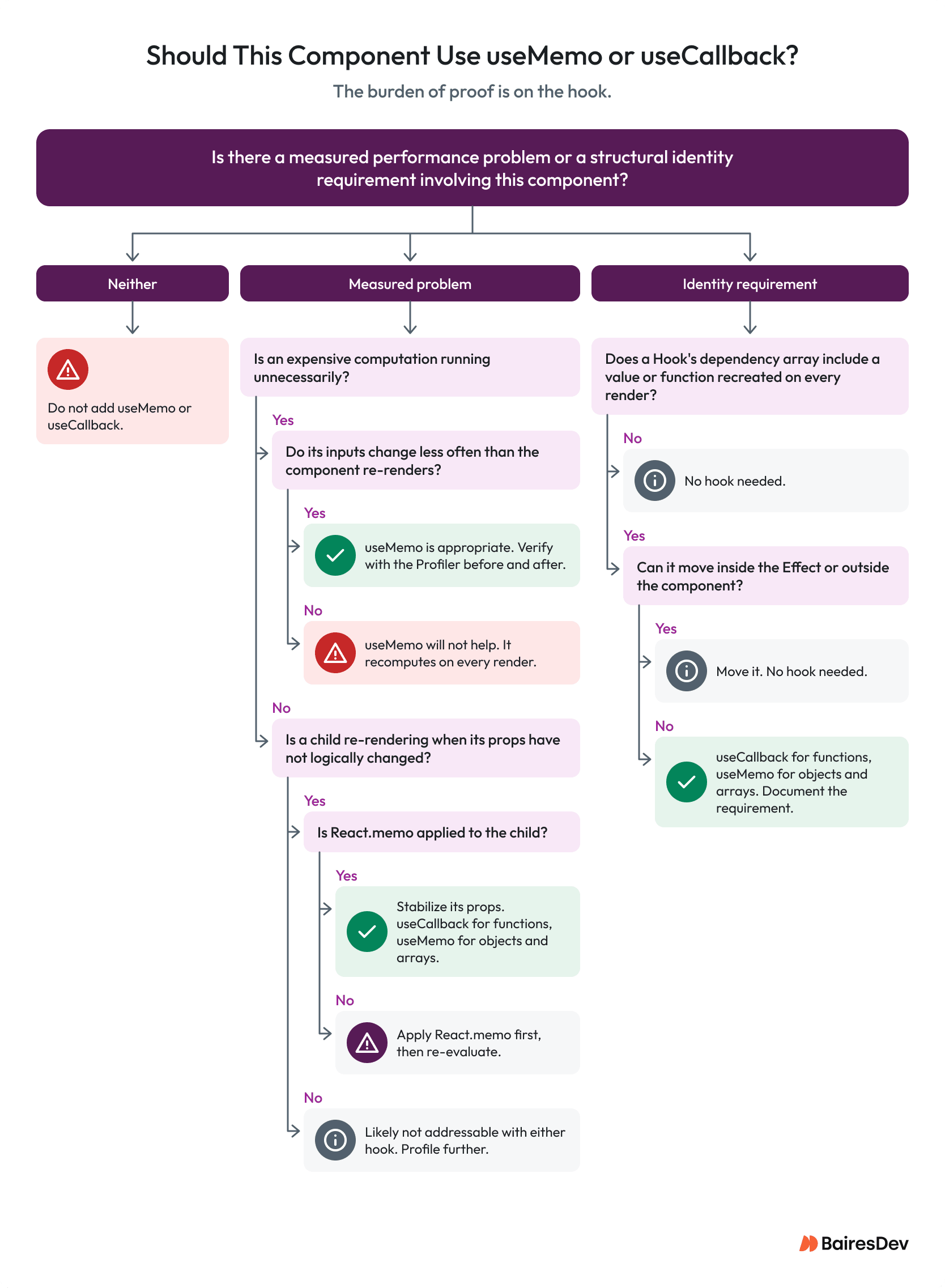
Each decision point names a condition that can be verified, so reviewers can tell which path the author followed and whether the evidence supports it.
When Not to Use the useMemo and useCallback Hooks
Skip the useMemo and useCallback hooks if there is no expensive calculation to avoid, if no profiler run has shown the component to be a bottleneck, or if the memoization will cause more confusion than it saves in render time. The first render pays the setup cost regardless, and nothing is recovered if later renders never hit the cache.
React directly states this trade-off. Memoizing everything makes code harder to read, and one value recalculated every time the component renders will nullify memoization for the entire component.
However, the greatest expense is organizational. Each hook in a component sends a message to any future maintainers that a performance issue was found and fixed at this location in their own code. When no such issue existed, the message is false and permanent.
React provides a list of five structural fixes to try before anything else: accept JSX as children so wrappers stop forcing child re-renders, keep state near where it is used, keep rendering logic pure, remove Effects that exist only to update state and trim Effect dependencies that don’t need to be there.
Stale closures increase the risk. If a dependency array omits a value, such as a variable inside the closure, then that value remains frozen at the render in which the function was generated, which is the same type of error that the react-hooks/exhaustive-deps rule identifies. It flags dependency mismatches that can create stale data or wrong synchronization.
Table: Code-Review Signals of Speculative Memoization
| Signal | What It Indicates | Recommended Action |
| useMemo wraps a very inexpensive calculation | Unlikely to justify the added complexity (react.dev) | Measure render time with and without before retaining |
| useCallback used, child has no React.memo, no Hook depends on the function | Stable reference has no consumer, so no unnecessary re-renders are prevented (react.dev) | Apply React.memo to the child, or remove the hook |
| Dependency array includes an inline object or array | The dependency array changes on every render, so the hook memoizes nothing | Extract the value, or depend on its stable primitive members |
| Every handler and derived value in the file is memoized | Speculative optimization applied as house style | Audit with the React Profiler; remove where cost is unconfirmed |
| The author cannot name the problem the hook prevents | Hook added prophylactically | Require a documented reason before merge |
Most of these rows can be checked without any profiling expertise. The reviewer asks the author what the hook prevents, and the table supplies the follow-up question.
What the React Compiler Changes
React Compiler v1.0 has been production-ready since October 2025 and applies memoization at compile/build time. It can also memoize after early returns, a location manually written hooks cannot reach because React Hooks cannot be called conditionally.
The React team reports Meta Quest Store results of up to 12% faster initial loads and cross-page navigations and more than 2.5x improvement on some interactions following its adoption of the Compiler. Those numbers represent what happened to the application post-migration, with no controlled comparison against manually written hooks.
Manual hooks have not been deprecated. The React team’s current guidance is that new code will likely rely on the Compiler’s memoization, that useMemo and useCallback are available for teams who need fine-grained control over their memoization, and that existing manual memoization should stay in place until teams test their code thoroughly, since removing it changes what the compiler emits.
The leadership question is what the standard will become once the Compiler is enabled, and how you retire the manual hooks without forcing churn on code that currently works.
Setting a Memoization Standard Your Team Can Defend
Our recommended standard is a documented-reason standard. A manual useMemo or useCallback ships only with a measured rendering or computation cost, or a specific identity requirement that restructuring the component or Effect cannot remove.
This language accomplishes more than a profiler evidence-based rule would. The requirements for identity are structural; no profiler run would reveal one, and a measurement-based policy quietly encourages teams to create undocumented exceptions.
For Compiler-enabled code, we treat manual memoization as the exception rather than the norm. Each surviving hook contains a single-line comment identifying which of the two conditions the hook meets and providing reviewers with a tangible test to apply. The same rule covers any custom hook that returns a memoized value.
The standard has portability. When delivering React development services alongside a client’s in-house team, a written standard ensures both teams apply the same evaluation criteria. New engineers then inherit the rationale for each hook.
We retire existing hooks on an opportunistic basis, at the time a file is being modified anyway and tests provide coverage for the behavior, following React’s recommendation against en masse deletion.
What to Measure Before Adding a Hook
When profiling, the question is whether the expensive operation a hook would prevent is the actual cause of the slowness, and whether preventing it costs less than the hook itself.
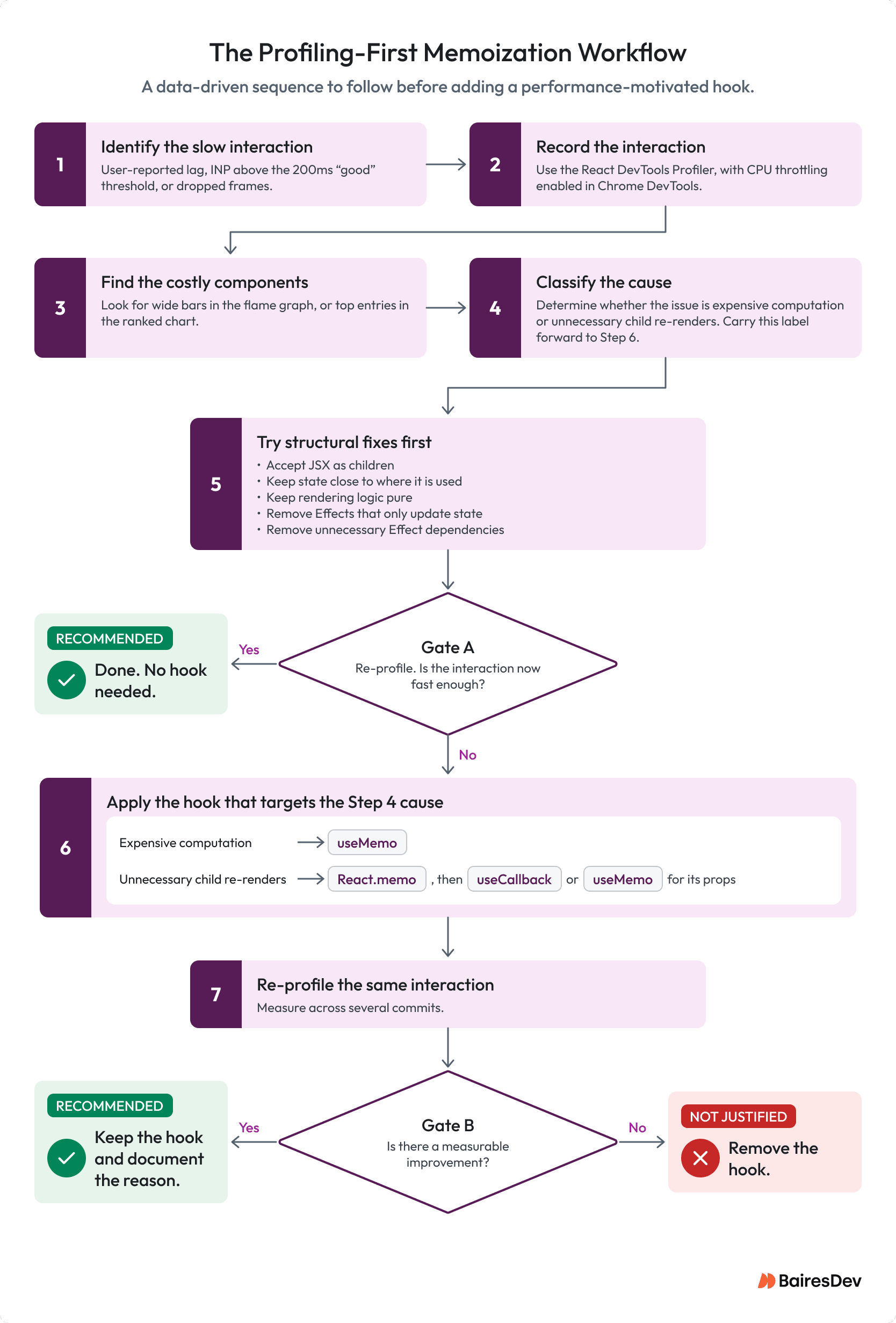
The React Profiler exposes two useful metrics. The actualDuration reports the milliseconds spent rendering a subtree for the current update, and baseDuration estimates what a full re-render of that subtree would cost without optimizations.
Treat both as signals. Profile the same interaction before and after the change across several commits since a single reading says little about whether a given hook is doing any work.
React recommends timing the calculation directly and testing with an artificial CPU slowdown, since development machines outrun user devices. A computation measuring 0.2ms on a workstation can cross the roughly 1ms mark React suggests is worth investigating once it runs on a mid-range phone.
The Chrome DevTools Performance panel supplies the frame-budget context. At 60 frames per second the browser produces a frame every 16.66ms and after its own overhead roughly 10ms remains for all of your per-frame work during an animation.
Discrete interactions the user initiates follow a different target. According to web.dev, the INP “good” threshold is 200ms or lower , a figure chosen to accommodate devices of varying capability, and cites 100ms as the commonly referenced point at which a change feels instant.
A hook that saves 0.3ms inside a 2ms render affects neither budget.
Frequently Asked Questions
What Should a Team Measure Before Adding useMemo or useCallback?
Record the interaction in the React Profiler to see which components re-render, how often they re-render and how long each render takes. Then confirm in Chrome’s Performance panel that render time actually consumes frame budget.
Compare actualDuration against baseDuration across the initial render and several subsequent renders of the same interaction and enable an artificial CPU slowdown so the measurement reflects the devices your users carry.
When Does useCallback Fix Behavior Rather Than Performance?
Stable identity matters when a function serves as a dependency of an Effect or another Hook. Without it, the Effect re-synchronizes on every render, which can cause redundant connections or update loops.
React still treats useCallback as a performance optimization and prefers structural fixes. Move the function inside the Effect where possible, and reserve the hook for a callback function shared between the Effect and other handlers.
Does Widespread Memoization Make a React Codebase Harder to Maintain?
Yes. Each hook adds dependencies to track, invites stale closure bugs whenever a dependency slips out of the array, and tells future maintainers that a performance problem existed here.
React makes the same point about readability. The cost accumulates across every file, whether or not a benefit was ever confirmed.
Does the React Compiler Make useMemo and useCallback Obsolete?
No. React Compiler v1.0 handles memoization at build time for most components, so your new code rarely needs manual hooks. Both hooks are still available when you need fine-grained control over specific cases the compiler does not cover.
Avoid bulk-deleting existing manual hooks after enabling the compiler. React advises thorough testing first because removing them changes what the compiler emits. Retire them opportunistically when you’re already modifying a file and your tests cover the relevant behavior.
What Is the Difference Between useMemo and React.memo?
useMemo caches a computed value inside a component. React.memo wraps a component and skips its re-render when it receives the same props, compared shallowly under Object.is, the built-in comparison function.
The difference matters because useCallback only prevents unnecessary re-renders in child components that use React.memo. Confusing the two is a frequent source of memoization that adds overhead and prevents nothing.
By Pablo Bassil
Pablo is a senior software engineer with 15+ years of experience in full-stack development. He serves as tech lead at Red Ventures, building serverless architectures using React, Go, Node.js, and AWS. Pablo has also worked with Paychex on mobile and web applications.
Expertise