



Vetting often stops at case studies, online reviews, a few reference calls, and friendly chats with your network. This guide covers what to do after this shortlist, how to genuinely evaluate a vendor’s hiring process, verify their delivery claims, and run serious reference checks that surface problems instead of pleasantries.
Key Points
- A vendor’s engineering quality is only as good as their hiring process, and you need to know what to look for and what to ask.
- Watch how they handle a candidate rejection, as that can tell you more than any sales call or Clutch review.
- Almost every project has problems. If a reference can’t name one, they’re probably not being straight with you.
Everything Went Well, Until It Didn’t
The typical failed partnership doesn’t look risky at first. Before you signed, everything seemed promising: the first call went well, the pitch was confident, the case studies were relevant, and the proposal felt customized.
But a few months in, things started to fall apart. The lead engineer is suddenly gone, and their replacement is picking up the pieces, slowly. A missed deadline was noticed internally weeks ago, but never reached the manager. Somewhere along the way, your development partner dropped the ball, and important warning signals were overlooked.
When you vet a software development outsourcing company, there’s often a gap between what vendors promise and what they actually deliver.
Much of the advice you’ll find online usually covers the basics: look at case studies, read reviews, talk to the account manager, and check certifications. True, these steps are important, but they’re insufficient. Potential software development partners know how to pass these checks. If you only follow the standard process, you may choose an outsourcing provider based on their sales skills rather than their true ability to deliver.
This buyer’s guide is aimed at engineering leaders who want to go beyond the usual vetting checklist. You already know the basics, and you’ve probably outsourced before. What you might not have is a clear plan for what to do after you make your shortlist. This is the stage where most teams stop vetting and regret it a couple of quarters later.
A Framework You Can Run Before Anything Else
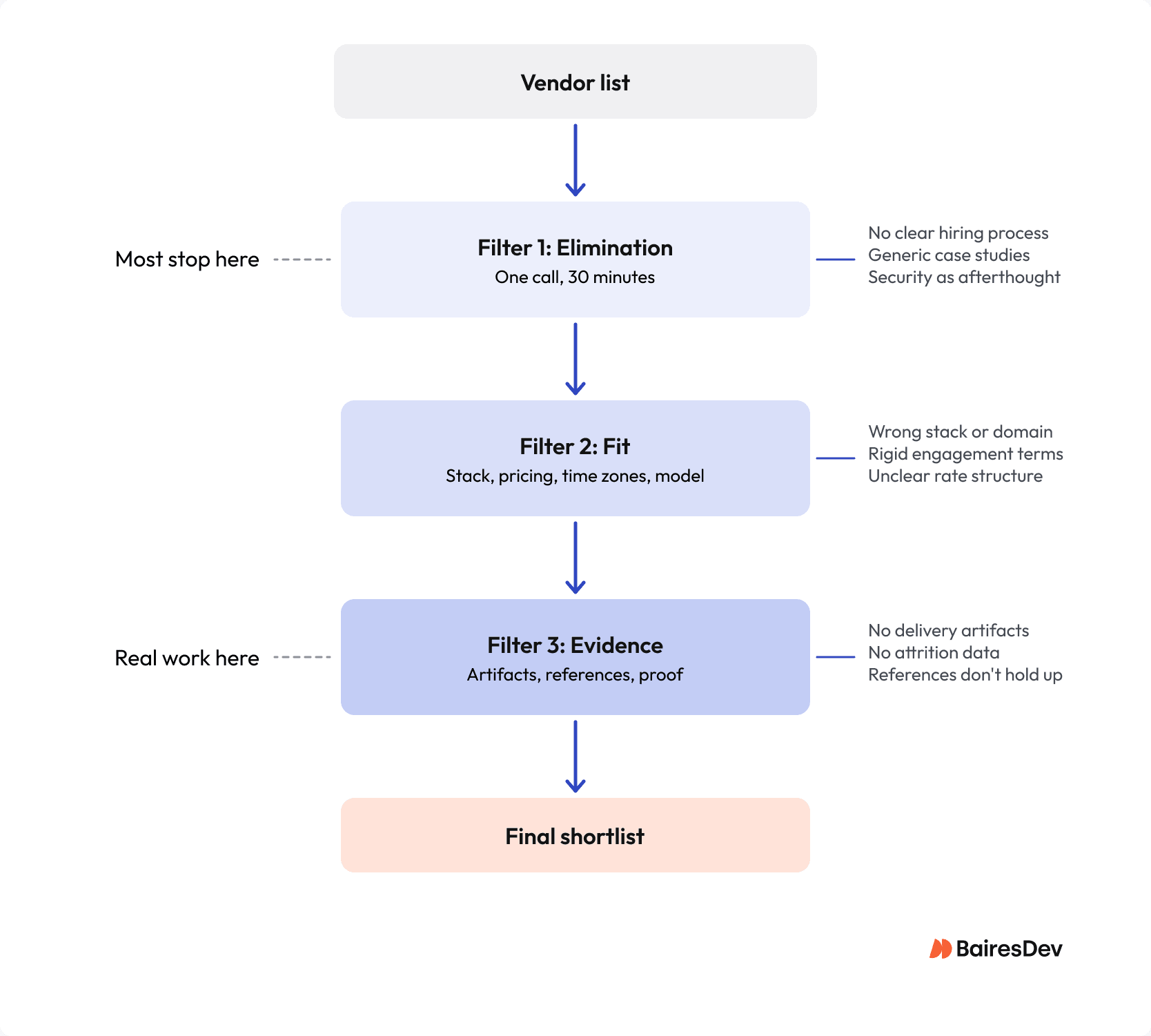
Three filters, in order: Elimination, fit, and evidence.
The first filter is elimination. Some vendors should not make it past a half-hour call. If they cannot clearly explain their hiring process, if their case studies are too generic, if they do not know which engineers would be best for your project, or if they treat security as an afterthought, it’s best to cut your losses and move on. This step is quick and saves you time spent on partners who are not a good fit.
The second filter is fit. From the vendors who pass the elimination round, choose those whose experience, pricing, engagement model, time zone overlap, and communication correspond to your needs. Sadly, Deloitte’s 2024 Global Outsourcing survey found this is where many teams stop their vetting process.
The third filter is evidence. Few teams do this well. Here, you ask the vendor to prove their claims: how they hire, how they deliver, who will work on your account, what happens when problems arise, and how they protect your data and IP.
| Filter | What you’re testing | Red flags |
| Elimination | Can they explain their process in a half-hour call? | Vague hiring process, generic case studies, security as an afterthought |
| Fit | Experience, pricing, time zones, engagement model | No overlap with your stack, rigid engagement terms, unclear rate structure |
| Evidence | Can they prove their claims with artifacts? | No real scorecards, no attrition data, no delivery metrics |
Most of this guide focuses on the third filter, since the first two are widely discussed, but the real work happens in the evidence stage.
The Basics, Handled Quickly
Before diving into the evidence stage, some items on the standard checklist need closer attention.
Relevant experience should match your specific problem. A vendor with years of healthcare experience may not be the right fit for your fintech project, and a team with marketplace MVPs may not be the best choice for migrating an old monolith. Ask them to describe a project similar to yours in detail. Vague case studies are a red flag.
Pricing models are less important than how openly the vendor explains them, whether it is time-and-materials, fixed-price, dedicated team, or retainer. Each model has pros and cons, and the best decision depends on your project. Look for a vendor who can explain why a certain model fits your needs, not just what benefits them. Watch out for unclear pricing that relies on change orders for extra profit, which is often obvious in the contract.
Security is about more than just listing certifications. Ask how they manage access, rotate credentials, and train engineers on handling data. If your product handles regulated data, such as healthcare, payments, or personal information, ask about their real experience with the standards in your industry and how that played out in practice. Certifications are just the starting point.
Communication and time zone overlap are not the same. Overlap allows real-time conversations, but it does not guarantee they will happen. Ask for a sample status report, how they handle escalations, and what engineers do when they are blocked, and their lead is unavailable. Time zone overlap is important, but so is the vendor’s communication culture. Some vendors encourage engineers to raise issues directly, while others filter everything through a delivery manager who softens the message. The second approach may seem smoother during sales, but it often leads to problems surfacing too late.
Cultural fit is often seen as a soft factor, which can lead to it being overlooked. It should be treated as hard evidence. You want to know if the vendor’s engineers will challenge bad requirements, ask the right questions, and flag issues early. A team that only follows instructions will likely build the wrong thing, even if it does so efficiently.
How Do Outsourcing Firms Actually Hire?
A vendor’s engineering quality depends mostly on how they hire. Delivery quality, architectural skills, stakeholder management, and the ability to handle uncertainty all come from who they choose to hire or reject. Vendors with a strong hiring process deliver better results than those focused only on sales.
Serious vetting begins with a full walkthrough of their real technical interview process, not just the marketing version. Ask how they find candidates, what the initial screening looks like, who conducts the technical interview, and what they test for. Find out how they make sure ‘senior’ means the same thing across different world locations, how they handle disagreements between interviewers, and what their offer-to-acceptance ratio is.
A strong vendor can explain their evaluation criteria, show you an anonymized scorecard, describe how they assess architectural skills, coding ability, and teamwork, and share how often their interviewers reject candidates. A weaker vendor only talks about ‘senior engineers’ and ‘years of experience’ and cannot say what makes someone a good or bad hire for them.
Also, try to find out what they do not test for, as this can be just as telling. Many vendors focus on algorithmic problem-solving and little else. This may find people who are good at coding puzzles, but not those who can work with legacy systems, handle unclear requirements, or challenge product decisions that could cause technical debt. If their process skips these skills, it will show up as a gap in your project.
Next, consider the interviewers themselves. If the vendor’s engineers run technical interviews, ask to observe one or request a recording (with the candidate’s consent). You will learn more from watching a real interview than from hours of sales calls. If the vendor refuses, consider why.
Finally, pay attention to candidate experience. Ask the vendor how candidates describe their interview process, how they give feedback, how quickly they make decisions, and how they handle rejections. Vendors who treat candidates with respect and clarity usually treat clients and teams the same way. If their hiring process is disorganized or unclear, that attitude will eventually affect your project, too.
| Signal | Strong vendor | Weak vendor |
| Interview process | Shows rubric, real problems, calibration method | Talks about “senior engineers” and “years of experience” |
| Who interviews | Their engineers run technical interviews | Recruiters or account managers screen candidates |
| What they skip | Can tell you what they don’t test for | Never considered the question |
| Rejection response | Recalibrates in one conversation | Sends the same profile with a different name |
The Communication Check
How a vendor communicates during their vetting is a good preview of how they will communicate during the project. Pay close attention to this.
If you send a non-trivial technical question and receive a polished sales response within hours that does not actually answer the question, that is a red flag. If you raise a concern and the reply is defensive or avoids the issue, that is another warning. If technical leaders are hard to reach during evaluation and all questions go through the account manager, expect the same during delivery. Their willingness to disagree is the behavior you actually need from an engineering partner.
Verifying Delivery, Not Just Delivery Claims
Every vendor claims to follow good engineering practices, and your job is to find out if that is true. Delivery maturity is harder to judge than hiring, since it often only shows under pressure. Before you sign a contract, look for evidence of their process: how they plan, estimate, handle defects, share status, and create documentation.
Ask for real delivery artifacts, not just descriptions. Request an anonymized pull request and its review, a sample architecture document, a sprint retrospective, a post-incident review, and a runbook. Mature vendors will have these ready and will walk you through them. Less-experienced vendors will only show you templates designed for proposals.
Ask how they manage quality at the engineering level. What’s their usual turnaround time for code reviews? How do they set and enforce coverage standards, and who decides what gets covered? Who makes architectural decisions: an architect, the delivery team, you, or a mix? What happens if the team disagrees with your direction?
There is no single right answer, but if a vendor has not considered these questions, they’ll be learning at your expense.
Quality assurance gets overlooked too often. Many vendors call their manual testers ‘QA engineers,’ but they are actually only executing test cases written by other engineers. These roles usually are not the same as test automation, exploratory testing, or true quality engineering. The difference is between a team that finds bugs and a team that prevents regressions before release. Ask what a QA engineer does day-to-day at their company.
When it comes to project management, most vendors sound the same, i.e., everyone’s agile. What matters is how they actually do it. Who leads meetings? Who manages the backlog? How do they handle changing priorities? How do they spot risks before deadlines are missed? Ask them to describe a project that went off track and how they responded to it. Vendors with real delivery experience can answer these questions easily and do not hide their failures.
Additional Evidence That’s Worth Asking For
When you start serious negotiations, ask to see the vendor’s internal process documents. Request their onboarding guide, definition of done, security policies, and so on.
You do not need perfection, just proof that these documents exist and are used. As mentioned, the same goes for delivery artifacts: anonymized architecture diagrams, PR reviews, status reports, retrospective notes, and post-mortems from real projects. Whether these are available or not tells you a lot.
Team composition should be more specific than just ‘a team of five.’ Ask for each person’s role, seniority, a CV with verifiable work history, and whether they are full-time, long-term contractors, or subcontractors. For compliance, request current certifications and audit dates, and ask how these relate to your project.
Also, ask for three to five client references you can speak with, including at least one from a project that had challenges.
| What to request | What it tells you |
| Onboarding guide | Real ones have timelines, access checklists, and first-week milestones. Generic ones read like HR templates or one-shot AI outputs. |
| Definition of done | Should be engineering-specific: code reviewed, tests passing, deployed to staging. If it’s just “client approved,” they don’t own quality. |
| Engineer replacement process | What happens when someone leaves mid-project? How fast is the backfill, how is knowledge transferred, and who covers the gap? This is where bait-and-switch becomes visible. |
| Team composition with CVs | Named engineers with verifiable work history, not generic “senior developer, 8 years experience” profiles. If the CVs look templated or lack specifics, that’s a major red flag. |
| Sample status report or delivery dashboard | Shows how the vendor communicates progress without being asked. Vague weekly summaries vs. real metrics (cycle time, PR throughput, blockers) tells you whether they run a delivery operation or a staffing desk. |
Reference Checks That Actually Reveal Something Useful
Most reference calls are not helpful because the questions are too simple. Asking ‘Were you happy with them?’ will not give you real insight. The references vendors provide are likely to say yes. Your job is to ask questions that require more than a simple affirmative answer.
- Ask what went wrong during the engagement. Every project has issues, and if the reference cannot name any, they may not be telling the full story or may not have been paying close attention. Either way, you learn something useful.
- Ask how the vendor handled difficult moments, like a missed deadline, a production issue, a staffing change, a disagreement over scope, or a budget overrun. You learn a lot about a vendor from how they act when things go wrong, and the reference either saw that or did not.
- Ask what the reference would change about the engagement if they could start over. This question evokes reflections that a reference may not volunteer and often produces the most honest part of the conversation.
- Ask how the vendor shared bad news. Good vendors raise issues early and offer solutions. Weaker vendors let issues grow until they become crises. The reference will know which approach was used.
- Inquire about staffing changes during the project. Who was assigned at first, who actually worked on it, and what happened when people left or were replaced? This helps you see if the vendor’s claims about team stability are true.
| Ask this | Listen for this |
| What went wrong? | Specifics, not “nothing major” |
| How did they handle the worst moment? | Ownership and speed, not excuses |
| What would you change? | Honest reflection, not a rehearsed endorsement |
| How did they share bad news? | Early and with solutions, not late and reactive |
| Any staffing changes mid-project? | Transparency about who left and why |
Legal and Commercial Clarity Is Part of Vetting, Not Separate From It
IP ownership is the clause too many buyers assume is handled, but then discover it’s not. The contract should be explicit about who owns what the engagement produces: code, designs, documentation, models, data, and derivative works. Vague language about “work product” rarely carries the precision needed, and most vendor contracts aren’t written to protect the buyer.
Data protection obligations need to be explicit and appropriate to the data you share. This is not the place for boilerplate. Whatever regulations apply in your industry and jurisdiction, the contract should make them concrete. If your counsel is not involved in this part of the vetting, that is where to start.
Pricing transparency is about more than just the rate card. Make sure you know what is billable and what is not, such as discovery calls, onboarding, knowledge transfer, covering leave, and training replacements. Unclear terms can lead to surprise invoices. Ask for a sample invoice from a similar project, or a detailed example if a real one is not available.
Finally, understand the exit. What notice period applies? What handover commitments exist? What happens to your data, your repositories, your production access, and your documentation at the end of the engagement? A partner who treats the exit as a normal event to be planned for is confident in your reasons for staying.
What Separates the Vendor Who Sounds Credible From the Vendor Who Is
The difference is always in the details. Strong vendors can clearly explain their processes. They name engineers, describe how they screen candidates, show you real artifacts, talk openly about failed projects, share their rate card without hesitation, and even discuss their competitors and why clients choose them. They welcome your questions because they are prepared to answer them.
Weaker vendors are warm, well-spoken, and vague. Their case studies are polished and generic. Their proposals sound tailored but generalize when pressed. Their references are favorable but thin. They do not resist your questions either, but the answers do not hold up when you verify them.
Vetting is not about being adversarial. The best partnerships begin when buyers ask tough questions and vendors welcome them. Both sides know that careful scrutiny builds a relationship that can handle real challenges later. Vendors who handle tough questions well are usually the ones who handle the work well, too.
Your shortlist is just the beginning. What you do with it will determine if the partnership you sign is the one you actually get.