



Outsourcing comparisons tend to focus on cost and time zone differences. While these are key considerations, the everyday difference between onshore, nearshore, and offshore shows up in how external engineers integrate with your in-house team and your existing workflows. Geography is only part of that story.
Key Points
- Geography narrows the collaboration gap, but it doesn’t narrow the talent gap.
- A vendor that only reports billed hours is running a staffing agency, not a proper delivery operation.
- The first 30 days of an engagement reveal most structural problems, if you know what to look for.
- The coordination tax on offshore can erase much of your rate savings.
The Wrong Approach to Choosing The Right Outsourcing Model
Too many outsourcing decisions start with a spreadsheet. An executive compares the cost of a US-based senior engineer to that of their counterpart in Buenos Aires, Bangalore, or Bucharest. The difference can be staggering, and the team is often built around the lowest number. It looks good on paper, the CFO will like the approach, and leadership won’t have a hard time explaining it to investors.
The actual cost starts showing up a couple of quarters later: missed sprints, slow escalations that take days instead of hours, and senior engineers spending way too much time coordinating rather than building. What looked like a great deal on paper starts to fall apart in real life.
The question is how well external engineering talent fits with workflows and whether the outsourcing model genuinely supports delivery needs without causing weeks of rework and dozens of inefficient handoffs.
Definition and Differences
Before we proceed, let’s make sure we define each term accurately, since people (and marketing teams) often use them loosely.
Onshore Outsourcing
Onshore outsourcing means working with contractors based in the same country. The team is reachable during the same business hours and works under the same legal and commercial conventions you do. It is the most expensive of the three models, both in engineering costs and vendor margins. There’s still some room for arbitrage, though, as hiring a team in Atlanta is substantially cheaper than looking for talent in San Francisco.
Nearshore Outsourcing
Nearshore means working with talent in countries with significant time zone overlap with the continental U.S. For obvious reasons, this is usually Latin America, countries such as Mexico, Argentina, Brazil, Colombia, and Uruguay. Time zones are close, with a maximum three-hour difference. Hourly rates are lower than onshore but higher than the cheapest offshore options. LATAM tends to be on a par with Eastern Europe in terms of rates.
Offshore Outsourcing
Offshoring is when you work with teams so far away that you share only a few working hours, or sometimes none. For U.S. companies, common offshore locations are India, the Philippines, and Vietnam, where hourly rates are usually a third or less of onshore rates. Offshore is the largest and most established market for contract engineering, and at scale, it offers the best cost efficiency. The goal is to get better cost savings, but this may involve challenges related to communication and cultural alignment.
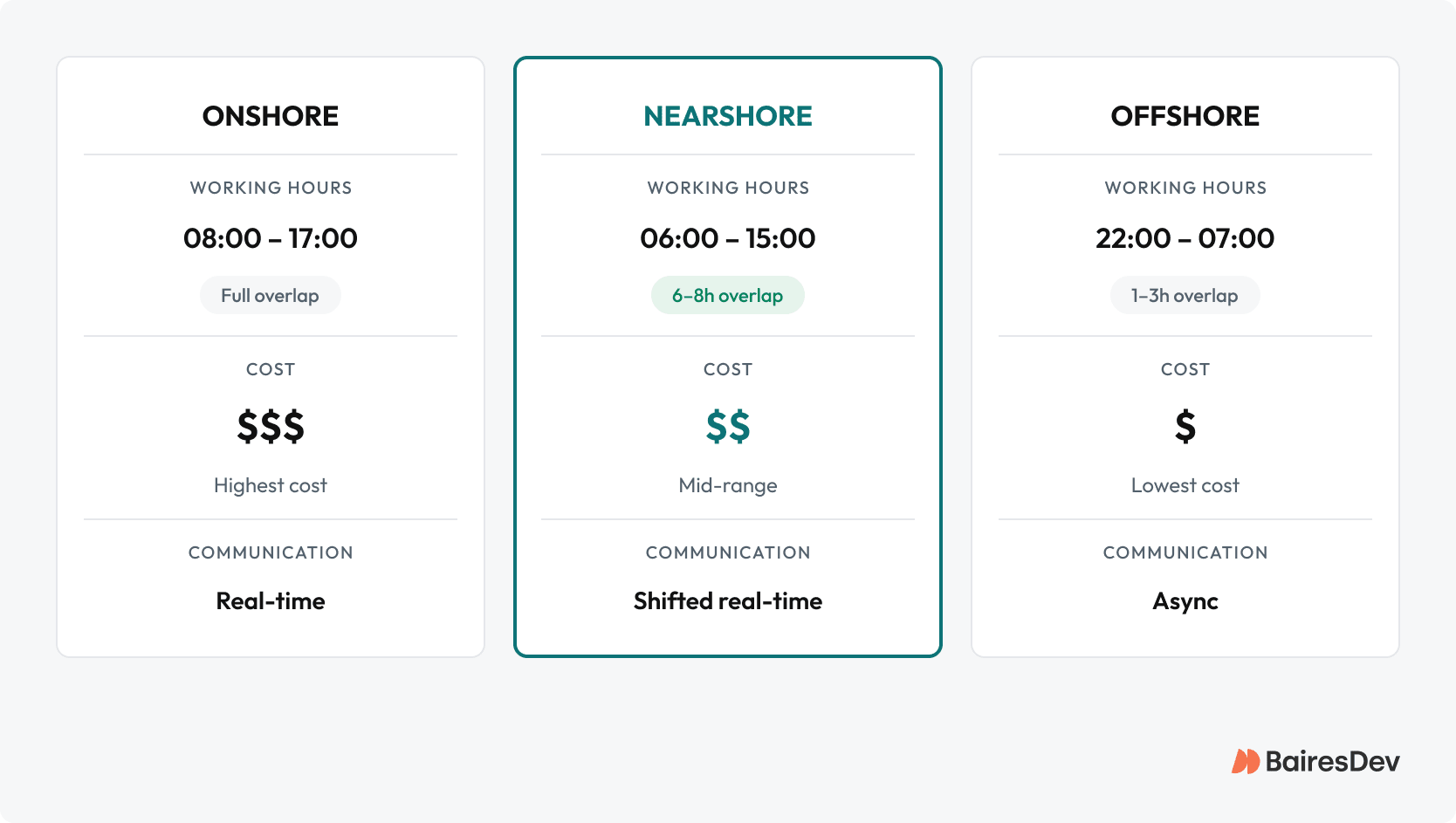
Outsourcing Model Comparison
People usually compare these models on cost, time zone overlap, communication, cultural fit, and access to talent.
| Dimension | Onshore | Nearshore | Offshore |
| Cost vs. U.S. rates | Baseline | 40-60% lower | 60-75% lower |
| Time zone overlap | Full | 0-3 hr difference | 8-12 hr gap |
| Communication ease | High | High | Low |
| Cultural alignment | High | Medium-High | Variable |
| Senior talent access | High | Medium-High | Low-Medium |
Cost Savings
The Stack Overflow 2025 Developer Survey shows that U.S. engineering managers earn about $200,000, while in India it’s $52,000, a difference of almost 4-to-1. But hourly rates aren’t everything. What really matters is the total cost to deliver a working product, including the time your team spends reviewing, fixing, and reworking outsourced work. A team that’s 40% cheaper per hour but delivers 50% less after you factor in integration isn’t such a good deal.
Time Zone Difference
Time zones affect delivery more than many leaders realize. Whether your team is online together most of the time or only sometimes changes how everything else works. On a technical level, it speeds up iteration and problem-solving, and on a more human level, it allows the team to bond and work more cohesively.
Communication
Communication is closely tied to time zones, but it’s not the same thing. Most professional engineers speak English well enough, so language barriers are simply not a problem anymore.
The issue is how quickly and easily teams can have informal chats, reply to Slack messages, join ad-hoc calls, and brainstorm and come up with ideas together. These moments are key for coordination and alignment, yet async teams often miss out on them.
Cultural Familiarity
Cultural alignment is even more important. Latin American engineering culture is often very similar to U.S. business practices, as most engineers have honed their skills working with North American clients. Teams usually give direct feedback, focus on the product, work independently, and speak up to managers.
Other regions may have different norms, which can lead to misunderstandings or take time to adjust. Nowadays, you can find great engineers anywhere, but it’s important to know if your new team shares your work style or if you’ll spend months adjusting expectations.
Talent Availability
For talent access, the market is now mature enough that you can find excellent engineers almost anywhere. However, the concentration of specific skills like senior backend engineers with cloud experience, ML engineers with real production experience, or staff-level infrastructure experts varies by region and partner.
Also, bear in mind that high-quality talent is in demand across the world, so no matter where you’re looking, don’t expect easy sourcing and low rates if you’re looking for a unicorn.
When Each Model Fits
None of this means there is a clear single winner. Each model has situations where it fits best.
| Scenario | Best fit |
| Regulated work requiring U.S. personnel | Onshore |
| Short engagement, under 3 months | Onshore |
| Product team needing daily collaboration across product, design, and engineering | Nearshore |
| Scaling by 10-20+ engineers while maintaining team cohesion | Nearshore |
| Large, well-structured delivery streams with clear boundaries | Offshore |
| Mature org running follow-the-sun development | Offshore |
| Core team needs real-time collaboration, secondary streams are well-defined | Nearshore + Offshore |
Onshore is the right call when the work is tightly regulated or when compliance and security constraints require U.S. professionals. It’s also the right call for short projects where the overhead of setting up a distributed team isn’t worth it, for engagements where physical presence is part of the customer contract, and for small augmentations of an existing team where the premium is modest in absolute dollars.
Offshore is the best choice for large-scale work that can be broken into clear, well-bounded streams that don’t need constant real-time collaboration. It also works well for companies with strong management capable of running a follow-the-sun approach properly. Big companies have been doing this successfully for decades, and the best of them operate something close to a genuinely integrated global engineering organization. It’s not easy, and many mid-sized firms underestimate the effort required to make it work.
Nearshore is usually the best default for most U.S. software teams. For companies growing engineering teams and businesses updating how they deliver, real-time collaboration is very important. Features are designed in conversation. Incidents get resolved in minutes. Pair programming, code reviews, planning, retrospectives, and the daily work of a modern engineering team all go more smoothly when your team is online at the same time.
The Case for Nearshore
Nearshore stands out because it gives you most of the cost savings of offshore and most of the collaboration benefits of onshore. For many teams, that combination is exactly what they need.
Think about your typical workday. If you’re on U.S. Eastern time, a Buenos Aires team is just one or two hours ahead, depending on the season. Bogotá is in your time zone in winter and an hour behind in summer. Mexico City runs on UTC-6 all year, matching U.S. Central in winter and an hour behind in summer, and overlaps both U.S. coasts.
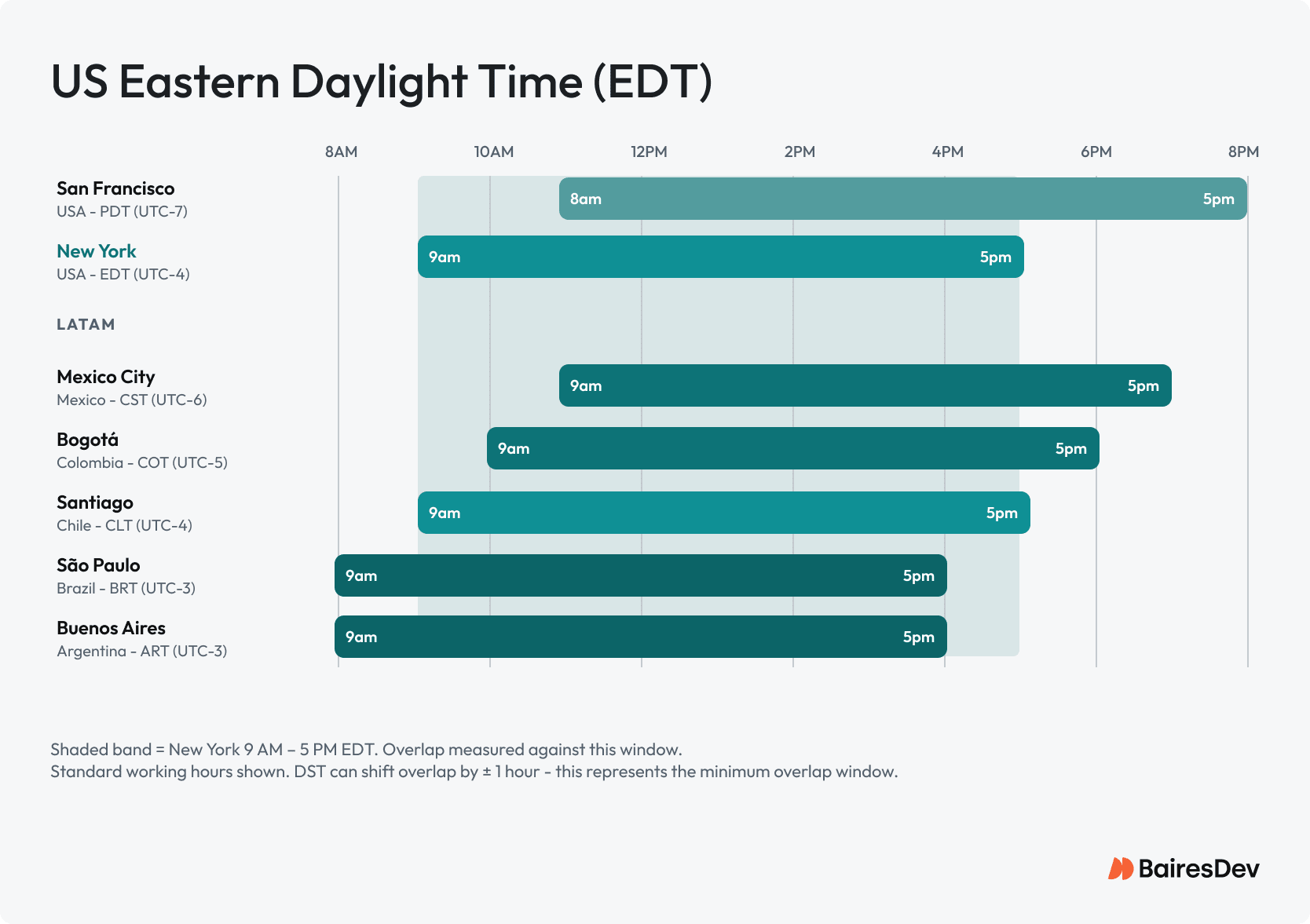
These small gaps mean you don’t have to wait until tomorrow to get answers, and you can reach out right away. When you’re dealing with significant time zone differences, you are likely to wait until tomorrow, and the option of pinging someone and getting a reply in minutes disappears. That’s not a small perk. It’s a real change in how teams work, and it compounds every day.
Integration also feels more natural. Nearshore teams usually align with your working hours, feedback styles, business habits, and even your busy or slow times of year. You end up with something closer to a single distributed team instead of two teams separated by a handoff, and that change affects every part of delivery.
If your product is still in development and your team is small, or if you rely on close collaboration between product, design, and engineering, nearshore is probably your best option. Offshore offers somewhat better hourly rates, but for this kind of work, the coordination tax is high. In many cases, it will prevent you from achieving significant cost savings with offshore.
Looking Beyond Geography
That’s the standard regional case, and it covers everything geography can decide. What happens after is where most engagements actually succeed or fail.
I’ve spent most of my career training technical interviewers, building screening systems, and scaling vetting operations inside talent marketplaces and global delivery firms. The pattern I see most often is a company making a smart regional decision, only to lose that advantage by choosing a vendor whose standards, retention practices, or delivery model don’t fit the work.
Nearshore is a model, not a guarantee.
In every region, from the Bay Area to Ukraine, engineering quality varies a lot. A staff-level backend engineer in Buenos Aires can be one of the strongest people you’ve worked with. But a vendor offering “nearshore freelance talent” based only on availability and rate might send you someone who looks good on paper but lacks experience with complex production systems.
Geography narrows the collaboration gap, but it doesn’t narrow the talent gap.
Evaluating a Partner
What actually determines whether a nearshore partnership works is the layer most decision frameworks skip:
- How seriously does the vendor screen, and who runs the interviews? A fifteen-minute coding exercise dressed up as vetting produces wildly different results from a real technical interview calibrated to senior work.
- Retention is a second tell, especially attrition in the first ninety days, where mismatched hires almost always surface.
- A third is who owns delivery on their side. Whether there’s a senior technical lead embedded in each engagement or the account is handled by a commercial manager who forwards technical questions elsewhere.
- And the last is what they report back to you. A partner who tracks cycle time, review turnaround, and incident response is running a delivery operation. A partner who only reports billed hours is running a staffing agency.
The First Month is Not a Honeymoon Phase
Pay close attention to how the 30 days of any engagement actually go.
A strong partner has their engineers contributing to your codebase within the first two weeks, with access set up, environments ready, tickets picked up, and the first pull requests in review. A weak partner spends those weeks on onboarding theater: kickoff calls that produce slide decks instead of commits, vague status updates, and engineers who are billing but not yet contributing in a real way.
The first few weeks are when most structural problems become visible, if you know what to look for. Issues like slow access, unclear ownership, or vague answers about who is doing what are not small problems that fix themselves. They are signs of what the next year will look like.
When you’re talking with a partner, the most useful questions are about structure.
Ask to see their real interview process, not just the marketing version. Look for the actual rubric, the real problems, and how they keep interviews consistent across interviewers. Push for details on how they find senior engineers, since sourcing mid-level ICs and staff-level engineers are almost different businesses. Ask about attrition numbers over the last two years, especially in the first 90 days. Also, find out if they track delivery metrics themselves or wait for you to point out problems.
Watch how they handle rejection. If you push back on a candidate they sent, how quickly do they understand why? A partner whose bar matches yours will recalibrate in one conversation. A partner whose bar doesn’t work will keep sending you the same profile with different names.
Also, pay attention to the structure of their team on your account. Is there a technical lead on their side who joins technical conversations, raises concerns about scope or design, and takes responsibility for part of the outcome? Or does every interaction go through an account manager? The first scenario is a sound delivery partnership, while the second adds extra layers for no good reason.
What to Take Away
For engineering leaders who have to make this call: if you’re a U.S. software company building a product, running a small-to-mid-size engineering organization, and collaborating closely across product, design, and engineering, nearshore is the most balanced default.
You get most of the cost advantage of offshore, most of the collaboration quality of onshore, and working hours that let you run a single team instead of two teams across a handoff. Latin America, in particular, has matured into a genuinely deep talent market over the last decade.
If your work is highly structured, runs at scale, and your company is ready for a global setup, offshore still offers the best cost efficiency and can deliver excellent results in the right hands.
If your context demands physical presence, regulatory constraints, or premium-rate specialist work, onshore earns its price.
None of these decisions is about geography alone. The region sets the limit on how well your outsourced team can integrate with yours. The partner you choose, and how seriously they handle screening, retention, and delivery ownership, determines whether you actually reach that limit.
A strong nearshore partner is better than a weak onshore one. A weak nearshore partner can be worse than a strong offshore one.
The model matters less than actual execution, and execution doesn’t appear on the price sheet (until it’s too late).
Engineering leaders who see this as just a regional choice often repeat the same cycle every few years. Those who treat it as a delivery choice, combining the regional decision with a serious look at how the partner manages their talent, usually don’t have to revisit the decision as often.