


Key Points
- Scala supports both object-oriented and functional programming, but that is not the real enterprise question.
- What matters is whether teams use those styles consistently enough to keep the codebase easy to change and support.
- The most practical default is object-oriented structure at the edges and functional logic in the core.
- Scala works best when that split becomes a team standard, not a per-service preference.
A payments service fails in production.
The team traces the issue to a downstream client. The client library throws exceptions. Inside the service, some layers convert failures to Either. Other layers still throw. Logging happens in both places.
Nothing is technically broken. The service compiles. Tests pass.
But during the incident, engineers lose time answering basic questions:
- Does this code throw or return errors?
- Where are failures transformed?
- Which layer is responsible for logging?
Now multiply that pattern across 30 services owned by different teams.
That’s where Scala’s flexibility becomes an enterprise problem.
Scala supports both object-oriented and functional programming. It runs on the Java Virtual Machine, integrates with Java libraries, and allows teams to adopt immutability and explicit error handling gradually.
Early on, that flexibility lowers friction. At scale, the question changes. The real issue isn’t whether Scala is functional or object-oriented. It’s whether your system models state, side effects, and especially error handling consistently enough that engineers can move between services without relearning assumptions.
How Scala Gets Used in the Real World
The Scala language combines object-oriented programming with functional programming in a single language. It shares the same compiling model as Java and integrates directly with existing Java libraries and types.
What’s variable is the way Scala developers actually write Scala code. Instead of defaulting to imperative programming and mutable objects, many teams move toward immutable collections and data structures that don’t change after creation. This is supported by Scala’s type system through type inference, which reduces boilerplate in everyday Scala syntax, keeping the codebase compact.
Scala makes patterns like algebraic data types, using case classes and sealed traits, practical in real-world production systems. With pattern matching, teams can model domain states explicitly and force edge cases to surface at the Scala compiler level instead of during incidents.
Higher-order functions and anonymous functions push the functional approach further. Logic shifts from control structures coordinating behavior through Scala classes to composing transformations across data. This functional paradigm is a different mental model, and not every team applies it the same way.
That variation, not the language features, is where problems start. In practice, Scala developers aren’t just choosing a functional language or an object-oriented programming language. They’re choosing how those paradigms show up across a shared codebase.
Why This Becomes an Enterprise Problem
In smaller Scala programs, stylistic differences are manageable. In a multi-service system maintained by multiple teams, they compound. Error handling is the clearest example. Consider a common pattern:
- A Java library throws exceptions.
- A boundary layer converts some failures into Either.
- Core logic returns typed errors.
- Another layer catches exceptions but ignores typed failures.
- Logging differs depending on which path triggered the failure.
From a compiler perspective, everything is valid. From an operational perspective, failure behavior is inconsistent.
During an incident, engineers need to answer simple questions quickly:
- Does this service throw or return failures?
- Are errors propagated through types or stack traces?
- Where does failure actually get logged?
When those answers vary by service, diagnosis slows. Code reviews shift into debates about style instead of correctness. Onboarding requires unlearning assumptions between repositories.
Industry research reflects this pattern. Cortex’s 2024 State of Developer Productivity report highlights how cognitive load and inconsistent practices slow teams down. In Scala systems, paradigm drift often shows up most clearly in how errors are modeled.
The issue isn’t that Scala allows both exceptions and typed errors. It’s that large systems can’t afford both without a clear standard.
Why JVM Compatibility Doesn’t Solve Governance
Organizations already dependent on the JVM can adopt Scala without abandoning infrastructure, frameworks, or deployment models built around Java code.
Scala flexibility can be so contrastive that two services can look like they belong to completely different ecosystems.
| “Better” Java | Pure FP |
| One repository may look very close to readable Java code with classes dominating the structure. Control structures follow familiar imperative programming patterns, and developers treat Scala largely as a simpler language layered on top of the JVM. | Then, another codebase written in the same language might rely heavily on functional programming concepts: immutable values, pure functions, algebraic data types, pattern matching, and declarative transformations. |
Both compile. Both run on the same Java Virtual Machine. But they aren’t equally easy to maintain. Engineering leaders care about diagnosis speed and change safety, not language labels.
The impact shows up quickly:
- Onboarding slows as engineers move between services
- Code reviews shift into style debates instead of design decisions
- Incident diagnosis takes longer because behavior isn’t predictable
Most issues blamed on Scala stem from internal inconsistencies, not from the language design.
Where Object-Oriented Programming Still Wins
OOP remains a reliable pattern in a Scala codebase at system boundaries, not because it’s simpler, but because it maps directly to ownership.
When a dependency fails, the first question is always: which component failed?
That’s where traits, classes, and encapsulation are still useful. They define clear boundaries around integrations, API clients, and adapters to external systems, especially when working with Java libraries on the JVM.
1trait PaymentGateway {
2  def charge(cents: Long, token: String): Either[String, String]
3}
4final class StripeGateway(client: StripeClient) extends PaymentGateway {
5  def charge(cents: Long, token: String): Either[String, String] =
6    client.charge(cents, token).left.map(_.message)
7}
This stays intentionally close to what you’d see in Java. The structure is familiar: interfaces, implementations, clear ownership, making it easier for teams coming from the JVM ecosystem to modify without deep familiarity with advanced Scala or functional programming concepts.
Functional Programming Where It Pays Off
A functional approach is more useful in core logic. A basic example might look like this:
1final case class LineItem(price: BigDecimal, qty: Int)
2def subtotal(items: List[LineItem]): BigDecimal =
3  items.map(i => i.price * i.qty).sum
The Scala standard library supports this pattern directly. No shared state. No mutation. Behavior is visible in the functions. This functional language style matters most in data processing pipelines where other languages might struggle with thread safety.
Using immutable collections, pure functions, and explicit error handling reduces that risk. Returning Either or Option makes failure paths visible in the type system, which is more useful during incidents than tracing exceptions across multiple layers.
Comparative Strengths: Object-Oriented vs. Functional Programming in Scala
| Concern | OO in Scala | FP in Scala | Team Impact |
| Reuse Mechanism | Traits, classes, polymorphism | Function composition, higher-order functions | Pick one default per layer to reduce review arguments |
| State Handling | Mutable state possible, encapsulated in objects | Immutability-first with val and immutable collections | Hidden-state bugs drop when core logic stays immutable |
| Error Modeling | Exceptions and type-based wrappers | Either/Option pipelines with explicit outcomes | On-call reads failure paths faster when errors are explicit |
| Change Safety | Subtype contracts and interface boundaries | Exhaustive pattern matching on algebraic data types | Refactors fail earlier in compile or test stages |
| Primary Use Case | Integrations, transport adapters, lifecycle wiring | Domain rules, transformations, validation flows | Clear seams improve code consistency |
The Default That Actually Works
For teams working with the Scala programming language, consistency across programming paradigms matters more than flexibility.
The pattern that holds up in production codebases is straightforward:
- OOP at system boundaries
- FP in core logic
- Minimal orchestration in between
In practice:
Use object-oriented programming at the edges of your Scala programs and a functional style in the core. Treat anything else as a deliberate exception. This separation becomes clearer in a simple service structure:
1final class PricingService(repo: PriceRepo, clock: java.time.Clock) {
2  def quote(order: Order): Either[PricingError, Quote] = {
3    val now = java.time.Instant.now(clock)
4    repo.fetchBasePrice(order.sku).flatMap { base =>
5      PricingCore.calculate(order, base, now)
6    }
7  }
8}
9object PricingCore {
10  def calculate(order: Order, base: BigDecimal, now: java.time.Instant): Either[PricingError, Quote] = {
11    val seasonal = if (isHoliday(now)) BigDecimal("0.95") else BigDecimal("1.00")
12    Right(Quote(order.id, base  seasonal  order.qty))
13  }
14}
The outer layer owns dependencies and side effects. The core logic stays isolated and predictable. This is the kind of separation that allows teams to move faster without introducing inconsistency across the codebase.
At the boundary, Java exceptions can be caught and translated into typed errors. Inside the core, failure should move through explicit return types like Either, not through thrown exceptions. That seam is where teams need a standard.
No advanced abstractions. No unnecessary layers. Just a clear separation between side effects and core logic.
Where Scala Codebases Break Down
Most failures in Scala codebases come from how the language is used by different developers. Different teams often apply different Scala syntax, error handling patterns, and assumptions about state within the same Scala programs.
Common patterns:
- Multiple error handling strategies in the same service
- Null values leaking in from Java code and not being contained
- Inconsistent use of immutable collections
- Overuse of advanced functional programming abstractions that only part of the team understands
A typical failure looks like this: a Java library returns null, one layer wraps it, another assumes it’s safe, and the issue surfaces downstream.
These are not limitations of the Scala programming language. They are consistency problems in how Scala programs are structured.
Suggested Structure for Scala Programs
Most stable Scala codebases converge on a similar structure, whether teams document it or not.
Boundary layers handle integrations and side effects. Core logic stays focused on transformations and domain rules. A thin orchestration layer connects the two without introducing additional complexity.
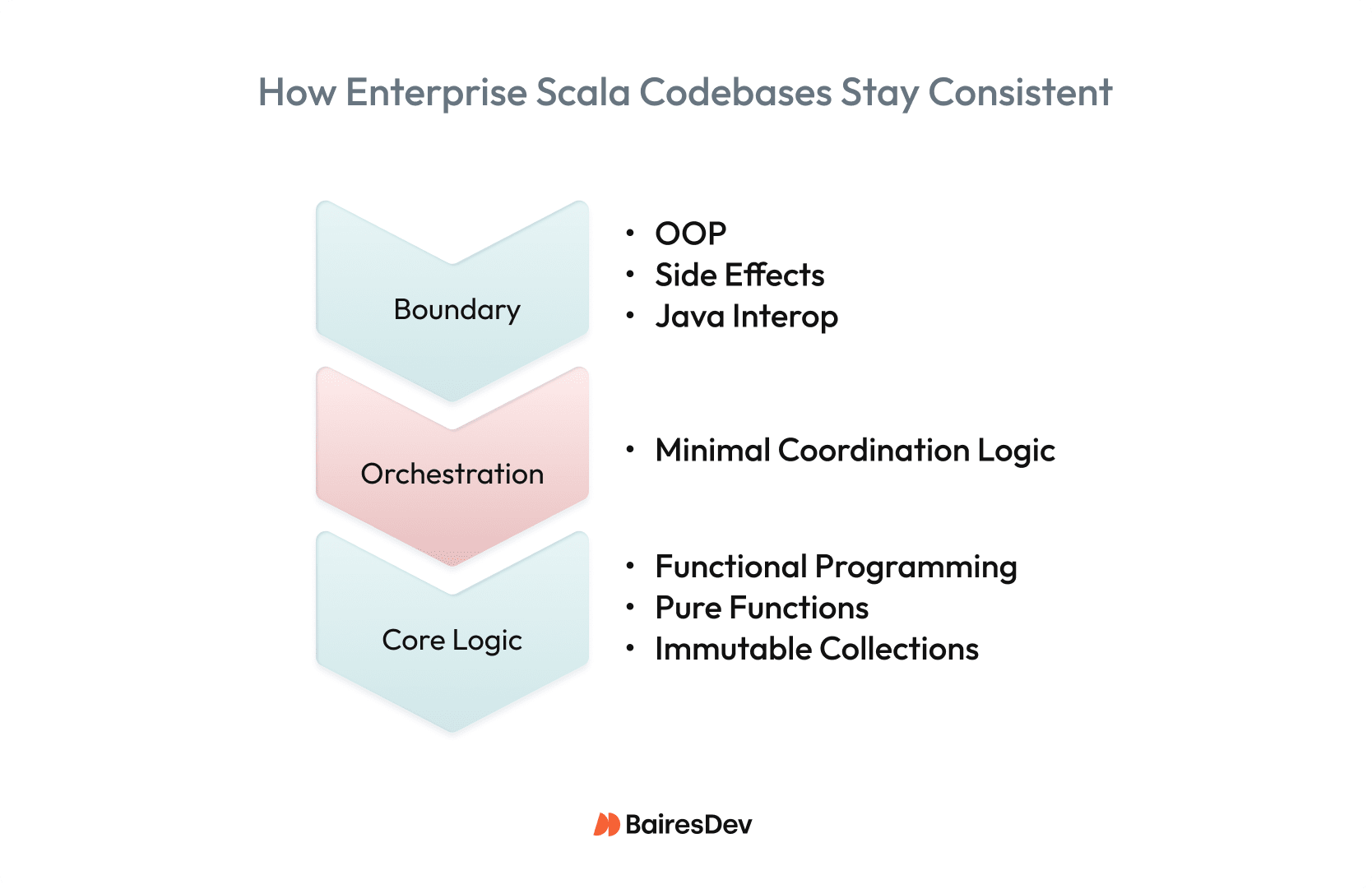
This doesn’t remove flexibility. It limits where variation is allowed inside the codebase. That predictability is what allows multiple teams to work in the same Scala codebase without introducing friction.
Consistency vs. Drift
The language isn’t the constraint. Governance is. If engineers can move between services without relearning assumptions about state, error handling, and control flow, the system scales. If they can’t, the cost shows up in slower delivery, longer onboarding, and harder incidents.
That’s the tradeoff. The Scala programming language isn’t the constraint. Inconsistent use of its programming paradigms is.