


Key Points
- Scala pays off where correctness matters and the cost of failure is high.
- It fits best in data pipelines, event-driven systems, and services with dense business rules, not routine CRUD work.
- The strongest strategy is the selective use inside a mixed stack.
- Adoption works best through a bounded pilot with clear standards and senior ownership.
A common mistake in evaluating Scala is treating it as a language preference and asking whether it’s a good language. It is, but that’s really not the point.
The useful questions should be a lot narrower. Which Scala use cases produce fewer incidents, clearer change paths, and better long-term cost curves than the alternatives you already run? Let’s say your platform has ten service categories. Scala could belong in two, maybe three. Forcing it into all ten usually creates technical debt faster than value.
Language bets age by workload, not by hype cycle, and most expensive strategy mistakes start when teams ignore that distinction. A payment-risk engine that ships policy changes weekly fails in different ways than a CRUD-heavy admin API.
In this scenario, the first category can benefit from Scala’s type safety and expressive syntax. The second often gains little beyond a harder staffing conversation. Scala’s versatility as a programming language is real, but this versatility is only useful when it maps to a problem your team actually has.
The Short Answer Leaders Actually Need
Scala is strongest where mistakes are expensive and frequent change is unavoidable.
A concrete portfolio move looks like this: keep the public profile service in Java, move risk scoring and event normalization into Scala, and leave internal CLI tools in Python. You get domain-level type checks where they pay, keep hiring pressure lower on commodity services, and avoid a rewrite you cannot staff.
The decision pattern is practical. You should focus on workloads where strong modeling and concurrency discipline reduce recurring incidents, then protect those wins with style rules and ownership boundaries.
Scala is not uniquely capable. Kotlin, Java, and Go have a lot going for them, too. What distinguishes Scala is that it runs on the Java Virtual Machine while blending object-oriented and functional programming into a single coherent model. That powerful combo gives teams more ways to encode invariants in code, and the extra power helps only when your engineering system can absorb it without turning every review into a seminar.
Where Scala Tends to Pay Off
Use this table as a screening tool before roadmap planning. Read the fit signals narrowly against your production constraints, not ideology.
| Use case | Why Scala | Fit signals | Trade-offs to plan for |
| Data processing and ETL | Strong data modeling, JVM performance, functional transforms | Strict data contracts, costly batch failures, replay requirements | Build speed tuning, library discipline, senior review capacity |
| Streaming and event-driven systems | Composable stream logic and explicit effect handling | Stateful consumers, strict correctness, high event volume | Schema evolution governance, backpressure, observability overhead |
| Backend services for complex domains | Rich domain modeling and compile-time guardrails | Dense business rules, expensive edge-case bugs | Onboarding ramp, style divergence risk, need for house patterns |
| High-concurrency and distributed workloads | Structured async composition on JVM stacks | Tail-latency pressure, retry storms, coordination-heavy paths | Execution-context hygiene, cancellation discipline, failure testing |
| Internal tooling and platform libraries | Shared contracts and seamless JVM ecosystem integration | Multi-team platform APIs, JVM-heavy estate | Avoid clever abstractions, keep APIs teachable, treat docs as product |
Data Processing and ETL at Scale
Scala became common in data engineering for a reason: teams needed predictable transformation behavior under heavy load. The core win in large-scale ETL and big data processing is rarely raw speed by itself. The bigger win is encoding data contracts as immutable data structures and immutable collections so drift shows up before an overnight run collapses. When you are processing large datasets across distributed systems, a silent schema mismatch is a much more expensive problem than a slow compile.
Picture a nightly pipeline that joins billing events with entitlement records. A new upstream field arrives as nullable text instead of enum-like values, which seems minor until every downstream assumption starts wobbling at once. One model change now triggers compile failures in two transforms that assumed the old shape. That pain lands in CI.
Apache Spark still fits teams deep in JVM tooling, especially when platform engineers own shared transformation libraries and can enforce testable, reusable patterns. PySpark still wins many greenfield experiments because analysts can sketch ideas fast.
The economics shift once pipelines become regulated or financially sensitive: teams start caring less about notebook speed and more about replay semantics, idempotent sinks, and explicit schema transitions.
A recurring trap is building ornate internal DSLs for “clean pipelines,” then spending six months teaching new hires the DSL instead of shipping business logic. Do your best to keep abstractions plain. A pipeline should read like a checklist, not a magic trick.
Streaming and Event-Driven Systems
Streaming architectures benefit from Scala when you must reason about state transitions under continuous load. The language helps structure that reasoning, but structure alone does not save operations. Event-driven architecture works only when operating rules are explicit and enforced.
Consider a Kafka consumer that enriches fraud events and writes alerts to three downstream systems. A broker rebalance hits during peak traffic, offsets replay, and one endpoint times out. Weak idempotency keys can duplicate alerts for hours, then your on-call team spends the night deduplicating noise and explaining false positives to support leadership.
Scala’s concise and expressive syntax can keep decode, validation, and failure routing paths readable. It cannot assign ownership for dead-letter topics. A dead-letter queue without a triage SLA is just a storage bucket for deferred regret. Schema evolution work, compatibility rules, version windows, and producer enforcement policies are operations problems first and language problems second.
Backend Services With Dense Business Logic
Most service fleets are not complex enough to justify Scala. Plenty of endpoints just move validated data between systems. However, Scala backend services become defensible when your domain has many invalid states that should never survive compile time.
Insurance pricing, entitlement policy, and risk adjudication are common examples, and the finance industry sees this pattern more than most. A service may allow quote revisions only in strict state sequences, and strong domain modeling (including pattern matching on sealed types) can encode those transitions so illegal moves fail during development instead of after deployment.
Scala reduces a class of boilerplate that even modern Java still requires, particularly around algebraic data types, exhaustive matching, and effect composition, and higher-order functions make it straightforward to compose reusable validation logic across services. That cuts a specific bug class fast, and it standardizes error semantics, so incident triage gets faster because logs describe known categories rather than ad hoc strings. Building microservices in Scala works well in this context because the same type discipline that prevents domain errors also makes service boundaries explicit and enforceable.
Kotlin remains a serious alternative, and many organizations should consider it. Hiring friction is lower, and the mental model is simpler for teams new to advanced type systems. When complex business logic grows every quarter and regressions are costly, Scala’s type safety often buys back time that would have gone to repetitive incident cleanup.
High-Concurrency and Distributed Workloads
High-throughput systems tend to punish sloppy assumptions. Scala’s concurrency model supports disciplined asynchronous programming and can keep processing flows explicit enough to debug when pressure rises and incident timelines get messy.
In distributed computing contexts, this matters more than it does for straightforward request-response services. In this cluster, language features are half the story. Queue limits, cancellation behavior, timeout budgets, and retry policies decide whether a traffic spike is a blip or a cascading outage.
A common failure pattern looks simple in code and brutal in production.
A service fans out to five dependencies per request, each with retries, and a regional slowdown turns that into a multiplier that saturates thread pools and melts p99 latency. Teams blame the runtime when the root problem was unbounded fan-out plus weak backpressure. Scala’s ability to keep effect boundaries visible is a genuine advantage when building high-performance systems and fault-tolerant applications, but it does not remove the need for disciplined operations.
Go may still be the better pick when your dominant pain is straightforward concurrency plus broad hiring needs. High-performance applications for actor-based coordination are a strong fit via Apache Pekko (the open-source successor to Akka) or commercial Akka under Lightbend’s BSL license ; services that just need a simple async HTTP call are not.
Platform Libraries and Internal Tooling on the JVM
Internal tooling sounds low stakes at kickoff. It almost never stays low stakes.
A platform library adopted by sixty services becomes critical infrastructure, and seamless integration with existing Java libraries is a real advantage when security, auth, and telemetry standards need to stay aligned across teams. Scala developers who invest in well-designed shared libraries can produce reusable code that raises code quality across the entire fleet without requiring every consuming team to be Scala experts.
This is the part many strategy docs skip: internal APIs have users, and users punish cleverness. If your shared libraries need a two-hour whiteboard session to explain init order, adoption stalls and teams fork around you.
Good Scala libraries for platform engineering keep defaults obvious, expose escape hatches intentionally, and ship migration notes that respect operator reality. Command-line tools built in Scala can also share contract types directly with JVM services, eliminating whole classes of integration mismatch that shell scripts or Python glue code introduce. Teams treat docs as decoration until pager duty proves otherwise at 2:00 a.m. The best platform groups write docs like incident artifacts, not marketing pages.
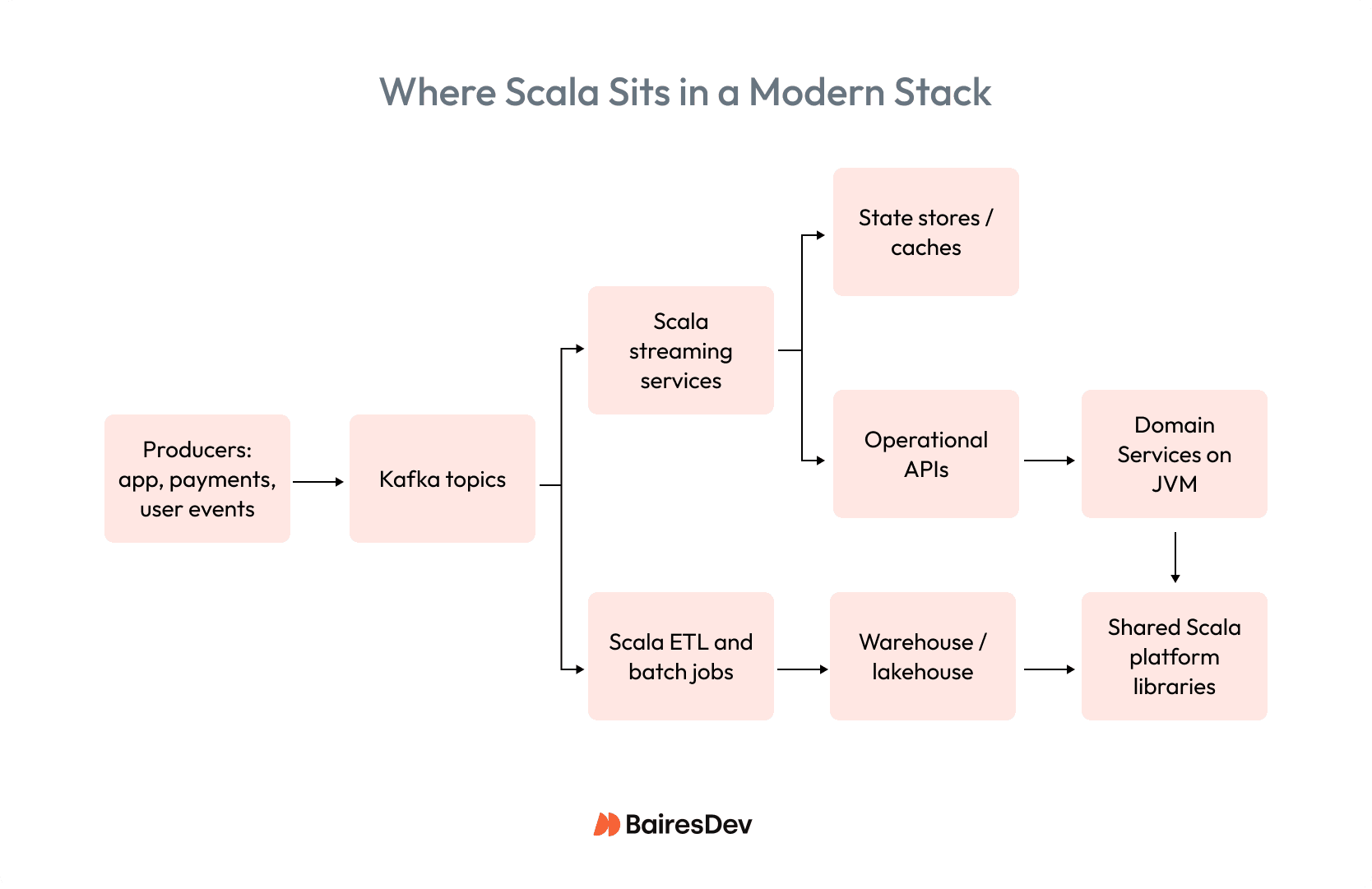
In healthy systems, Scala lands where correctness and change pressure intersect. It does not need to sit everywhere to matter. Your hiring plan will decide more than your language plan.
When to Avoid Scala and How to Pilot Safely
If you are building short-lived apps, mostly simple CRUD services, or operating with light governance and a need for rapid generalist hiring, Scala is often the wrong immediate choice. The language will not fix weak ownership, weak testing, or unclear product boundaries.
A safer pilot pattern is a constrained scope. Pick one workload where failure cost is visible, define business and delivery metrics before writing code, and keep scope tight so reversal stays cheap. A concrete example: one risk-scoring service, one senior Scala lead, one deputy from the incumbent stack, and a 90-day review tied to incident frequency, lead time, and maintainability signals from the on-call team. The time spent learning Scala on a bounded pilot is recoverable; the time spent unwinding a fleet-wide adoption that was not ready is not. If the pilot misses targets, stop expansion without politics. Treat Scala adoption as organizational design first. Code follows.
When Scala Fits
Domain correctness failures are expensive and recurring. The workload is async, stateful, or coordination-heavy. Platform leaders can enforce a house style and review standards. Teams can staff a senior core and maintain Scala skills through mentoring plans. Observability and failure testing are treated as first-order work. JVM ecosystem reuse is strategically valuable.
When to Avoid
You need to maximize hiring throughput immediately. Services are mostly straightforward CRUD and short-lived. Engineering governance is intentionally light. Team ownership boundaries are unstable. You cannot fund ramp time for language depth. You are considering Scala mainly for perceived prestige. Treat multiple checks in this list as a direct warning to delay adoption.
The Decision in Plain Terms
Strong Scala outcomes come from narrow, deliberate placement. The pattern repeats: choose hard domains, keep abstractions readable, and measure adoption like a risk program rather than a belief system.
The official Scala documentation covers the language’s functional programming features, object-oriented programming styles, and concurrency abstractions in depth, and is worth bookmarking for teams moving into implementation.
If you need a rule to share with staff engineers: deploy Scala where long-lived complexity is unavoidable, and avoid it where simplicity is the real requirement. It is less exciting than a full-stack rewrite story. It works better.
Other Factors to Consider
- Build times and CI cost: Scala compile times are a real operational cost at scale.
- Compiler/tooling licensing: Relevant if Lightbend commercial support is in play.
- Long-term maintenance: Who owns the library upgrades when the senior lead leaves?
- Talent market reality: Scala developer pool is materially smaller than Java/Kotlin/Go. Compensation premium is typically 10–25% over equivalent Java roles in major markets