


Key Points
- Scala’s biggest enterprise cost is delivery friction through a smaller hiring pool, slower onboarding, and heavier dependence on senior engineers.
- The main maintenance risk is style divergence, where different teams write Scala in different ways and shared ownership breaks down.
- Compile times, ecosystem complexity, and framework dependence can slow iteration and make large Scala systems harder to change.
- Scala makes the most sense in complex, high-risk systems where that extra cost is justified and tightly managed.
Engineering leaders don’t choose Scala for its simplicity, but to address a complex problem. Perhaps they face a high-throughput risk engine, a massive data science pipeline, or a big data processing pipeline. Scala offers the precision of functional programming paradigms to keep it from collapsing.
Scala was famously born from Martin Odersky’s work at EPFL. It’s a powerful hybrid of object-oriented programming and functional programming. Scala’s precision, however, comes with a “delivery tax” that isn’t always immediately apparent. For all its strengths, Scala has real disadvantages that are not evenly distributed.
Operational Challenges and Risk Factors
The Recruitment “Seniority Floor”
On paper, Scala is the ultimate JVM language. In practice, however, a VP of Engineering might need to overlook the theoretical beauty of Scala if they’re already juggling overcommitted internal teams and want to avoid the added burden. It could mean buying into an ecosystem that’s notoriously difficult to scale, hire for, and maintain. If you aren’t careful, you end up with “clever” code that only three people in the company can debug. This is one of the cons of Scala that leaders feel most acutely.
The most obvious and immediate disadvantage of Scala is the hiring math.
According to the 2024 Stack Overflow Developer Survey, only about 2.6% of professional developers are using Scala, compared to 30% for Java. This creates a massive supply-demand imbalance. In a typical US-based engineering market, the number of Java developers is vast, while the Scala pool is a small, very small pond. It’s the classic limited developer pool problem.
But the real risk isn’t just the number of resumes, it’s the “seniority floor.” Scala raises the effective experience threshold for many teams. Junior engineers can contribute, but they typically require more structured mentorship than in Java or Kotlin environments. This is why teams end up relying heavily on their best developers for Scala work.
In a mid- to large-scale enterprise environment, it’s common for a backend team to spend several months trying to fill a Scala role. When they finally do, the onboarding often takes nearly three months because new hires often struggle with the specific functional programming style required in a production Scala project. They must absorb functional concepts, other functions, and idioms that don’t exist in simpler programming languages.
This is a clear delivery risk. When hiring locally is slow, many leaders turn to outsourcing, but even then, finding a vendor with deep, idiomatic Scala expertise is significantly harder than finding a standard Java development shop.
The Style Divergence Trap
Scala is a “choose your own adventure” language. One team might write Scala that looks like “Java without semicolons.” Another might use Cats Effect or ZIO to write pure functional code that looks like Haskell.
This flexibility sounds great, yet it’s a nightmare for engineering leaders trying to maintain a cohesive platform.
When multiple teams work on a large project, this style divergence often leads to “ownership silos.” If Team A’s microservice uses a completely different set of programming practices than Team B’s, the org loses the ability to move engineers between projects and effectively has two languages running under the same banner.
This is a common risk of using Scala in enterprise settings: the language allows for so much abstraction that readability and maintainability suffer. For a pragmatist, five lines of boring, predictable code will always beat one line of elegant symbolic logic that’s difficult to understand during a production incident or a site-down emergency. Large teams want predictable code, not clever puzzles.
Organizational Maturity Requirement
If your organization already has strong platform engineering practices, using Scala may be a good choice.
Without governance like consistent code standards, shared libraries, and experienced reviewers who understand functional patterns, Scala’s flexibility could lead to fragmented styles. Down the road, these make systems harder to maintain and slow further development.
The Build-Time Productivity Sinkhole
Lengthy compile times aren’t just a developer gripe. They chip away at your bottom line and derail your roadmap. Because the Scala compiler does so much heavy lifting (static type checking and static typing, implicit resolution, macro expansion), compile times can be heavy.
Module boundaries, metaprogramming scope, and test partitioning determine whether the system stays responsive as repositories grow. SBT exposes timing and task diagnostics that can feed p95 budget alerts before slowdown becomes normal, letting platform teams catch regressions before they show up as slipping commitments.
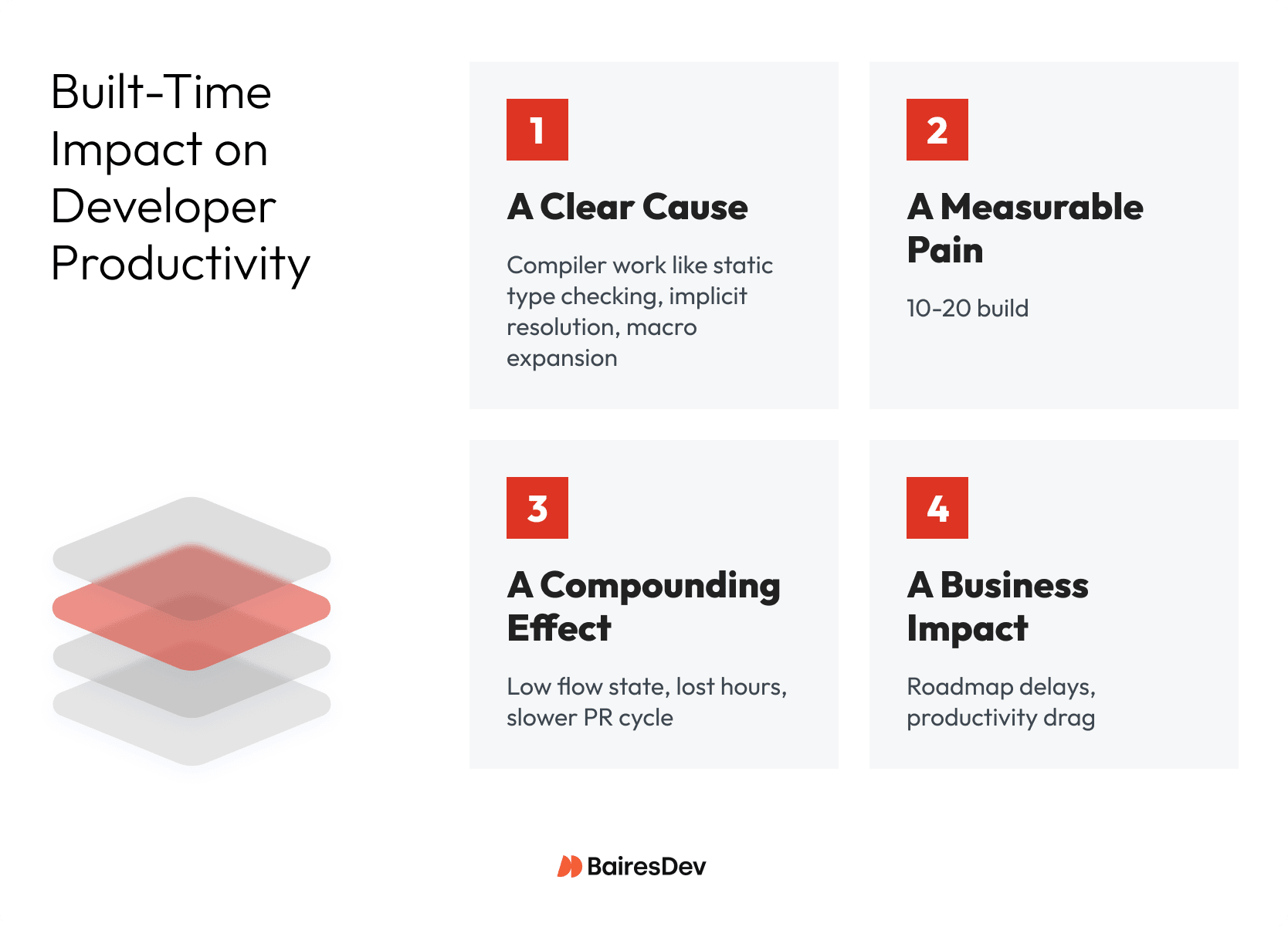
A developer forced to wait 10 to 20 minutes for a build loses their flow state. More importantly, they lose the thread of the problem they were solving. Over a year, for a team of 10 developers, this tooling drag can cost hundreds of labor hours in lost productivity, slower iteration cycles, longer PR feedback loops, and even slower incident response.
While the Java Virtual Machine provides a great runtime, the Scala developer experience of writing code at scale often feels like wading through molasses compared to Go or even modern Java.
Faster builds directly support higher productivity. And let’s not forget about morale, either.
Framework Lock-in Risk
Many Scala systems depend heavily on frameworks such as ZIO, Cats Effect, or Akka. These libraries provide powerful abstractions, but they also create ecosystem lock-in.
Rewriting or migrating such systems to another JVM language can be extremely expensive because the architecture itself depends on functional patterns that don’t translate directly. This is especially painful in legacy systems.
Portfolio Strategy: Where to Deploy (and Where to Avoid)
A Scala-only policy may be viewed as a costly mistake for an org. As an engineering leader, you’re in the unique position to strategically determine where and when to accept Scala’s disadvantages.
| Project Domain | Fit Level | Management Strategy |
| Big Data / Data Analytics | High | Standardize on Apache Spark; leverage Scala’s immutable collections and data structures. |
| Complex Logic / Rules Engines | High | Use static typing to prevent edge-case bugs in high-risk areas. |
| Standard CRUD / Web Apps / Web Development | Low | Use Java or Kotlin for faster delivery and easier staffing. |
| MVP / Prototyping / Small Projects | Very Low | The learning curve and build times will kill your speed-to-market. |
Even the creators of the language recognized the need for a more pragmatic approach in the enterprise. With the transition to Scala 3, there has been a significant push to simplify the language and reduce the boilerplate that often leads to complexity.
However, the migration itself is a significant undertaking. While many features are backward-compatible, the change in how macros and certain type-level or advanced features work can require a multi-month refactoring effort for legacy systems.
Real-World Mitigation: A Manager’s Guide
If your organization has already committed to a Scala codebase, or if your mission-critical infrastructure is underpinned by the language, consider implementing rigorous technical and procedural guardrails that enable a predictable SDLC.
The following strategic constraints let your org harness the power of the Scala programming language without succumbing to its inherent risks:
- Enforce a Standardized House Style: Avoid usage of the language’s exhaustive range. Instead, define a pragmatic subset of functional programming paradigms and enforce its use across all Scala programming projects. That way, Scala code remains readable for the broader engineering population, including those more accustomed to object-oriented programming.
- Prioritize Build Infrastructure: Investing in high-performance build tools and remote caching like Bazel or sbt-rsc is essential for a large Scala codebase. Reducing compile times is the most direct way to reclaim lost developer productivity.
- Hire for Reliability over Complexity: When vetting Scala developer candidates or staff augmentation partners, prioritize those who emphasize SLAs, observability, and robust error handling. While expertise in category theory is impressive, it often correlates with a level of abstraction that’s costly or difficult to maintain.
- Implement the Two-Team Rule: No mission-critical service should be left for a single team to support. If only one group understands a specific library, such as ZIO or Cats, you’ve created a knowledge silo. Institutional resilience requires that at least two independent teams possess the competency to debug and deploy any given project.
A VP’s Reality Check
Before signing off on that next big Scala project, ask your Lead Architect: “If our top Scala developer quits tomorrow, could our mid-level Java devs keep the lights on for a while?”
Bearing in mind that hiring and onboarding could take six months or more, if your Java developers can’t maintain the codebase, stop. You may not be building a system at allyou may be building a dependency.
The goal of software development is to ship reliable solutions that solve a business problem without burning out your team. Scala can do that, but only if you manage the risks with your eyes wide open.
Scala is a scalable and powerful language, but it’s by no means the right choice for every team.