


Executive Summary
This article examines why agentic AI inflated engineering velocity scores without improving business outcomes and why most organizations made staffing decisions based on that corrupted signal. The real bottleneck in agentic workflows is not code generation, but the 5.5-hour average lag when an agent blocks and no human is available to resume the work. Closing that gap requires a fundamentally different org structure, cost model, and definition of what engineering output is supposed to produce.
Sprint velocity was the first engineering metric to become unreliable after agentic adoption, and leadership teams largely celebrated it as a win. In an agentic workflow, an AI agent can generate the code for a story in seconds. Velocity scores can jump from 50 to 5,000 in a single sprint without any corresponding improvement in delivered outcomes. Leadership teams still anchoring resourcing decisions to velocity are navigating a high-speed delivery system with a broken speedometer.
John Zeren, SVP of Marketing Technology on my team at Walk West, watched this pattern repeat across every deployment we ran. Velocity spiked as soon as adoption took place. Teams turned around documents and decks faster, built small tools to parse data or handle tasks, and the numbers looked like progress. They weren’t. What the spike actually represented was the clearing of busywork, and without stronger guardrails and shared agentic processes, teams fed AI-generated output directly into strategy without adapting it to their actual business model.
Faros AI’s research, drawing on telemetry from over 10,000 developers across 1,255 teams, confirmed the disconnect at scale. Teams with heavy AI use completed 21% more tasks and merged 98% more pull requests, yet organizational delivery metrics stayed flat. Leadership saw the numbers go up and drew the wrong conclusion: reducing contractor headcount, accelerating release timelines, and making structural staffing decisions based on a metric already corrupted by the very tool they were scaling.
The gap between apparent productivity and realized business value is a leadership accountability problem, and closing it requires a fundamental reexamination of what engineering output is actually supposed to produce.
Why Agentic AI Is Not a Headcount Reduction Strategy
Agentic AI is not a headcount reduction strategy because the bottleneck it creates lives in human judgment, not code authorship, and cutting people is the fastest way to widen that gap. The strategic error is treating agentic adoption as a staffing efficiency play. PwC’s May 2025 survey of 308 senior executives found that 88% planned to increase AI-related budgets over the next twelve months, driven by agentic AI opportunities. It also found that broad adoption doesn’t mean deep impact, with most employees using agentic features to speed up routine tasks without approaching anything close to transformation.
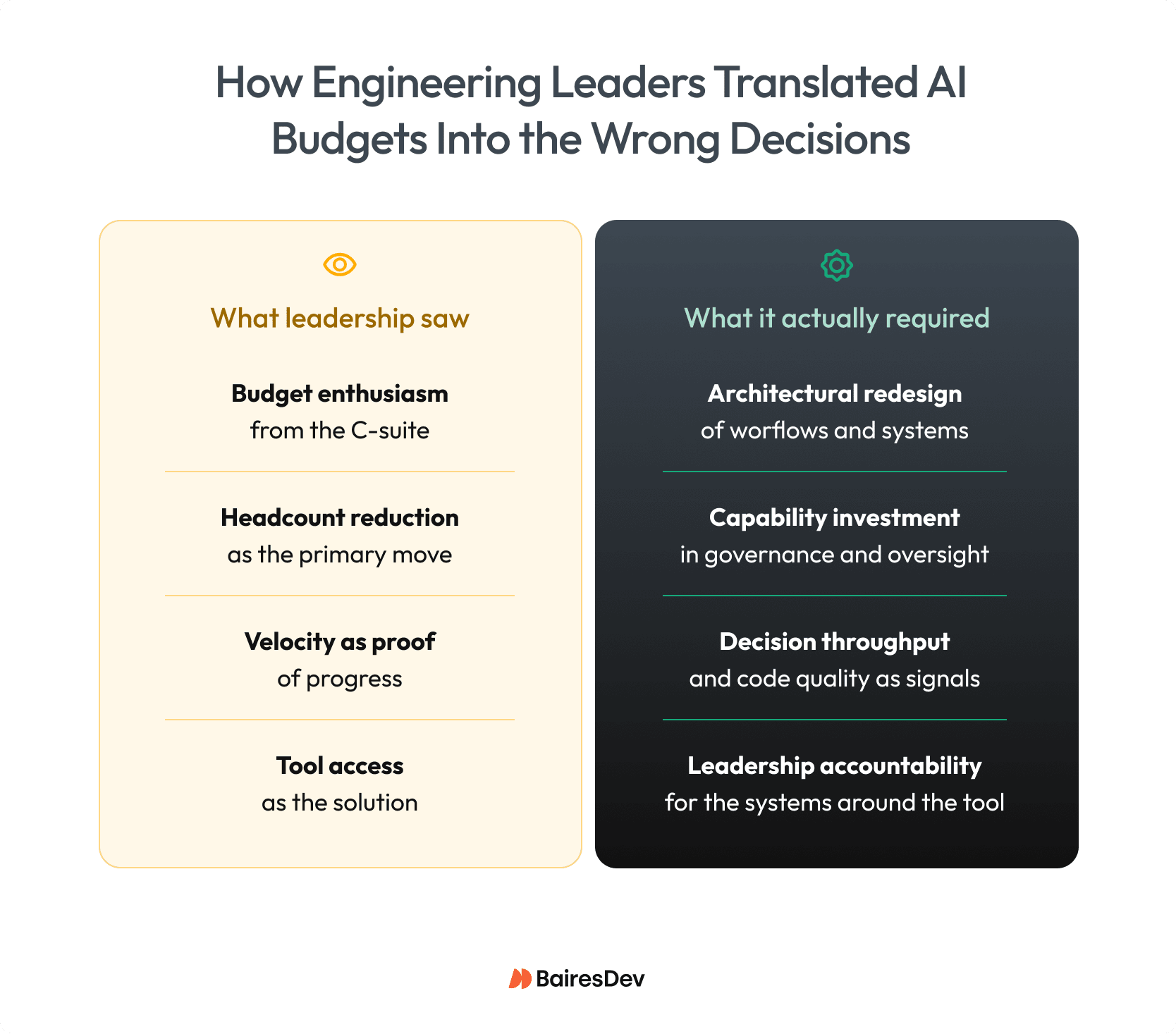
Engineering leaders absorbed the budget enthusiasm from the C-suite and translated it into headcount reduction rather than capability redesign. That reframe is where the damage compounds. The findings from Faros AI were never about what AI could generate. They were about what human organizations were, and still are, structurally unprepared to govern. Closing that gap requires engineering leadership to treat agentic adoption as an architectural commitment.
Research from the agile methodology community has introduced a new KPI called Human-Agent Handoff Time. This is the elapsed time between an AI agent signaling it is blocked and a human successfully resuming the work. In documented team environments, that lag averages 5.5 hours per incident. That gap is now where the majority of delivery delay lives, not in the writing of code, which agents handle in seconds.
The implications for role design are direct. Senior engineers are no longer bottlenecked on code authorship. They are bottlenecked on context-switching into an agent’s unfinished work, interpreting what the system was attempting, and making the judgment calls the agent cannot make. Performance frameworks built around individual code contribution are now actively misaligned with the work that creates the most organizational value. Engineering leaders who delay this redesign are systematically misallocating talent toward outputs the organization no longer needs, at the expense of capabilities it urgently does.
The Staffing Model Agentic Engineering Actually Requires
The financial math of an agentic engineering org has changed, and most budget models have not caught up. Agentic tools running in high-autonomy modes carry token costs that most CTOs are still pricing at the $30-per-seat mental model from the copilot era. That gap distorts every downstream calculation around headcount, ROI, and team structure. AI is a variable infrastructure expense, and organizations that still treat it as a fixed SaaS line item will keep mispricing scale and underinvesting in the systems required to support it.
Marc Sirkin, Chief Growth Officer at Walk West, observed that teams moved faster almost immediately but produced sub-par results because the operating context those tools needed had never been built. As teams learned to bring genuine context to their inputs, output quality improved quickly across copy, image generation, and data analysis. What that experience confirmed, and what we continue to see across client engagements, is that the velocity of the tool was never the variable that mattered. The quality of the direction given to the tool was.
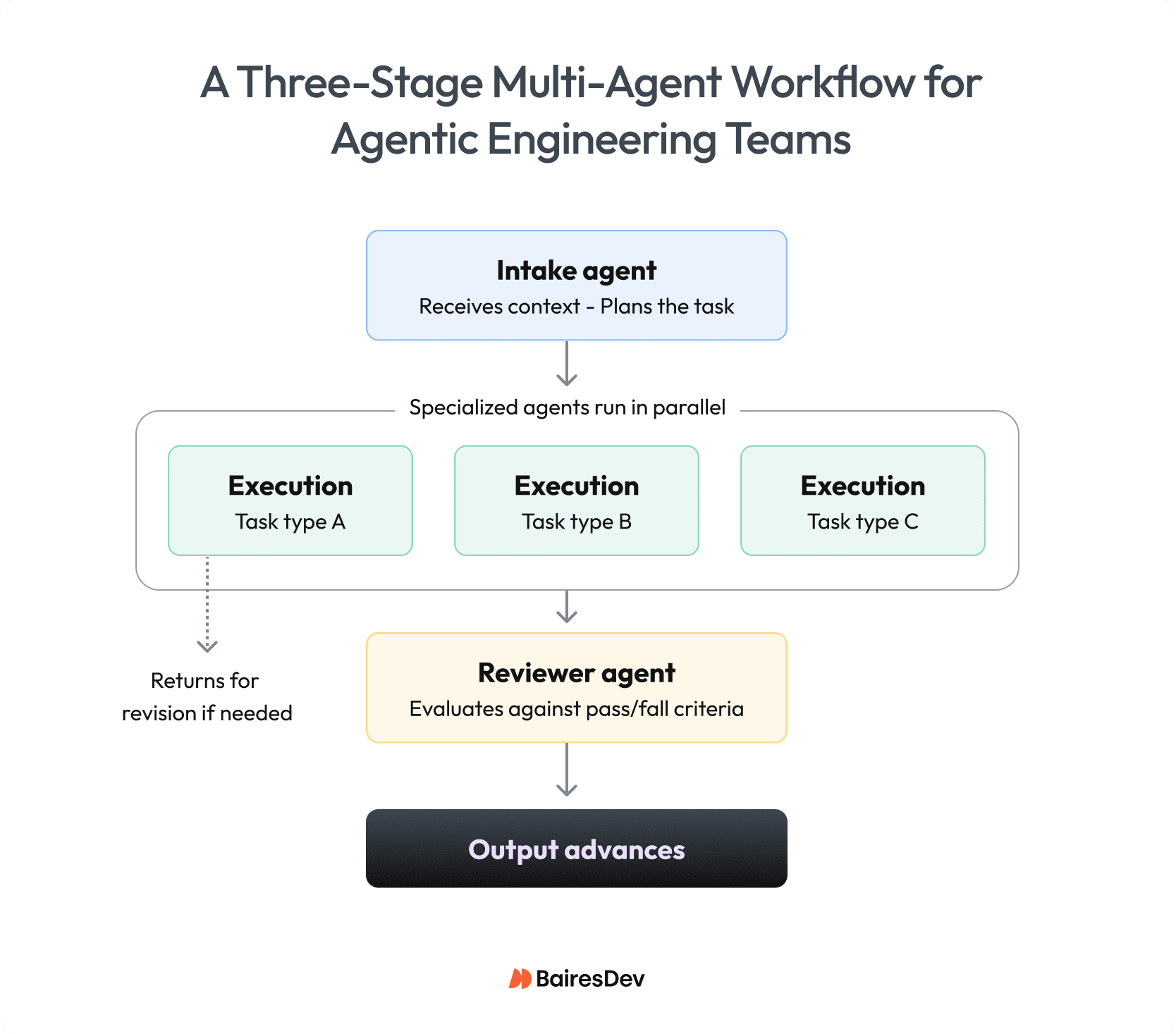
The workflow architecture problem has a structural solution. At Walk West, we run a multi-agent approach where one agent intakes context and plans, specialized agents execute specific tasks, and a reviewer agent evaluates output against defined pass/fail criteria before anything advances. That structure reduces ambiguity and forces higher-quality handoffs by eliminating the interpretive gaps that manual workflows leave open at every transition point. With frameworks like the GSD repo layered on top of tools like Claude Code, the planning and execution handoffs no longer require manual orchestration. We have seen measurably fewer iteration cycles and higher output accuracy across client work as a result.
What Engineering Talent Actually Matters in Agentic Teams?
The engineers who deliver the most value in AI-augmented environments are the ones asking the right questions and designing the right constraints, not the ones writing the most code. A VP of Engineering still measuring tickets closed, optimizing for individual PR throughput, and backfilling junior roles with cheaper agentic automation has built an org optimized for the wrong output.
On role redesign, QA is the hardest call. The repetitive nature of traditional QA work makes it difficult to justify a dedicated human now that AI can generate entire test plans and much of the automation code. The volume of work required to justify a dedicated QA hire has increased significantly, and the role has shifted from repetitive execution toward higher-stakes oversight of outputs before they reach the client. As Marc puts it: every single role and every single hiring decision needs to be rethought once agentic tools are in place, because the question has shifted from who can do the work to who needs to own the outcome.
Why Time Zone Coverage Is Becoming an Engineering Advantage
Time zone coverage is becoming an engineering advantage because the 5.5-hour handoff gap is also a geography problem. When an agent blocks during off-hours and the senior engineers who can resume the work are asleep, latency compounds by design. The organizations solving for this are not necessarily adding headcount domestically. Instead, they are adding judgment capacity in compatible time zones. Nearshore senior engineers embedded in agentic workflows function as handoff coverage. The value proposition is available human judgment at the moment the agent needs it, which is increasingly the moment that determines whether a sprint ships or stalls.
What Should Engineering Leaders Prioritize in the Agentic AI Era?
Engineering leaders should prioritize redesigning work around the new capability now, before the compounding advantage available to early movers becomes too wide for late adopters to close. Bank of America Global Research projects agentic AI spending could reach $155 billion by 2030, triple the estimates of most industry analysts. Those returns accrue to organizations that redesign work around the new capability now. The compounding advantage available to early movers will be difficult for late adopters to close once those patterns are embedded in delivery culture.
The most immediate change available to CTOs and VPs of Engineering is a shift in what they report to the board. Velocity as a proxy for team health is no longer a reliable signal, and reporting it to executive stakeholders creates misaligned incentives that flow down through every resourcing and prioritization decision. The metric worth tracking is decision throughput: how fast the engineering function moves from strategic intent to production outcome, alongside code quality indicators like churn rate and defect density that reflect the actual cost of AI-generated output.
Deep agentic adoption requires deliberate investment across five dimensions: training, workflow redesign, cross-functional alignment, infrastructure, and governance. All five are leadership decisions, and none of them resolve through tool access alone. The organizations compressing development cycles in ways that compound over time are the ones where engineering leadership has explicitly defined which decisions require human judgment and which workflows the agent owns end-to-end.
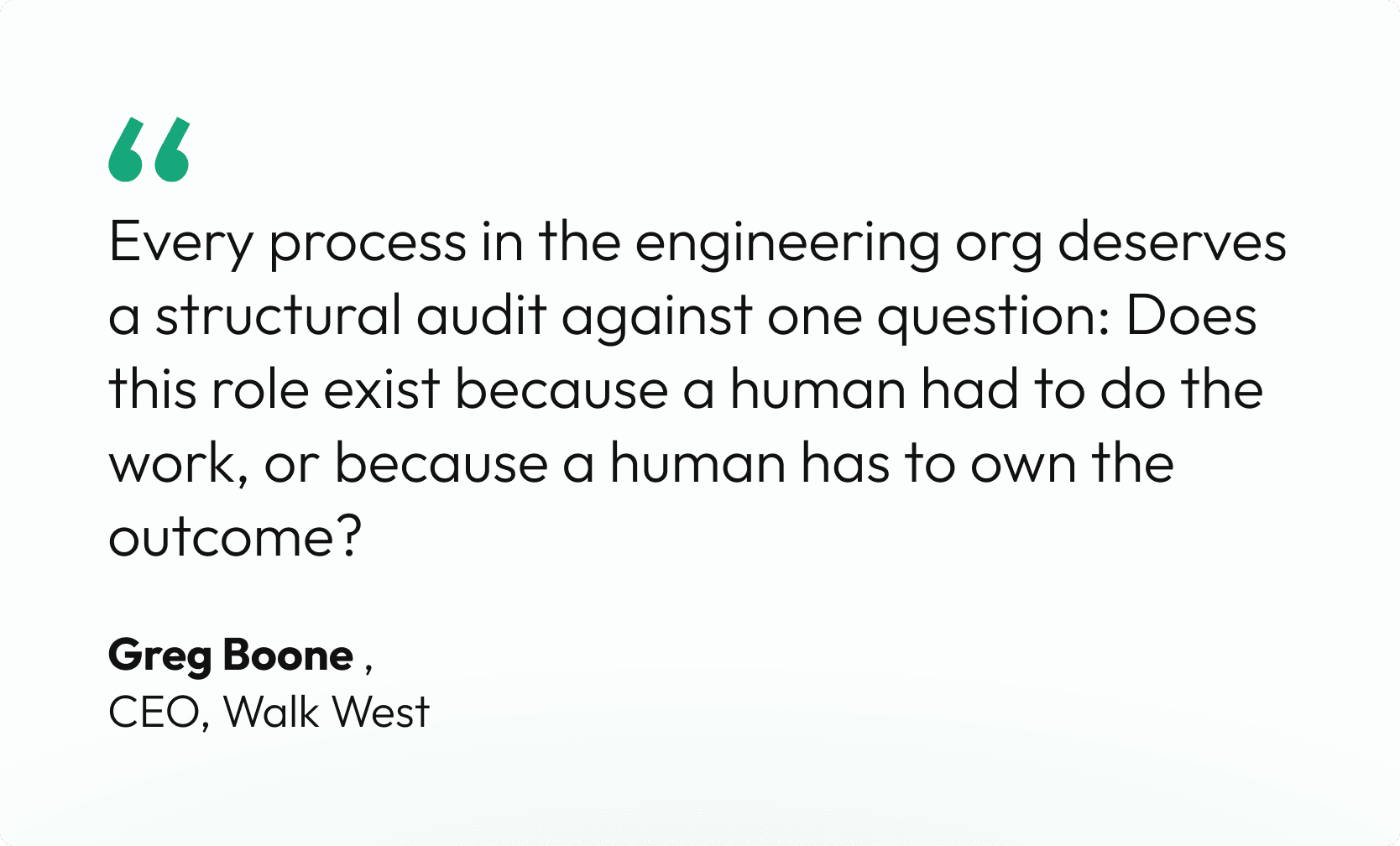
Every process in the engineering org deserves a structural audit against one question: Does this role exist because a human had to do the work, or because a human has to own the outcome? Those are not the same thing. The leaders who answer it with honesty and precision will build engineering organizations capable of sustaining the pace that agentic development makes possible.
Key Takeaways
- Sprint velocity became unreliable the moment agentic tools entered the workflow. Scores can jump tenfold with no corresponding improvement in delivered business value.
- The primary delivery bottleneck in agentic workflows is Human-Agent Handoff Time, averaging 5.5 hours per incident — not code generation speed.
- Agentic adoption is an architectural commitment, not a cost lever. Organizations that treated it as headcount reduction are now managing the consequences.
- The engineers who deliver the most value in AI-augmented environments ask the right questions and design the right constraints — they are not the ones writing the most code.
- The staffing solution to the handoff gap is senior judgment available in compatible time zones at the moment the agent needs it.
- Every engineering role deserves one audit question: does this position exist because a human had to do the work, or because a human has to own the outcome?