


Key Points
- Scala fits best where defect cost is high and system behavior is complex, especially in concurrent or event-driven backend services.
- JVM compatibility and Java interoperability reduce platform disruption.
- The main adoption risk is organizational rather than technical
Scala is a JVM language that combines object-oriented and functional programming to build concise, reliable software, especially for complex backend systems. However, to an engineering leader, Scala is more than that. In practical terms, it’s a tool for handling the complexity of modern distributed systems, but it requires a higher level of organizational discipline than Java, i.e., more upfront alignment and often more senior engineering talent.
Adopting Scala means choosing a different cost curve: slower early momentum due, in part, to a steep learning curve, in exchange for higher system reliability and lower long-term maintenance overhead, provided everything is managed well.
Scala in Context: More Than a Multi-Paradigm Language
At a surface level, Scala is a multi-paradigm language that supports both Object-Oriented and Functional Programming. It compiles to Java bytecode, runs on the Java Virtual Machine (JVM), and integrates with Java libraries and existing Java code.
That basic definition misses the operational impact.
In production, Scala changes how teams model problems. Using immutable data structures, pattern matching, and higher-order functions, engineers can represent business rules so that invalid states fail during compilation rather than at runtime. This is where Scala programs diverge from typical Java code or other languages.
That shift matters most in systems where logic errors are costly:
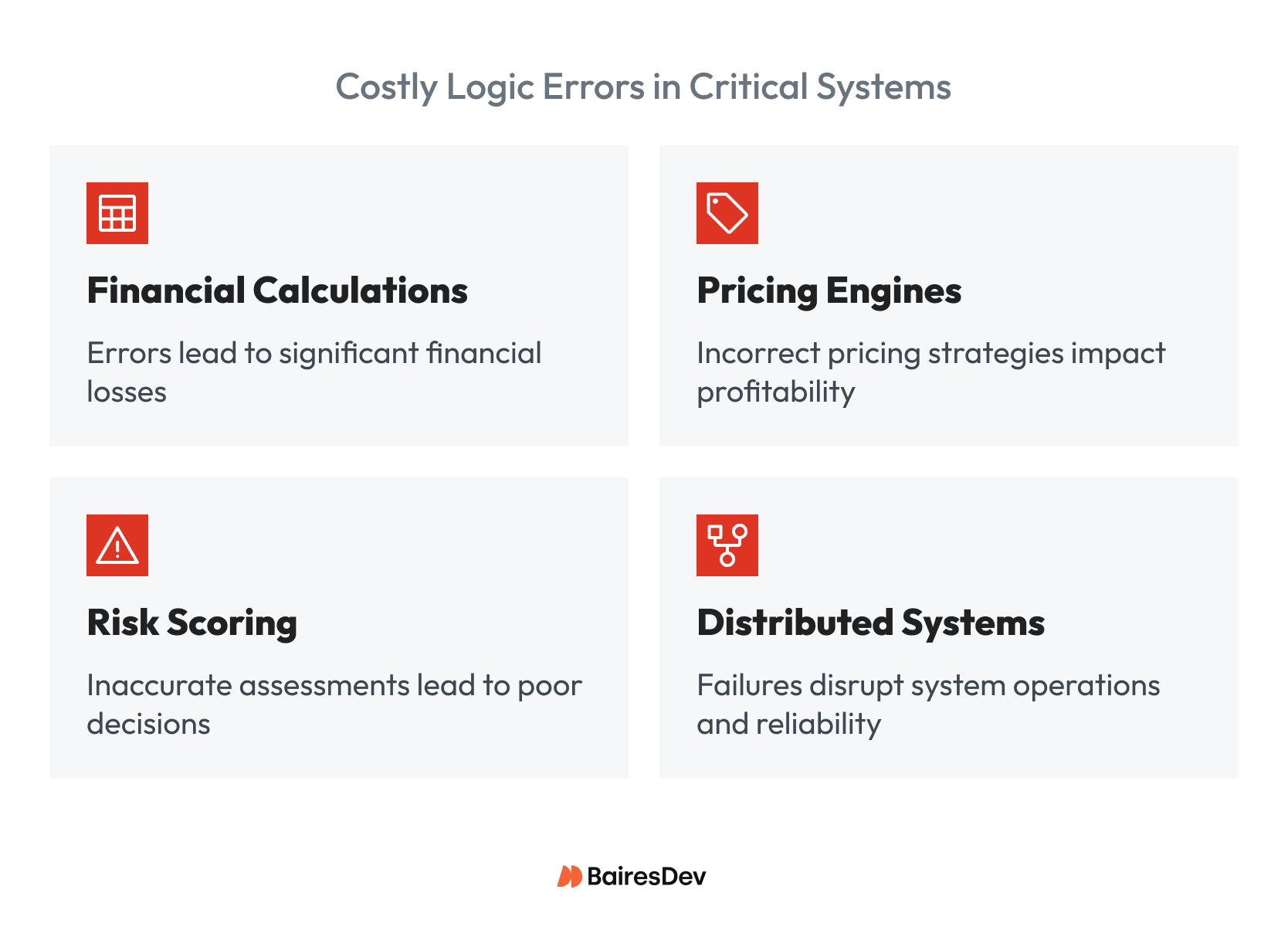
In these domains, encoding constraints into the type system leads to more predictable behavior under load.
However, that same flexibility introduces risk. Scala syntax is expressive and concise, but it allows multiple valid approaches. Without a defined subset, teams drift into inconsistent styles. Over time, that inconsistency becomes a delivery problem.
Scala doesn’t fail teams. Lack of alignment does.
How Scala Fits Into the Java Virtual Machine Ecosystem
JVM Compatibility and Operational Continuity
Scala runs on the Java Virtual Machine, which makes it attractive for enterprise adoption. Because Scala code compiles into Java bytecode, it operates within the same runtime environment as Java applications.
This provides immediate benefits:
- Existing deployment pipelines remain usable
- Monitoring and observability tools continue to work
- Runtime behavior stays consistent
- No changes to memory management models
For platform teams, this reduces the risk of introducing a new programming language.
Interoperability With Java and Existing Systems
Since it integrates directly with Java libraries, Scala allows teams to reuse mature components rather than rebuilding them. Most large engineering orgs rely heavily on this interoperability.
In practice, successful organizations define clear boundaries:
- Scala for high-complexity services
- Java for broader application layers
Blending Java and Scala at the file level tends to create ownership confusion. Keeping boundaries at the service or module level reduces long-term friction.
Build Systems, Compilation, and Developer Workflow
The Scala compiler has a larger impact on delivery velocity than many teams expect. Its advanced type system and verification during compilation increase safety—but also increase build time.
This has a number of real-world implications and may lead to increased friction, slower iteration, longer feedback cycles, and so on.
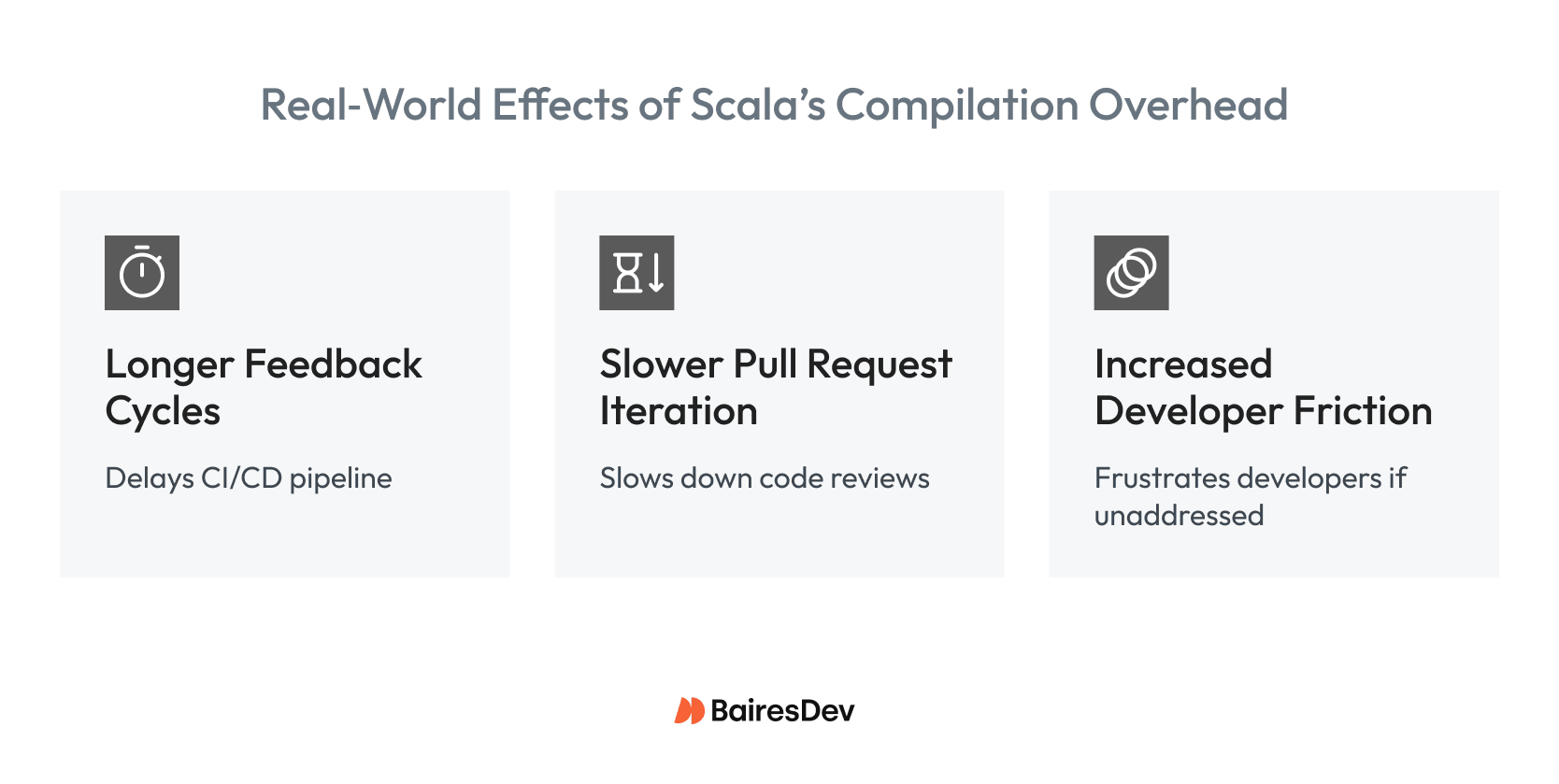
In most cases, this isn’t exactly a language problem. It’s the existing build architecture being exposed under stricter conditions.
For specific workloads, Scala Native offers an alternative by compiling to native binaries. This can improve performance, but comes with tradeoffs in ecosystem maturity.
The Business Case: Where Scala Actually Delivers
Correctness in High-Stakes Systems
Scala’s primary advantage is its ability to encode correctness directly into the codebase. Through immutable collections, type inference, and Functional Programming paradigms, it reduces reliance on runtime validation.
This matters most where defects carry real cost: financial loss, compliance exposure, or customer trust erosion. In these environments, preventing errors is more valuable than fixing them quickly.
Concurrency and Distributed Systems
Scala’s functional programming approach reduces shared mutable state, which simplifies concurrency. In concurrent, multi-service environments, this leads to more predictable behavior and fewer race conditions.
This is one reason Scala is commonly used in reactive programming and stream processing systems, where stability under load matters more than raw feature velocity.
Big Data and Data Engineering
Apache Spark, one of the most widely used big data frameworks, was originally built in Scala, which continues to anchor its core APIs and performance-critical paths.
Many data processing engines and Hadoop jobs are written in Scala, making it a common choice for data engineering teams.
That said, Scala rarely operates alone. Python and SQL are widely used for data analysis and feature engineering. Scala typically anchors the infrastructure layer, where performance and control matter most.
Efficiency and Expressiveness
Scala allows developers to write efficient code in fewer lines through concise syntax and abstractions like higher-order functions and lazy evaluation.
This can improve long-term maintainability, provided readability is preserved. However, without constraints, the same features can produce code that is difficult to understand during incident response.
Organizational Risk: Where Scala Breaks Teams
Inconsistent Standards and Code Divergence
Scala places more responsibility on teams to define how code should be written. Unlike Java, which has well-established conventions, Scala allows multiple interpretations of best practice.
This gives teams more freedom, but introduces risks as well. Without governance, codebases fragment into different styles, reviews become subjective, and delivery slows.
A team can tolerate two patterns, while five patterns create friction in every pull request.
Teams that adopt Scala without enforcing a standard subset often converge on a predictable failure mode: multiple styles emerge, only a small group of engineers can confidently modify core systems, and delivery slows as ownership becomes uneven.
Hiring Constraints and Talent Availability
Scala developers represent a smaller segment of the market compared to Java developers. For context, a recent Stack Overflow Developer Survey shows Scala used by only 2.6% of professional developers globally, reinforcing the reality of a tighter hiring pool.
Most enterprises address this by upskilling internal teams rather than relying solely on external hiring. Strong Java engineers can learn Scala, but the transition requires structured onboarding and clear standards.
The Seniority Requirement
Scala tends to concentrate ownership among more experienced engineers. This creates what many teams describe as a “seniority magnet.”
| Benefits | Risks |
| High-quality system design | Knowledge concentration |
| Strong architectural decisions | Limited on-call coverage |
| Higher code quality | Dependency on a small group of engineers |
If only a few engineers can safely modify core services, the system becomes fragile, regardless of language quality.
Learning Curve and Productivity Impact
The learning curve for Scala is steeper than most programming languages. For many developers, the challenge is not syntax, but the shift to functional programming and a different way of modeling problems.
In practice:
- Initial velocity drops
- Code reviews take longer
- Debugging requires deeper context
Teams that invest early in training and standards recover faster. Teams that don’t remain slow.
Scala Readiness
| Dimension | Low Fit | High Fit |
| Defect Cost | Minor bugs, easy fixes | High financial or compliance impact |
| System Complexity | Simple CRUD | High-throughput or event-driven architectures |
| Team Experience | Junior-heavy | Senior, stable core |
| Governance | Weak standards | Strong review discipline |
| Hiring Strategy | No plan | Clear upskilling approach |
A practical rule: if most signals fall on the left, Scala will slow you down. If they fall on the right, it can improve long-term outcomes.
How to Run a 90-Day Pilot Without Overcommitting
1. Choose the Right Starting Point
Select a bounded service where:
- Logic complexity is high
- Interfaces are well-defined
- Failure cost is meaningful
Avoid starting with core infrastructure. That introduces too many variables.
2. Define Success Criteria Upfront
Measure:
- Defect rates
- Build performance and compilation impact
- Developer productivity
- On-call performance
Without baseline metrics, perceived gains are unreliable.
3. Test Operational Reality
Include at least one simulated incident. Evaluate whether engineers who didn’t write the original Scala code can debug it effectively.
If they can’t, readability is your limiting factor.
4. Control Scope Expansion
Set clear decision gates:
- Expand only if defect rates improve without a major delivery slowdown
- Pause if hiring, readability, or build performance becomes a constraint
The Hidden Factor: Team Structure and Scaling
Scala changes how teams scale. Because of its complexity and smaller talent pool, it favors stable, long-term teams over rapid expansion.
This has a number of strategic implications: knowledge continuity becomes critical, and short-term staffing models become less effective, as senior presence must remain consistent.
Organizations that treat Scala as interchangeable capacity tend to struggle. Those that treat it as a specialized capability tend to succeed.
Where Scala Earns Its Place
Scala is a powerful general-purpose language, but that alone isn’t a reason to adopt it.
It earns its place when the cost of being wrong is high, systems are complex and concurrent, and the engineering discipline is already strong.
In these conditions, Scala’s combination of Object-Oriented and Functional paradigms, strong type system, and ability to run on the Java Virtual Machine becomes a practical advantage.
Without those conditions, the learning curve, hiring constraints, and complexity outweigh the benefits.