

Multi-Agent AI systems are becoming increasingly common, but their advantage over single-agent systems cannot always be assumed. Here’s when you should use multi-agent architectures, and what you need to consider before you take the plunge.
Key Points
- Multi-agent systems excel at decomposing difficult problems, parallelizing at the task level, and adding fine-grained security controls to each level.
- Despite many advantages, using multiple AI agents comes with more complexity, cost, and potential control issues.
- Best practices, like architectural design hygiene and extensive, detailed logging, should be implemented to accelerate the strengths of multi-agent setups while controlling for the pitfalls.
When a Single Agent Isn’t Enough
As large language models continue to grow in capability, AI engineers are developing increasingly sophisticated patterns to take advantage of the growing functionality. In the most recent phase of innovation, agentic AI has emerged as a leading architecture for AI development.
There are changes within the agentic AI architectural framework as well. While single-agent systems are quite capable and have a lot of valid use cases, using multiple specialized agents allows teams to solve much more complex problems through coordination and parallelism.
But there’s an important tradeoff: agentic systems are much more difficult to set up and maintain, making it easy to make mistakes that surface much further down the line. Therefore, as organizations continue to adopt agentic AI with growing enthusiasm, they must take into account the risks and pitfalls that often surface too late in the development process.
| Decision factor | Lean single-agent | Lean multi-agent |
| Task structure | One goal, few tools, short turn count | Decomposes into distinct, specializable subtasks |
| Parallelism | Steps are tightly coupled and sequential | Subtasks can fan out and run independently |
| Security / data isolation | One trust level is acceptable | Different steps need different data access |
| Cost and latency budget | Tight, as every extra LLM call hurts | Room for more tokens and round-trips |
| Team maturity | Limited observability tooling | Logging, tracing, and replay already in place |
The goal of this article is to explore the use cases, pitfalls, and best practices of agentic systems, so that teams can orchestrate and deploy specialized AI agents with greater confidence and trust.
A Brief History of AI Agents
Before we look at the practical aspects of AI agent orchestration, it is a good idea to understand the genealogy of agentic AI, since it informs the types of problems these systems are adept at solving, as well as the failure modes.
External Tools and Actuators
“Tool calling”, where AI models could invoke functions before returning an answer, was originally created to allow agents to navigate an increasingly complex data environment. Pioneering papers like Toolformer illustrated how AI models could learn to use external tools, specifically items like calculators, web search, and specialized database retrieval tools.
This transformed the AI programming paradigm. Where AI engineers previously handled data engineering as a manual step, retrieving and transforming data in a way that was useful to the AI, language models could now control these data engineering tools on their own.
This made the RAG (retrieval-augmented generation) pattern truly dynamic, as AI systems could now adapt on the fly and handle a much wider range of situations.
Much more than dynamic data retrievals, however, tool calling gave LLMs “actuators” that allowed these models to do things in the real world. Instead of being constrained to “read” actions, AI models could now “take actions” in the world using these tools.
For example, rather than simply pulling and inspecting a code base, they could now write bug fixes and propose changes. This marked the rise of the first generation of AI agents like Claude Code, which went beyond the code-suggestion features of RAG-like products like the early version of GitHub Copilot. The most important conceptual shift was the transformation of LLMs from passive information processors into an execution platform where data and instructions could be translated into real action.
The Rise of Multi-Agent Orchestration
For a period of time, most early agentic AI programs were single-agent. The agent usually had a simple goal, a small set of tools, and a relatively limited set of turns. However, three simultaneous developments pushed agentic AI architecture towards multi-agent systems.
- First, engineers developed deeper intuitions about design patterns. Practitioners on the leading edge began using multiple AI agents to process deliverables, allowing each agent to focus on one part of the problem.
- Second, LLM performance continued to improve, allowing models to stay accurate under longer and longer context load. This made agent operations far more reliable in real-world scenarios.
- Third, foundation labs began investing heavily in multi-agent workloads, resulting in models that were fine-tuned for orchestration-related tasks. These forces led to the emergence and increasing prominence of multi-agent architectures, where we are today.
With the basics out of the way, let’s explore why the industry is rushing to embrace multi-agent frameworks. Are we witnessing more AI hype, or a genuinely helpful approach that lets us get more mileage out of LLMs?
Practical Use Cases for Multi-Agent Systems
There are three main reasons companies reach for multiple agents: specialization, scalability, and security. Let’s take each in turn.
Why Multiple Agents Can Complete Complex Tasks
First, multi-agent solutions tend to solve much more complex tasks because they can rely on a system of specialized agents instead of a single autonomous AI agent.
Tasks within a large organization or enterprise can usually be decomposed into a small set of subtasks that can be tackled sequentially. For example, the rather complex task of software testing can be decomposed into a series of less complex tasks, e.g., pulling the current test suite, reviewing the updated product specs, writing the new tests, running the tests, and writing the summary report.
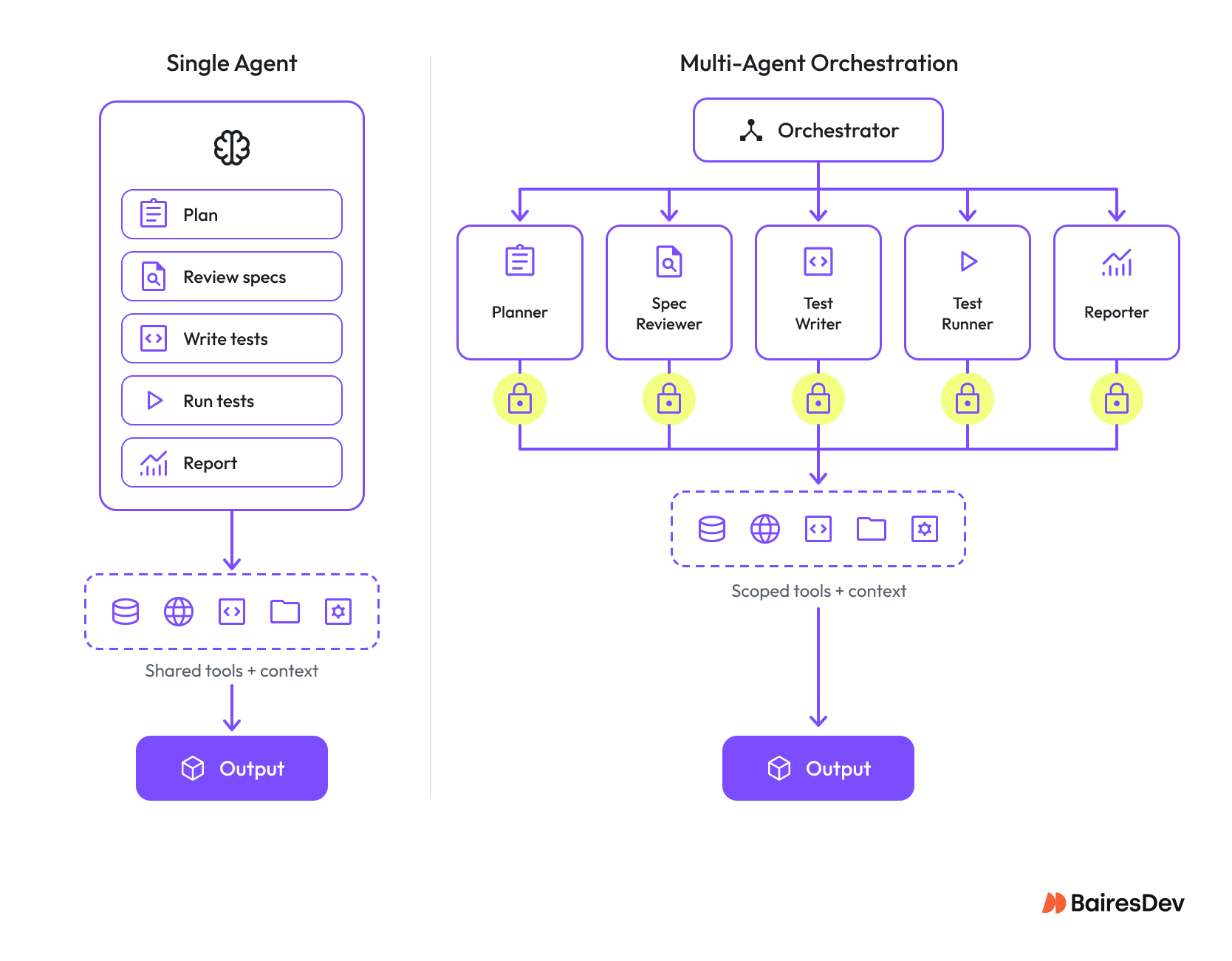
If an organization wanted a single-agent system to handle the entire workflow, the agent would need a very detailed roadmap along with every tool needed to run every step in the process. The instruction prompt would quickly become unwieldy, and the agent would be difficult to maintain and troubleshoot. As the instructions become complex, there is also an increased possibility for misinterpretation and undefined behavior, making the agent harder to test.
Multi-agent systems solve this problem by making the task decomposition explicit. A system might, for example, create a planning agent that is specialized in building code plans. Another agent might be an expert in creating tests based on the plans, and yet another one specializes in creating Python code that satisfies the created tests. By decomposing the system into individual agents, each agent is able to devote maximum computing power to the task, increasing the competence ceiling of the whole system.
This is not just theoretical: early adopters of AI coding agents used this exact “agent-driven TDD” technique to account for the error-prone nature of coding agents like Cursor or Claude Code. Additionally, each agent can be tested and improved independently, improving the reliability of the system.
Scalability Isn’t Just a Buzzword
Second, multi-agent systems tend to be much more scalable than single-agent systems.
Most single-agent setups, whatever the architecture, rely on a linear pattern that alternates between analysis and action. This linearity allows for simplicity, but presents challenges for scalability, since the tightly coupled steps create little space for parallelization or multiprocessing.
Multi-agent systems, at the cost of complexity, introduce that space into the architecture. For example, a research system could implement a fan-out architecture, where one agent formulates a research plan and then delegates various topics to sub-agents that go and perform data collection in parallel. This architecture is also much more fault-tolerant, since one research agent crashing would not result in the immediate failure of the whole pipeline.
A good example of this parallel search architecture is Gemini Deep Research, which featured a planner agent that spawned several sub-agents to implement the research plan.
Granular Controls Can Boost Security
Lastly, multi-agent systems can be secured with finer-grained access controls compared to a single-agent system.
Agentic systems are notoriously hard to secure and full of idiosyncratic risks. For example, an agent may misunderstand an instruction, resulting in the agent deleting sensitive data. Agents that process unverified text can also be vulnerable to prompt injection attacks, giving users access to information that they shouldn’t have. The need to protect against these actions constrains the type of capabilities that can be granted to the agent.
Multi-agent setups can bypass many of these problems with proper security design. Because each agent performs a specialized task, the data access of each agent can be restricted to what is needed for each task.
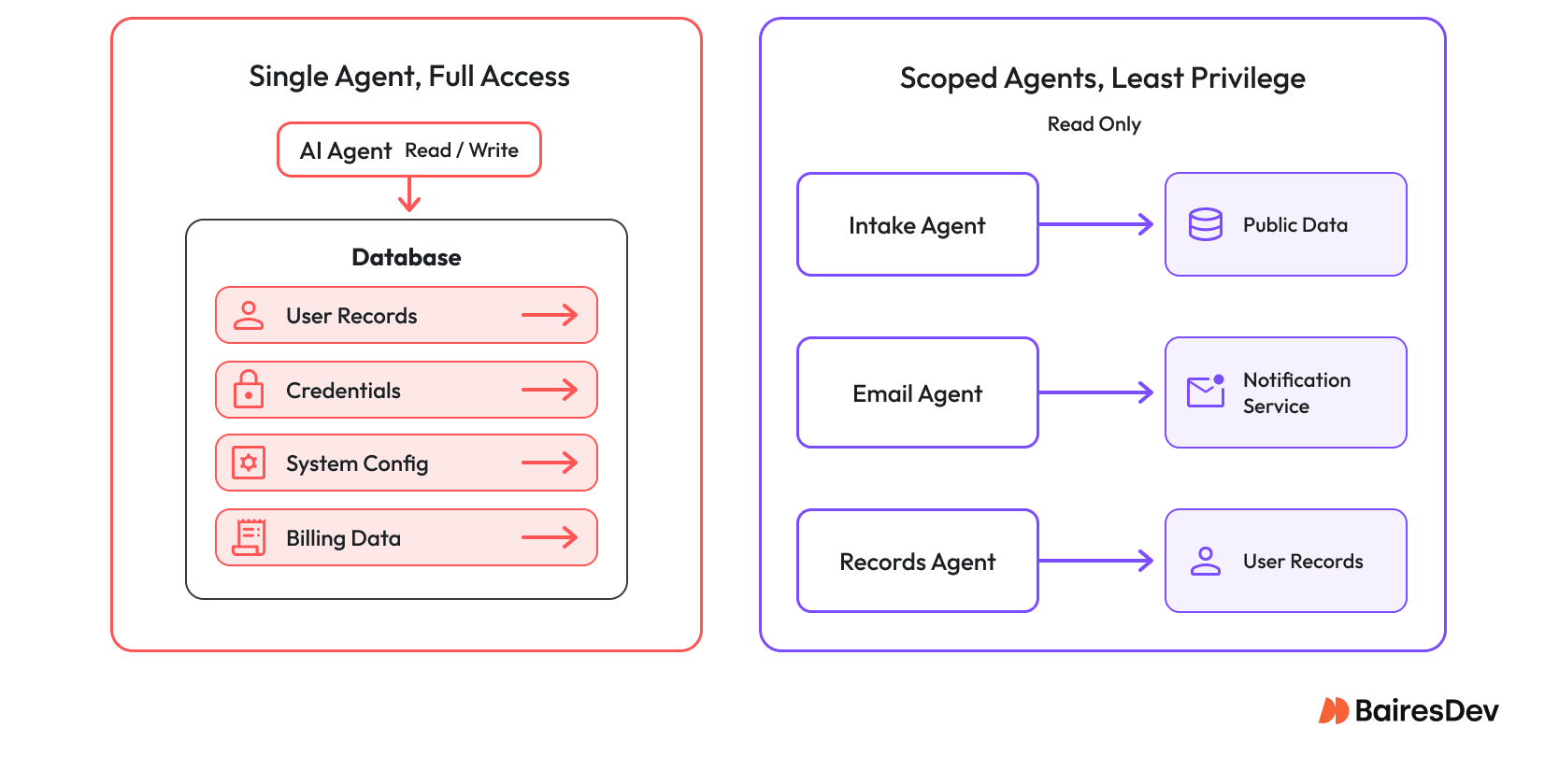
A healthcare assistant agent whose job is to send emails and alerts, for example, would not need to access a patient database, thus reducing the probability of sensitive data being leaked. The communication protocol between agents constitutes a form of protection against drift, since context is organized in a structured way that is resistant to bloat, reducing the chance that an LLM will become overwhelmed by the accumulated context. Lastly, agents that process unsanitized input data can be run with strict security permissions, reducing the risk of prompt injection attacks.
In fact, the now-infamous McKinsey hack, where McKinsey’s internal chatbot was compromised by a penetration testing firm, could have been contained by a proper multi-agent architecture. In this compromise, the attackers used SQL injection to gain access to the chatbot’s data retrieval system, which also had write access to the database that contained the chatbot’s own system prompts. This access allowed the attackers to escalate their privilege by directly modifying the behavior of the chatbot.
Instead of one agent that had access to the entire database, a network of permission-controlled agents could have specialized in accessing different parts of the database, containing the privilege escalation and preventing the attackers from directly controlling the chatbot’s behavior.
Now that we understand the benefits of agentic systems and the importance of multi-agent orchestration, let’s look at some potential pitfalls and drawbacks.
Pitfalls and Drawbacks
One of the most obvious drawbacks of a multi-agent architecture, compared to a single-agent one, is the complexity.
| Pitfall | What goes wrong | Guardrail |
| Complexity / rigidity | Explicit decomposition reduces flexibility; problems get obscured between agents | Clear service boundaries, minimal capabilities, defined I/O per agent |
| Cascading failure | One bad output misdirects every downstream agent | Replay-grade logging at each agent (inputs, outputs, version, timestamp) |
| Cost and latency | One call becomes many; tokens and latency multiply | Size the design against a realistic time and spend budget before committing |
When you build a multi-agent workflow, the problem decomposition has to be explicit and built into the architecture instead of being delegated to the LLM. This inherently leads to less flexibility, which can result in the system adapting less well to unexpected changes in the environment or the problem set. Complexity also presents visibility pitfalls, where insufficient logging and monitoring can easily lead to problems in one agent being obscured by downstream agents.
Highly related to the visibility problem is the control and reliability problem. Because AI agent orchestration entails agents building on top of each other’s work, a poorly designed system can become vulnerable to multiple points of failure. When agents in a chain are highly dependent on each other, failure in any one agent along the chain can crash the entire system, multiplying the support load.
Additionally, if an agent in the chain misbehaves or encounters an unexpected input, the agent may respond with a bad output that misdirects downstream agents. This is known as “cascading failure”, and is a persistent failure mode within agentic programming.
One example of cascading failure is the infamous OpenClaw email deletion incident, where the head of AI safety at Meta deleted a large quantity of her emails using an OpenClaw instance. This deletion was caused by an error in OpenClaw’s compaction agent, which removed instructions to never delete emails, causing other agents to misbehave.
A third drawback that is often underestimated early in design is cost and latency. AI orchestration, due to its natural tendency for decomposition, tends to split a single LLM call into multiple LLM calls. While there are certainly benefits to this change, multiplying LLM calls almost always results in more token usage compared to its single-call alternative. End-to-end latency also tends to increase in lockstep, since the overhead of initiating an LLM call is incurred multiple times.
This is a common complaint about agentic research systems across domains, where even simple queries are decomposed and analyzed according to an agent orchestration template, dramatically increasing response time even when it’s unnecessary. In light of this, teams should size their design against a realistic budget for both time and spend before committing to a specific multi-agent architecture.
Let’s look at some best practices that help us maximize the benefit of multi-agent systems while minimizing the risks.
AI Agent Orchestration Best Practices
The first and most important point to keep in mind when orchestrating is to practice good architectural hygiene. Agents should have very clear service boundaries, the minimum set of capabilities they need, and a well-articulated set of desired inputs and outputs. A clear definition allows for more rigorous testing as the system evolves, which will help contain architectural drift as more features are added onto the system.
Another benefit of architectural hygiene is a consistent contract between the agents, which will be crucial as the AI engineering team scales, resulting in multiple engineers or departments responsible for maintaining different parts of the multi-agent system.
Once the agent is architected, implemented, and tested, it is important to have rigorous logging throughout the architecture. This is important to control cascading failures, as well as silent crashes in an upstream agent that are obscured by downstream agents. An easy way to ensure sufficient logging for agent troubleshooting is to ensure that there are enough logs to actually replay the agent workflow. This ensures the inputs and outputs of each agent, as well as metadata like timestamp and agent implementation version, are properly logged and labeled.
This level of output allows for monitoring of aggregated metrics in a dashboard, deep debugging sessions with tracing, and architectural reviews with real-world performance data.
Agents Are Here to Stay
As LLMs evolve and capabilities develop, new techniques will undoubtedly surface, but agent orchestration is well-positioned to be a valuable skillset for years to come.
In order to understand agent orchestration best practices, we covered the use cases for agent orchestration, as well as the pitfalls, where a multi-agent system can introduce more failures. Finally, we addressed these pitfalls by covering some agent orchestration best practices, which aim to minimize the likelihood and impact of these pitfalls.
After a few years building these systems, here’s what I’d tell a team considering a multi-agent push: don’t reach for orchestration just because it’s where the industry is heading. Ignore the hype and go multi-agent only when it solves a problem you actually have. Nail the boundaries and logging early, and the architecture will work for you instead of against you.