


Executive Summary
This survey of senior technology leaders explores the gap between AI ambition and real-world delivery. The study identifies which factors help some companies move AI initiatives from planning to production, and what’s getting in the way for everyone else.
AI investment across U.S. enterprises is accelerating rapidly. But among the leaders managing that investment, what gets reported to stakeholders doesn’t always reflect what’s happening on the ground.
A new BairesDev survey of over 500 senior technology leaders, including directors, VPs, and C-suite executives, focused specifically on organizations actively running AI initiatives. It found that 79% feel pressure to overstate the progress or impact of those initiatives to satisfy executive or stakeholder expectations. Nearly half (46%) say that pressure comes primarily from the C-suite or board.
That pressure plays out at multiple levels. Senior leaders are navigating shifting executive priorities, infrastructure constraints, and mounting pressure to deliver results faster than their organizations are built to move.
Meanwhile, the developers executing those initiatives face a different set of pressures entirely. According to BairesDev’s Q1 2026 Dev Barometer, 59% of teams are adopting AI tooling without adequate training, and 55% lack the testing standards needed to move quickly and safely.
What the data reveals is that the distance between what leaders are reporting and what their teams are actually experiencing runs deeper than individual decisions. It is the product of structural and cultural forces, and this article examines how those forces are shaping AI delivery outcomes across U.S. enterprises in 2026.
Key Takeaways
- 79% of tech leaders feel pressure to overstate AI progress to satisfy stakeholders, and 46% say that pressure comes primarily from the C-suite or board.
- 83% of respondents report positive ROI from their AI initiatives, though most are measuring it through operational metrics like employee productivity rather than hard-dollar returns.
- 77% of organizations had two or more AI initiatives significantly disrupted by a mid-project shift in executive priorities within the last 12 months.
- 51% of tech leaders cite security, privacy, and compliance as their biggest barrier to AI execution, and 46% point to data readiness, suggesting execution challenges run deeper than access to talent alone.
Tech Leaders Face Pressure to Inflate AI Results — Often From Their Own Peers
When nearly 4 in 5 senior technology leaders report feeling pressure to overstate the progress or impact of AI initiatives, the finding alone is striking. What makes it more so is where that pressure is coming from.
46% of respondents identify the C-suite or board as the primary source of pressure to overstate AI progress. That pressure appears to be felt most acutely at the top. 57% of C-level executives say it originates from the C-suite or board, compared to 42% of directors. The higher up the organization, the more directly that pressure lands.
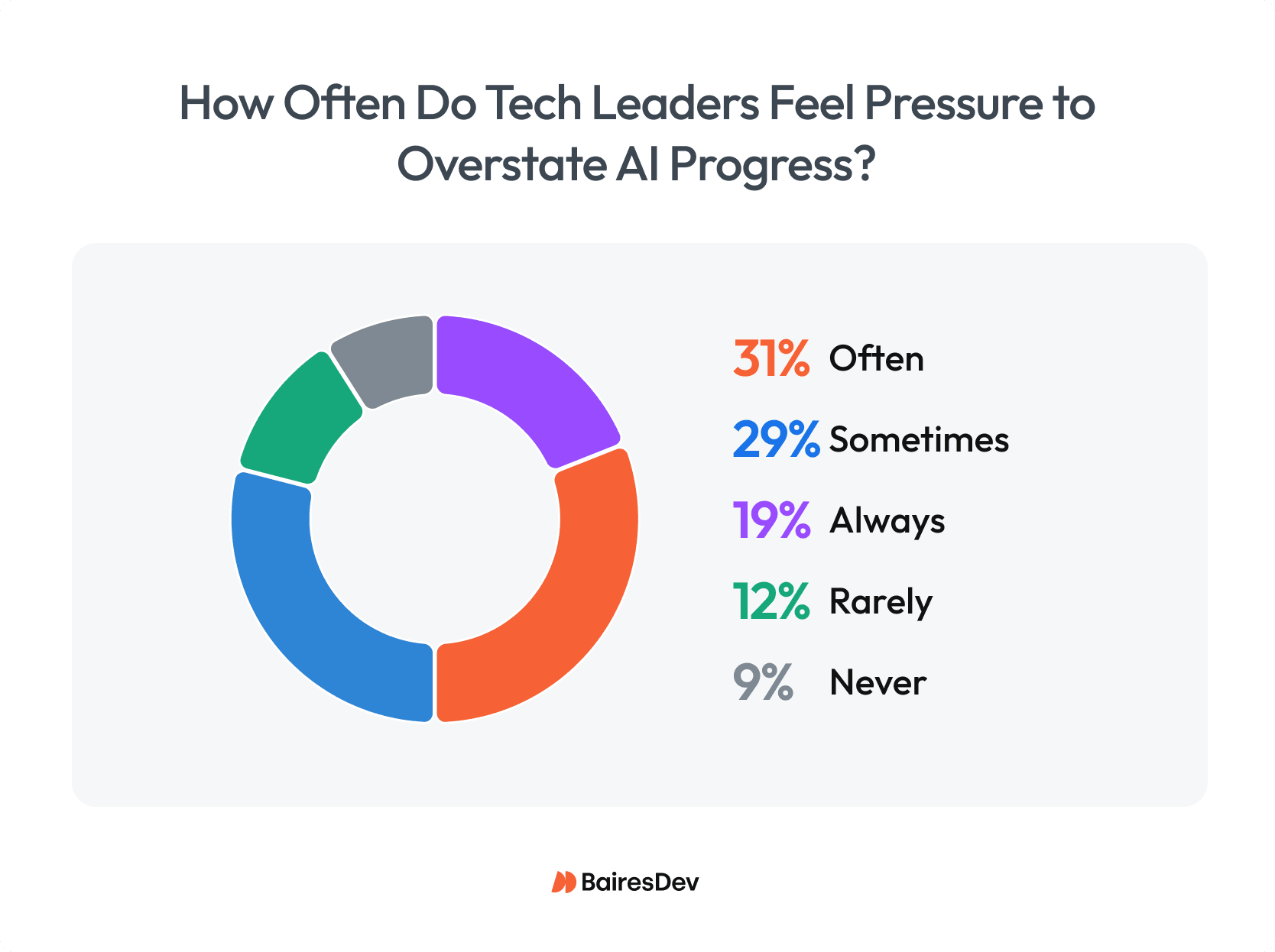
This pattern points to a cycle in which leadership sets the expectations, then feels the most direct pressure to prove those expectations are being met. This could be due to a variety of factors, from internal accountability culture to board-level demands for results, and likely varies significantly from one organization to the next.
There’s an expectation now that every initiative has to be framed as AI-driven. Even when it’s not, you’re pushed to find the angle, because otherwise it feels like it doesn’t count as progress.
Federico Schwarzbock, BairesDev Engineering Manager
But the consistency of the finding across seniority levels suggests it has become a structural feature of how AI progress gets communicated, rather than an isolated dynamic at any one level of an organization. Understanding how business leaders track and measure AI performance may be a starting point for addressing it.
Executives Who Shift Priorities Are Disrupting AI Initiative Timelines
This pressure to overstate AI initiative progress does not exist in isolation. It coincides with a pattern of mid-project disruption that is remarkably common across organizations of all sizes.
77% of respondents say their organization had two or more AI initiatives significantly affected by a change in executive priorities in the last 12 months. While the survey did not define a minimum scale for what counts as an initiative, the volume of disruption points to a consistent pattern of strategic instability at the organizational level.
Among organizations where four or more initiatives were affected by shifting executive priorities, the rate of projects delayed indefinitely rises to 22%. For organizations that experienced no mid-project priority shifts, that figure drops to just 3%. Frequent priority changes do not simply slow projects down. They stop them.
The consequences of those disruptions look different depending on where you sit in the organization. For senior leaders, they show up as delayed timelines and stalled initiatives. For the developers executing those initiatives day-to-day, they show up in more immediate ways.
BairesDev’s Q1 2026 Dev Barometer finds that the top barrier developers face when validating AI-generated output is delivery pressure, cited by 20% of respondents. That is followed by insufficient test coverage or poor-quality data (16%) and limitations in current tools (12%).
When executive priorities shift repeatedly, and timelines compress as a result, that pressure does not stay in the boardroom. It lands directly on the teams responsible for making sure AI outputs are accurate, reliable, and ready to ship.
That same research finds that 55% of software development teams say they lack the tests and standards needed to move safely. It’s a challenge that compounds significantly when shifting priorities compress timelines further.
AI Initiatives Are Reaching Production but Not Without Compromise
AI launches are happening, but getting to production on time is proving harder than planned, and many teams are making real compromises to get there. 73% of respondents report moving at least one AI initiative to live production on schedule in the last 12 months.
At the same time, 54% report at least one initiative that arrived significantly behind schedule, and 34% had to reduce at least one project in scope before it could ship. On-time delivery and delayed delivery frequently coexist within the same organization.
The timeline data helps explain why. 66% of leaders say their most recently completed initiative took four months or more to move from pilot to production, with 27% needing seven to 12 months and 9% needing 13 months or longer.
That is a significant investment of time for any initiative, and it suggests that production is consistently harder to reach than initial plans account for. Software and SaaS organizations, despite sitting at the forefront of industries championing AI, show a notably higher rate of projects ending up behind schedule (67%) compared to the overall average (54%).
Leaders often plan around how quickly an AI prototype comes together, but production is where the real engineering work begins. Data quality, validation, security and integration determine whether an initiative can scale. Even then, adoption is its own challenge. Speed to market is one solved bottleneck. Getting people to actually use the thing is another beast entirely.
Justice Erolin, BairesDev CTO
When timelines slip, scope is often what gives. 34% of respondents report reducing at least one project in scope before it could ship, a pattern that looks less like failure and more like a pragmatic finishing strategy. Teams are cutting what they can to get something deployable across the finish line. But that approach has limits.
Senior leaders may be trimming scope to hit deadlines, but the developers executing those projects are working within constraints that do not disappear when scope is reduced. Shipping faster does not solve that problem. It compounds it.
Half of Tech Leaders Say Security and Compliance Are Blocking AI Execution
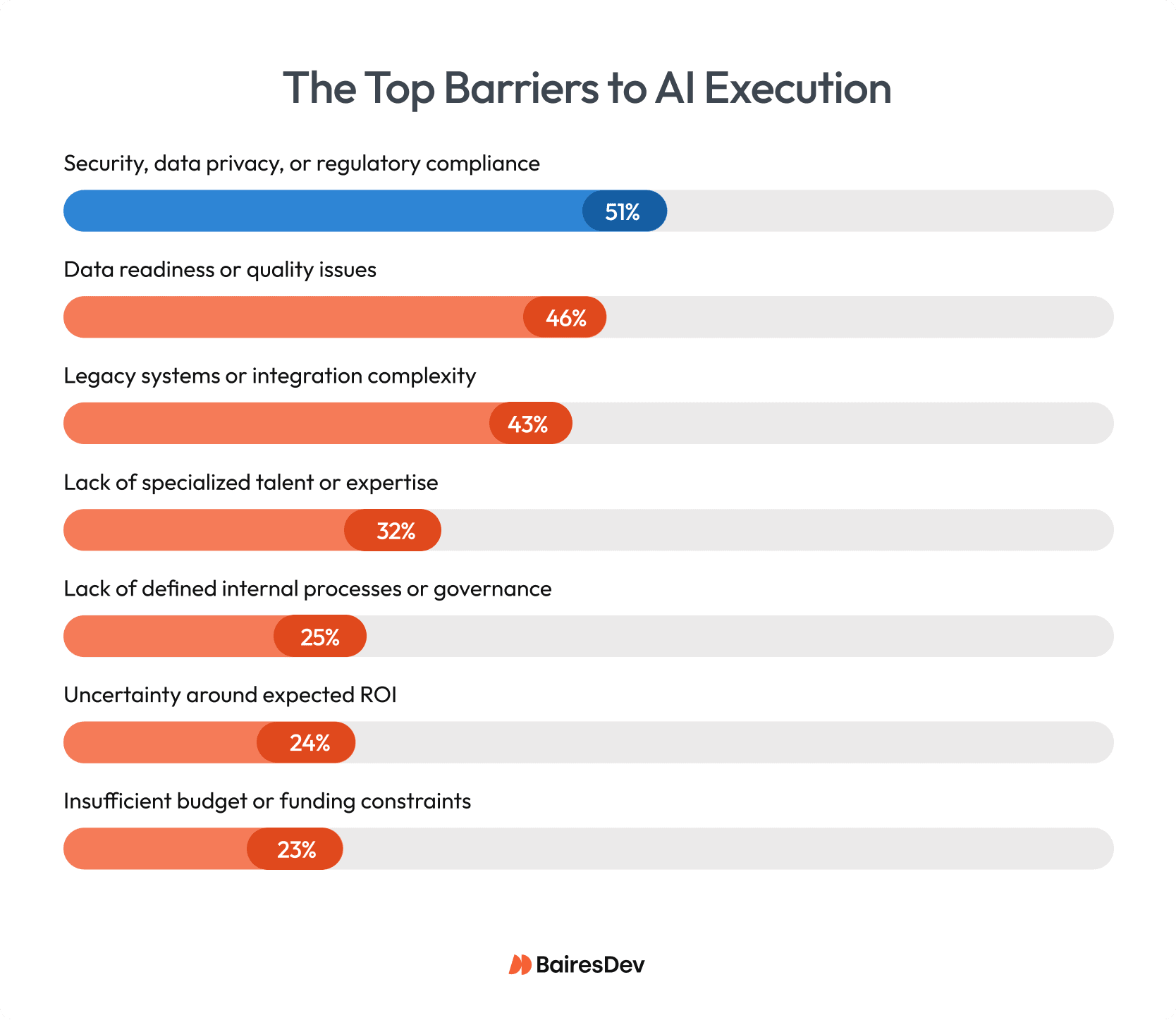
Senior technology leaders are clear about what is slowing AI execution down. Security, data privacy, and regulatory compliance concerns top the list, cited by 51% of respondents.
Data readiness and quality issues follow at 46%, a challenge so common that scaling enterprise AI before the data is ready has become a practical reality many organizations are actively navigating. Legacy systems and integration complexity follow close behind at 43%, with talent shortages ranking fourth at 32%, pushing back on the common assumption that people are the primary obstacle to AI execution.
The talent picture is more complicated than the ranking suggests. Tech budgets are up roughly 10% in 2026, but expected headcount growth dropped from 6% to 2%, according to a Gartner CFO survey cited in our analysis of software outsourcing trends. Spending is there, but the engineers aren’t.
That reality looks different from the developer side. While senior leaders are focused on infrastructure, compliance, and data quality as their primary obstacles, the developers working within those constraints are contending with a different set of challenges entirely.
According BairesDev’s Q1 2026 Dev Barometer, 67% of developers say their teams do not know how to validate AI-generated outcomes, and 59% say tooling is being adopted without adequate training.
That contrast is worth noting. Leadership is navigating organizational and regulatory friction. Developers are navigating a skills and standards problem. Both are real, both slow execution down, and neither gets resolved by addressing only the other.
More Than 80% of Organizations Are Seeing AI Returns, but the Full Picture Is More Nuanced
At first glance, the AI ROI picture looks strong, as 83% of respondents report a positive return on their AI investment. But that figure needs some context.
The survey asked specifically about launched AI initiatives, meaning failed or canceled projects may not factor into how respondents assessed their returns. It also excluded organizations with no active AI initiatives in the past 12 months, a segment that likely includes companies that lack the talent, data infrastructure, or bandwidth to get started, as well as those that quietly shelved plans before anything launched.
The tech-heavy composition of the survey respondents, with more than 76% of respondents working in SaaS or IT services, may also push that number higher than it would be across a broader cross-section of industries.
It is also worth being precise about what ROI means in this context. The metrics respondents most commonly use to measure it are employee productivity (66%), operational efficiency (60%), and client or customer satisfaction (46%). These are meaningful indicators, but they are largely operational and experiential in nature. They reflect how AI is changing the way teams work and how customers feel, rather than hard-dollar profit impact.
According to Gartner’s January 2026 forecast, worldwide AI spending is projected to reach $2.5 trillion in 2026, a 44% increase year-over-year. More than half of that figure reflects infrastructure investment, primarily datacenters. AI software and services represent a smaller but fast-growing share. The harder financial returns from that investment will likely take longer to materialize and become clearer in the years ahead.
Regardless of where organizations stand on ROI today, AI investment intentions remain strong. 83% of all respondents plan to increase AI spending over the next 12 months.
The Execution Problem Is Structural and Teams Are Absorbing the Cost
AI investment is accelerating, but the data tells a more complicated story beneath that momentum. Delivery timelines are slipping and executive priority shifts are compounding pressure on already strained teams.
That pressure doesn’t stay in the boardroom. When priorities shift and timelines compress, developers absorb the impact. They ship faster, with less confidence in what they’re shipping and fewer guardrails than the work calls for.
What the findings make clear is that the distance between AI ambition and AI delivery is more about organizational readiness than organizational will.
The barriers showing up most consistently, including data infrastructure, security, compliance, and legacy system complexity, are not solved by enthusiasm or increased headcount alone. They require experienced engineering teams who can build securely, move deliberately, and scale AI responsibly.
BairesDev connects technology teams with skilled software developers to help move AI initiatives from pilot to production faster.
Methodology
The survey was conducted by Centiment for BairesDev. The survey was fielded in April 2026. The results are based on 501 completed surveys.
In order to qualify, respondents were screened to be over 18 years of age and U.S.-based software development or engineering professionals with 4+ years of experience, a director or higher job title, and were required to have some level of decision-making authority or influence over AI initiatives. Respondents whose organizations had no active AI initiatives in the past 12 months were excluded from the survey.
Data is weighted, and the margin of error is approximately +/-4% for the overall sample with a 95% confidence level.