

Executive Summary:
The Q2 2026 Dev Barometer surveyed 1,569 developers across 77 countries on what defines a job-ready engineer in the AI era. Both groups converge on the answer: problem-solving, analytical thinking, and real-world project experience matter more than AI tool proficiency. Where they diverge is on whether juniors are demonstrating those fundamentals today, and both point to the same source: limited exposure to real engineering work during university.
As graduation season arrives, a new wave of young talent is preparing to enter a job market that looks very different from the one they were trained for. With AI now embedded across most workflows, the rules for entry-level tech roles are being rewritten in real time.
Several news outlets have spent the past year documenting an employment compression: fewer postings, longer searches, more applications per opening. The Stanford Digital Economy Lab reported a decline in employment in the most AI-exposed occupations, specifically at the entry level. But the picture is shifting as employers settle into the technology. A recent Wall Street Journal report found that executives at companies using AI are now nearly three times more likely to be increasing junior-level hiring than cutting back. Additionally, over 40% of surveyed employers noted that AI is bringing more complexity and analytical responsibility to entry-level roles. That pattern lines up with what this Dev Barometer edition found.
The Q2 2026 Dev Barometer surveyed 1,569 developers (1,059 juniors and 510 seniors) across 77 countries to map how AI is reshaping early-career software engineering. This edition examines where juniors and seniors converge on what defines a job-ready engineer, how they see AI shaping early-career development, and where academic preparation can better meet industry expectations.
For the full survey breakdown, click here.
Nearly Half of Junior Devs Rank Problem-Solving as the Top Hiring Skill — 3x the Share Citing AI Proficiency
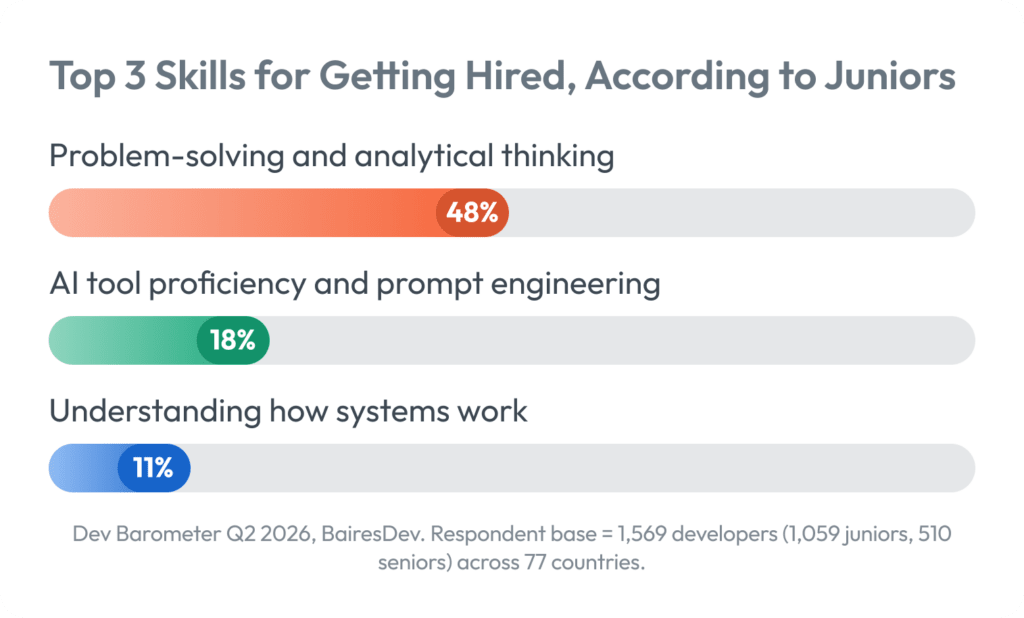
When juniors and seniors were asked what defines a job-ready engineer today, they landed in the same place. Juniors themselves rank fundamentals well above AI tool proficiency. Almost half of them identify problem-solving and analytical thinking as the most important skills for getting hired, nearly three times the 18% who point to AI tool proficiency and prompt engineering. Understanding how systems work follows at 11%, with collaboration, communication, and writing code from scratch trailing in single digits.
Seniors agree on today’s credential and extend the logic forward. When asked what indicates a junior is ready to contribute, 70% point to real-world project experience, 56% to internships, and 53% to strong performance in practical coding tasks. All three measure what gets built through real exposure to the work. They point to the ability to recognize and resolve actual problems, not just textbook ones.
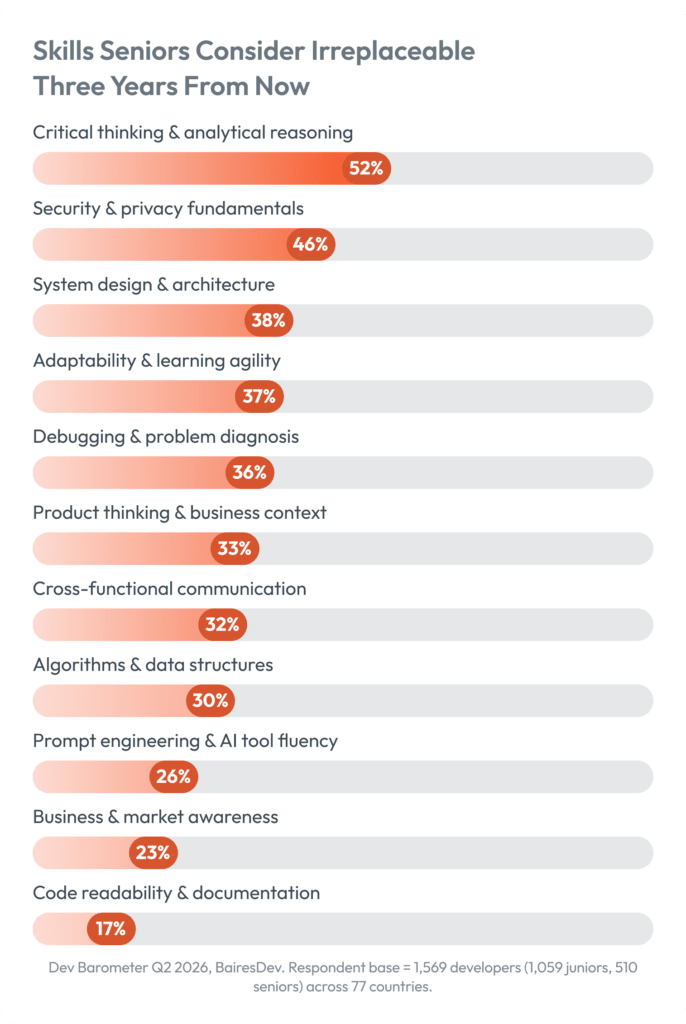
Seniors also reported on which skills they consider irreplaceable three years from now, with multiple selections allowed. Critical thinking and analytical reasoning top the list at 52%. Traditional engineering fundamentals like security and privacy, system design, and debugging follow close behind. Tellingly, prompt engineering and AI tool fluency rank much lower. The skills both groups prioritize are the ones AI cannot substitute.
This convergence reframes what juniors are actually expected to bring. They are being asked to demonstrate the kind of judgment seniors built over years, now expected from the start.
That shift is something Virginia Moré, Sr. Software Engineer at BairesDev, sees directly in how she evaluates a junior colleague’s work. “What’s expected today is being able to detect whether you understand what you’re building, whether you can validate a solution, anticipate impacts, or errors. Because today, even as a junior, you can produce code much faster, but the impact of a poorly functioning system on the end user is still the same.” The bar isn’t higher in terms of what juniors are expected to know. It’s higher in terms of when they’re expected to own it. As Moré puts it, “I don’t think juniors today are expected to ‘know more,’ but they are expected to have more intellectual autonomy and well-founded judgment from earlier stages.”
Seniors recognize the new generation contributes something in return: 62% say juniors bring fresh perspectives on user experience and product thinking, 40% say juniors question assumptions the team stopped challenging, and 37% say juniors bring fluency with the latest AI tools that seniors haven’t fully explored.
Both groups agree on what readiness looks like. Where they diverge is on whether juniors are demonstrating those fundamentals in practice today.
85% of Junior Devs Say AI Improved Their Understanding of Software Development. Seniors See Something Different
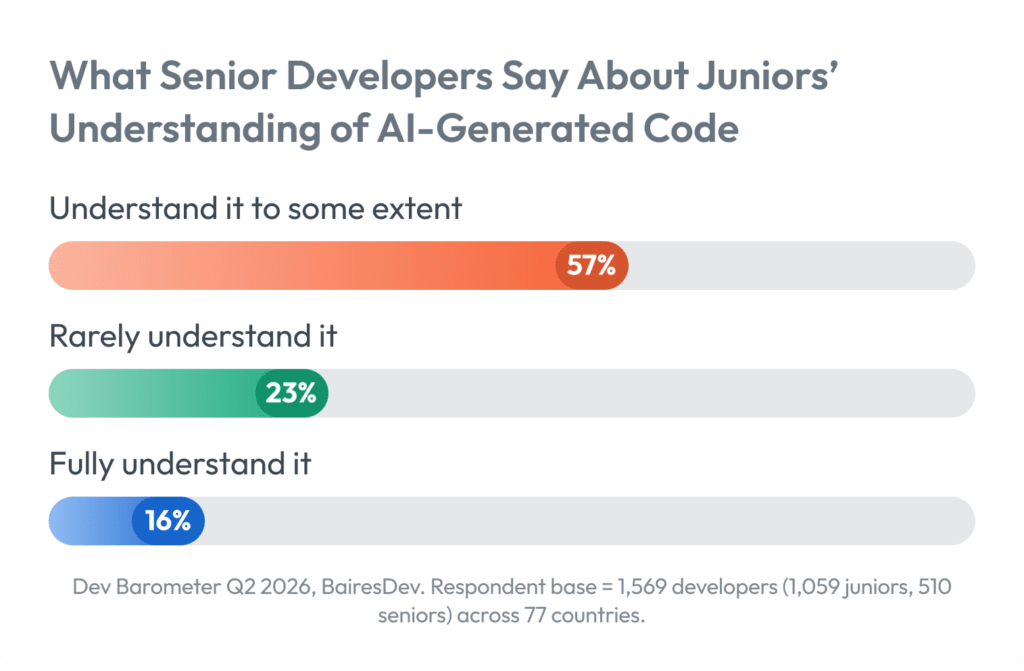
AI has become the default companion for early-career engineers, and most juniors describe it as a learning accelerator. Most (85%) agree or strongly agree that AI has improved their understanding of software development. Seniors, working alongside them, describe what they see in day-to-day practice. Only 16% of senior devs say juniors fully understand the AI-generated code they submit, 57% say juniors understand it to some extent, 23% say juniors rarely do, and 4% say they don’t at all.
The gap between how juniors and seniors view AI understanding has a documented basis in learning science. In an academic framework analysis of the Q2 2026 Dev Barometer findings, Professor Francisco Anello, director of the Master in Business and Technology at Universidad de San Andrés, applies cognitive research to the data and explains that calibrating one’s own learning depends on having a comparative reference point. Juniors who learned to code with AI from the start lack the alternative experience that would let them gauge their own gaps.
Seniors see the consequences of that gap up close. Two-thirds (64%) identified over-reliance on AI without understanding as the most common mistake graduates make when joining a team, followed by weak debugging skills (50%) and difficulty breaking down problems independently (49%).
Omar Corrales, Tech Lead at BairesDev, describes a recurring pattern in code review. He notes that a simple, scoped request comes back as hundreds of lines across multiple files with no clear tie to the original requirement. What follows is a conversation to find out which parts the developer actually understands and which were accepted without analysis. “Often the AI proposes generic solutions that work in isolation but don’t respect the patterns or architecture already established,” he said, “That’s where antipatterns start to appear.”
The clearest signal of the asymmetry shows up inside juniors’ own answers. When asked which task they feel least confident performing without AI, 24% point to writing code from scratch — the top answer. And when asked which skills matter most for getting hired today, only 5% name writing code from scratch. The skill juniors feel least equipped to perform independently is the same skill they have largely concluded does not define their hireability. The reasoning and structural thinking that come from writing code from scratch may be exactly what shows up later as weak debugging and difficulty breaking down problems.
“The next generation of developers is learning to produce output without fully owning it. If we don’t close that gap now, we have a real problem: where are the senior engineers, architects, and technical leaders of 2035 going to come from? The seniors of the future are the juniors of today. And right now, the people closest to the work are telling us the foundation isn’t there yet.”
-Nacho de Marco, CEO, BairesDev
If the foundation isn’t there yet, the question is where it was expected to be built. Both groups point to the same place.
One in Two Junior Developers Say Their Education Should Have Provided More Real-World Project Experience
Juniors describe their education as adequate in coverage but thin in real-world application. Half of them say their university programs should have focused more on real-world project experience, being the top answer by a wide margin, with internships a distant second at 20%. And when juniors assess how prepared they actually felt walking out of school, only 37% say university prepared them fully. The remaining 63% land somewhere between “somewhat” and “not at all.”
The gap juniors describe isn’t unique to this generation. What’s different is the speed at which the requirements changed, leaving universities and industry adjusting in parallel rather than in sequence.
Seniors identify the same gap and specify what’s missing. A quarter of them point to understanding how systems work end-to-end, and 24% to breaking down problems independently, both connected to the analytical fundamentals juniors themselves prioritized. When seniors describe the gap they see, they aren’t pointing at missing technical knowledge. They’re pointing at judgment: how to evaluate a trade-off, when to call something not production-ready. That isn’t taught in a class. It’s built in real projects. Employers and universities are looking at the same problem from two different angles.
Professor Anello’s analysis reaches a similar conclusion. In his framework analysis of the Q2 2026 findings, he explains that the gaps juniors and seniors describe (working in large or legacy codebases, system design at scale, critical evaluation of AI-generated code) don’t require changing what is being taught. They are applications of knowledge training programs already provide, but in conditions of scale, ambiguity, and complexity the classroom can rarely replicate. The gap, in his framing, is one of format and exposure, not of content.
For Anello, the convergence between juniors and seniors on what matters most also opens a question the industry cannot afford to leave unexamined: “Can critical thinking and technical judgment be built learning with AI from day one, or do those competencies require having gone through the process without it? We don’t have a definitive answer yet, and that is exactly the conversation this generation of developers is asking us to have.”
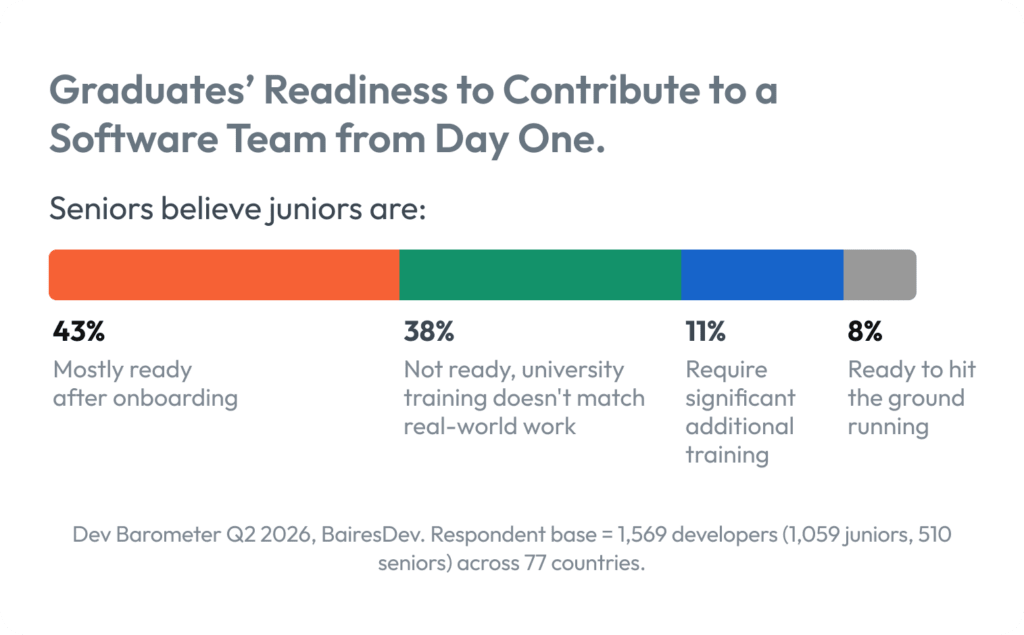
While that question remains open, the day-to-day picture is less precarious than the gaps alone might suggest. Over half (51%) of seniors say new hires are broadly ready to contribute after onboarding. The gap isn’t alarming, but it’s visible enough that both groups agree it needs closing.
Sebastián Diéguez, Sr. Software Engineer at BairesDev, points to where that exposure gap is most visible in practice. He mentions that, “most courses teach the technical part of the technology. Few teach good practices, and some are difficult to teach because they’re pain points that some projects have and others don’t.” His prescription is concrete, highlighting real practice environments found in bootcamps, hackathons, and live codebases. These are what build the judgment to know when not to trust AI output. That capacity doesn’t come from curriculum. It comes from having been wrong on something that mattered.
What seniors are describing is an experience gap that predates AI. AI didn’t create the skill gap, but it makes the gap harder to spot, because juniors can now produce code that hides the missing fundamentals until later. The mismatch is older than AI, but the pace of change has made it more urgent.
A New Baseline for the Next Generation of Software Development
The entry path into software development looks different than it did a few years ago. What used to develop over time at mid-career, such as independent problem decomposition, judgment about AI-generated output, systems thinking, and real-world project exposure, is now part of the baseline. Juniors and seniors agree on what readiness now requires. They also agree on where the gap is. Closing it is the work ahead.
Beyond the technical skills the moment requires, what junior developers bring to the profession is more valuable than ever. Energy, creativity, and a questioning spirit are exactly the qualities that move teams forward at a time when adaptation, judgment, and curiosity define the next frontier.
With 4,000+ engineers and 2.5 million annual talent applicants, BairesDev sits at the intersection of these shifts. The Dev Barometer will keep tracking how developers experience the changes shaping their profession.