By Edgar Vigil
Edgar is director of strategy and operations at Adobe. His career spans operational leadership at Google, Meta and Fortune 500 companies, grounded in the discipline of the U.S. Marine Corps.
Expertise


Executive summary
Most companies are adding AI to workflows built for a pre-AI world and measuring success by adoption. The real transformation requires redesigning the work itself: reorganizing how tasks flow, aligning incentives to outcomes instead of usage, and assigning ownership of the full result, not just the sped-up task. Until those three levers move, AI scales the existing problems faster.
I’ve spent over twenty years redesigning how work gets done, starting with aircraft maintenance in the Marine Corps and later running operations at technology, retail and healthcare companies. So when I look at how most organizations are rolling out AI, the pattern is familiar.
When AI doesn’t pay off, the tools or the training usually get blamed first. The mistake I keep seeing is different. Companies make individual tasks faster and leave everything around those tasks the way it was. They treat the technology as the transformation, when the real work sits underneath it. For companies investing in AI software development, the larger challenge is redesigning the workflows, decisions and responsibilities surrounding the technology.
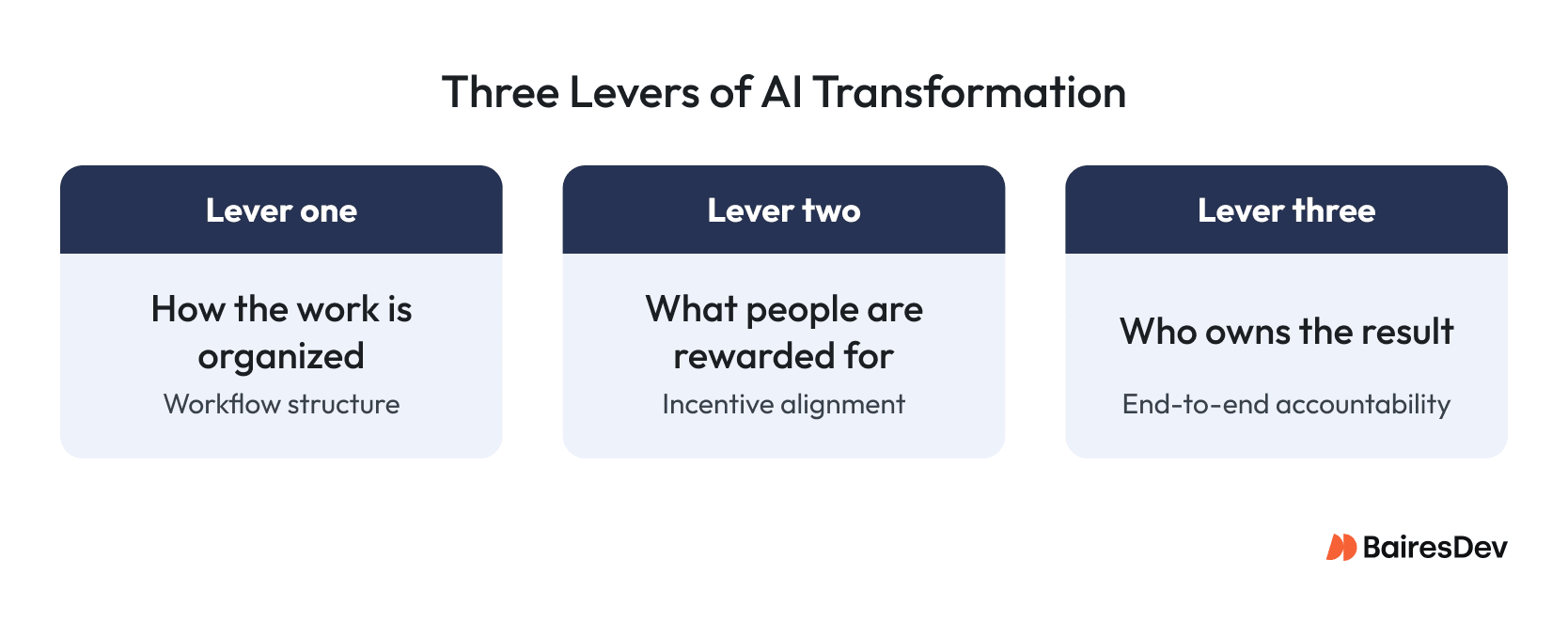
That work comes down to three things no tool will change for you: how the work is organized, what people are rewarded for, and who owns the result. In my experience, that’s where AI transformations succeed or stall.
In McKinsey’s 2026 State of AI survey, nearly nine in ten respondents say their companies use AI regularly, but only about 6% qualify as AI high performers, attributing at least 5% of EBIT to AI and describing its impact as significant. The adoption climbed and the financial return didn’t move.
The pattern has a precedent. In the 1990s, companies poured money into process reengineering and big ERP systems and hit the same wall. Michael Hammer summed up the lesson in the title of a 1990 Harvard Business Review article: “Don’t Automate, Obliterate.” If a process is broken, making it faster just gets you more of the broken process. AI does that faster than ERP ever could, and it bills you by the token.
So the place to start is the workflow, not the task.
Lever One: Why AI Requires Workflow Redesign
In the Marine Corps, I ran maintenance operations for a large fleet of aircraft. Turnaround was slow, and the easy assumption was that the repairs took too long. They didn’t. Most of the time, an aircraft wasn’t being worked on at all. It was waiting for a part from supply, for an approval, for someone to decide what came next. We didn’t fix that by asking mechanics to work faster. Instead, we changed how work came in, who could make decisions, and where work was allowed to sit. Once the waiting went away, the turnaround dropped.
The slowest part of a workflow is usually the space between the work, not the work itself.
I saw the same thing years later, running HR operations for a national health system. HR ran out of several regional centers, and each region had built its own way of doing the same work. The company was paying for the same processes several times over, with no common way to measure or compare performance across regions. Putting new software on top would only have automated each region’s version. So we first agreed on one standard way to run each process, then brought the work into a single national service center. The tools paid off because, for the first time, everyone was running the same process, and leadership could see performance across the whole company.
AI runs into the same wall. A team produces analysis in minutes, but approval still takes two days. A developer writes code faster, and now review and testing are the bottleneck. A planning team runs ten scenarios instead of two, but leadership still decides on the same monthly calendar. Every task got faster. The work as a whole didn’t. Chris Alaimo, another BairesDev Fellow, saw the engineering version of this in his team’s AI pilot: sprint planning, backlog grooming and standups quietly stopped happening, while code review stayed.
The best AI redesign I’ve been part of worked because it removed a step entirely. At a consumer tech company, our best record of what customers were saying lived in recorded sales calls. If someone in research or product had a question, they had to book time with the sales team to get an answer. We made those calls searchable through an AI assistant inside tools people already used, and built it into how we developed messaging. The recurring meetings and one-off research requests between go-to-market and product teams dropped month over month, because people no longer had to wait on someone else for an answer.
Lever Two: How AI Adoption Metrics Reward the Wrong Behavior
Building a deal desk to manage vendor contracts taught me how quickly people work around a process they don’t like. Deal owners wanted speed, and legal and finance wanted control. Nobody owned the space in between, and I had no authority over any of them. A stricter policy would only have pushed more deals around the process. So we designed it so that going through the desk was the fastest way to get a contract signed, and instead of running it as a checkpoint, we ran it as a service. Once the right path was also the easy path, people used it.
People respond to the system they work inside, not to the behavior leaders say they want.
A lot of AI rollouts get this backwards. Usage is the easiest thing to count, so it becomes the goal, and people deliver usage. But usage is an input, not an outcome. This past year the pattern got a name: tokenmaxxing.
Uber pushed engineers to use AI coding tools as much as possible and ranked usage on leaderboards. By its own account, the company burned through its entire 2026 AI budget in about four months. COO Andrew Macdonald stated that if you can’t draw a direct line to useful features you’re shipping, that spending gets hard to justify. At Amazon, an employee-built leaderboard called KiroRank ranked developers by AI token consumption. Some people started running AI on tasks that didn’t solve anything, just to climb the rankings. Amazon shut it down. SVP Dave Treadwell told staff, “Please don’t use AI just for the sake of using AI.”
Uber’s CTO later said the company was coming to the end of the tokenmaxxing era and Amazon shifted to measuring normalized deployments instead of raw usage.
Even so, the gap between what companies say and what they measure persists. In LeadDev’s AI Impact Report 2026, only 19% of respondents called tokenmaxxing effective, while 58% still measure AI impact by token consumption. The adoption number quietly becomes the business number, and the company looks like it’s transforming while the economics barely move.
Leaders feel the same pull one level up. They’re rarely rewarded for a redesign that dents this quarter’s numbers, and as Tom Davenport has pointed out, it’s far easier to “AI wash” a process than to redesign it. Redesign changes roles, budgets and metrics. Buying more AI licenses doesn’t.
Lever Three: Who Owns the Downstream Costs of AI?
Most companies are organized by function, yet the work, and the cost of the work, moves across functions. I learned that running operations for an e-commerce customer support team that handled voice, email and chat. Our only record of why customers contacted us was what agents typed into their notes, and those notes were inconsistent. We added voice transcription and speech analytics so we could see the real reasons people were reaching out.
Seeing the problem wasn’t the same as fixing it. Many of those reasons, like returns and gift cards, were owned by other parts of the business. So I took what we found to the owners of those processes, framed around a number they already watched. That’s when things started to change. The tool showed us the problem and the owners fixed it.
Generative AI makes this gap more expensive, because one person can look faster while the organization gets slower. The cost moves to whoever has to check, correct or redo the work. A business unit can report strong AI adoption while risk, legal, finance or operations quietly absorb the extra checking. Picture a strategy team that uses AI to write its weekly business summary. The author saves a few hours, and the summary reads well. But nobody reconciled the numbers to the source, and a few claims were never checked. The finance partner who receives it spots a mismatch and spends the afternoon rebuilding the numbers. Nobody counts those hours against the AI tool that produced the summary.
How AI Workslop Increases Rework Across Teams
There’s a name for this now: workslop. It is polished AI output that doesn’t actually move the work forward. In a BetterUp Labs and Stanford Media Lab 2025 survey of 1,150 US desk workers, 40% said they had received workslop from a colleague in the past month, and each case took about two hours on average to sort out.
In BairesDev’s Q3 2026 Dev Barometer, two-thirds of developers say they spend more time reviewing AI-generated code than they did a year ago. BCG’s 2026 AI at Work survey of nearly 12,000 workers found that 47% now spend more time managing and directing AI than doing the work itself. Workslop is what happens when the person producing the work gets credit for speed and the person receiving it absorbs the cost. That’s Lever Two and Lever Three failing at the same time.
The question worth asking is what happened to the total work it takes to get a reliable result, not whether AI made a single task faster. If nobody owns the whole workflow, nobody is tracking that number.
What Happens to Judgment and Time Saved by AI?
There’s a slower cost, too. If AI takes over the entry-level work, where do people build the judgment to review what AI produces? Christine Richardson, also a BairesDev Fellow, raises that question for engineering teams in her piece on developing clear thinkers.
Ownership also covers the time AI frees up. Saving five hours a week doesn’t automatically create five hours of value. Someone has to decide what that time is for, or it disappears into more meetings and more review.
Questions to Ask Before You Call It a Success
Before anyone reports an AI win, I’d ask four questions, and I’d set a baseline for each one before the rollout starts.
- What step went away? Name the handoff, approval or queue that no longer exists. If the work still moves through the same people in the same order, AI sped up a task. It didn’t redesign anything.
- What are people rewarded for? If the scorecard counts usage, you’ll get usage. Measure what the work is supposed to produce.
- Who owns the whole result? That includes the checking and rework downstream. If every team owns its own step and nobody owns the total, each team will optimize for itself.
- Where did the saved time go? Decide before the time shows up. Otherwise it leaks into more meetings and more review.
AI is the easy part to buy and the easiest part to measure. The transformation is in the work, the incentives and the ownership. The public data on AI is still early and much of it is company-reported or survey-based. But I’ve watched this pattern play out for over twenty years, long before AI. What’s different now is that AI makes it much harder to ignore.
Key Takeaways
- Speeding up a task inside a broken workflow creates new bottlenecks. The gains show up locally; the delays accumulate in the handoffs AI never touched.
- Measuring AI by usage produces usage, not outcomes. Uber and Amazon both learned this through tokenmaxxing.
- When one team gets the speed and another absorbs the rework, AI adoption looks productive while total cost rises. 40% of desk workers receive workslop monthly.
- If AI takes over entry-level work, organizations lose the training ground where people build judgment to review what AI produces.
- Saved time without a plan disappears. Decide what freed hours are for before the rollout starts.
Frequently Asked Questions
Why does AI transformation require workflow redesign?
Automating individual tasks doesn’t eliminate the handoffs, approvals and bottlenecks surrounding them. When the underlying workflow stays the same, AI speeds up one step while delays accumulate between steps.
What is the difference between AI adoption and AI impact?
AI adoption measures how widely employees use AI tools. AI impact measures whether that usage improves business outcomes after accounting for delivery speed, costs, quality and downstream rework.
How can companies measure the success of AI transformation?
Through end-to-end workflow outcomes rather than tool usage: cycle time, eliminated handoffs, output quality, rework volume, operating costs and the productive use of time saved.
What is workslop, and why does it matter?
Workslop is AI-generated output that looks polished but lacks the accuracy or context to be useful downstream. In a 2025 BetterUp Labs and Stanford survey, 40% of US desk workers said they had received it from a colleague in the past month, and each case took about two hours to sort out.
Who should be accountable for AI-generated work?
Someone should own the full workflow outcome, not just the sped-up task. That includes quality, validation and downstream consequences. When every team owns its own step and nobody owns the total, each team optimizes for itself.
By Edgar Vigil
Edgar is director of strategy and operations at Adobe. His career spans operational leadership at Google, Meta and Fortune 500 companies, grounded in the discipline of the U.S. Marine Corps.
Expertise