

Key Points
- While you can price time zones and hourly rates before contract signature, as you would with offshore models, issues like talent drift, split or unclear ownership, increased leadership load, and knowledge concentration come from how you structure and manage the relationship, and their costs become visible once external engineers join your pipeline.
- Name specific engineers in the SoW and require client-run interviews for every addition and replacement to hold the original hiring bar.
- One telemetry study found median review time was roughly five times longer at peak AI adoption than at its lowest point in the same organizations.
- Your engineers and vendor engineers should share on-call responsibility for each service regardless of which company employs them.
- Track DORA’s deployment rework rate per service so rising bug-fix deployments don’t hide behind strong overall velocity numbers.
To summarize: The nearshore outsourcing challenges are organizational and include uneven talent as the team grows, ambiguous ownership of architecture and production, internal leadership time consumed by review and coordination, and product knowledge concentrated among only a handful of vendor engineers. Those challenges are influenced by decisions surrounding staffing and contracts, then become visible in how the engagement runs. A procurement checklist covers only what vendors can demonstrate in advance.
This article is for CTOs and VPs of Engineering who are choosing a nearshore partner or already running an engagement. It covers five problems that surface after signing and a seven-step framework to control them, with examples at three engagement sizes. These problems decide whether nearshore and offshore capacity improves business performance and operational efficiency or absorbs the leadership time it was meant to free.
Nearshore outsourcing involves partnering with software development vendors in nearby countries, whose working hours overlap with yours. That overlap addresses the usual offshore outsourcing cost of clock gaps. But research on distributed work points to a second cost.
James Herbsleb and Audris Mockus measured how long work items took in a multi-site software organization in 2003. Items distributed across sites in software development took approximately 2.5 times longer than colocated items. Additionally, they required participation from more individuals. The authors also found a strong correlation between headcount and completion time.
Geographical proximity narrows the clock gap while keeping the organizational boundary in place, a distinction from onshore outsourcing, where the boundary exists without the time zone advantage.
The five problems below become visible after you’ve signed for nearshore software development services, and each one can erode the benefits of nearshore outsourcing if it goes unmanaged.
Visible Risks vs. Operational Risks: What Procurement Misses
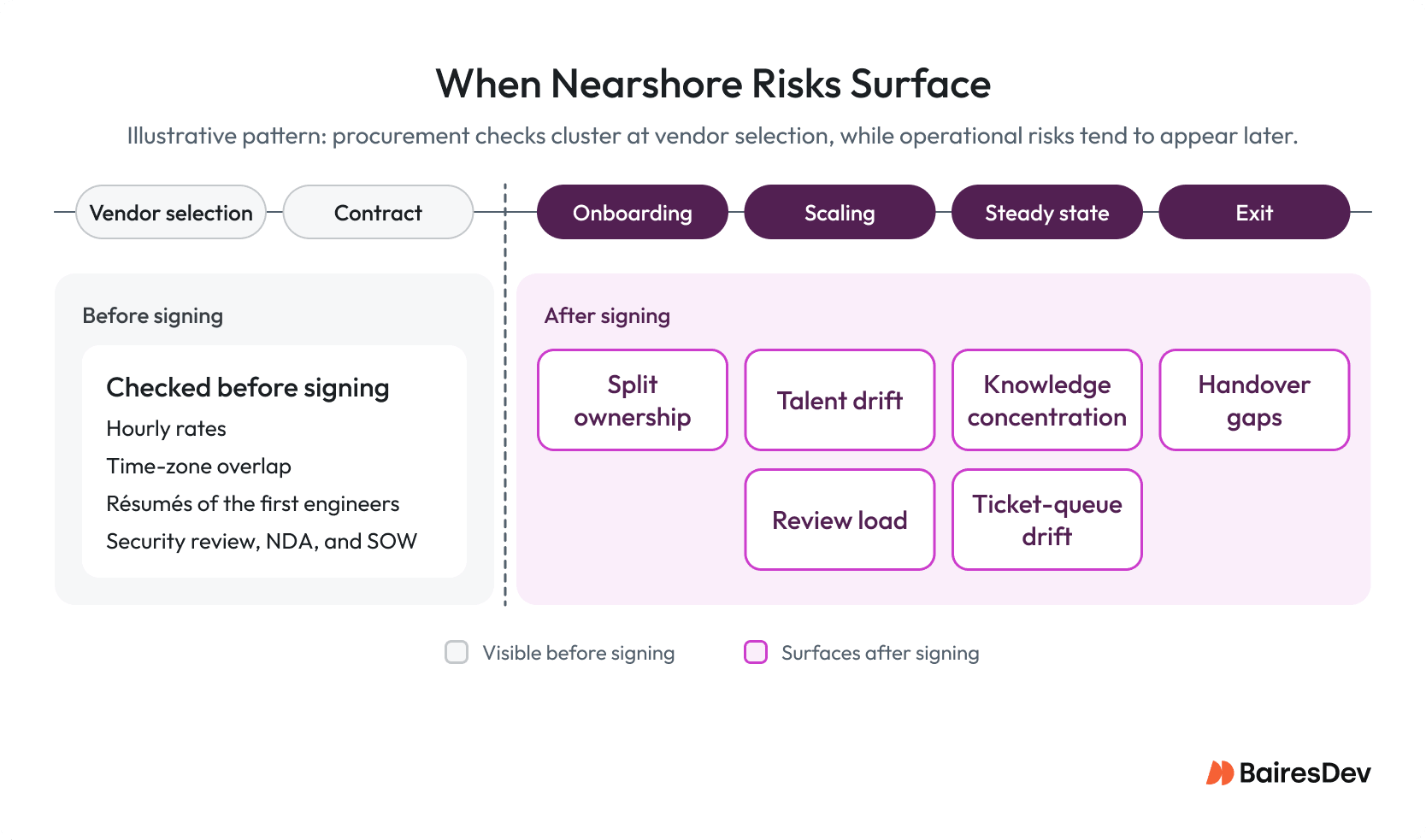
Procurement evaluates what potential outsourcing partners can demonstrate about their nearshore services before committing to a contract: price, resumes, time zone overlap, and security certifications. Operational risks depend on how the agreement is executed day to day.
Time zone differences, language barriers, and surface-level cultural differences belong to this first group, since you can check all of them before signing. Nearshore teams typically work zero to four hours from their clients’ time zones.
For US tech companies working with vendors in nearby countries like those in Latin America, overlapping time zones are easy to plan: Mexico ended daylight saving time in 2022 outside some northern border areas, so Mexico City remains on Central Standard Time year-round, matching Chicago in winter and running one hour behind it in summer. Bogotá and Buenos Aires, two major Latin America tech hubs, remain within two hours of New York time at all times.
Travel belongs to the same visible group. Carmel and Abbott’s CACM study of nearshoring contrasts nearshore locations with offshore destinations “many hours to travel” away, and shorter trips cut the cost of on-site visits compared with offshore outsourcing models.
This table lists each pre-signing evaluation area and the type of risk it cannot identify.
| Risk type | Evaluated prior to signing | Identified post-scale up | Red flag indicators | Impact on delivery process | Ways to mitigate the issue |
|---|---|---|---|---|---|
| Talent | initial engineering resume screening/interview process | subsequent additions to the team below the bar of the initial team | rising number of review rejections for new engineers | senior internal engineers pulled into rework | define and assign names to specific engineers; client-led interview for each subsequent hire/addition/replacement. |
| Ownership | statement of work (SoW); scope of work | architecture and debt decisions nobody owns | incidents in vendor-built services escalate to internal on-call support engineers | system can split at the contract boundary | assign ownership of each service; production support included. |
| Leadership capacity | vendor account management & meeting cadence | internal leads spend their week reviewing/unclogging | longer wait times between change review than it took to write/develop | increased coordination load = slowed down internal delivery process | defined team interaction modes; self-service platform; track hours spent by reviewers. |
| Knowledge | vendor NDA & onboarding plan | vendor engineers’ domain context held by one or two people | only one person can deploy or review a service; lost context when one person departs | roadmap item delayed due to loss of single engineer; | define architectural decision records (ADRs); rotate review pairs; establish an internal co-owner for each service. |
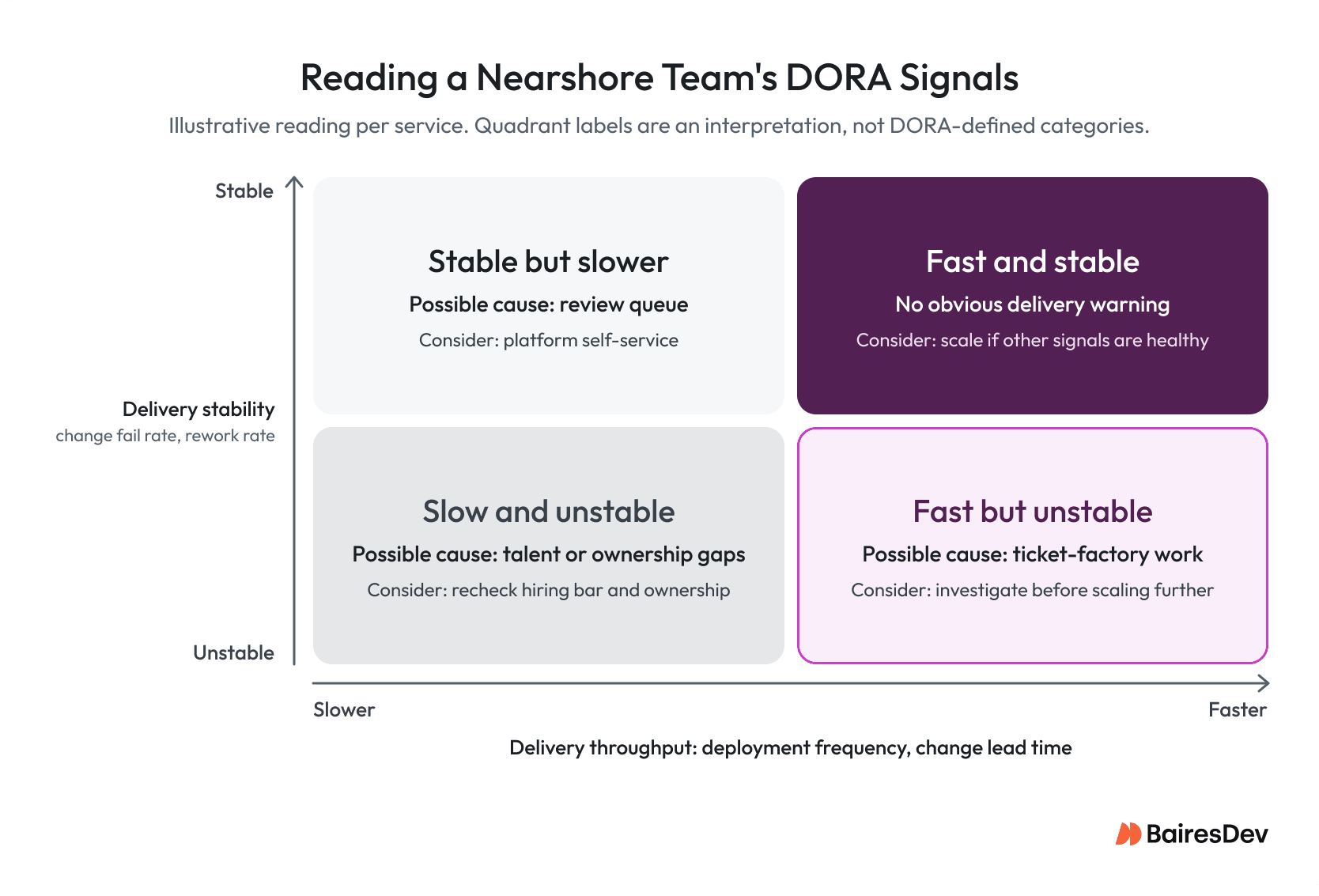
| Integration | tooling; agile ceremonies | layer closing tickets without product context | deployment frequency + rework rate increase together | debt can accumulate behind velocity looking good | use the same pipeline and quality control gates; include seats in incident reviews; DORA metrics per service. |
Talent Consistency: The Tenth Engineer Versus the First
Procurement can partially evaluate talent before signing a contract. You assessed the engineers listed in the proposal.
Unless the contract states otherwise, an engineer added in month six can join without going through the same evaluation process. Do you believe your own hiring committee would approve this same engineer?
Nearshore outsourcing providers can draw on a diverse talent pool across many nearshore locations in Latin America, such as Mexico and Colombia for US companies. They compete for skilled professionals in a global market, and they must maintain one bar across all locations.
Turnover creates costs. Gallup estimates that replacing an employee costs one-half to two times that person’s annual salary. Although the vendor may pay the recruitment portion of those costs if applicable, ramp-up time and lost context can still negatively impact your team.
Define controls in the contract: include the names of the engineers in the SoW and provide that all additions and replacements must complete a technical interview in which your internal engineers assess technical expertise against your internal hiring criteria.
Once this step is completed, you should then compare review rejection rates by cohort and reassess vetting processes for any cohorts that require noticeably more review rounds than the original team.
Technical Ownership Across the Contract Boundary
After you find the appropriate engineers for your teams, how those teams connect will ultimately influence the architecture that you create. Martin Fowler’s entry titled Conway’s Law has an example of an architect creating six subsystems (i.e. areas of the system to be developed) for a six-team, multi-city project without first understanding what each subsystem was intended to accomplish.
As the architect explained, components created across different time zones needed narrow, well-defined interactions because their development teams had little opportunity to collaborate.
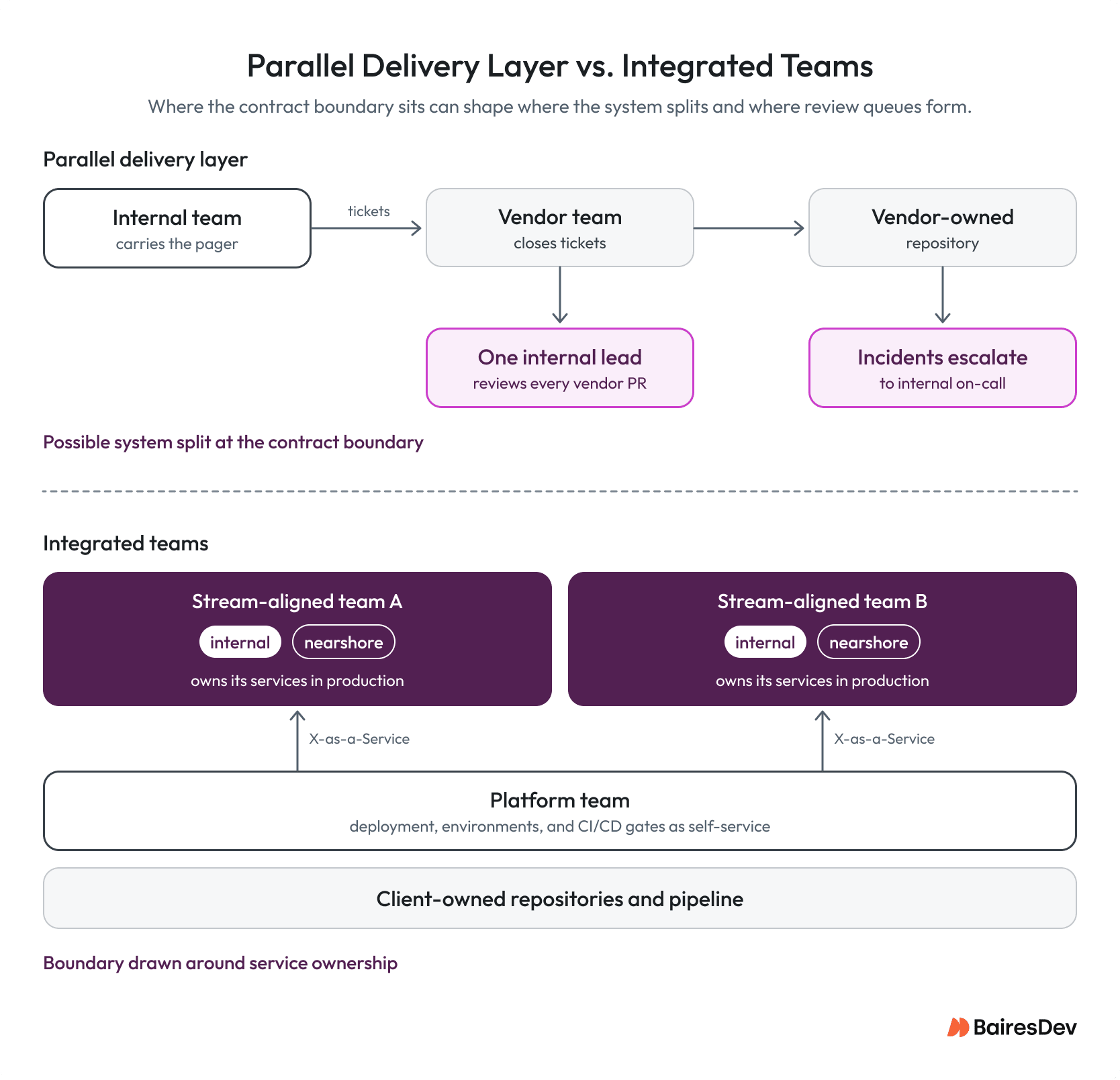
Nearshore arrangements that manage the vendor team as a separate unit can produce the same result, with the architecture splitting along the contract boundary. In one version of this split, the vendor is paid to close tickets while your team handles the production incidents that disrupt business operations.
However, the long-term health of the code between the teams may have no clear owner. Therefore, assign ownership per service, production included. Each service can include both internal and nearshore personnel as long as the people responsible for writing the code for each service are also on call for that service.
For each service the vendor runs end to end, as in a managed services agreement, put the service’s SLOs into the contract.
Bring vendor engineers into your own code review process, with the same static analysis gates your internal teams pass.
Management Overhead: When Leadership Time Erodes Cost Savings
When vendor engineers participate in shared reviews and shared on-call rotations with your staff, you are placing more of the vendor’s work in front of your most experienced engineers. Herbsleb & Mockus linked distributed delay to the number of team members involved with each individual task.
An internal architect reviewing a vendor design, or responding to a domain question, is one more person on that work item. These hours come out of your own engineering budget, so an engagement that may deliver substantial cost savings on paper returns less in practice.
How many hours of your architects’ week does the vendor already consume? Measure it with two metrics: the hours your senior engineers spend each week reviewing and unblocking vendor work, and the share of lead time each change spends waiting for review. Monitor both metrics as the vendor team grows: if review-wait time continues to increase, your internal review resources may be becoming a bottleneck to delivery.
Left unchecked, that review load can cancel out nearshore outsourcing benefits such as time zone alignment, fewer cultural barriers, and the cost savings that were projected at signing. It also pulls senior engineers away from business strategy and roadmap work.
You can cap this cost using the interaction modes described in Team Topologies. Collaboration mode relies on real-time collaboration between teams for a set period of discovery. Afterward, X-as-a-Service provides a stable interface between teams.
AI Adoption and the Review Queue
Adding AI coding tools adds another variable to your review queues.
Faros AI’s 2026 engineering report draws on telemetry collected from 22,000 developers and 4,000 teams. According to Faros AI’s data, between an organization’s lowest and highest AI coding tool adoption levels, median review times increased about fivefold. Incidents per pull request increased more than threefold. While the data establishes correlation, it does not establish causation.
If your internal engineers review and approve vendor pull requests, some of the extra review load falls on them. Ask nearshore providers which AI coding tools their engineers use and who reviews the AI output before it reaches your review queue.
Knowledge Risk: When a Key Vendor Engineer Leaves
Review loads will show up in your weekly metrics; however, knowledge concentration can stay hidden until a key engineer quits.
Avelino and colleagues estimated the “truck factor” (the number of developers whose departure would stall the project) of 133 popular GitHub projects. For 65% of those projects, the truck factor was two or fewer.
While this study analyzed publicly available open-source projects and did not analyze vendors or nearshore partners, it shows how concentrated project knowledge can become. In a vendor engagement, the vendor may control staffing and rotations unless the contract gives you approval rights.
Using Architecture Decision Records (ADRs) helps lower that risk. In his 2011 write-up introducing ADRs, Michael Nygard reported that six to ten developers had already cycled through projects that used ADRs. With ADRs, you document one architectural decision at a time, including each decision’s context and consequences (e.g., why you chose event sourcing for orders).
Your documentation also sets how quickly external engineers ship their first code. Have an internal co-owner assigned to each service. Rotate review pairs across the contract boundaries. Include hand-over notes as part of the definition of done for each sprint.
Integration: Keeping Nearshore Engineers Out of the Ticket Queue
Knowledge also has to flow from your product organization to the outsourced team. Tickets tell engineers what they need to build, while incident reviews and customer feedback explain why the work matters to business priorities and the business processes it supports. If you put your nearshore engineers on-call for their services (and invite them to postmortem meetings) you can support real-time communication and knowledge sharing between your teams.
Regular check-ins with nearshore teams help avoid misunderstandings and delays. Cultural sensitivity training on both sides can address cultural differences, improve communication with nearshore teams, and is worth the investment. McKinsey’s 2023 analysis of 1,265 companies found that those in the top quartile for ethnic diversity on executive teams were 39% more likely to outperform on profitability, an association between cultural alignment and business performance.
Then, measure DORA one service at a time, just like DORA’s own guidance recommends. Review this information, along with project outcomes, with the team that owns each service. In 2024, DORA introduced deployment rework rate as its fifth metric: the percentage of deployments that are unplanned work resulting from production incidents. Read against deployment frequency, it shows whether rework rises as deployments increase.
If so, determine whether the new work adds technical debt for your company. DORA’s delivery metrics do not directly measure structural code health. So use them alongside structural metrics like cognitive complexity per module.
How Nearshore Challenges Change as the Engagement Scales
Which of these signals matters most depends on the outsourcing models in use and the size of the engagement. The three nearshore models below are illustrative examples.
Filling Individual Skill Gaps
A platform team lacks the specialized skills for a cluster migration and adds two senior Kubernetes engineers through staff augmentation, drawing on the vendor’s local talent pool. It is much simpler to ensure consistent talent at this level, since you interviewed both engineers directly.
While access still needs to be planned, delays can occur while waiting on repository permissions or reading old Slack messages to learn the deployment process. Lead time can include a week-long delay.
Give them the same accounts and runbooks as if they had been internally hired from day one.
Adding an Entire Engineering Squad
A product group adds a six-person dedicated team with fintech industry expertise to develop a billing service. The team can deliver quickly while their design choices get settled within the vendor’s own chat channels outside of the view of the internal architects.
Identify an internal principal engineer as the architecture owner and require architecture decision records (ADRs) for data model and framework decisions. The team’s code resides in your repositories from the very first commit.
Scaling a Long-Term Nearshore Delivery Organization
A modernization program runs five nearshore squads for three years under a software development outsourcing agreement. Talent drift and leadership burden can grow into being the largest risks at this scale.
Each replacement requires the same client-run technical interview as the first hire. With 40 engineers, routing every pull request (PR) through a handful of internal architects causes a bottleneck for review. Create a platform team that provides deployment and testing environments as a self-service offering, and use architect reviews only for design changes.
A Step-by-Step Framework for Nearshore Risk
Whatever your outsourcing strategy or the outsourcing models you select, the controls fall into two categories across all three engagement sizes: contract terms you agree to before signing, and processes that run for the life of the engagement. The seven steps below follow that order.
- Interview named engineers: conduct a technical interview with each engineer identified in the proposal without having the account managers present, and write the substitution rule in your contract.
- Ownership contract: work with legal counsel to define IP ownership terms and when transfer occurs. Differing legal and regulatory environments can complicate nearshore agreements and add hidden costs, such as legal fees. Ensure your organization maintains control over repositories and production accounts from the date of the first commit.
- AI use in contract: require disclosure of the AI tools vendor engineers use. The U.S. Copyright Office concluded in January 2025 that AI-generated output can receive copyright protection, but only where a human author has determined sufficient expressive elements. Ask counsel how that affects your IP clauses.
- Exit plan before start: include requirements for notice period(s), paid knowledge-transfer window, revocation of vendor access, and return of your documentation and assets by the final date.
- Integration into your pipeline: apply your internal processes, including continuous integration/continuous deployment (CI/CD) gates and review standards, to your vendor engineers, and assign ownership per service in week one.
- Record decisions: maintain architecture decision records (ADRs) for architecturally significant choices, and maintain a knowledge map identifying who can deploy/review each service.
- Governance by data: review these measures at every quarterly business review: DORA metrics per service, reviewer hours, wait time for reviews, vendor retention. If rework increases with deployment frequency, investigate the cause before expanding further. Fund rework where incident data and code-health metrics support it.
Key Takeaways
- Make named engineers a contract term: interview every addition and replacement yourself, against your internal selection criteria.
- Ownership assigned per service: regardless of who employs them, make those who built a service accountable for running it.
- Measure leadership load directly: Measure reviewer hours/wait times, and count AI-generated volume as review load.
- Document as you go: both ADRs and internal co-owners help keep one departure from derailing a roadmap item.
- DORA measurements per service: if rework increases with deployment frequency, check new work for technical debt