By Paul Azorin
Paul Azorin is Co-Founder of BairesDev and Managing Partner for Europe, where he leads the company's European expansion and operations. Paul also serves as Managing Partner at BDev Ventures.



Nearshore software development in Mexico means a US company builds or extends its engineering team with developers based in Mexico who work the same business day as the US team. Companies choose it over offshore for working-hours overlap: Mexico City matches US Central time from November to March and runs one hour behind it the rest of the year.
Key Points
- Mexico had about 3.1 million GitHub developer accounts in Q2 2026, up 40% in a year and second in Latin America only to Brazil.
- Mexico ranks 103rd of 123 countries for English overall, but its IT professionals score in EF’s high band, and Monterrey outscores Mexico City by more than 100 points.
- USMCA’s digital trade chapter still protects cross-border data flows, though the agreement moved to annual reviews after the US declined to extend it in July 2026.
- The early problems we see most often come from three decisions: hiring through a body shop, no on-site anchor in the first month, and a city picked without checking its talent mix.
Why Do US Companies Choose Nearshore Software Development in Mexico?
Mexico offers a hiring company four things that offshore locations rarely combine: shared working hours, short travel, a fast-growing developer base, and a trade framework built for cross-border digital work.
Shared Working Hours
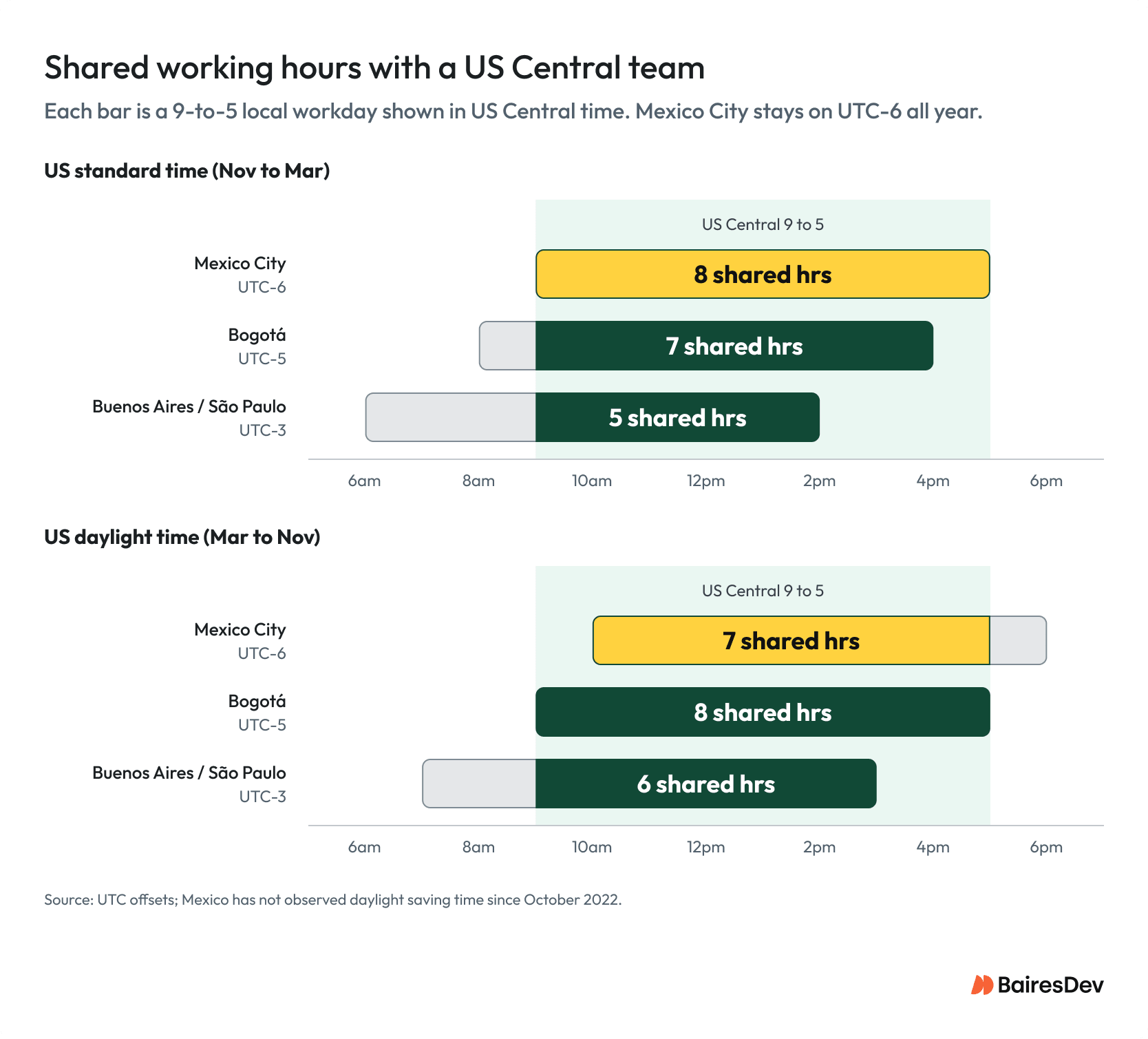
Mexico abolished daylight saving time in most of the country in October 2022, so Mexico City stays on UTC-6 all year. Most of the country runs on Central time, while Baja California and parts of the northwest use Pacific and Mountain time. For a team in Chicago or Dallas, that means a full shared workday from November to March and seven shared hours the rest of the year. Standups, code reviews, and blocker calls happen the same day, which keeps the development process moving and is the real-time collaboration offshore teams in Asia or Eastern Europe cannot match for US teams.
Geographic Proximity
Mexico City, Guadalajara, and Monterrey are a short direct flight from most major US hubs. A US lead can fly down for a planning week, and a Mexico-based lead can sit in your office for a quarter kickoff without losing two days to travel. Many Mexican engineers already work in Agile teams for US companies, so sprint rituals and US business norms rarely need explaining.
A Growing Tech Talent Pool
GitHub counted about 3.12 million developer accounts in Mexico in Q2 2026, up from 2.24 million a year earlier. Accounts are not the same as working engineers, but the trend points to growing talent availability. The National Autonomous University of Mexico (UNAM), the National Polytechnic Institute (IPN), and Tecnológico de Monterrey anchor the country’s technical education system and supply a large share of Mexican software developers and other Mexican tech professionals.
English, With a Caveat
Mexico ranks 103rd of 123 countries on the EF English Proficiency Index 2025, in the “very low” band. The same index scores Mexican IT professionals at 559, which is in the “high” band. National averages say little about the engineers you will interview, so test English per candidate rather than per country.
A Trade Framework for Digital Work
USMCA’s Chapter 19 protects cross-border data transfers, bars data localization requirements, and stops governments from demanding a company’s source code as a condition of doing business between the US, Mexico, and Canada.
Mexico vs. Colombia, Argentina, and Brazil for Nearshore Development
Against other Latin American countries, Mexico matches Colombia on overlap with US Central time, leads on Pacific time, and has the largest developer base after Brazil. Argentina leads on English, and Brazil has the largest pool overall.
| Country | Overlap with a 9-to-5 US Central day | English (EF EPI 2025) | GitHub developer accounts (Q2 2026) | Main tech hubs | Trade and data notes |
| Mexico | 8 hrs Nov to Mar, 7 hrs Mar to Nov | #103 of 123 (440, very low) | ~3.1 million | Mexico City, Guadalajara, Monterrey | USMCA; new private-sector data protection law in force since March 2025 |
| Colombia | 7 hrs Nov to Mar, 8 hrs Mar to Nov | #76 of 123 (480, low) | ~1.8 million | Bogotá, Medellín | US-Colombia Trade Promotion Agreement in force since 2012 |
| Argentina | 5 hrs Nov to Mar, 6 hrs Mar to Nov | #26 of 123 (575, high) | ~1.8 million | Buenos Aires, Córdoba | No US free trade agreement |
| Brazil | 5 hrs Nov to Mar, 6 hrs Mar to Nov | #75 of 123 (482, low) | ~9.1 million | São Paulo, Rio de Janeiro | No US free trade agreement |
Sources: EF English Proficiency Index 2025 for English rankings and scores; GitHub Innovation Graph for Q2 2026 developer accounts. Overlap hours are calculated from standard time-zone offsets.
If your team sits on US Central time, Mexico and Colombia are about even: Mexico has one more hour in winter, Colombia one more in summer. On Pacific time, Mexico gives you the most shared hours. If your engineering org is on Eastern time, Colombia gives you more overlap than Mexico, and Argentina is worth the extra hour or two when spoken English matters more than headcount. Offshore software development in India or Eastern Europe can cost less per hour, but those markets share a few hours of the US workday at most.
Which Mexican City Fits Your Team: Mexico City, Guadalajara, or Monterrey?
All three cities share a time zone, but they differ on English, ecosystem size, and the kind of companies that trained their engineers. Choose the city before you choose the people.
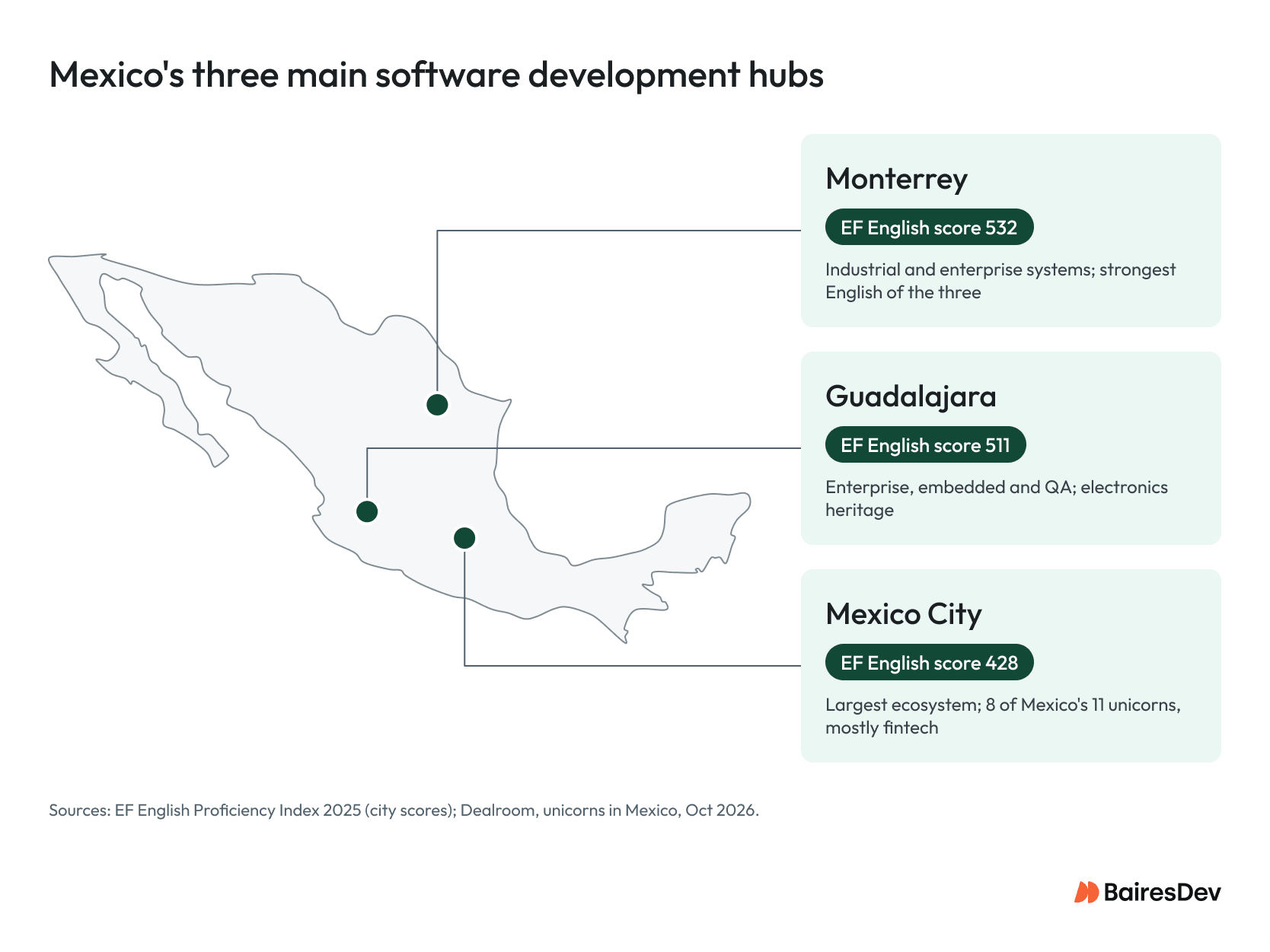
Mexico City is the largest tech ecosystem in the country and the second-ranked startup city in Latin America after São Paulo. Eight of Mexico’s 11 unicorns are headquartered there, most of them fintechs, so it has the deepest pool of skilled talent for fintech and consumer product work. It also has the lowest English score of the three, at 428 on EF’s city ranking, so English screening matters more here.
Guadalajara‘s tech industry grew around electronics manufacturers and their software teams, and its tech community clusters around Ciudad Creativa Digital (Creative Digital City) and the Guadalajara Software Center. Skilled developers here often come from enterprise, embedded, and QA backgrounds. Its EF city score is 511.
Monterrey is home to Tecnológico de Monterrey and a large industrial and manufacturing base. It posts the highest English score of the three, at 532, which makes it a strong fit for client-facing roles and teams that run long design discussions in English.
How to Set Up Nearshore Software Development in Mexico
Setting up a Mexico team comes down to three decisions: the engagement model, the team shape, and the legal basics.
Choose the Nearshore Outsourcing Model
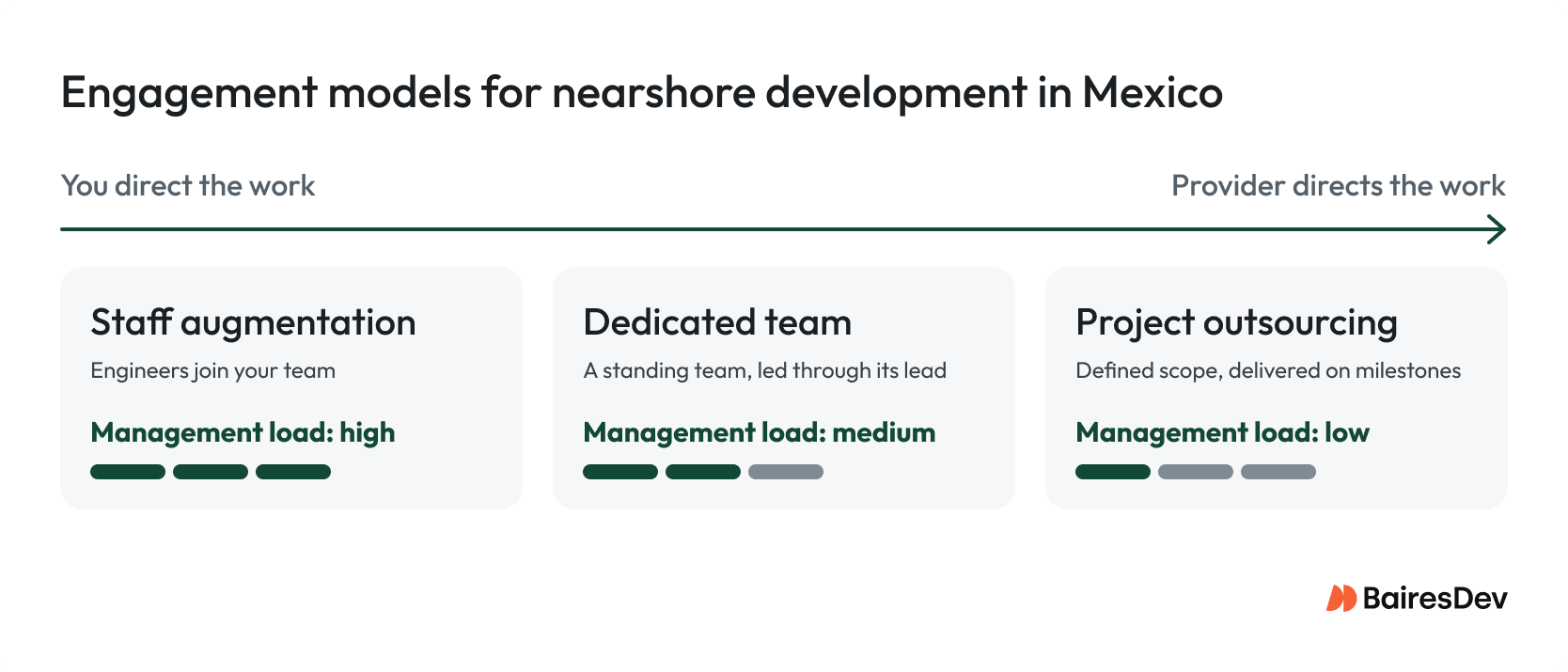
Every nearshore software development outsourcing engagement in Mexico runs on one of three models, from staff augmentation to full project outsourcing, and the right one depends on how much of the management of your software development projects you want to keep.
| Factor | Staff augmentation | Dedicated team | Project outsourcing |
| Who directs the work | Your engineering leads | Your leads, through the team’s lead | The provider’s project manager |
| What you get | Individual engineers in your existing team | A standing team that works only for you | A defined scope, delivered against milestones |
| Your management load | High | Medium | Low |
| Best when | You need extra engineering capacity in a team you already run | You need a long-term software development team without hiring it | The work has a clear end and your team won’t maintain it |
Staff augmentation suits teams that already have strong engineering leadership; our staff augmentation guide walks through how the model works, including a week-one onboarding playbook. A dedicated development team fits long-term product work, and project outsourcing fits scoped software projects, with project management handled by the provider. Whichever model you pick, the nearshore partner should be able to walk you through its hiring process, including how it tests English and stack-specific technical expertise.
Start With a Small, Single-City Pod
A first Mexico pod usually works best at three to five people in one city, with a senior lead who owns technical decisions and mid-level engineers who carry most of the tickets.
| Role | Seniority | Headcount | Notes |
| Tech lead | Senior | 1 | Owns design reviews and is the main contact for your architects |
| Software developers | Mid-level | 2 to 3 | Carry sprint work; pair with your existing team on the first tickets |
| QA engineer | Mid-level | 0 to 1 | Add once the pod ships to production |
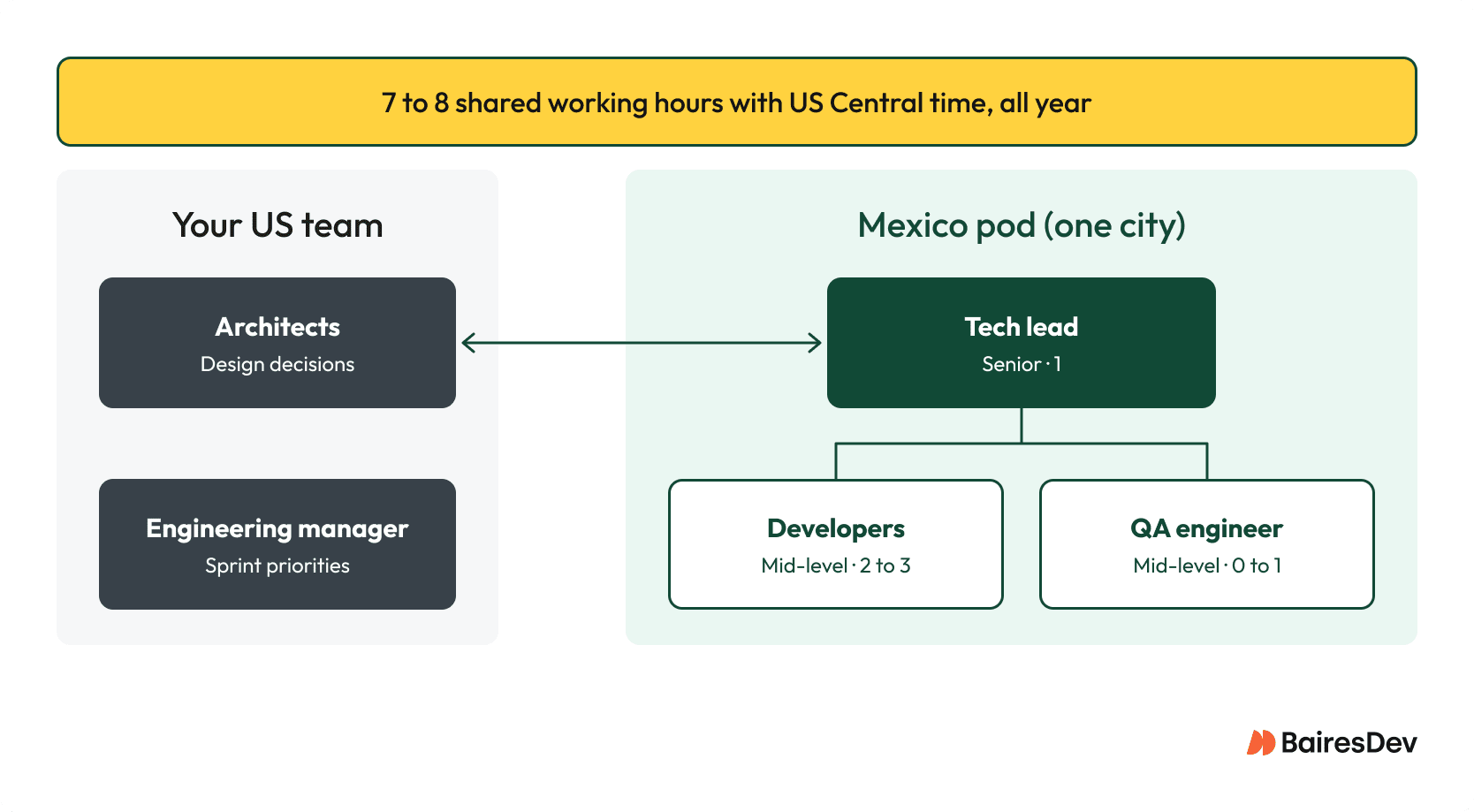
Plan for at least seven hours of overlap with your in-house team, which Mexico gives you all year against US Central time. Keeping the pod in one city makes in-person visits cheap and keeps the team’s working norms consistent.
Cover the Legal and Data Basics
Review the legal structure before you sign. It protects your intellectual property and keeps the team running if the outsourcing relationship changes. Three rules matter for most US companies:
- Data protection. Mexico’s new Federal Law on the Protection of Personal Data Held by Private Parties took effect on March 21, 2025, replacing the 2010 law. If the team will handle personal data of people in Mexico, your contracts and privacy notices need to reflect it.
- Outsourcing rules. Mexico’s 2021 labor reform banned personnel subcontracting and requires providers of specialized services to register in the government’s REPSE registry. If you contract through a Mexican entity, ask for the provider’s REPSE registration.
- Intellectual property. Make sure the contract assigns all code and work product to your company and that the provider’s employment agreements with engineers support that assignment.
Common Problems With Nearshore Software Development in Mexico, and How to Fix Them
These three problems usually surface in the first months, and a hiring company can prevent all of them.
Hiring Through a Body Shop
Some companies win the deal with senior profiles and then fill seats with whichever nearshore developers are on the bench. Your leads find out when code reviews start taking noticeably longer.
The fix: interview the engineers who will join your team, not a sales shortlist. Ask who employs them, what the average engineer tenure on client teams is, and what happens if someone leaves mid-project.
No On-Site Anchor in the First Month
Remote onboarding works for individual engineers. It works less well for a whole new team, which needs to learn how your company makes decisions. Without a shared week in the same room, the pod tends to wait for instructions instead of pushing back. A week together builds the cultural alignment that video calls take months to reach.
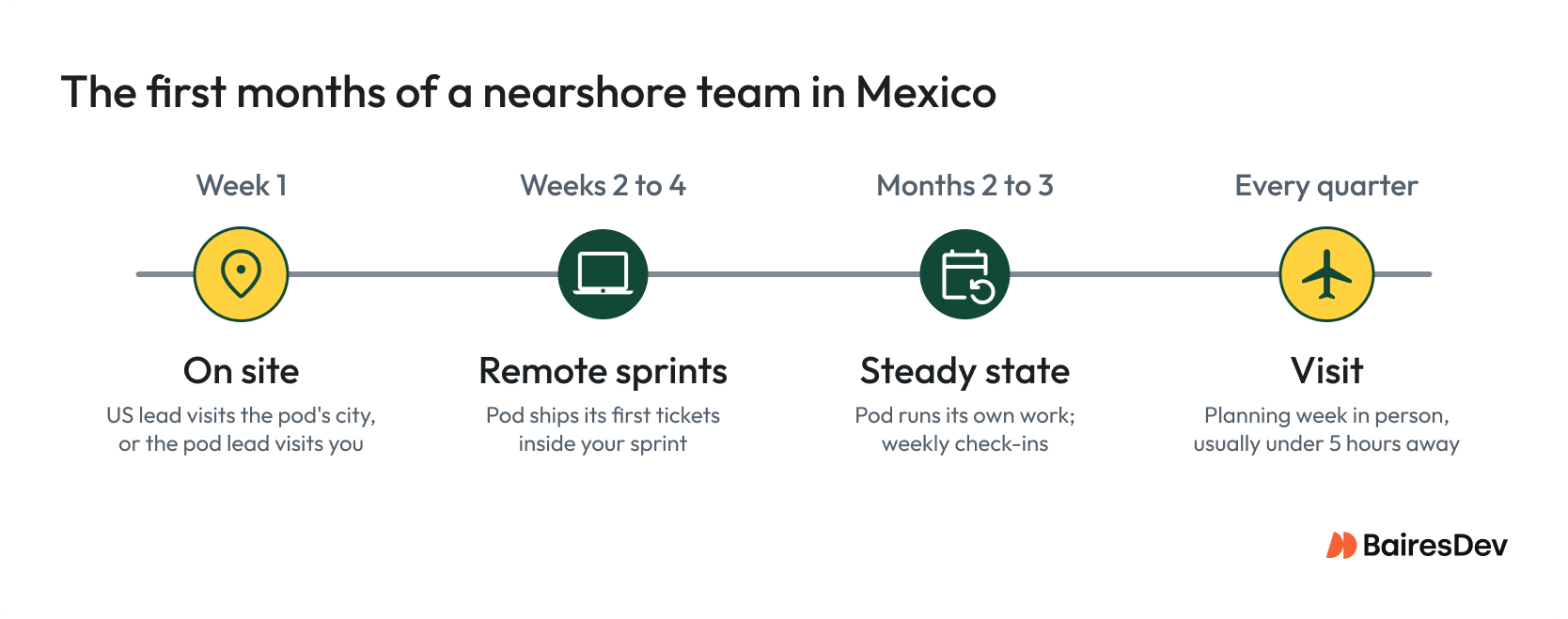
The fix: send a senior engineer or engineering manager to the pod’s city for the first week or two, or bring the pod’s tech lead to your office. After that, plan a visit each quarter. The short flight is one of the main reasons to choose Mexico, so use it.
Treating Monterrey and Guadalajara as Interchangeable
Teams often pick a city because a partner has an office there. The cities differ in English scores, industry background, and seniority mix, and a mismatch shows up as slow hiring or a team that is strong in the wrong stack.
The fix: decide what the pod needs first. For client-facing roles and English-heavy design work, Monterrey’s English scores give you the widest pool. For enterprise and embedded work, Guadalajara’s background is a better match. For fintech and consumer product work, Mexico City has the most depth.
Next Steps
Nearshore software development in Mexico works best when you pick the city, the engagement model, and the partner with the same care you would give a senior hire. BairesDev’s nearshore software development services cover all three engagement models.
Key Takeaways
- Mexico’s main advantage is overlap: a full shared day with US Central from November to March and seven hours the rest of the year.
- Pick the city before the partner. Monterrey suits English-heavy roles, Guadalajara enterprise and embedded work, and Mexico City fintech and product work.
- Test English per candidate. Mexico’s national rank is low, but its IT professionals score in EF’s high band.
- Start with a three-to-five-person pod in one city, led by a senior engineer, and grow after two or three sprints.
- Put someone on site in week one, and make sure the contract assigns all code and IP to your company.
Frequently Asked Questions
Is Mexico cheaper than offshore?
Usually not on hourly rate. Offshore markets in South and Southeast Asia generally have lower labor costs and bill less per hour than Mexico. Mexico’s advantage is overlap: same-day code reviews and decisions remove much of the coordination cost that an hourly rate does not show.
Which Mexican cities have the most developers?
Mexico City, Guadalajara, and Monterrey are Mexico’s three largest tech hubs. Mexico City has the largest ecosystem and ranks as Latin America’s second startup city after São Paulo. Mexico does not publish official developer counts by city.
Do Mexican developers work US hours?
Yes. Mexico City is on UTC-6 all year, so it matches US Central time from November to March and runs one hour behind it from March to November. Against US Eastern time, overlap is seven hours in winter and six in summer.
How does USMCA affect nearshoring software work?
USMCA’s digital trade chapter protects cross-border data transfers, bans data localization requirements, and prohibits customs duties on digital products traded between the US, Mexico, and Canada. The agreement remains in force. After the US declined to extend it on July 1, 2026, it moved to annual reviews and runs until July 2036 unless the three countries agree to extend it.
What is a typical team size to start with?
Three to five people: one senior tech lead and two or three mid-level developers, all in the same city. Add a QA engineer once the pod ships its first features, and grow after two or three sprints show the team works.
By Paul Azorin
Paul Azorin is Co-Founder of BairesDev and Managing Partner for Europe, where he leads the company's European expansion and operations. Paul also serves as Managing Partner at BDev Ventures.