A former enterprise technology professor at TEC de Monterrey, Enrique has an 18-year track record of delivering complex ERP and digital transformation projects. He has commanded over 20 such initiatives for both corporate and government organizations.


Executive Summary
Organizations might use IT infrastructure outsourcing as part of regular hiring planning, but it is more common when urgent risks arise. When a critical failure occurs, outsourcing becomes a way to manage risk by determining who handles incident response, documentation and uptime responsibilities.
Key points
- With IT infrastructure outsourcing, an external partner takes over the operation of your core systems. This covers cloud environments, networks, servers, security, monitoring, disaster recovery and end-user support.
- Staff augmentation keeps delivery ownership with your team while dedicated teams transfer it to the provider; that distinction matters more than the price difference.
- Per-device pricing charges you the same flat fee whether an endpoint is well-maintained or a maintenance burden so your actual costs rarely match the quote.
- 70% of executives have brought outsourced work back in-house over five years so your sourcing model should be reviewed as your platform team matures.
What Is IT Infrastructure Outsourcing?
IT infrastructure outsourcing means hiring an external provider to manage some or all of your core technology operations, including cloud and on-premises environments, networks, servers, security, monitoring, disaster recovery and end-user support. Companies often consider outsourcing when their needs outpace internal resources, require round-the-clock coverage or cannot find the right specialized skills in-house.
That is the short answer, but the meaning of ‘infrastructure’ has shifted considerably over time. Twenty years ago, outsourcing meant handing over your data center to a provider. Now, it usually means letting a provider manage cloud platforms, Kubernetes clusters, CI/CD pipelines, observability systems and identity management. These are all important for product teams, but they are not usually their main focus.
Market trends show the change. Mordor Intelligence estimates the global IT outsourcing market will be worth about $638 billion in 2026 and could reach $752 billion by 2031. Outsourcing scope has changed as well. Deloitte’s Global Outsourcing Survey, reported by Auxis, found that cybersecurity, once rarely outsourced, is now as commonly outsourced as infrastructure services. A growing number of organizations are trusting outside partners with complex and critical tasks.
“Nearly every infrastructure outsourcing conversation I’ve participated in centers on the same question: ‘Who do I trust to handle critical incidents?’ Trust is valued more than the (cheap) price.”
What Does IT Infrastructure Outsourcing Actually Cover?
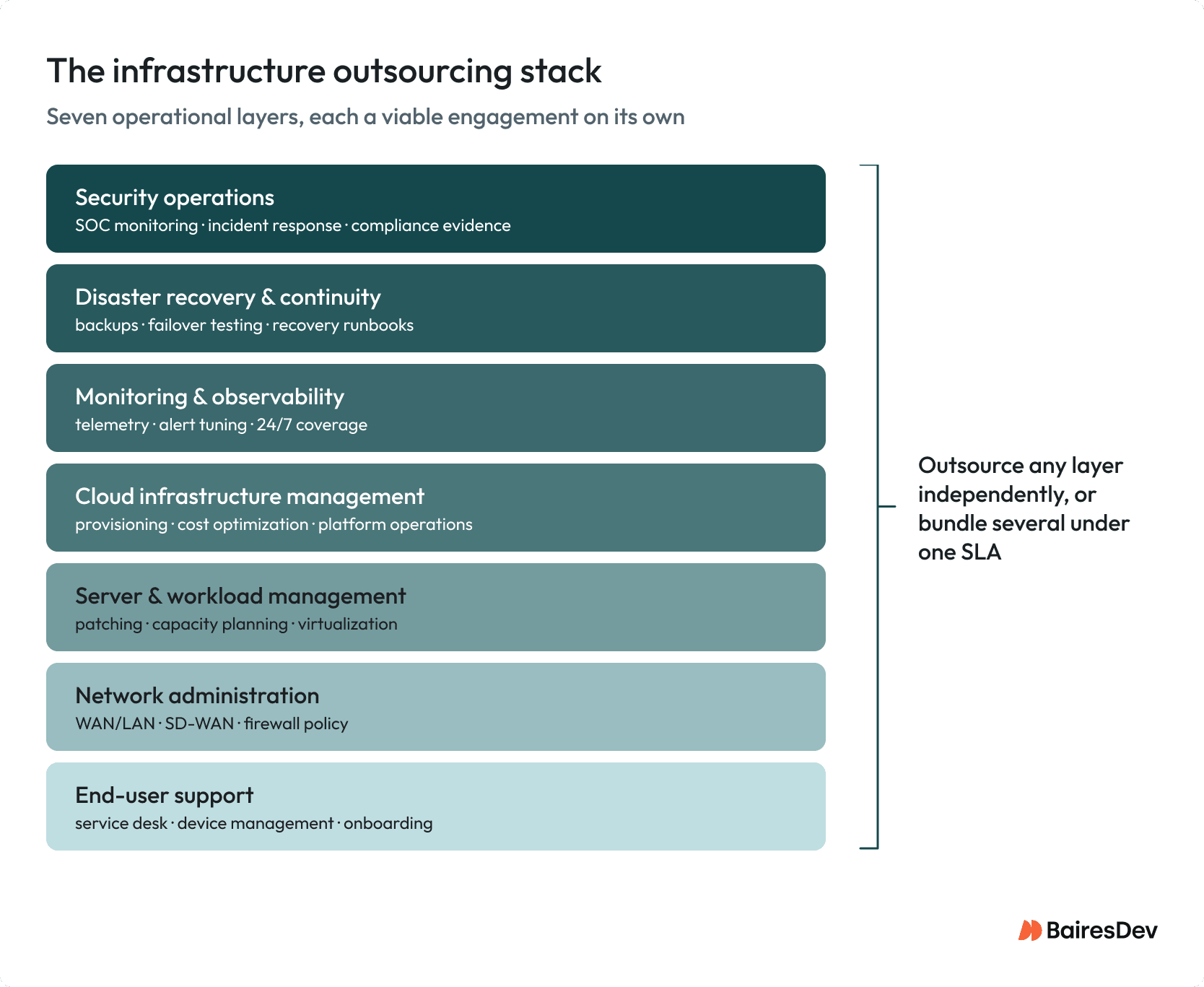
Infrastructure outsourcing spans several operational layers, and you can outsource each one separately or all at once.
Cloud infrastructure management is for many mid-size companies the biggest and fastest-growing part of outsourcing. This includes managing cloud platforms, scaling policies and platform operations across AWS, Azure, GCP or hybrid environments.
Network administration includes WAN and LAN management, VPNs, SD-WAN rollouts, firewall policy, and connectivity for distributed offices and remote workforces.
Security operations spans SOC monitoring, vulnerability management, incident response and compliance evidence gathering. This is the function organizations now outsource more than almost anything else, largely because staffing a 24/7 SOC internally is rarely practical outside the largest enterprises.
Server and workload management includes patching, capacity planning, virtualization and lifecycle management for systems that have not yet migrated to the cloud. In organizations with 200 to 5,000 employees, some workloads typically remain on-premises.
Monitoring and observability involve managing the telemetry stack, configuring alerts, and providing continuous oversight. Internal teams often struggle to sustain this coverage across time zones.
Disaster recovery and business continuity include backup operations, failover testing and keeping recovery documentation current. They matter most during incidents yet typically receive the least investment when nothing is failing.
End-user support rounds out the scope. It covers service desk operations, device management, onboarding, offboarding and handling daily tickets. This frees senior engineers for higher-value work.
Mismanaging these layers can be very costly. Uptime Institute’s 2026 outage analysis found that 57% of operators said their last major outage cost more than $100,000, and 20% incurred costs exceeding $1 million. Both internal teams and external partners must manage this risk.
Which Engagement Model Fits Your Organization?
There are three main ways to structure infrastructure outsourcing. Your choice depends on where you want to place operational responsibility within your organization.
A dedicated team is a stable, provider-managed group that works exclusively on your infrastructure for an extended period. The provider manages staffing, continuity and delivery, while you retain control over direction and priorities. This model functions as an extension of your organization, with operational responsibility transferred to the provider.
Staff augmentation means bringing in specialists like cloud engineers, network architects, or SREs to join your team, but you still manage them. You retain full control over delivery, while the provider handles staffing. This model is fast to start, easy to end, and gives you flexibility without a long-term commitment.
Project-based outsourcing is when you hire a provider for a specific goal, such as a cloud migration, an SD-WAN rollout, or a disaster recovery upgrade. The provider handles everything within a defined scope and timeline, then hands control back to you once the project is complete.
| Dimension | Dedicated team | Staff augmentation | Project-based |
| Ownership | Shared: you own direction, provider owns delivery | You own delivery entirely | Provider owns delivery end to end |
| Scalability | High: provider scales team with demand | Moderate: scales person by person | Fixed to project scope |
| Pricing model | Monthly rate per team or per member | Hourly or monthly rate per specialist | Fixed price or milestone-based |
| Operational responsibility | Provider runs day-to-day operations | Stays with your internal team | Provider, for project duration only |
| Flexibility | High within engagement; longer commitment | Very high; short commitments | Low; changes require re-scoping |
| Ideal use cases | Ongoing 24/7 operations, managed platform teams | Filling skill gaps, surge capacity | Migrations, rollouts and one-time modernization |
Many providers offer a dedicated-team model as part of a managed services agreement that includes SLAs, on-call rotations, and clear service catalogs. If you need guaranteed uptime, make sure these details are included in your contract.
I have seen companies select staff augmentation for its perceived low commitment, only to transition to a dedicated team model with the same contractors within a year. The appropriate model is the one that aligns accountability with your organizational needs, not simply the most convenient to initiate.
How Is IT Infrastructure Outsourcing Priced?
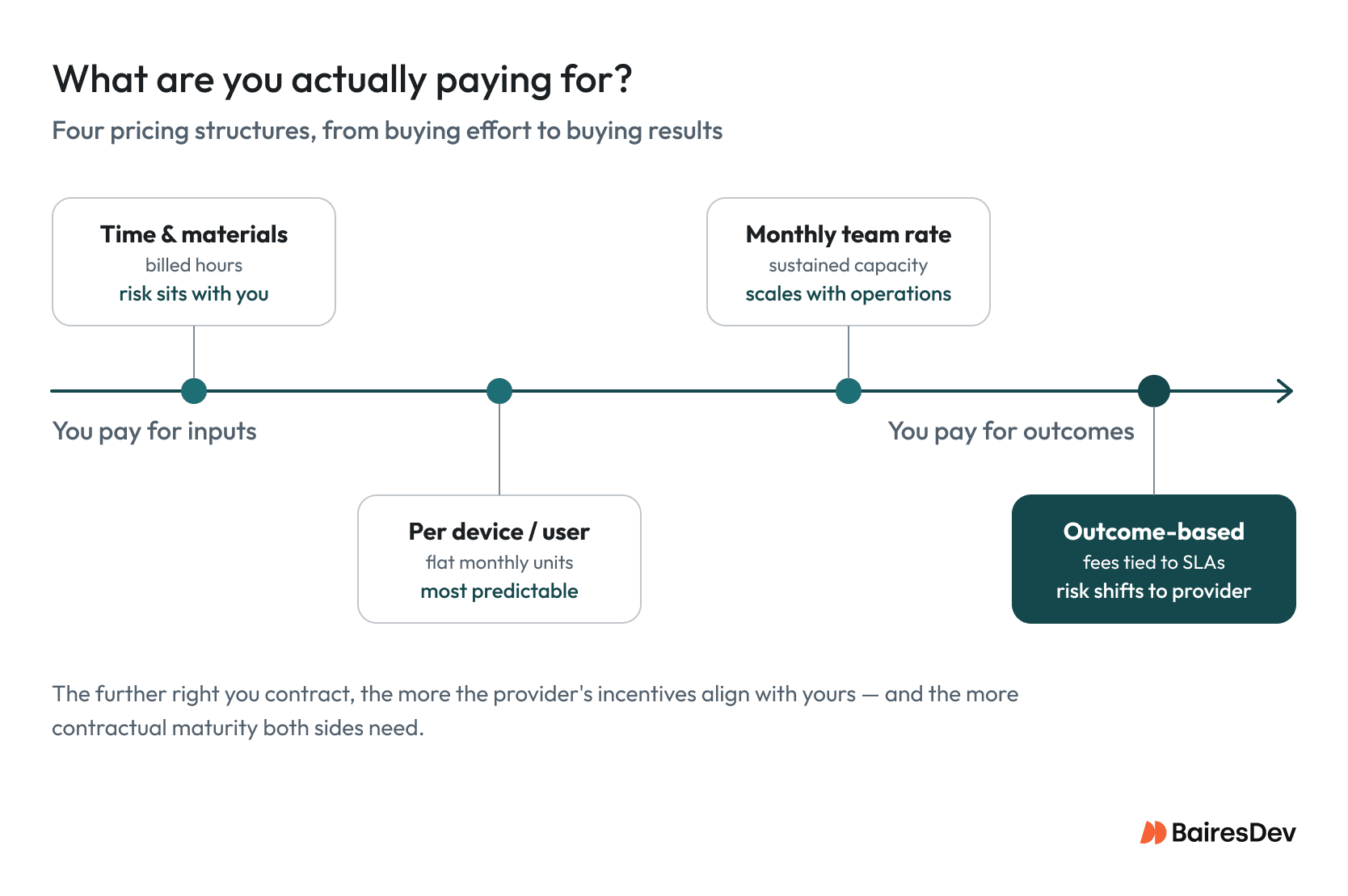
How you pay for infrastructure outsourcing depends on the engagement model. Knowing the four main pricing structures helps you compare provider proposals more effectively.
Per-device or per-user pricing is a traditional model where you pay a flat monthly fee for each server, endpoint, or employee. This method is predictable and easy to budget for, which CFOs like, but it does not always reflect the real work involved. For instance, a hundred well-behaved endpoints and a hundred troublesome aging ones typically cost you the same per-unit fee despite very different effort.
Time-and-materials pricing means you pay for the actual hours worked. It is common for staff augmentation or flexible projects. This model gives you the most flexibility, but costs are harder to predict, so you take on more risk.
Monthly team rates let you pay for a dedicated team as one unit. This structure scales best for ongoing operations because it provides steady capacity without requiring you to track every ticket or hour.
Outcome-based pricing ties fees to SLAs and measurable results, like uptime, response times and resolution targets. This model aligns incentives well, but both sides need to be disciplined and must agree on what counts as a successful outcome before the contract is signed.
Besides pricing structure, there are three main cost drivers to consider. First, coverage hours: 24/7 support costs much more than business-hours coverage, and providers handle nights and weekends differently. Second, scope boundaries: the lowest price often means a narrow definition of what counts as an “incident.” Third, transition costs: early expenses for knowledge transfer, documentation, tool access and running systems in parallel can make initial invoices higher than ongoing costs.
When comparing proposals, make sure you know the full cost of your current in-house operations, including salaries, on-call pay, tools, training and hiring. Outsourcing quotes only make sense when you compare them against a complete internal baseline, which many organizations lack.
How Do Organizations Use Infrastructure Outsourcing in Practice?
Mid-size companies often follow three common patterns when outsourcing infrastructure.
The first pattern is called follow-the-sun operations. For example, a 700-person SaaS company with engineering teams in just a few time zones might outsource overnight monitoring, incident triage, and first-line response. This setup takes the pressure off internal engineers by removing tough on-call shifts, while the provider escalates only issues that require product expertise. Many companies start outsourcing this way because it solves a big operational problem without giving up control over their architecture.
The second pattern is compliance-driven security. When a company enters a regulated market such as healthcare, fintech, or the public sector, it often needs SOC monitoring, vulnerability management, audit evidence and incident response processes that would take a long time to build in-house. A provider can set these up in just a few weeks. In this case, working with an external partner is mainly about getting to market faster.
The third pattern concerns migration projects that require ongoing support. A company might hire a provider for a cloud migration, only to realize the new setup requires continuous platform management they cannot handle internally. The work then shifts to a dedicated team or managed services. Engineering leaders who plan for this transition during contract talks usually get better terms than those who wait until later.
In all three cases, successful companies treat the provider as an operational partner and establish clear interfaces, such as runbooks, escalation paths and shared dashboards. Without this clarity, the relationship can become confusing and unproductive, no matter what the contract says. Clear interfaces matter more than the engagement model itself.
When Is Outsourcing Infrastructure the Wrong Choice?
These situations happen more often than provider marketing suggests.
If your infrastructure is integral to your product, as with hosting platforms, low-latency trading systems, or edge networks, operating it is a core competency. Outsourcing in these cases can erode essential expertise. Similarly, when infrastructure reflects significant institutional knowledge, such as years of optimization, this expertise cannot be easily transferred to a provider through documentation.
Regulatory and data-sovereignty rules can also clarify the decision. Some compliance requirements make third-party access so complicated that any savings from outsourcing disappear into audit and contract costs. If you already have a strong platform engineering team with good on-call coverage, outsourcing adds little value but still brings coordination costs.
Market data shows the reversal is common. Deloitte’s 2024 Global Outsourcing Survey found that 70% of executives have brought some outsourced work back in-house over the past five years, and 78% of organizations now run global in-house centers. Sourcing decisions change over time, and experienced organizations adjust as needed.
For many companies, a hybrid approach works best. Keep architecture, security policy and product-related work in-house, and outsource coverage, routine tasks and standard operations. This split, with strategy inside and execution outside, is usually the most sustainable. If you are also looking at application development or broader delivery, remember that infrastructure outsourcing differs from software development outsourcing, especially regarding codebase and product roadmap ownership.
The healthiest outsourcing relationships I’ve seen all drew the same line: judgment stays in-house, toil goes out. The unhealthiest ones outsourced the judgment and kept the toil.
Frequently Asked Questions
What is the difference between IT infrastructure outsourcing and managed services?
Managed services is a contractual form of infrastructure outsourcing, not a separate category. A managed-services agreement adds SLAs, defined service catalogs and provider-owned operational responsibility. All managed services are a form of outsourcing; not all outsourcing engagements carry managed-services commitments.
How long does it take to transition infrastructure operations to a provider?
For a mid-size environment, plan on one to three months. That window covers knowledge transfer, tooling access, runbook validation and a parallel-running period before the provider takes primary responsibility. If your estate has heavy legacy components or strict compliance requirements, that will take longer. Rushing this phase is one of the most common reasons early engagements fail, so push back on any provider who treats it as optional.
Does outsourcing infrastructure mean losing control over it?
Not if the contract and interfaces are designed properly. You retain control over architecture decisions, security policy, access governance and provider management; the provider executes within those boundaries. Control problems in outsourcing engagements rarely stem from the model itself. They are almost always interface problems: missing runbooks, undefined escalation paths or unclear decision rights.
Is infrastructure outsourcing only about cost savings?
No, and treating it that way leads to poor decisions. Access to scarce skills, 24/7 coverage, faster compliance readiness and freeing internal engineers for product work are frequently the stronger drivers. Cost savings materialize most reliably when the alternative is to build a round-the-clock function, such as a SOC or overnight operations, from scratch.
Can we outsource infrastructure partially?
Yes, and most organizations should. Individual layers, such as monitoring, service desk, security operations or cloud platform management, can each be handed to an external provider independently, while others remain in-house. Partial, layered engagements with clean interfaces are how many successful infrastructure outsourcing relationships begin, because they let both sides prove the working model before the scope grows.
A former enterprise technology professor at TEC de Monterrey, Enrique has an 18-year track record of delivering complex ERP and digital transformation projects. He has commanded over 20 such initiatives for both corporate and government organizations.