
A former enterprise technology professor at TEC de Monterrey, Enrique has an 18-year track record of delivering complex ERP and digital transformation projects. He has commanded over 20 such initiatives for both corporate and government organizations.



Key points
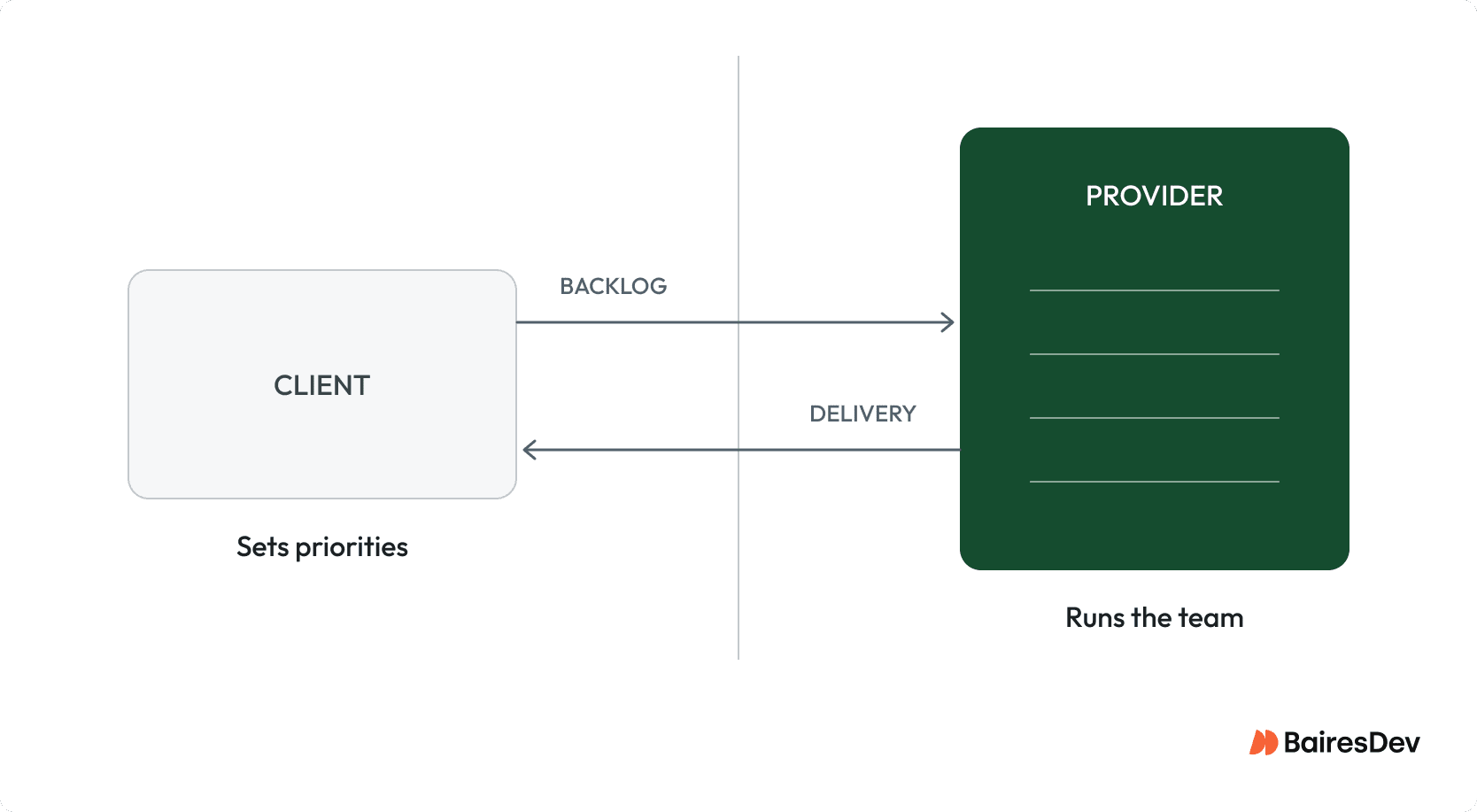
- Your team sets the roadmap while a single provider contact handles all day-to-day task management below that level.
- Your provider handles backfilling departures so staffing gaps never become your operational problem to solve.
- Your contract can include scheduled scale-up periods, making managed capacity a practical fit for seasonal demand spikes.
- You absorb scope risk directly since no fixed-price protections exist, so managed capacity suits initiatives where requirements are still evolving.
As the technology outsourcing industry continues to develop, many working models have evolved to meet client needs. The old days of “hire your next star developer in Bangalore” are over. The value proposition is now an often dizzying menu of choices, each with unique, non-obvious advantages and tradeoffs. As businesses grow, they need to consider all of these options against their business needs and decide how, and if, they should hire external staff.
The managed capacity (sometimes called managed services) model is one of the most complex and misunderstood arrangements in technology outsourcing. While the concept is simple on paper, implementing managed capacity successfully is no easy feat, and companies balancing business growth plans and operational efficiency would do well to consider the pros and cons of this structure.
This article explores the Managed Capacity model, its advantages, disadvantages and alternatives. We will conclude with some strategic guidance that helps you figure out if the managed capacity model is appropriate for your project, or whether a different arrangement would serve you better.
What Is Managed Capacity/Managed Services?
Put simply, managed capacity is a technology outsourcing model where a client acquires units of engineering capacity in the form of a managed and often cross-functional team.
Breaking that down: The following attributes make managed capacity model unique:
- The client buys capacity rather than hours. While the hours are an important part of the discussion and often used as a unit of account, the hours rarely translate directly to delivery capacity due to assignment, seniority, and team composition. By contracting for an entire team at once, the client buys a more reliable delivery capacity over time, rather than the raw material that makes up that capacity. However, they can still contract for e.g. Specific hours of engineering services weekly, outside their normal business hours, in order to fill specific needs for after hour support.
- The client buys capacity rather than delivery. The client is thinking above individual developer-hours yet below fixed outcomes. Not at contract signing, anyway. While project-based work often also entails the provider putting together a team, in managed capacity, the deliverable is not specified in the contract but changes as directed by the client, usually from sprint to sprint. We will cover the value proposition of this arrangement during the comparison section.
- The capacity is managed, that is, the managed capacity services provider is responsible for operating and maintaining that capacity. The provider typically provides project management, goal-setting and technical leadership. The provider maintains the capacity by, for example, backfilling a departure or swapping out talent when the performance dips below client expectations.
- The team is often dedicated. While this isn’t always necessary, the benefit of managed capacity is often integration. The team learns the client’s best practices and tooling, which make them more effective over time. A dedicated team can often do this more effectively than a non-dedicated team.
- The team is given access to cross-functional skills. In order for the team to deliver capacity while removing as many external dependencies as possible, a managed capacity team usually comes with their own project manager, engineering and QA resources.
In practice, there is a large variation across arrangements. For example, a client may contract for a managed capacity of senior developers to provide support on a new initiative, and the provider assembles a small team to take on the backlog and a tech lead to head the effort. The capacity is managed, but not cross-functional. In another instance, a client may contract for a managed team of a designer, a project manager and two engineers to assist on the development and maintenance of a new part of the application, but need the team only part time due to the cadence of upstream assets, resulting in the provisioning of a cross-functional but non-dedicated team. In both examples, we see the recurring pattern of a capacity that is created and managed by the provider, working on priorities that shift as client needs evolve.
Now that we understand the definition of a managed capacity, a cursory view of other methods of working with engineering outsourcing providers follows.
Alternatives to the Managed Capacity Model
Staff Augmentation
Is when the client contracts for specific individuals on an hourly, daily, or monthly basis, usually asking the talent to work alongside the client’s existing team and within the client’s existing management structure. This is considered the full control option and directly analogous to full time hiring and managing an in house team locally. However, this arrangement lacks some of the advantages offered by other offshoring arrangements, as the client takes on onboarding and management overhead typically associated with external hires directly. Additionally, if the client is hiring for specialized expertise, they may have to incur one-time recruitment and onboarding costs for a relatively short engagement.
Dedicated Teams
Is when, instead of hiring an individual talent, the client hires an entire team of provider talent, often operating as a cross-functional pod. This setup retains the flexibility of the staff augmentation approach, while providing significant efficiencies in recruitment and onboarding costs. Additionally, dedicated teams often provide better ramp up speed over putting together a team piecemeal, since the individual members come from the same provider bench and tend to have experience working with each other in past engagements. However, the management overhead is often multiplied, and integrating a whole team of engineers with already established best practices (e.g. Sprint planning methodologies, retrospective cadence, testing workflows, etc.) and work dynamics requires significant time and effort on the part of the client, and it may take a while before the team learns the company culture.
If Dedicated Teams is the natural next step to Staff Augmentation, Project Based Outsourcing exists on the other end of the spectrum. In Project Based Outsourcing, the client forgoes the day to day management of the provider team altogether, relying instead on the provider’s management services. Instead of paying for talent by the hour, the client pays for an agreed-upon final result. The client trades direct control for predictability, as once the contract is signed and the project starts, the client has relatively fewer day-to-day responsibilities. Despite these advantages, Project Based Outsourcing lacks the flexibility to re-point the talent team as priorities shift, and the client usually pays a premium to insure against underestimation and other risks offloaded to the provider.
Now that we understand the options on the table, here is why a client might prefer Managed Capacity over other types of arrangements.
Advantages of Managed Capacity
One of the most often talked about benefits of the managed capacity model lies in the flexibility of the arrangement. The client gets many of the benefits that come with fully managed project-driven outsourcing, such as management risk offloading, while retaining the flexibility to point the team at different daily tasks in response to changing demands without requiring another contract discussion. This flexible setup allows the team to function with the agility of an internal pod while sidestepping the need to manage this pod directly, which can be one of the thorniest risk factors when it comes to working with an offshore or nearshore team.
Another benefit is something that was hinted at above: the operational predictability of a managed capacity pod. In the managed capacity model, the client is interacting with one or two points of contact, who then takes over the day to day task management. With a high-quality point of contact, this allows the client a high degree of operational consistency, even when new team members are pulled into the pod temporarily to fill specific skill gaps, or when the team needs to scale up due to increasing demand. A well-implemented managed capacity arrangement can also provide stability during times of high turnover, as the provider covers the backfill and onboarding by drawing from their pool of local talent. The provider can also use the flexibility afforded to them to manage workload and prevent burnout.
A final benefit that often draws clients to the managed capacity model is the integration that happens over time. Many clients prefer to hire individual talent or dedicated teams over project-driven work because working with the same talent over time creates significant efficiencies in the form of team integration. The external professionals or team learns the client’s unique tooling and best practices over the course of a long engagement, reducing communication overheads and revision costs over time. In a managed capacity arrangement, the team learns and integrates similarly, allowing the client to access cost-effectiveness improvements usually reserved for direct staff augmentation or dedicated team arrangements.
Despite some clear advantages, the managed capacity model comes with clear and persistent drawbacks and risks that require careful management.
Disadvantages of Managed Capacity Services
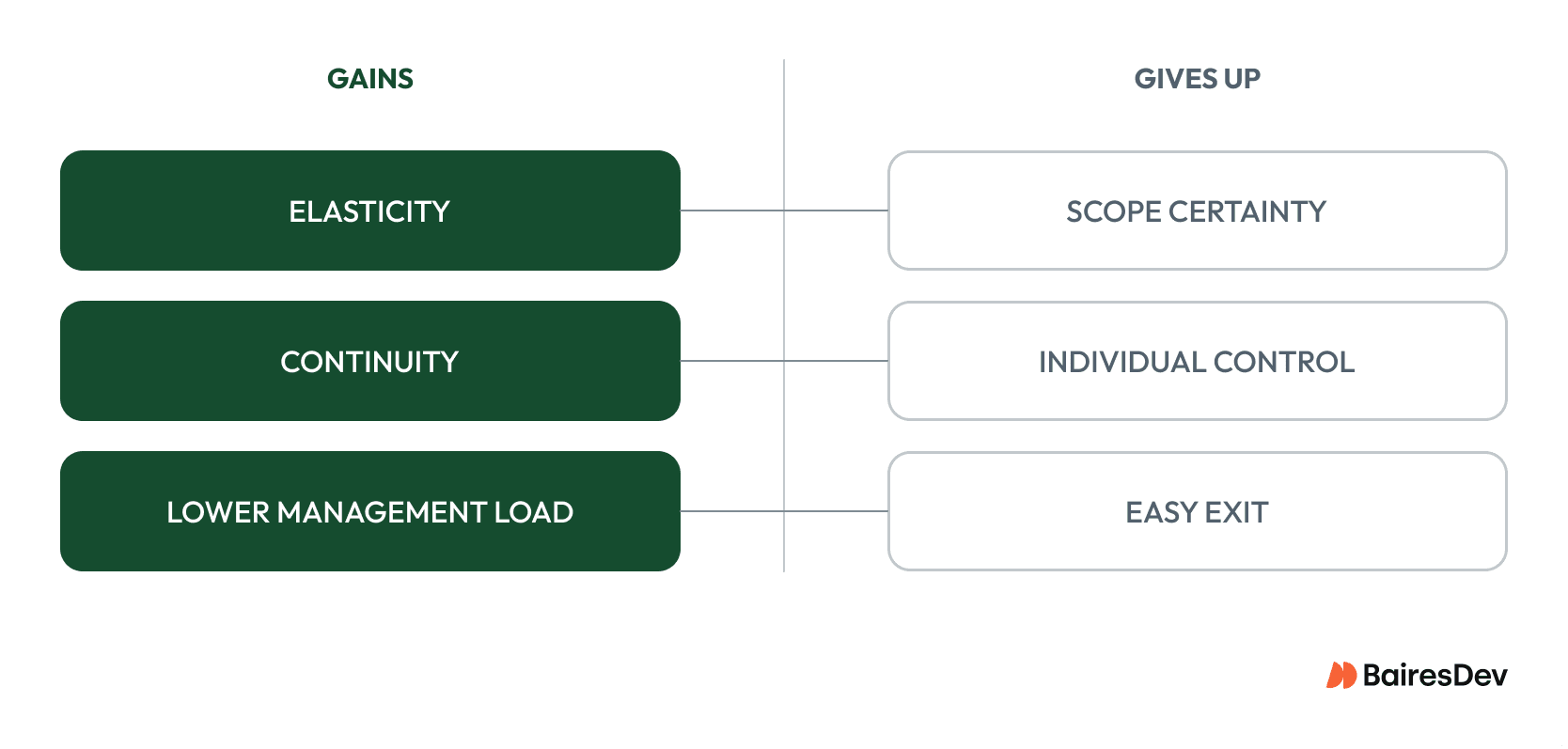
One of the major risk factors inherent in the capacity model comes from a risk mismatch within the arrangement: the client owns scope risk while giving up significant control. In a project-based engagement, the deliverable is specified up front. When the project scope turns out to be much larger than expected due to underestimation of discovery, the impact to the client is often cushioned by protections and risk premiums built into the contract. In a managed capacity model, the client pays for the additional work without the same cost protection, requiring a certain level of risk tolerance upfront. On the flip side, because the managed capacity client lacks execution control that direct-hiring provides, they do not have access to many of the mitigation strategies. This is one of the most difficult complexities of this arrangement, which is why strong SLAs, metrics, and transparency mechanisms between the managed capacity provider and the client must be established for a successful managed capacity engagement.
Another related risk is the concentrated interface. In a managed capacity arrangement, the client pays for a team, but mainly interacts with one or two people. Normally, this is considered a feature, but quickly turns into a single point of failure if the provider’s project manager does not practice effective communication with the client. While this risk exists in many outsourcing arrangements, it is amplified here due to the client’s lack of visibility. When a project goes off-track, for example, a direct-hire client can simply talk to the developers, identify the source of the issue, and reallocate resources as they see fit. In a managed capacity arrangement, a project manager may smooth over emerging difficulties until the damage to project execution becomes unavoidable. A successful engagement requires the client to ensure alignment and maintain visibility and transparency across the entire workflow, even when most interaction is managed by one main point of contact. Studies show over 46% of businesses switch away from the managed capacity model due to coverage limitations.
Finally, a hidden risk in the managed capacity model comes from dependency. This is the flip side of the integration advantage, where the provider team learns the client’s best practices. Over time, the provider team may learn the client’s codebase and technology stack so well that they become of critical strategic importance within the client’s business. However, because the communication is often managed by the provider team lead, documentation on key technologies and processes does not flow as naturally as it would in a direct-hire scenario. While documentation decay is a common issue in many outsourcing arrangements, managed capacity arrangements are particularly prone to this due to the team usually being paid to deliver KPI improvements rather than documentation. This can shift bargaining power to the provider at renewal time, creating an adversarial dynamic that eventually damages both sides of the relationship. To mitigate this risk, managed capacity engagements should include thorough documentation as part of the deliverable, and insist on knowledge transfer as a central provision within offboarding procedures.
With the pros and cons of the managed capacity model covered, the next question is when a client might want to choose Managed Capacity over other types of arrangements.
Where the Managed Capacity Model Fits
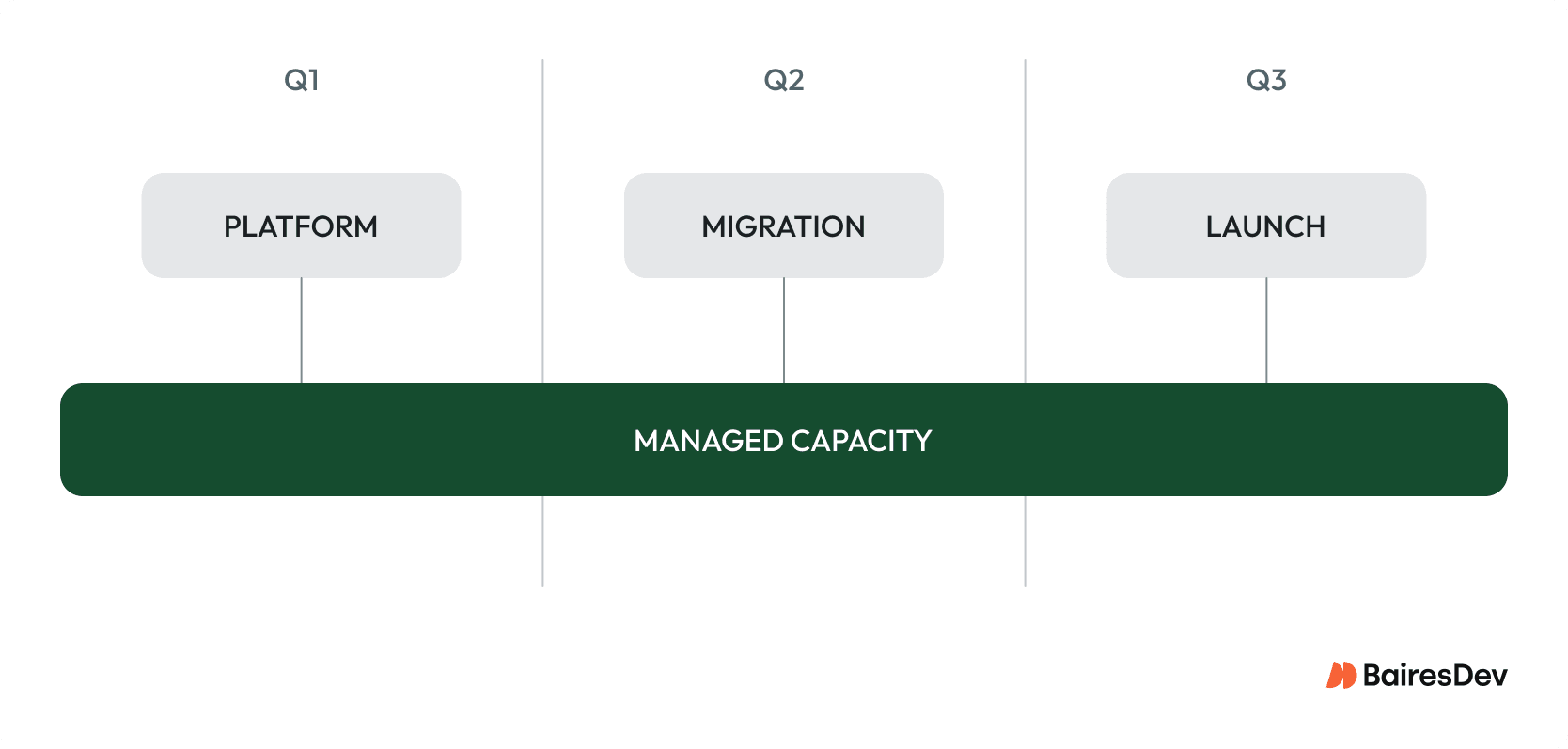
Put simply, a Managed Capacity model fits the client needs best when the work demands are long-term, unpredictable in scope, and tends to experience fluctuations in volume. Breaking it down:
- The work demands are long-term, that is, there is a recurring, sustained need for access to additional engineering capacity. This creates an ability for the Managed Capacity pod to integrate with the client organization and take advantage of the efficiency gains.
- The demands are unpredictable in scope. This is where the flexibility to redirect the Managed Capacity from sprint to sprint differentiates it from longer term project outsourcing, since the client can point the Managed Capacity pod to different priorities as business goals change.
- The demands tend to fluctuate in volume. Managed Capacity contracts make it easy to gracefully scale up or down based on changes in demand. Clients with high seasonal demands, for example, can often take advantage of a Managed Capacity to avoid paying for unused resources during low-demand times, and scale up quickly when demand picks up.
- The demands can require specialized skills or related resources that fill coverage gaps. Because Managed capacity services allow scaling up and down based not just on headcount but specific skillsets, they can often serve as occasional clutch-players to fill gaps that were unaccounted for during the initial strategic planning.
The following real-world scenarios illustrate where the Managed Capacity model works well:
- Product development: A boutique insurance company is developing an application to help their policyholders access benefits, change their policy, and receive communications from the insurance company. They have strong backing for a long-term project, but the roadmap and operational requirements are still live, because they want to iterate their feature set based on initial reception and feedback. They also need the ability to ramp up quickly in response to potential new regulations, cybersecurity developments and competitor applications. They choose Managed Capacity due to its ability to support a changing roadmap, long-term engagement and the ability to handle burst demand in engineering capacity.
- Modernization initiatives: A logistics company has been running on legacy inventory software that is becoming harder and harder to maintain. The company wants to invest in modernization and know it’s long-term, but there are many undocumented aspects of the legacy software that require a diverse skillset to properly modernize. They choose a Managed Capacity model because the arrangement naturally handles a project of unknown scope and gracefully rotates in team members with the right skillset as requirements change.
- Fluctuating Workloads: A tax-preparation software provider sees seasonally elevated demand around tax season. They need a team of engineers and systems administrators to maintain the application during the year, and a ramped-up capacity to handle increased user demand during peak months. They choose a Managed Capacity model even though the project scope is relatively stable, because Managed Capacity arrangements support long-term, sustained engagements that scale up and down on a schedule, providing risk mitigation against high demand.
- Long-term engineering programs: An e-commerce brand wants to develop and maintain its internal data analytics platform. Because the majority of the senior leadership is focused on marketing and product development, they prefer to offload engineering management to a provider who can offer a single governance surface. They choose a Managed Capacity engagement, asking the provider to handle recruitment, backfill and project management.
Now that we have looked at some real-world projects where Managed Capacity makes sense, The comparison matrix below summarizes these differences visually.
Managed Capacity vs Staff Augmentation vs Dedicated Team
| Scope Flexibility | Management overhead | Capability Scaling | Integration | |
| Staff Augmentation | Highest – manage the talent directly | High – must manage the talent and understand individual capabilities | None – if you need to scale up/down, you must hire and let go directly | Highest – the team member integrates with the existing organization |
| Dedicated Team | High – manage the team, may be harder to steer than individual talent | High – must manage the whole team and understand the work dynamic, even if the team comes with a lead | Difficult – adding and removing members of the team is possible though suffers from the same difficulty as staff augmentation. | Highest – the dedicated team works exclusively with the client, learning the tools and best practices |
| Managed Capacity | Medium – repoint the capacity to new priorities over time | Low – interact with a predictable governance surface, though pitfalls remain | High – capability scaling is built into the contract and can be executed gracefully. | High – The pod maintains documentation through staffing changes |
| Project Outsourcing | Low – deliverable pre-agreed upon in scope | Lowest – once the contract is signed, the client manages through milestones and change orders | None – the provider decides on the capability without client input. | None – the provider decides the tooling and best practices, with limited input from the client. |
Conclusion: Enabling Business Growth while Maximizing Operational Efficiency
Today’s outsourcing client faces a diverse array of choices when it comes to the specific business model of the engagement. Managed Capacity is one of the more unique options on the table, offering the flexibility of the Dedicated Teams model alongside the management predictability of the Project Outsourcing model. However, many risks and drawbacks remain, and engineering leaders should exercise discernment when deciding if Managed Capacity is right for them.
This article aimed to give you a deeper understanding of the options available and help you make a more informed decision in your next engagement.
Frequently Asked Questions
How quickly can Managed Capacity pods be scaled up or down?
Your contract will typically define two windows: a notice period during which the provider recruits, and a ramp-up period before new talent reaches full productivity. Both are negotiable before signing so you’ll want to pressure-test those timelines against your actual peak demand schedule.
How are Managed Capacity engagements priced?
Pricing is usually structured as a baseline envelope of person-hours covering your core team, plus a unit rate for any capacity added beyond that. Your team negotiates both figures before the engagement starts so there are no surprises when you need to scale.
What is the client’s responsibility in a Managed Capacity engagement?
You own the roadmap and you’re expected to review output on a regular cadence. In practice that means you need an internal product owner who can make product-level decisions and communicate them clearly. Without that person in place your provider’s point of contact has no one to align with and the engagement drifts.
A former enterprise technology professor at TEC de Monterrey, Enrique has an 18-year track record of delivering complex ERP and digital transformation projects. He has commanded over 20 such initiatives for both corporate and government organizations.